English translation of the French transcript, made with AI and not yet proofread — click a paragraph to jump to it. Show the French original
Easter, Eid, and the danger of war 11:55 Good evening everyone. My apologies for the slight delay, but there were some minor electrical problems in the building which pushed back our meeting a little. So here we are, meeting again on Easter Monday. As announced, tonight is going to be about the quest for the Grail, but I won't hide from you that I find it hard to talk about anything other than the war.
12:37 The danger of war for us, because war as an actual event is, alas, already happening not very far from us, isn't it? In various theaters, none of them very distant from us. But we'll see that our subject, far from taking us away from the question, keeps bringing us back to it, to the bloodletting, the slaughter, a theme I had developed when we did the series from Ulysses to Daedalus.
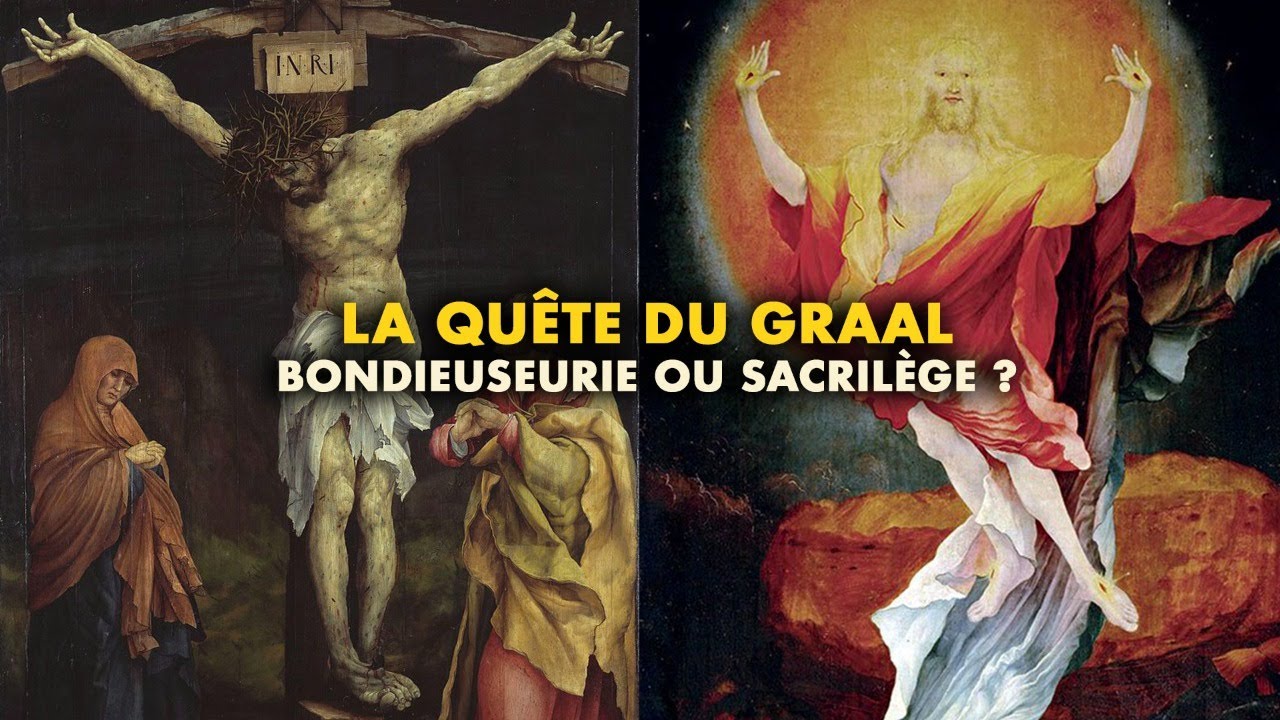
13:17 But before going into these details, which may seem confusing to those who are jumping on the train mid-journey — let me reassure them — I'll come back to the fact that it's Easter Monday. And so we have overcome the worst, the worst being Good Friday, the crucifixion, right? And I thank Pierre-Hélène for having offered you this magnificent title card, borrowed from a painting that is in a museum I recommend to you the day you pass through there, or along the banks of the Rhine.
13:51 It's about Colmar, in Alsace, halfway between Strasbourg to the north of Alsace and Mulhouse to the south. You have the marvelous Colmar, the Venice of the Rhine, with its magnificent old town. And there you have this — the museum itself, the Unterlinden Museum, is worth the trip on its own. And inside this museum, which is a magnificent setting, you have this jewel, the triptych altarpiece — you see, these are wooden panels that unfold like this — this altarpiece, dramatized in the sequence of the Crucifixion that you saw on the title card, the Resurrection, and between these two extremes — we skipped it, because it would have made the screen a bit crowded — there are, during these mysterious hours that pass between the paroxysm of suffering on Good Friday and the radiance of the Resurrection, radiance in the literal sense, irradiation, on the Isenheim Altarpiece a Temptation of Saint Anthony that rather recalls the monsters swarming in Bosch's paintings.
15:19 It's roughly from the same period. By the painter Altdorfer, which literally means the old villager. Altdorfer, a Rhenish painter. At the time, notions like France-Germany were really not very fixed. And there, in that region, is where this magnificent altarpiece was made. So, we are steeped in Christianity. Well, I want to begin by paying tribute to my former students, some of whom are currently following us from Niger, in the context of a story that is making the news for the whole planet, that of these countries of the Sahel which are undergoing, not only — I would even say they are embarking on a path that goes from what had been in place since the official independences of the 1960s, since that formal independence, during which, instead of France calling the shots
16:44 as had been the case in colonial times, it became the World Bank and the IMF that became the masters of those regions. And it's the emancipation from these powers, which are, in the last analysis, of course Atlanticist — in the service of Atlanticist geopolitics, I'll go quickly, it's not our subject — they are taking the road that leads from formal independence to real sovereignty.
17:16 It's still an extraordinary adventure that is unfolding. Why do I pay tribute to them? Because, at the moment when Lent is ending for Christians, today the fast is being broken in Islam. Yes, Ramadan ends today. That's why I chose this Monday, you see, because everything is done to set us against one another. So I'm balancing things out a bit by showing everything that brings the children of Abraham together. And yes, Abraham is the first prophet spoken of — well, the first patriarch spoken of in the Old Testament, in the Bible — but he is recognized with an eminence at least as great in Islam, Ibrahim.
18:04 And since Black Africa likes to add vowels to soften the guttural sounds of our Mediterranean or Semitic languages, Ibrahim becomes Brahima, just as Ahmed becomes Amadou or Mohamed becomes Mamadou. It's a celebration. And just as the tradition of Easter Monday has it — don't think my parallel is artificial. It's done a bit less now, but I mean that families go out when the weather allows it.
18:38 That was the case today in quite a few regions of France. And you can guess there's plenty of spring in all this, in all these traditions of renewal. And people would go eat lamb, the paschal lamb, the one sacrificed on the cross, right? Lamb was chosen for its whiteness and thus its purity. People go enjoy it in the countryside, on a picnic, wherever you like, outdoors.
19:08 Well, right now, this evening, you'll see in the homes of Bamako, Niamey, Ouagadougou — the three major countries that are gradually undergoing a fusion which already has an acronym, the AES, the Alliance of Sahel States. They narrowly escaped the vile war that people wanted to wage on them, among the poorest countries in the world, right?
19:38 Simply because they reject the tutelage I denounced a moment ago. And on top of that, people wanted to wage war on them, of course through African proxies, through ECOWAS, you see. It's a bit like what's done in Ukraine: war is waged against the Russians, but taking care to use Ukrainian corpses to progressively weaken Russia.
20:12 And if possible, to annihilate it before turning — once it's defeated — toward China, which remains its principal ally. You didn't think we'd be talking about all this during the quest for the Grail? You see, it doesn't take us so far away. So you'll still say to me, still, still, still, Christianity, love of neighbor, God is love, and especially, especially at Easter time, right?
Chrétien de Troyes and the matter of Britain 20:44 Yes, yes, yes, but I will begin nonetheless. The quest for the Grail has a thousand adaptations, a near-infinite number of variants. As early as — I'm setting a bit of a chronology here, you see — the thirteenth century, the first of our greatest poets, Chrétien de Troyes, wrote novels, poems, call them what you like, in any case they are poems in the Romance tongue, as it was called at the time, close to our present-day French, situated within the cycle that it has become customary to call —
21:42 The romances of the Round Table — but that's a bit tabloid-ish — in literary terms, it's called above all the Matter of Britain, as opposed to the imitation of Antiquity or the Germanic cycle, the Matter of Britain. "Britain" being taken here in an extensive sense, so it includes our Brittany and present-day Great Britain, right? These are the same heroes, with the legendary kings.
22:12 Some of them will have turned out to have historical existences, but let's leave that aside. And above all, we're going to dwell on the reworking Wagner does of it in the modern era. Parsifal was first performed in 1882; Wagner dies in 1883 — it's his testament, the same year as Marx.
22:42 It's his testament. — I thought Wagner wasn't the Matter of Britain, that it was Siegfried, Germanic heroes. — Yes, yes, that's the Ring. I refer you to our site, to the series we did on that, on the Ring of the Nibelung. But precisely, what gets into Wagner, at the moment of his testament, that makes him turn away from Germanic material, he who is taken to be the pan-Germanist par excellence, right, and pagan, with gods killing one another, and come instead to the quest for the Grail.
23:22 I will still read you very quickly — because afterward there are texts that will be projected for you to follow along with me, since they're dense — but for now it's just three lines that Chrétien de Troyes addresses to his readers, to his audience, because it was oral, and he begins by laying it on thick, in good troubadour fashion, as griots also do in Africa, with the chiefs, with tradition, with the dignitaries or ministers nowadays.
24:03 And the jester-poets, etc., are made together in those cultures. And they come to praise Philippe de Flandres, who was one of his patrons, so to speak, one of his sponsors, etc. But what interests me is the way — he knows perfectly well that as soon as there's a troubadour, the court is there, he's going to recite his poem, there are the girls, the women, the young maidens who are there. What used to be called damsels. Not quite the same meaning as today.
24:42 And I'll read you the few lines where he finishes his eulogy of Count Philippe de Flandres. And you'll see. One must note the solemnity with which he introduces this new theme, for he is the first to bring forth the word Grail. Even now we're not sure what this word designates. You see, that's to tell you, there have been specialists, medievalists, specialists in medieval literature who have searched everywhere.
25:14 One even has to trace it back to an Arabic etymology, that it was the Crusades that brought back this "kral." Others link it to "graillon," yes, to "graillon," because the Grail is also a food that renders one invincible in battle. Let's set the meanings aside for now. There's a new text coming up shortly on the notion of meaning. But look, listen rather, here's the end of his presentation before he begins his poem, his exordium.
25:53 "Know then in truth that Count Philippe's gifts are indeed given out of charity, but he never speaks of it to anyone, save to his generous heart which moves him to do good. No flattery here. Is he not worth more than Alexander, who never cared for charity nor for any good deed? Certainly, let it not remain unsaid, and Chrétien" — so he speaks of himself in the third person, Chrétien de Troyes — "and Chrétien will spend his effort upon it."
26:40 "He who, at the Count's command, undertakes to put it into rhyme. Listen well: the best story ever written at a royal court, this is the Tale of the Grail." The introduction is solemn. So, we're going to do a Pagani-style shortcut here, because I'd still like to give you the gist, since some of you are picking up the story from scratch.
The Grail and Plato's sun: light and nourishment 27:10 So the Grail — of course, if I ask the average person, they'll tell me: oh yes, I seem to recall it's the vessel that originally collected Christ's blood, which is therefore a sacred object, almost miraculous, and which radiates a dazzling light to those to whom it appears. And when it appears, it's the end of all quest. Replace it with the absolute, with God, with whatever you like, because it puts an end to every quest once the Grail has been found. Every quest is over.
27:46 That's the Christian version, but this Christian, Christianized version actually takes over from pagan Celtic traditions that existed before — I'll go quickly — before Robert de Boron, the monk who was the first to make a Christian adaptation of this tradition. At the outset, what is certain, the continuity, is that the Grail is linked to food.
28:17 And I'm sure that among you, those who are attentive and who have been following us for a long time now and regularly, remember that I have quoted several times what seemed to me to be one of the high points, not only of the history of philosophical thought, not only of Plato's dialogues, but even in the entire history of thought, the extraordinary final lines of Book Six of Plato's Republic.
28:51 This is not a detour far from our subject; I am commenting on what the Grail connotes, the end of every quest. Now, you know that the myth of the cave illustrates this well. All of Platonism is a procession, as will later be said, after him, by a Neoplatonist like Plotinus, a procession that starts from the very bottom, the back of the cave, the corner café, opinion. I repeat each time that I have no contempt for the corner café. It is not the place of clear and distinct knowledge, nor is it — it is not the place where truth unfolds.
29:26 It is the place where you buy your friends a round, where they get you to pay for one, and where people clash over opinions, over doxa, not over epistêmē, over knowledge. There, that's not our subject. The lowest degree of knowledge is this bottom of the cave, a world of shadows, illusions, nonsense, whatever you like. It's a bit like what's left of dreams when you wake up. And gradually one climbs — it hurts, because knowledge hurts.
30:05 And yes, losing one's illusions is not always very pleasant. Moving from certainty — I myself am certain that I'm walking on solid ground. Yes, in fact the Earth is moving at 30 km a second. You see, that certainty doesn't express the truth. So this rugged path — much is made of how steep and difficult the climb is, it hurts — which goes from opinion up through the stages, mathematics, dialectic, the highest degree of epistemic discourse, and then all of a sudden it stops, there's no more discourse at all, one arrives at the sun. That is what it's meant to represent.
30:50 And the idea of the Good — it's Plato speaking, not me, it's not I who am giving meaning to the sun by interpreting it — Plato says that the Good is so far beyond all discourse, all idea, that for Plato to say there are things beyond the Idea is quite a solemn claim. And when his interlocutors say to him, "tell us what the Good is," he says that would be a sacrilege, one cannot speak of it, it is beyond words.
31:20 I can tell you about what most resembles it in the sensible world — always with humor, and perhaps as a piece of staging on Plato's part — I will not speak to you of the Good directly, I'm incapable of that, but I can speak to you of its offspring, that's his own expression: in the sensible world it is the sun, one imagines, which is the visual symbol. Because the sun has the advantage of enabling the eye to see and the object to be seen, but the sun is neither the eye nor the object. It is what makes the relation possible. It is a third thing, a tertium quid, as Freud will later say when speaking of the symbolic order.
32:01 All the same, what depth Plato reaches! Except that, with this sun, there's no more logos, no more discourse. This is what in Greek is called a theoria, in the strict sense, that's it, it's a contemplation. It's rather passive, after all. This is Plato's stroke of genius. For he adds these few lines in which he suddenly makes an incredible leap in depth, one that brings us closer to the Grail.
32:34 You think I've lost my thread? I said that the Grail has a necessary relation to food. Do you remember? And here is what Plato adds about the Sun. You'll notice that the Sun is not only what allows the eye to see and the object to be seen. Let me dig a little deeper. I have an eye that sees very well, excellent visual quality, I have an object that exists, that has all its properties — I see nothing, I am in darkness.
33:04 You see clearly that a third term is needed — it's called light, in this case provided by the sun, and which is neither the eye nor the object. A third term that sets the other two at a distance from each other. And that's where he — I add, you'll notice that the sun does not merely enable, I repeat on purpose, it's solemn, the eye to see, and the object to be seen, but it also gives, in addition, growth and nourishment to living beings. And here we are back at the Easter Monday meal, which is where we started.
33:42 And I say this in tribute to my young former students, friends in Niger, and through them, to Africans in the process of emancipating themselves, to sub-Saharan peoples in the process of emancipating themselves, and in particular to those of the Sahel States and the Alliance of Sahel States. This is what they call in Arabic — it's the Eid al-Fitr, the end of the fast.
34:14 It's a festival where people go to homes to offer pieces of grilled lamb, etc. And in sub-Saharan Africa it's called the Tabaski. There, I wanted — not to de-Christianize, but to de-conflict, forgive these barbarisms — the Christianity-Islam relationship here — I'm not talking about Islamism, Christianity-Islam — just as it is not written in the Gospel that one must pour molten lead into the eyes and anus of Jews, as the Catholic Inquisition did — that's not in the Gospel.
34:57 Likewise, it must always be recalled that the Muslims celebrating their festival today — the most joyous one, if I may allow myself the redundancy — are, statistically verified, the principal victims, in terms of number of victims, of Islamism. So I pay tribute to them too, in that, to the children of Abraham.
35:29 So, I took this detour because I was very moved by the comments I received following my talk precisely on what is currently happening south of the Sahara, as part of the invitation the Café Marxiste kindly sent me to speak about it. I was very moved. For the first time, I saw reactions from the region, from people I don't know. So I wanted to make this detour. Now I return to the Grail. Is it a vessel? Before it was a vessel, some say it was a dish.
36:07 In Chrétien de Troyes, who is the first to speak of it. Had there been no Chrétien de Troyes, we wouldn't be talking about the Grail. When one does research to find out where he got that word from, well, the research is still ongoing. There are certain predicates attached to it. The Grail must be served to someone who feeds on it, but is it a plate, a dish, a vessel?
Siegfried against the fool: Pascal's third order 36:38 But we'll keep the image of the vessel, you'll see why. Because I'm going to focus now on the reworking — we're doing Wagner, then, in the second half of the nineteenth century. But what's happening in this second half of the nineteenth century? How does Wagner turn away from Siegfried? He's the opposite of Parsifal. Siegfried, sword in hand, smashes the anvils with which he forged his sword, he breaks the laws of the gods, he shatters Wotan's spear, the chief of the gods, the blond beast, as will later be said in geopolitics. One shouldn't read too much into it. What connection is there with "if someone strikes you on one cheek, turn the other," and the stammerings of the idiot?
37:33 For that is indeed what was being decided in this second half of the nineteenth century, practically at the same time and without any coordination. Dostoevsky writes The Idiot. Now Parsifal is referred to throughout Chrétien de Troyes's poem — and Wagner takes this up — as reiner Tor in German. The fool, one might say in medievalist terms, the pure idiot, reiner Tor.
38:09 And at the same time, Flaubert writes Saint Julian the Hospitalier, which begins with a massacre, a hunter who destroys and slaughters, who shows himself, and who, one day — I won't tell every story, I'm not going to tell three stories at once — but then, seized by pity, becomes a saint, I mean, he shelters a leper, covers him with his own sheet.
38:44 And Flaubert is not the holy-water-font-frequenting type, so what gets into these three, without any agreement among them, to converge toward what Pascal would have called the third order — it's one of Pascal's key moments, so I won't leave it aside, I recall it here: three orders, the order of bodies. The order of bodies is what geometry and the sciences study, the order of bodies. I'm speaking like Pascal.
39:20 Infinitely beyond the orders of the body. Infinitely here doesn't just mean superior in eminence, it means that we leave the order of bodies. It's not physical, it's metaphysical. The order of minds is, in the same way that the order of minds is infinitely beyond the order of bodies, there is a third order that is infinitely beyond the order of minds. It's the order of charity, which will play a very great role in Wagner's Parsifal, which is traversed from beginning to end, musically and textually, by the theme of the Last Supper.
40:04 It's the moment when it is said, "Take and eat, this is my body; take and drink, this is my blood." I'm gathering materials and now I'll give you the plot's development in its chronological order. Wagner's lyric drama — let me recall that Wagner doesn't make operas but anti-operas, which he himself named "lyric drama," Tondrama, Ton, and everything that is sonic and musical in German is Ton, T-O-N, as in tonality.
40:45 Tondrama, lyric drama. For Parsifal, there is yet another designation — you know how attentive I am to differences of genre. It's no longer opera in the bel canto sense that I adore, mind you. That's a separate question. And Wagner knew bel canto very well, he had a wild admiration for Bellini's arias. He wrote about this, saying no one had ever written airs as smooth as those of Giovanni Bellini, with his namesake the painter.
41:16 But here, for Parsifal, he says "Bühnenweihfestspiel." I'll say it in German first, since some of you understand it. Word for word, Bühne is the stage, for a theater. Festspiel, festival, isn't it? Bühnenweihfestspiel, sacred stage festival. That means a lyric drama, but whose subject is religious and sacred, let's say — because we'll see afterward, that's the whole theme of tonight.
41:49 We are really in what the religious man speaks of, where we are in transgressions bordering on sacrilegious scandal. You see? Bühnenweihfestspiel, sacred stage festival. But we have the French equivalent. It's what was performed at high points, at Easter week among others, but not only then, in front of, on the forecourt of cathedrals: the mystery plays. The mystery plays are a performance, already a spectacle, part of the performing arts.
42:24 It's a performance, so it's not there for classical, comic, romantic tragedy, bourgeois drama, whatever you like, but drama, these are performances given before an audience. Like a movie, yes, but favoring a sacred subject, unlike Tristan and Isolde, a profane love. Wagner had thought at one point, while composing Tristan, of bringing in the character of Perceval, having him appear in the third act of Tristan, when Tristan keeps agonizing on the shore of Kareol, his little kingdom lost in the mists.
43:18 Of Cornwall. And where he waits desperately watching for a sail offshore, for a ship to appear announcing Isolde's arrival. And she will arrive, but when it comes down to it, he had thought of bringing in Parsifal, the representative of divine love, to the side of the hero of human love.
43:48 And then he saw, rightly, his talent as a dramatist stopped him from overloading his subject, that it would add too much material for the unity of the dramatic form. So here we're dealing with a sacred stage festival. So, the plot: it begins in the domain of the Grail, the castle, the domain — because there's a lake, there are forests, but centered around a castle that houses this relic, the vessel that collected Christ's blood, which was brought back from the East.
A domain wasting away: the Grail deprived of the spear 44:34 All this, he detailed in the plan. That means he borrows from the medieval material, it's not his invention. On the other hand, this is the only version where we start there. The quest for the Grail is what one sees at the end. Here it's the opposite. We are in the domain of the Grail. But the domain of the Grail is going downhill fast. That's what it's going to speak of. Everything is withering. This is the society we live in.
45:09 Nearly ten years ago now, I began all my lecture series with the generic title "Between Crisis and War, Philosophizing." We have never been so close to war, I hope, as we will be close to it without ever quite reaching it. And I'm not here to prophesy. But I note in the present — and unfortunately I'm no longer alone now in drawing attention, as I've been doing for ten years, to the fact that this is the main subject — that we've tried to cover it up by talking sometimes about feminism, about ecology, I mean bourgeois feminism, I've talked enough, haven't I, about the emancipation of Malian women?
45:49 Just to tell you that I take this very seriously, but nobody cares about Malian women in MeToo and company. That was so as not to talk, during that time, while we were busy with talk-show topics. Meanwhile, it was drowning out the clatter of weapons. And now our country, France, which of all the so-called Western powers — you know how much I question these big issues — was the least Atlanticist, but was very poorly viewed for that, especially under De Gaulle. Anti-European, anti-Atlanticist, anti-European.
46:45 France now wants to be at the forefront of the war. First in line. The other Westerners are no more pacifist, I'm not saying that. They're quite happy to see some fool volunteering, aren't they, to encourage sending troops, but they don't take political responsibility for it, they let Macron do it, in short. You didn't think we'd be talking about all this while discussing the quest for the Grail, did you?
47:15 And yet, you'll see that blood plays a great role. Let's start there. We are in the domain of the Grail, in which there is a relic, the greatest relic of Christendom, the vessel that contains the blood, the blood of the martyr, the blood of Christ. So what is there? First, I recall the community of knight-monks, roughly, they're a bit like the Templars, if you will, who surround this relic, and who inhabit the castle and manage the domain around it.
47:55 A domain which no one can access unless grace opens the path leading to it. That is to say, people like you and me cannot simply access the domain of the Grail. You'll see why this is important for what follows immediately. Every Friday, they must celebrate the rite of the Last Supper: take, drink, this is my blood; take, eat, this is my body.
48:29 And so at that point, the head of this community, the king of the Grail, who is called, in the setting — these are names Wagner borrows from the medieval material — Amfortas, uncovers the Grail, which radiates its light over the whole community and feeds them with it. It's a bit mysterious, don't ask me to be clearer. How can one feed on a light, a radiance? We've seen stranger things.
49:01 And above all, this nourishment makes them invincible in combat. Because this domain of the Grail — it's not located in Germany. No, I mean it's the material of Brittany. But neither in England nor in Brittany! Where does Wagner locate it? On a ridge, one of the peaks of the Pyrenees, at the border of Christendom and the world of infidels. So it's a place of combat. The Song of Roland is supposedly the Saracens who came to slaughter poor Charlemagne's nephew.
49:41 We know very well that historically it was a band of raiders, probably Basque. I'm Corsican, I mean, mountain folk. There's no good and evil in all that. There aren't good guys and bad guys, it's not like a western, but... but they spend their time fighting, and what makes them invulnerable in combat, this elite of chivalry that are the knights of the Grail — well, the elite of the Round Table too, actually, at King Arthur's court — imagine King Arthur's court transplanted onto a peak in the Pyrenees.
50:14 And this domain is called Montsalvat. Montsalvat, S-A-L-V-A-T. Some have seen a Cathar trace in it. We know Wagner studied all these sources. He studied the doctrine of grace in Saint Bernard, all the Cathar doctrines. It's no accident we're talking about the southwest and the Pyrenees. And among the Cathars, there's a symbol of Christianity of considerable importance, the lance, which one sees engraved on the walls, on the... of the churches in which the Cathar cult took place.
50:51 Now here's what's wrong: the Grail is there, but the lance has disappeared, because the castle housed — you see why I hold to the image of the vessel — the feminine element, the womb, that which gathers, like the Madonna holding the child and protecting it, "Den Waffen fern, der Männer Kampf und Wüten," as Kundry will say in the second act of Parsifal, when she reveals it to the hero.
51:27 Because she has had past lives, she saw an infant near his mother in the forest. And he was sheltered from shocks, from wars and hatreds, in order to fight for it, within the very quest for the Grail. No, no, I wasn't dragging my feet talking about war because I can't manage to shake it off.
52:06 The lance has disappeared. How could it have disappeared? The lance and the Grail were both there. Well, you don't need to be a great psychoanalyst to see that the lance is a bit more phallic than the vessel. When the two are both present, all is well. But if there's only one or the other, the Grail no longer feeds the knights. This world withers away — and how could the lance have disappeared? So I come to it, second stage. Among the knights of the Grail — rather, there was one of these knights who did everything to try to suppress the libido within himself.
Klingsor, the garden of sorceries, and Amfortas's wound 52:52 They didn't put it that way, they said concupiscence, didn't they? And since he doesn't manage it, he doesn't fail at it — he lays a criminal hand upon himself, as it's laboriously put, with a euphemism in the text: he castrates himself. I told you this is a work in which blood keeps appearing, blood of different origins. We began with the most eminent blood, the blood of Christ. And now here we have the blood of the sinner, of the one who mutilates himself. This abominable crime gets him driven out by his fellow believers from the domain of the Grail.
53:36 This is a recollection of the theology that says the devil is a fallen angel, an angel fallen from heaven, Satan is a fallen angel. And to prepare his revenge, he settles in the desert. I told you not everyone can access the Grail, because between the world and the domain of the Grail there is a separation occupied by a desert. And the place was none other than the desert.
54:08 God unrolls it in a fragment. The place was none other than the desert. What place? Back to it. The place of the monotheistic, transcendent religions. So let me recall there are three of them. And so as not to upset anyone, I'll list them in chronological order: Judaism, Christianity, Islam. But all three appeared within a geographical handkerchief-sized area, which is the desert.
54:43 You understand why I was thinking of my young comrades in the Sahel, right on the edge of the desert, since Sahel means "shore, border, the ocean's edge," the ocean being the Sahara, which means "great desert." And camels, called in the region the ships of the desert — these are beautiful metaphors created in the Arabic language.
55:14 So this one — I'll give you his name, Klingsor, the monk, who is the second source of blood — a garden streaming over this strange work, decides to settle in the desert and transforms the desert into a garden of sorceries. What could be more opposed to the desert than a luxuriant garden? And Wagner, in the stage directions and didascalies, dared to include oriental embroideries, as it happens.
55:48 We were at the summit of the Pyrenees. The Arab world is not far off. And at the time, it was a bit like America — it was far more developed in refinement. Under Charlemagne, you know, the campaigns in Gaul, whereas Egypt, that's already 4000 years old, and it wasn't huts and smoke there.
56:19 And then, of course, following the conquest, the jihad of conquest, by which Islam left the peninsula to spread eastward, to the borders of China, and westward, to Poitiers, right? People always think that after Poitiers there wasn't a single Muslim left in France. No, no, they remained for a very long time still, further south, in Narbonne for example.
56:49 And in Spain, they remained for 700 years. And it's a refinement, a magnificently wrought sword, with designs on it, on the steel, arabesques — they called it a damascened sword, from Damascus. I tell you, it was dreamlike at the time, it was luxury and above all pleasure. But yes, it's the world upside down. Today they say Arabs aren't a joke — no, not the Arabs, the Islamists.
57:20 That NATO sends to harass Muslims and the countries that refuse to bow to its planetary domination. It's so much more convenient. To make, say, 150 dead in Moscow and say it's the Islamic State. It makes the whole Third World laugh. The majority of humanity knows perfectly well that when you say Islamic State, it means the Pentagon. The Taliban in Afghanistan were armed by the Americans to drive out the poor — from their point of view, it's a good war, I'm not saying it is. I don't know if wars are good, but well, there it is.
57:57 We see things here, wait, wait, Klingsor grows an oasis — well if that's it, fine, an oasis after all, for the knights who leave the domain of the Grail to go fight down south, to make a stop and drink some water. This oasis, what grows there are the famous flower-maidens. These are strange beings. The lower body is a stem, a corolla, like a flower. And out of the calyx there's a woman's bust. And why does he do that? To seduce. Because he isn't the only one with libido — our knight knows they too are susceptible to temptation, to seduce the knight of the Grail.
58:53 When they're intoxicated in the arms of one of the flower-maidens, he grabs them and forms an army of shadows, of the undead, an underground army with which he plans one day to attack the Grail community and seize the Grail, and above all extinguish it. It's this radiant light that is unbearable to his wound. So, to put an end to it — I continue the plot — to put an end to it, because more and more knights are succumbing to the charm of the flower-maidens, the king of the Grail, the head of the Grail community, Amfortas, decides to go settle accounts with Klingsor.
59:44 That's where you understand why the lance matters so much. He takes the lance, the lance that pierced Christ's side. There's the vessel that collects the blood, and there's the lance that made the wound. We're not far from the first text I'm going to read you. That's why I'm lingering a bit. He takes the lance, and at that moment, seeing that this is big game after all, Klingsor sends him the chief seductress.
1:00:17 Kundry — don't ask who Kundry is, she's 2000 years of avatars, of reincarnation. What does Klingsor say to her? "You were Herodias, you were" — you see. We'll learn later that she witnessed Golgotha, she witnessed Christ's calvary, and she laughed. No, sorry, she... yes, that's it, she laughed at his suffering, so he turned around, and his gaze condemned her to laugh forever.
1:00:53 She can no longer weep, for eternity. She's the one they send, and of course she's the most cunning, the most beautiful — it's Amfortas who succumbs in her arms, and while he's in Kundry's arms, Klingsor the magician bursts out of his lair, takes the lance, turns it around and strikes him in the side. So, I don't want to be more precise than the source material is, that would be dishonest, but the wound — we know he has a wound, the Fisher King, which never closes, which is incurable.
1:01:30 But where is this wound? Sometimes they say the groin, which is a bit odd, the hip — in any case he can no longer walk. And often he's seen on a boat, fishing, and there's a play on words about the king who "sinned" (péché), who committed sins, and the fisher king (pêcheur) who goes fishing. That's the Middle Ages for you. But at any rate he sits on a boat, he no longer needs to. And so, throughout the work — it lasts five hours, it lasts three hours — on a litter like that, unable to walk, the maimed king with his wound and his bandages always full of blood, for the wound never stops bleeding.
Gracq against Nietzsche: piety or sacrilege 1:02:09 Well then, let's sum up, because there's blood everywhere: there's the blood of Christ, there's the blood of Klingsor's castration, and now there's the wound of the fisher king. And it's the wound that never closes. And it's a backdrop of niceness, and the East. So, you'll tell me, listen, Pagani, we prefer you when you're a Marxist anyway, because this pious stuff is starting to bore us. Well listen, I told you that as for pious stuff, I'm not sure we're within orthodoxy, in everything I've just said.
1:02:42 And here, I'm going to call upon an immense writer, an immense novelist, no doubt one of the greatest novelists of the entire postwar period — I'm thinking of Julien Gracq and his first major publication, which I cannot recommend to you enough, Au Château d'Argol, which takes place in Brittany. In his preface, he says the following, and I'll let him speak to refute your objection, if I may put it that way.
1:03:14 Wagner's work closes on a poetic testament that Nietzsche made the grave mistake of throwing too lightly to the Christians as fodder. Nietzsche, Christianity — that doesn't inspire him much. So what is he alluding to? Let me read you a passage I've already read in other series, so I'll recall it here for the newcomers who are jumping on the train mid-journey. Nietzsche begins by paying tribute to Wagner, because there are the Nietzscheans — I won't even mention them, they're ignoramuses, they know nothing about music — for whom Nietzsche is a good reason to detest Wagner's music. That's not the case with Nietzsche himself.
1:03:55 But Nietzsche has his preferences. His preference is rather for Siegfried, which is what I'm going to read you now. So, uh... yes, that's it. I won't ask for a page because my book is falling apart.
1:04:26 I feel like I'm seeing... wait, wait... yes, yes, it's fine, excuse me. So, perhaps by pushing the comparison further, we shall discover, to Wagner's honor — and this is incredible, but he's not talking about Parsifal here, you'll see — it was, to the honor of Wagner and his Germanism, that in every respect he went higher, showed himself bolder, stronger, harder — these are Nietzschean values — greater than any nineteenth-century Frenchman could have done, in short a decadent, a socialist so to speak, I'm speaking as a Nietzschean here, for the reason that we Germans have remained closer to barbarism than the French.
1:05:17 Perhaps we come now to Siegfried, Wagner's most astonishing creation, which will always remain — and not only at present — inaccessible, foreign, inimitable for the Latin race in its decline? Nietzsche is the one whose German resounds best, literarily speaking, in that era, in his prose, we must give him that credit, and he knew it. So what is this creation, inaccessible, foreign, inimitable for the declining Latin race? It is the character of Siegfried, that's what I mean.
1:05:53 Siegfried, the very free man — the word is underlined — and perhaps indeed too free, too hard, too jovial. This opposite of the idiot of the time, this opposite of blood streaming everywhere. Too jovial, proving the blood of other writings. Too healthy, too anti-Catholic — underlined — for the taste of old, weakened civilized peoples.
1:06:23 But yes, you think it's today's West that wallows in consumption, but this is as old as the West itself. Ah well, these people who believe everything started with them — one must say, if not forgive them, at least understand them, because the whole dominant ideology is made so that nothing is thought through in terms of history but rather of nature, of what is timeless. So perhaps it is even a sin against romanticism, romantic Christianity, this Siegfried unsympathetic to the Roman peoples. But Wagner, in his declining old age — we now come to Parsifal — has amply redeemed this sin.
1:07:12 Anticipating a taste that later became a policy, he set himself, if not to follow, at least to preach with the religious fervor that is his own, the road to Rome. You can't understand all the allusions if you don't know the history well. Is he really on the road to Rome? The greatest event in German history is Luther's Reformation. It's about having freed itself from Rome's tutelage. And there were doubtless reasons for that. I'm not taking sides, I'm not saying one is right and the other wrong — there are things I admire in the Reformation, and there are things I find harmful, particularly in its Anglo-Saxon Puritan incarnation, which drenches the world in blood with a clear conscience.
1:08:02 On the other hand, I mean, the great conflict of the whole Middle Ages is the conflict between popes and emperors — the popes of Rome, the Italians, and the emperors of the Holy Roman Germanic Empire. Up to, as he puts it, the last one, the wandering suffering at Canossa. When the emperor of the Holy Roman Germanic Empire came to beg the pope's forgiveness, and the pope refused to receive him — received him in that little village of Canossa, and condemned him to stay all night in the snow, and only received him in the morning — the wandering suffering at Canossa.
1:08:41 So when Nietzsche says he followed with the fervor he knows so well the road to Rome, all that is behind it. "To cut short any ambiguity, I shall have recourse to a few well-struck verses that will betray, even to the least subtle ears, what I mean, what I reproach." In Wagner's late-year Wagner and the music of his Parsifal. And here is the poem, it's quick: "Would this still be German? These muffled groans — could they come from a German heart? And would these be German bodies mortifying themselves here? German, these gestures of blessing priests?"
1:09:18 It's true there are three works in Parsifal. "And this lubricity with its vague reek of incense" — you'll have noticed he spotted the libido there — "this lubricity with its vague reek of incense, these abrupt genuflections, these swoonings, this staggering gait, and this uncertain swaying of bells." There are real bells. "These sidelong glances of nuns, these Angelus chimes, these faked ecstasies whose surge claims to surpass heaven itself."
1:09:48 End of quotation. So you understand — I take it up again, I go back to Julien Gracq's text — we couldn't have understood this allusion without it. Wagner's work closes on a poetic testament that Nietzsche made the grave mistake of throwing too lightly to the Christians as fodder — it's far more complicated than that — thereby taking on the grave responsibility of leading critics astray toward another line of inquiry, harder than the violent unease one still feels today hearing talk of the master's acquiescence to the Christian mystery of redemption, whereas Wagner's work — and now you'll see the sacrilegious version, no longer the pious-image version, of Parsifal — whereas Wagner's work has always so clearly tended to widen further the orbits of its subterranean, or more precisely infernal, quest.
1:10:47 Well, it's difficult. It alone would end up letting us hear that "Parsifal" means, contrary to what Nietzsche says, something quite other than the ignominy of extreme unction administered to a corpse that is, moreover, still noticeably recalcitrant. So here's where we stand. Let me resume the plot: in a society that is in full decay. The Grail deprived of the spear, substance deprived of the concept.
Substance deprived of the concept; Gracq and Hegel 1:11:23 Don't look for it, it's your humble servant translating. It's not an interpretation, I'm translating, I'm modeling — that's different. That is, you can do without it, I'm not imposing it as a meaning. But if you look closely, the concept always has something pointed about it. The concept is combative, a bit aggressive. It's pointed like the tip of a sword or a spear — I'm making the allusion. No, no, this isn't an interpretation, it's etymology. "Concept" comes from capere, to capture. You have to go back to the hunter-gatherer to understand the concept — you have to sharpen the flint to get a stone that allows you to make captures. And then afterward, spears, arrows, swords — all of that is thrust forward and pointed. It's the opposite of the vessel, isn't it?
1:12:27 Let's keep this well in mind then: deprived of that which wounds, the Grail loses. It loses those who make the knights invulnerable, so fewer and fewer of them, and the army of the undead.
1:12:57 And here's the situation. When the curtain rises on the first act, everything I've just told you is narrated. It's long, it's long, these are works technical in their images. It's exactly the opposite of Wagner's exact contemporary — I'm thinking of Giuseppe Verdi, who is the Italian equivalent, completely opposed to Wagner, but truly the equivalent because the two are strictly contemporary — both born in 1813 for instance — and both are contemporaries of the political unification of their peoples.
1:13:54 Italian unity was achieved around Piedmont, whose king was Victor Emmanuel; German unity was achieved around Bismarck and thus the King of Prussia. Bismarck's equivalent in Italy being the statesman Cavour, who played a great role in Italian unity. And that's why Verdi was so popular with the Italian left and the Redshirts, as Garibaldi's followers were called.
1:14:26 Because it happens that his name, by happy coincidence, formed the initials V.E.R.D.I. — Vittorio Emanuele Re D'Italia — who went on to unify, unified, under the banner of Piedmont, of Turin. Quite a thing when you think about it. So, as I told you, it's often said that with Verdi — I always point out the contrast between the pace of Wagnerian action and that of Verdi's action.
1:15:03 It's said that with Verdi the characters burst onto the stage like a pistol shot. Here, we're far from that. Everything is narrated, it's stories telling stories. A spellbinding, bewitching music, which further dilutes time, stretching it into immense measures. I might play you a first sound illustration, but first I'd like to keep following my order.
1:15:43 Before the sound illustration, let me continue reading Julien Gracq, with a passage following the one I just read you. So, I told you all this is taken from a novel called The Castle of Argol. You can find these texts in PDF on a site I've put a link to here, which lets you access a good portion of the opening pages — at least it contains these particular texts — from the beginning of The Castle of Argol.
1:16:17 And there he introduces his hero, Albert. It takes place in the contemporary period; Albert is going to take possession of his manor in Brittany, which he's bought, far from Paris. I'll skip over the physical portrait of the character — he's a handsome blond, a rather romantic figure. Julien Gracq belonged to the surrealist movement. He held a very, very important place in it. He didn't at all have the provocative side of the surrealists, but he's perhaps the one who remained most faithful to the movement. And I mention this because romanticism is the last...
1:17:04 You see my slip? Surrealism is the latest, the greatest of the recent upheavals of romanticism. It was above all, as we've seen — now he paints his intellectual portrait — to philosophical inquiries, which we mustn't set aside, that his mind had first applied itself. At twenty, setting aside all consideration of success or career, he had set himself the task of solving the enigmas of the world of the senses and of thought.
1:17:37 So, sensible, intelligible, it's all there. He read Kant, Leibniz, Plato, Descartes — the list could go on — but the natural bent of his tastes pushed him toward more concrete philosophies, some dared say more courageous, less abstract, which, taking the world in their arms generously, and not content to let the ray of this or that particular light shine through, demand of the world its truth and its total explanation by enumerating it in its component parts, like Aristotle and no longer Plato, like Plotinus, like Spinoza in Descartes' era, right after.
1:18:30 But above all he had developed a passionate curiosity for the prince of the geniuses of philosophy, Hegel, that king of architecture and of the science of totalities, he who dethroned — understood: forever — every branch of knowledge from its glory, he for whom the most brilliant philosophical systems, all those we've just seen, when Hegel comes along — no, they're not annulled, Hegel, quite the contrary — this impoverishment that an annulment, a tossing of these systems into the trash, would represent, are for him nothing but the nebulae of which he composes his gigantic Milky Way.
1:19:11 He had just developed an energetic predilection. He held Hegel's dialectic to be that lever demanded, in mockery, by Archimedes. Archimedes had said, "Give me a lever" — once he'd found the principle of the lever — "give me a fulcrum and I will move the world." He compared Hegel's dialectic to this lever demanded in mockery by Archimedes, one that would lift the world. And he carried Hegel off with him to his solitary manor in Brittany, to fill overabundantly the days he expected to be bleak and barren, with the Encyclopedia.
1:19:54 I don't know how Julien Gracq manages to weave philosophical abstraction into the fabric of a gripping novel without it interrupting the drama. It's quite astonishing, this fusion of the speculative genre with the novelistic, fictional genre. So, as I've just summed up for you — but it's essential to what precedes, truly, the beginning of the action — we're at the point where a good knight is giving catechism to the young men, to the young squires, at the domain of the Grail, a few steps from the lake where every day "the litter carries the Fisher King to refresh himself in the lake breeze." It's incurable, but there are relief measures, soothings. And the lake breeze is one of them. You'd have to hear the whole work — it lasts five hours, but it goes by fast.
The promise of the pure fool and the slain swan 1:21:07 So he's there like that, with the young men a bit off to the side, telling them all this before their wondering eyes, isn't he? Klingsor and so on, how he took the spear, turned it, inflicted the Fisher King's wound. He paints this negative picture for them — negative, 100% — well, not entirely, because his tale ends with the one positive element that remains.
1:21:40 That's the theme — you know that all these ideas I bring into the plot are illustrated musically, by Wagner, in his musical system, through what are called leitmotifs. There's a leitmotif for the spear, you recognize it immediately, rising, like this, ascending. There's the Grail motif, much more mystical, much more peaceful. There's the motif of Kundry's laugh, a kind of cackle, a horse's whinny, chromatic, compulsive.
1:22:14 And there's what we're going to talk about now, the one positive point: one day, while Amfortas was praying yet again near the altar, begging that one day his wound might close, a vision appeared to him one day — a vision with audiovisual — well no, but that's literally what the text says. There was the vision, the light, and a voice that said to him — and here's the text of the promise that will run through the whole work — "Made wise through compassion, the pure fool shall come; wait for the one I have chosen."
1:22:56 So I want to play you the passage where he arrives, where he utters this promise. He's a bass — let's talk a bit of music. Parsifal is a tenor, he's a bass, but he is by far the one who occupies, in musical time, the greatest duration of the work. So much so that some say the three acts of Parsifal are one immense rhapsody for basses and orchestra.
1:23:27 Don't overlook the character of Gurnemanz, who gives catechism to the young men — he's not the one who brings salvation, but he announces it. So, we're at the moment when he has just uttered the promise; wonder-struck, the squires take it up again with those strange harmonies. With Wagner, tonality dissolves, and soon there will be contemporary music, there will be Debussy, Schoenberg. The organic unity of sonata form. So, with a few exceptions, as Prokofiev said, you can't keep writing beautiful music in white-major, in C major, sorry — and they take up the chorus again, wonder-struck, on the word "Tor," the fool will come, the pure fool, the note proves itself — and at that moment, contrast.
1:24:20 Uproar, a commotion coming from the lake all the way here — I told you, this was action stuck in the glue of a haunting, fascinating, but desperately slow pace. And suddenly, they bring in a swan, a bird, a swan that normally admires its reflection on the azure waters of the lake, a swan splattered with blood. And they bring in this young man who has just sent an arrow flying in this domain of the Grail, where it's forbidden to touch even the smallest animal.
1:25:02 But yes, not everything began with vegans and so on. Wagner was a vegetarian. He was enrolled in organizations against animal vivisection. That's never been a guarantee of being progressive otherwise, I note in passing. There you go, you have to be against it. So this swan is splattered with blood. And I tell you, it's as if the knight — here's the guilty one — the squires bring in this young man who's there with his horse, a kid.
1:25:43 I say to him "it's you who killed the swan" and he answers him, and you can tell right away, from his very first words, that he's a fool. And yes: "I shoot down in flight whatever flies." — I'm translating the word "down" here — Im Fluge treff' ich, was fliegt. "I shoot down in flight whatever flies." And here we find ourselves — they never coordinated, this is me making the connection — Flaubert, in the same era, Saint Julian the Hospitaller, who will renounce hunting after carrying out the slaughter of every animal.
1:26:15 And then the fool — here it's the opposite. He arrives with all his gentleness, with all his Christ-like disposition, if you will, and produces nothing but disasters around him. It's the same thing, but in reverse chronological order. So here, we're going to see the scene where Parsifal's character finally appears.
1:26:45 We don't have time. Just look at how much time we've already spent — I've barely introduced the book to you. But this is only the start of a cycle, I reassure you, it's not today that we're going to stop talking about the quest for the Grail. But what matters is that I'm obliged to sketch out for you an extraordinary dialogue that begins. He can clearly see he's caused pain. "Who are you? I don't know. Who showed you the way? I don't know." Because he knows — the old knight — that no one can arrive there unless it is grace that has opened the way.
1:27:19 "Who is your father? I don't know." He knows nothing. They pile the guilt on him to the extreme. They bring the swan's corpse. He says, "Look at its eyes, look at the blood that has stiffened its wings!" And the red upon the white. We saw this with Nerval. The middle term being pink, the embroideries on the tunics. See how far this all reaches? White, absolute purity, but... it's beautiful, eclectic. But sterile.
1:27:56 As long as the girl is a virgin, she has no child, as long as she is white. "The queen white as a lily who sang with a siren's voice." And Joan, that's the Maid of Orléans, "Jehanne the good Lorrainer, and Jehanne the good Lorrainer whom the English burned at Rouen. Where are they, virgin sovereigns? But where are the snows of yesteryear" — that's the white; red is fecundity, but it's also violence.
1:28:35 And there are the two of them, over this swan, the animal par excellence. Bachelard made some very fine studies in Water and Dreams on the swan, which is the image of nakedness in fact, because it's always mirroring itself, narcissistically watching its own reflection in the water — we're in the symbolic order here, not the zoological one. It's interesting when the swan dips its neck underwater — that's to look for worms in the mud, in zoological reality. But it glides along like that. And so this contrast of the two extremes, white and red, weighs on him with guilt.
1:29:09 "Look at its glassy eyes" — it's all there, I'm inventing nothing, I'm staying short of the text. And the young man, all of a sudden, says nothing. He's answered — the only thing he says is "I don't know, I don't know" to every question. And faced with this guilt, he takes his bow and breaks it. It's lovely. So, we won't see that part, but I'll still show you his arrival — that is, the last moments of slowness, just before the promise, and then suddenly the uproar that accompanies the arrival of the one who will play such a great role, the pure fool.
1:29:47 I'm going to ask Pierre-Lin to please play us a first video excerpt. Oh yes, as I told you even before — all these videos are taken from a film I cannot recommend highly enough; here too I'll leave you the link, if not tonight then I'll add it later, don't worry, on our Facebook page. But this film is Parsifal — you search on YouTube, there are ten thousand versions of Parsifal, "Parsifal film" — it's not a filmed opera, it's a film by Syberberg, S-Y-B-E-R-B-E-R-G, Syberberg.
1:30:30 I'm skipping over themes. You see, the importance of this film lies in such a richness of material that I would either botch it or go on at such length that it would keep us from dealing with our subject this evening. But I notice that the domain of the Grail is cluttered with rubble, which brings us back to Gaza and to what remains of Bakhmut.
1:31:10 Or of Mariupol before the Russians rebuild them. We've seen some of that. No, we're not straying from our primary concern. I was so close to that concern. So how could you expect us to leave it? But there, we're going to move on to the sequence where, for now, he simply appears, saying "I shoot at everything that flies."
1:33:18 The king greeted him as a good sign, as over the lake the swan circled, then an arrow flew. Beautiful, beautiful, beautiful, beautiful, beautiful, in the fringe for the enemy, your lead.
Herzeleide and the Buddha: the child kept far from weapons 1:34:00 So, before that, after Gurnemanz, who is directing operations, tells the squires to go and bury this poor swan, Parsifal has still said nothing but "I don't know, I don't know" to all the questions asked of him about his origins, about his father, about how he found his way. The knight returns to the attack and says to him, "Tell us at least one thing about yourself, something specific about your identity." And all of a sudden, quite visibly, he says, "Ich habe eine Mutter." I have a mother. Her name is Herzeleide. Now, Herz is heart. Leid is suffering.
1:34:53 Word for word, it's the equivalent of what is called in theology Mater Dolorosa. I had a mother, Herzeleide, she raised me in the forest. And there, we learn. The old knight notices that he has the manners of a nobleman, yet he carries a vile weapon. The bow was considered at the time as a weapon just for children, or for poachers. The noble weapons, at that time, for chivalry, were the sword and the lance.
1:35:28 And he says, "Yes, yes, I'm the one who forged them." We learn that his mother, whose husband was one of the most valiant knights in all the matter of Britain, became a widow, lost her husband—an orphan of a father, if you will. She raised him alone in the forest. Why in the forest? Set apart. The forest is apart in both the literal and figurative sense, you see. Apart so that never, never what remained of the love she had for her husband, the love she had for Gamuret, that is to say, it's...
1:36:07 This child, this boy—so that he would never be tempted to go into chivalry, where she had already lost two brothers and her husband. She denounces this world where everyone, where all of them kill each other, the world of chivalry. And she put him in the forest, far from what Kundry will call, a bit later—I've told you this for the second time—"waffenfremd," far from weapons, "waffenfremd," "von Männer," from men, "Kampf," from battles, "und Wüten," and from rages.
1:36:41 [Unclear word]. Does that remind you of something? I know too that some of you are thinking, that does remind me of something. What other figure, in another religion, was raised apart like this? There you go, you've understood that I'm talking about Siddhartha Gautama, known as the Buddha. Wagner is a reader of Schopenhauer and of Buddhism, like Nietzsche. Now, you know that Siddhartha Gautama was originally the son of a maharajah, who loved his son so much that he wanted the impossible, that is, that his son should know nothing of the misery of the world.
1:37:22 I don't mean the misfortunes of the world, but the misfortune that the world itself is, this world which is a vale of tears, as it's said in the Bible. Well yes, we set religions against one another, but they all tell the same story. And so, to preserve this, he gave instructions to his whole court, throughout his immense domain, so that he would never, ever see any sign connoting sickness, death, poverty, misery, and so on.
1:37:55 And the adolescent grows—he goes through his growth—and one day he has become strong enough to climb over a wall, a wall at the edge of the domain, sneaking past the staff of his palace, and suddenly he sees, on the other side of the wall, a metonymy of India, a whole world, of which there are millions.
1:38:25 The Indies. And suddenly, all at once, what he had never suspected until then hits him: at the same time, ugliness, sickness, filth, death, old age. So he renounces all his noble privileges and begins to preach across that continent. He seeks the light of the arrow, the river of the arrow.
1:38:58 There you have it, so you see—don't pin me down to one single meaning—Wagner borrows from the Cathars, from Buddhism; it's his testament. He filtered everything, stirred everything together, everything... the female character of Kundry, the great seductress, the one responsible for the lance no longer being within the Grail domain, since she suborned the king of the Grail himself, didn't she?
1:39:32 Amfortas—that's going to be a whole other story. She is now going to attempt the great seduction, that will be the second act, we can't watch it all. Undoubtedly the greatest seduction scene in the history of the lyric stage, which, as I told you, without any sound illustration—but you have the time, don't you? You're living in an extraordinary era, you can stream almost anything you want, provided you have sources, of course.
The showing of the Grail and the unasked question 1:40:05 Parsifal begins with—we'll see this in a moment—he begins by entering the magician's domain, but how does that happen? Up to this point, he was a fool. He barely answered the questions, and the only precise thing he finally said was "I had a mother, that's not saying much." Well, that's just it—I go back a bit—the knight, the one who teaches the others, who tells the sacred history, so to speak, seeing that he is dealing with an extraordinary figure, says, "Perhaps he is the chosen one," he has an intuition.
1:40:43 And he takes him, he takes him by the shoulder and leads him, the young man, far from punishing him, he takes him to the domain of the Grail, for it is Friday, and he will witness a scene that stuns both eye and ear, and with which the first act will end: the unveiling of the Grail. But this scene is terrifying, because the king of the Grail, Amfortas, is there, on his litter, with sheets stained with blood, because the wound never stops reopening.
1:41:24 And he never suffers as much from his wound as when the Grail radiates its light. So in a way he is going against the grain of his own function. His dream would be to be allowed to resign, to no longer deal with the Grail, whereas normally his task is to unveil—literally—to remove the veil covering the Grail so that its light can spread among all the faithful. So, let's go!
1:41:55 Parsifal is going to witness this terrible scene with infinite slowness, a progression toward the paroxysm of suffering, until the moment he faints. And at the moment he faints, there is a voice from the dome, like the voice of an angel, repeating, "Enlightened through compassion, the pure fool shall come; know how to wait for the one I have chosen." Except the old knight was impatiently waiting for Parsifal to speak during the ceremony, to ask the question that would lift the curse from the world.
1:42:34 And that is a memory of Chrétien de Troyes. For in Chrétien de Troyes, Parsifal is received at the court of King Arthur. There, he is quite happy, he has realized his dream, he has left his mother's castle, she died of it—he turned around, he saw her fainting, but he went on, he left. That is what all of us do when we are born.
1:43:04 A prud'homme, that is, a hermit, will later teach him that it is the guilt of having "killed his mother" that keeps him mute, that ties his tongue. So he does not ask this question, which the knight had hoped would mark him as the one foretold, the one who would ask "Whom is the Grail served to? Who is this king? Why is he wounded?" And there he is, his hand on his chest as though the wound were his own. And the old knight, furious, drives him away with this somewhat enigmatic formula, which are the last words of the first act.
1:43:46 "You're nothing but a fool; from now on, leave the swans in peace and go chase geese, you gosling that you are." And the scene—it's the immense dome that the knights have left. It's not that all this is mere paraphernalia—it's the negative side of institutionalized religion with its traditions, its dogmas. I can't find a better word than paraphernalia. You know, in every religion, whatever it may be, there is the weight of the objects of worship—in short, all that empties out, the hall empties.
Act two: Klingsor and the flower-maidens 1:44:19 There's nothing left but the knight, the knight chases him, there's nothing left but the knight. And then a voice falls from the dome and instructs the promise. That said, as soon as the second act begins, well then, it's no longer that slowness, that music caught in glue, it's an unleashing of paroxysm. We're somewhere between the pimp and the prostitute. Yes, I'm not exaggerating anything. We finally see this famous Klingsor.
1:45:00 And we learn that the messenger of the Grail, Kundry, the one who roamed the whole world to find balms that soothe, if not heal, that soothe the wound a little — to the point of saying, no doubt a memory of Macbeth, that all the perfumes of Arabia will not suffice to close this wound, but still she does what she can — that it is she, the very same one who seduced the king, she changes appearance. Sometimes she is a wild woman in the bushes, serving the knights of the Grail, trying to ease their misfortune, to come to their aid.
1:45:38 Sometimes she is the quintessence of glamour and seduction, when she is under Klingsor's spell. And there, when we arrive, Klingsor is telling her 'Get to work!' But that's how it is, to work! She says she can't take it anymore, that she wants to rest and sleep, to annihilate herself — I won't go through all of it, you'll see it. He says 'Yes, but it's true that today you have a strange task, because — here I'm telling you the exact situation — the hardest one to seduce is he who today is protected by the shield of idiocy.' And because of that, of course, she doesn't want to.
1:46:22 Of course, he tells her 'But you have no choice, I am your master, all right?' And with what power, a sardonic allusion to the fact that he is castrated? Furious, Klingsor sinks into the ground with his magic tower. We are finally going to see the garden of enchantments, with its hidden tower, with the flower maidens. You'll see them there, gentlemen, the flower maidens.
1:46:53 A maiden too. And before disappearing, there is a rather strange passage, which I point out for those who don't neglect the perhaps most meaningful details. It has been noted that Wagner always has passages where he shows the extreme sensitivity and profound humanity of even his most negative characters. He's supposed to be the devil, Klingsor. And when he sees Parsifal cross his ramparts, slaughter all the knights he had gathered over the years, and draw near to him — but Parsifal hasn't seen that he's been seen.
1:47:31 But how beautiful the young man is, and how the roses bloom on his cheeks as he gazes upon the solitary's garden. I give you the text with its mysteries, without interpreting it — he sinks into the ground, and at that moment the flower maidens finally appear, each trying to seduce Parsifal. And I tell you in advance that he is amazed, like a young boy in the throes of puberty, but he still has this mission — we understood that he came to find the spear.
1:48:04 The vision of the wound, the vision of the terrible suffering of the Fisher King, means that he has made his resolve. He was moved by pity to go and recover the spear. And when he notices that the flower maidens are a bit overwhelming and are distracting him from his quest, suddenly a voice calls his name. I haven't told you yet — it's been an hour and a half since the work began and we still haven't heard his name. He is called the pure fool, and then suddenly we hear, from a woman's voice—
1:48:38 Kundry begins her great scene of seduction. Let's not go that far yet, let's watch the moment when suddenly he enters the magic garden, the garden of enchantments, the garden of the flower maidens, which would later inspire Proust with his marvelous title, the one for which he finally won the Prix Goncourt, Within a Budding Grove. Second excerpt.
1:49:54 Singing-la-la-la (sustained melodic humming). I would gladly stay a long time with the flower maidens. It seems that at the dress rehearsal, the very first rehearsal there was, old Wagner was sitting in the empty, empty hall with the orchestra and the musicians. After the scene of the flower maidens, he was up there on the balcony, and he called out 'Bravo!'
Kundry's kiss and the recovery of the spear 1:51:18 I'll continue with the summary before giving you the last elements that enrich this already extremely dense material. There's going to be the great seduction scene. The most important element to remember from this scene, on the dramatic level, is that instead of doing what the flower maidens did — showing her breasts, her hips, her legs, and so on — she understood that this is different prey. She unsettles and moves him by reminding him of his origins, by recalling the love of his father and his mother.
1:51:57 We are witnessing outright what is called in psychoanalysis the primal scene, almost the copulation of her parents which she describes to him, since she has had a previous life, and above all she identifies more and more with her mother. She says in fact, you didn't notice because you fled, you moved away, so she takes up the guilt-tripping again, but she says—he is overwhelmed because he suddenly realizes he was the murderer of his mother.
1:52:27 He says, "Yes, there is a consolation." It is that you should know the kiss by which you were conceived. She takes him in her arms, and the great turning point of the play is there. She takes him in her arms, and the touch of the kiss suddenly reminds Parsifal, who had been intoxicated in Kundry's arms for a few moments, of what he had come for: the suffering of the Fisher King. He pushes her away. And there, of course, as you can imagine, for the first time she falls in love with her victim. She begs to stay at least an hour with him. And there, the other one makes her understand that it means damnation for eternity if he stays an hour with her. In short, the tension grows. She condemns him—this is important for understanding the third act.
1:53:21 Since she sees—you find again all the rage of the great tragic heroines, Medea, Herodias, Phaedra, when she says: "Ah, cruel one, you have heard me too much," listen to Phaedra, in all her fury. All at once, she unleashes her fury against him, and to punish him for refusing her, she tells him all the paths—our theme tonight is the path that leads to the Grail—all the paths will be scrambled, you will never find the Grail again.
1:53:52 You will not be able to close the Fisher King's wound. All the paths will be led astray for you. Astray, that means illusions, illusions, deceptions. There's a lot to see in Parsifal. And so, what is it that remains drawn by this uproar, since the tone is rising? At last, Klingsor comes out from his hiding place. Well, we had already seen him in the scene with Kundry, but no one from the outside world had seen him.
1:54:22 Let's say that it's the unconscious, which never appears on the surface, which is not on the outside—let's say that. You can guess that he is living his last moments. When the unconscious shows itself to the adversary, it means it is already finished. In short, he comes out with the spear, and the spear stops miraculously over Parsifal, he takes it, makes a huge sign of the cross, and everything disintegrates—the garden, Klingsor's castle, the flower maidens—and the set becomes the desert.
1:54:59 End of the second act, on an enormous roll of timpani. So there we are, we won't see this great seduction scene, nor either—it happens at a moment when Parsifal recovers the spear, and we move on to the third act. You can guess what comes next. There is nothing left but to go to the Grail castle and touch the wound with the spear, so that the wound closes, for the prophecy had said: the hand that inflicts the wound—the spear, the spear, the spear that hurts—and the hand that heals.
1:55:43 It's the same thing. Knowledge hurts. I'll leave you for three seconds. Julien Gracq takes up this very dialectic in Le Château d'Argol. You'll see where he says this.
Hegel and the fall: the hand that wounds is the one that heals 1:56:14 So, sorry. There we go. I hope I'll be able to see it, because it's written small here. There. Afterwards we'll have one last excerpt, which will be the final moments of the work. But before that, we absolutely need to... to become aware of this. There, so...
1:56:54 The book has closed, since these are Pléiade pages, they're a bit flighty. There.
1:57:28 So, I can barely see. There. What now? Oh, wait. There aren't any missing pages at least. There, sorry, excuse me.
1:57:59 He was working, however, always Albert, with ardor, deciphering the difficult pages of this logic, where the entire Hegelian system suddenly seems to take its august and angelic flight. Albert bore a rich curiosity toward the myths that have cradled humanity throughout its long history. We're going to arrive at knowledge. You know, Adam and Eve touched a tree, the fruit of the tree of knowledge. You remember what the demon says, the serpent. It's the only moment when the liar tells the truth. Fine dialectic.
1:58:44 "If you taste this fruit, eritis sicut Deus, scientes bonum et malum, you shall be like God, knowing good and evil." The animal doesn't care. It does what it can, but not what it ought. So this introduces suffering, but it's only knowledge that can get us out of this suffering, not going backward. For as Nerval magnificently says—I often wanted to quote this phrase, but it becomes truer and truer each time it comes back—ignorance cannot be learned.
1:59:20 You're not persuaded now that the Earth is cubic. So here's the... There's precisely a passage where Hegel addresses this problem, isn't there? "Albert bore a rich curiosity toward the myths that have cradled humanity throughout its long history. He passionately sought their inner meaning. So one morning he was quite surprised to see that Hegel, despite his declared aversion to examples, had set out to give an explanation of the myth of the fall of man."
1:59:52 We're getting to it, the garden, the first garden. "If we examine more closely the story of the fall," he said, "we find, as I have already said, that it brings to light the universal reverberation of knowledge upon spiritual life. In its natural and instinctive form, spiritual life wears the garment of innocence and trust and simplicity."
2:00:22 The absorption of this immediate condition into something higher. The spiritual is distinguished from the natural, and more specifically from animal life, in that it rises to knowledge of itself and of a being of its own. This is the famous "know thyself," isn't it? This division must in turn vanish and be absorbed. Negation of the negation. Knowledge alone can suppress the misfortunes brought about by knowledge, but only by going to infinity.
2:00:53 You saw this too with Kleist's text on marionettes—I'm sure some of you thought of it, and I thank them for it. So, no regression, but on the contrary, one must go further, and to infinity, in knowledge. The hand that inflicts the wound is the same as the one that heals it. So I'll finish this passage. This division must in turn vanish and be absorbed, and the spirit can once again open a victorious road toward peace.
2:01:28 So, a happy end—the concord is spiritual, that is, the principle of restoration is found in thought and in thought alone. And here it's underlined: the hand that inflicts the wound is also the one that heals it. So, I'm telling you, it's over—he has recovered the spear, we're going to come back, close the wound with the point of the spear.
Act three: Good Friday and the closing of the wound 2:01:59 It's strange, as he says, closing a wound with a spear point. And no, it's not that quick. Between the second act and the third act, we'll learn at the start of the third act that ten years have passed. But what happened? When the old knight, one Easter morning—you see why I chose this date?—the morning of Good Friday, Gurnemanz, the old knight who has aged even more since then, right?
2:02:35 He can no longer bear Amfortas's suffering, the decline of his fellow knights, this decay of the society that was once his. He has become a hermit living near the domain of the Grail, in the forest, in a clearing. He goes out on this spring morning and hears a moan. He says, "That's not an animal." He recognizes Kundry, the wild woman who used to bring them remedies.
2:03:12 And for their wounds, the knight sees Kundry lying lifeless in the bushes. He revives her, rubs her to warm her, and he notices that her whole bearing has changed, her voice, and above all the only words she says: serve, serve. It's the complete opposite of the somewhat provocative wild woman she was until then. And she says melancholically, "Serve you for what? Because now I see no way out." And at that moment, a knight arrives in the clearing, visor closed, helmet shut, and with all his weapons. Now, one does not bear arms on Good Friday in Christendom. The knight points this out to the young man. He does not say, above all not today, "Schnell, ab die Waffen"
2:04:08 Drop your weapons. And the other says, "Do you see what day it is today?" And he says, "No." He says, "But through what pagan land did you pass, to be the only Christian in all of Christendom who doesn't know that today is Good Friday?" And at that moment, when—of course it's Parsifal, who has taken ten years, though we still don't know why—he removes his helmet, and the old knight says to Kundry, "Do you recognize him? It's the one who killed the swan, the one I drove away." And on this spring morning, when the meadow will bloom again, and this is what's called the enchantment of Good Friday, Parsifal returns—he's been searching for ten years to find the domain again, and he has just found it—and when I ask him, "But where have you been all this time?" he simply answers, "I passed through perilous paths."
2:05:09 In my opinion, this was again a memory—Wagner knew all these texts, I'm not making an idle hypothesis—a memory of Aeschylus, of Greek tragedy, and of the Oresteia in particular. For when Orestes stands trial, the whole city of Athens, the Athenian judges, gather to judge whether it is more serious to kill one's father or to kill one's mother. Which crime is the more serious? Since Orestes killed his mother to avenge his father, whom she killed for the sake of the couple she formed with her lover.
2:05:52 The people of Athens split into two, very Greek, on this matter—there are as many reasons to find the crime terrible in either case. And to tip the balance—and it's fitting to say so—in favor of Orestes, Athena, the patron of Athens and at the same time the goddess of wisdom, decides—and the expression in French comes from this—to put her weight in the balance. And so Orestes is acquitted.
2:06:24 What does this have to do with the ten years separating the second act from the third act of Parsifal? I haven't lost my thread. It's at that moment that Apollo, the prophet god, tells him, "All right, that's it, you're saved, but go away now, go far." Because the Eumenides, the mother goddesses, will take revenge. For you chose to avenge your father, they will avenge themselves—for ten years, more or less, stay away. In my opinion this is a memory of that. So, Parsifal returns to the domain of the Grail, accompanying the knight, and arrives just as the ceremony of the showing of the Grail is taking place again.
2:07:01 More than ever Amfortas's suffering is unbearable, the knight Amfortas himself is at the peak of his suffering, he suddenly tears off the bandages, bloody from his wound, he says, "Come, let's finish this, plunge your spears and swords into the wound and let it be over." And at the moment he is at the height of his pain, the great door opens wide, and Parsifal appears, accompanied by Gurnemanz and Kundry, who will close the work by closing the wound. With what Badiou—yes, Badiou, the Marxist who went to Bayreuth at age 15, taken by his mother, I told him once in his autobiography—Badiou puts it very well that…
2:07:43 It's a kind of salvation through gentleness at the end of Parsifal. It's not a happy ending in the style of "and he was happy, there will be lots of children." It is above all an appeasement of all tensions. We're going to play the coda of Parsifal. And afterward, I'll be happy to answer your questions.
2:08:41 ...and it is, the scar that struck itself... ...and sinneth, unignited... ...when I now administer your office...
2:10:47 ...you through the night by fortune, who lets only your hounds be shut in, flowing away in one blood.
2:15:21 Singing nonononononononononononononononononononononononononononononononononononononononononononononononononononononononononononononononononononononononononononononononononononononononononononononononononononononononononononononononononononononononononononononononononononononononononononononononononononononononononononononononononononononononononononononononononononononononononononononononononononononononononononononononononononononononononononon
Question from the audience: the Grail of capital 2:17:13 Thank you for staying this long, Hippolyte. As for my interpretation, I very readily grant that the term "expressionist" fits very well. This has been done for Wagner's music. It's no coincidence that the most expressionist musician, that is, the young Schoenberg, will be the first to acknowledge this debt, with a paroxysmal quality, whether in suffering or in pleasure.
2:17:55 And not in the half-tones of analysis. All of this proceeds in great strides, it deserves more nuance. So, where's the question? There's really a problem—I hope this isn't going to keep happening at my place. I'm sure there's a connection somewhere that's not working.
2:18:43 Claude Debris, whom I greet, I don't think I've seen him before, but my memory is becoming unreliable. Isn't the Grail of Capital our rattle/groan? What assonances, that's pleasing. Bending under the weight of dead labor and exchange value. Yes, indeed, absolutely, very good connection, but on condition of making it a species within a genus. I mean by that, I won't remain mysterious, that the…
2:19:26 That's my volume. There we go. The "dead" aspect, very well used here by Claude, of Capital had equivalents in other societies. I'm reacting against those who say that the theory of surplus value or of labor value is only valid in the modern world, the industrial world. In short, I sense a nostalgia for what came before.
2:19:56 And that's not Marxist at all. That Marx was as severe as no one else has been about the monstrosity of Capital—and there I think he agrees with what Claude says, we're in agreement. But still, I mean, at the same time, when you look at the opening pages of Capital, there are long pages, dozens of pages, where he praises what the bourgeoisie accomplished relative to the feudal world and the world of slavery, after all.
2:20:26 So, where am I trying to get to, in order to answer Claude's very interesting question? I'll answer with a text that remains within the Christian orbit, within Christian connotations. The author is not Christian himself, it's Julien Gracq, who is a surrealist, but this time, not in "Château d'Argol," but in "The Opposing Shore," the novel for which he won the Goncourt Prize, and which brings us back to our initial subject, and that's why I'm bringing it up here, because this novel ends just as the war begins.
2:21:03 It's a war that is… The main hero has crossed the boundary line for patrol boats, which both sides had refrained from crossing for three centuries, though peace had never been signed. So, without getting lost in detail, he attends, in a southern city of the Seigneury of Orsenna, his homeland, having been sent there as an observer on what is called, mockingly, the Syrtes front, since there's been no war for so long, no one thinks about war anymore—that's exactly when it's most dangerous.
2:21:41 And there, there's a city dying a little upon the lagoons, a sort of little Venice, if you will, across the way. So, the heroes all have Italian names, so you see, it could be Lampedusa, it could be Malta, it doesn't matter, people have exhausted themselves trying to find out where it was. These are all those places where there's a total rupture between one shore and the other, it's the same in the Balkans, one crosses from Islam to Christendom, from Orthodoxy to Catholicism—I'm thinking here of the Croats, the Serbs.
2:22:21 And it's Christmas Eve and he attends a sermon in the Church of Saint Damase—it doesn't matter what church it is, or where. The people sense the coming of what isn't being told to them in the propaganda of those in power—important changes are underway, and things are stirring on the other side. And he witnesses this extraordinary sermon, from which I'm going to read an extract, to answer Claude.
The Christmas sermon from The Opposing Shore; Clouscard 2:22:59 First he hears the choir of the faithful, orientalizing turns of phrase, etc. "It was poignant, that voice which took up the strange and funereal chant come from the depths of time, like the flapping of a black sail across this feast of joy." As with Pag earlier, this voice from the gut that settled—it's a memory, it's said of a voice—so naively in the mournful tonality of its deep past, and I could not listen to it without a shudder, for all it betrayed of muffled panic, like a man in mortal danger to whose lips rises the name of his mother. At the moment of obscure dangers, Orsenna—it's his homeland, Orsenna, it could be Malta—withdrew into its deepest seas, like a vessel in a squall that instinctively turns bow-on to the wave. It reinvested, in a single cry, its whole long history and made it its own.
2:24:13 The chant ceased. A more attentive silence, marked only by a barely perceptible sign that the officiant was about to speak. I now watched him with sharp attention. He wore the white robe of the southern convents, and something in him—his myopic, veiled gaze, of a distant gentleness and, at the same time, of a maniacal concentration—spoke of formidable visionaries.
2:24:48 Like coals half-consumed by the flame of mirages and the fire of the sands that Orsenna had so often seen rise up from the edge of the desert. You see, I'm speaking in harmony with what we were saying earlier. Walking toward the pulpit—the pulpit, where one preaches—he undulated between the rows without touching them, like a white flame, then when he climbed the steps, the cluster of candles lit him from below and cast a harsh, predatory shadow from his jaw.
2:25:23 His whole face seemed to come to the surface out of the indecisive night. A barely perceptible tightening ran through the assembly, as intimate as touching hands, and I understood that the time of the prophets had come again. And here, I'm now telling you the answer Claude is waiting for. There is something deeply troubling, and for some of you there is something like a bitter derision in the thought that this feast of Christmas, of fulfilled expectation and divine exaltation of hope, should be given to us to celebrate this year upon a land without sleep and without rest, under a sky devoured by evil dreams, and in hearts gripped and anguished as if by the approach of those very signs whose dread announcement is written in the book.
2:26:24 And yet, in this scandal of our spirit, in which our heart has no part, I invite you, brothers and sisters, to read a hidden meaning and to find again, in trembling, what we are permitted to sense of the deep mystery of birth. It is in the blackest depths of winter, and it is at the very heart of night, that the pledge of our hope was given to us. One must pass through the negative.
2:26:58 On this day, which we are now given to relive, the whole of creation lay prostrate, mute. The word no longer rose up. He spoke earlier of the recurring weight of dead labor and exchange value. As for environmentalists—this isn't Claude Maffesoli's case—there's nothing more to be drawn from this West wallowing in consumption. As if that were the problem. It's a symptom, not the cause.
2:27:30 "On this day, which we are now given to relive, the whole of creation lay prostrate and mute. The word no longer rose up. And the very sound of the voice found no echo in this night where the stars bowed lower in their course. It seemed—I come back to what Claude said—that the spirit of sleep penetrated all things, and that the earth, within the very heart of man, rejoiced in its own heaviness.
2:28:07 It seemed that creation itself weighed, at its very end, with all its mass, like a crushing stone upon the sealed breath of its creator, and that man had lain down full length upon its stones, like one who gropes in the dark toward the place of his sleep, for it is sweet to man to pull the sheet over his head. And who among us has not pursued his dreams further still and thought he might sleep better by making of his own body a comfortable bed, and of his head, something to feed on? There are also closed beds for the spirit.
2:28:45 Here, on this night, I curse in you this miring. I curse man, wholly absorbed in the things he has made. I curse his complacency. I curse his consent. I curse an earth too heavy, a hand tangled in its own works, an arm grown numb in the dough it kneads. On this night of waiting and trembling, on this most gaping and most uncertain night of the world, I denounce to you sleep, and I denounce to you your security.
2:29:24 A kind of shudder of attention and stirring in the darkness ran through the assembly. You see, I'm speaking to you of the one who was not expected—I'll skip a page—of the one, this is of course about the birth of Christ at Christmas, I speak to you of the one who was not expected, of the one who came like a thief in the night. I speak to you of him here in an hour of darkness and upon a land perhaps condemned. I speak to you of a night when one must not... I bring you the news of a dark birth, and I announce to you that the hour is now upon us when the earth, once again, will be weighed entirely in his hand, and the moment is near when to you too it will be given to choose.
2:30:18 May we not turn our eyes away from the star that shines in the deep night, and understand that from the very depths of anguish, stronger than anguish, there rises, in the dark passage, the inextinguishable voice of desire. My thoughts turn with you, as toward a deep mystery, to those who came from the depths of the desert to worship in his manger the king who brought not peace, and to cradle the burden so heavy that the earth trembled beneath its weight. I bow down with them. I worship with them the son in his mother's womb. I worship the hour of sending forth without passage. I worship the open way and the gate of morning.
2:31:05 There you have it—Clouscard, we're very far from Christian references, doubtless the most pertinent Marxist of the postwar period. Clouscard, when, in his debate with Séguéla on the program Apostrophes, when Séguéla says, "But I don't tell lies in my advertising, I just add a touch of dream!" And Clouscard says, "That's not dream, that's cheap trinkets." What the text I just read to you announces is that our desire has another ambition than to be satisfied by cheap trinkets. And there, I concede the point to Claude.
2:31:44 The trinkets that capital serves us. Thank you for this talk. Well, we've been exceptionally long tonight. Fortunately, there aren't too many questions, so I won't cut too much into your expectations. But, good news, we've begun a cycle, we haven't finished with it, on the extraordinary ambivalence of everything concerning the Grail, and thus on the dialectic. Thank you for being here, and see you very soon. And happy Easter, even if it's a bit in its last hours.