Dominique Pagani sees Marx as the one who founds the science of history. For him, Marxism is a critique of political economy, not one more economics or an economism1. He describes a young Marx who is Feuerbachian, naturalist and anti-Hegelian, and who becomes himself with the Theses on Feuerbach by giving the subject back its activity, praxis2. He then stresses Marx's debt to Hegel: all of Capital seems to him Hegelianizing, and each time Marx is separated from Hegel, the workers' movement retreats3. He often comments on the 1859 preface: base and superstructure, the contradiction between productive forces and relations of production, and relations "independent of their will", in which he reads a class unconscious4. From Capital, he keeps the architect and the bee, surplus value as unpaid labour, and primitive accumulation5. He also cites the Manifesto's tribute to the bourgeoisie, the robinsonades, the division of labour between man and woman, and the individualism of The German Ideology. He rejects the idea of an ecologist Marx. In his view, Marx's critique of capitalism remains valid, but not his positive proposals6.
Summary produced automatically from 150 of the passages below, to be reviewed; the numbers link to the moment in the session.
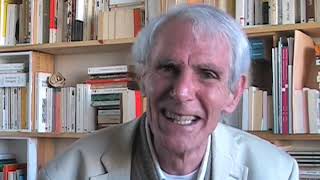
Who is this?
Karl Marx (German:; 5 May 1818 – 14 March 1883) was a German philosopher, social and political theorist, and revolutionary socialist. He developed the theory of historical materialism, analysing societal structure and change, particularly class struggle under capitalism, and predicting the system's ultimate replacement by communism. Marx co-authored The Communist Manifesto (1848) with Friedrich Engels, and undertook a critique of classical political economy in his magnum opus, Das Kapital (1867–1894). […]
1:19A Contribution to the Critique of Political EconomyHis text on Greek art poses the real difficulty: explaining why it still gives us aesthetic pleasure, which excludes any mechanism.
11:43A researcher until his death, he left a work in motion; his rare finished works were written with Engels.
34:29The Difference Between the Democritean and Epicurean Philosophy of NatureIn his thesis, the ambivalent relation of the Titans to the gods expresses that of the slaves to the free citizens.
47:45Wary of romantic fantasy-making, he remains German through his fascination with the Greek world.
52:16A Contribution to the Critique of Political EconomyThe 1859 preface announces the end of human prehistory, a highly profound anthropological statement.
0:30Hegel is the philosopher he worked on most; he places him far above the positivists in a letter to Engels.
18:51A Contribution to the Critique of Political EconomyThe 1859 preface contains the most of Marx in the fewest lines: man is a social production.
30:29CapitalThe chapter on primitive accumulation is the most concrete Marx, showing for instance Dutch practices in Indonesia.
49:37A Contribution to the Critique of Political EconomyProductive forces, relations of production and mode of production; to stop at infrastructure and superstructure is to have only half of Marx.
57:00A Contribution to the Critique of Political EconomyRelations of production become fetters on productive forces, and an era of social revolution opens.
26:55The German Ideology'Individuals always start from themselves': he is an individualist and a humanist; the social designates alienation, association the true relation.
50:21Theses on FeuerbachA participant objects with the sixth thesis, according to which human essence is the ensemble of social relations.
54:44The political is in him the real universal; class is the first moment of universalization; being is the social, truth is the political.
1:01:34For him totality exists as generic existence; he is an Epicurean atomist, with the clinamen.
1:23:55The force of production, which proletarian violence recapitulates, carries the relations of production, which are only its fixation.
51:04"I am not a Marxist" rejects a fixed system; this does not make him a relativist.
53:53A Contribution to the Critique of Political Economy1859 preface: productive forces enter into contradiction with the relations of production, which become fetters.
1:08:55CapitalEven the clumsiest architect has his house in his head before building it, unlike the bee.
1:19:20After Feuerbach, he sees the calculation of the English factory behind the trappings of the German dream.
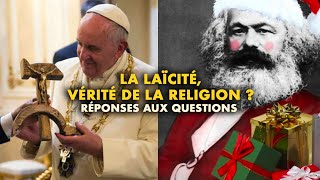
9:10Depicted as Santa Claus in the image of the evening.
33:52Critique of Hegel's Philosophy of RightReligion is not only the opium of the people but the self-consciousness of man who has not yet found himself or has again lost himself.
1:05:12Critique of Hegel's Philosophy of RightThe state and society produce religion, the inverted consciousness of an inverted world, a general theory and a motive of consolation for this world.
1:34:21Economic and Philosophic Manuscripts of 1844A bourgeois philosophy has wanted to draw from these manuscripts a philosopher Marx in order to depoliticize him, whereas Marx thinks the class struggle.
1:41:52Like Spinoza, he studies what is, capital; he adds the third term of ideology, which contains the Freudian unconscious.
6:17A Contribution to the Critique of Political Economy1859 preface: productive forces and relations of production, temporal lag of superstructures, becoming conscious in ideological form.
23:57CapitalThe clumsiest architect has his house in his head before producing it, unlike the bee.
28:49Theses on FeuerbachCredits German idealism with the merit of emphasizing activity (Tätigkeit).
30:56CapitalDraws closer to Hegel as he ages, preserves the dialectical method, dies before the chapter on social classes.
39:35CapitalHe made the sciences of history possible; his work studies what is, capitalist exploitation, and not what ought to be.
49:12A Contribution to the Critique of Political EconomyThe 1859 preface sums up his thought: infrastructure and superstructure, contradiction between productive forces and relations of production, succession of modes of production.
1:08:05Theses on FeuerbachHe distinguishes measurable productive forces from ideological forms, and criticizes Feuerbach.
1:47:35The Poverty of PhilosophyIn it he settles Marxism's relation to Proudhon's utopian socialism.
2:31Economic and Philosophic Manuscripts of 1844Marx quotes Shakespeare and shows that money transforms all impotences into their opposite, being "the bond of all bonds."
7:54The young Marx is still libertarian, Feuerbachian, Proudhonian, naturalist; the Marx of Capital ceases to be indignant.
11:00Mystification lies less in the solutions than in the way of posing the questions.
13:50CapitalThe chapter on primitive accumulation, accessible and rich in historical information, reveals the atrocities of the constitution of capital (Java).
36:32Marx studies what is and not what ought to be, for a scientific socialism rather than a utopian one.
1:19:00The German IdeologyIndividuals have always started from themselves; the social has for him a negative sense, association a positive one.
1:28:32The fetishism of the commodity; Marx an atomist in the manner of Epicurus, with the clinamen.
1:49:08A Contribution to the Critique of Political EconomyBourgeois society completes human prehistory; humanity only sets itself the problems it can solve.
8:10Theses on FeuerbachFirst a Feuerbachian, he rediscovers in Hegel the activity of the subject (Tätigkeit).
14:52According to Togliatti, taken up by Losurdo, Marx is the direct son of Hegel.
1:08:14The Communist ManifestoHis critique of capitalism denounces the dehumanization of the worker reduced to an instrument: his humanism is not a youthful weakness.
1:13:40Losurdo is wary of the notion of "Marx's actuality," since Marx transformed the world.
1:54:10The Communist ManifestoThe Manifesto describes a contradictory globalization that can produce a war of annihilation, thus anticipating the First World War.
41:29A Contribution to the Critique of Political EconomyText containing the most of Marx in the fewest lines; a sketch of Capital for the translators.
44:45A Contribution to the Critique of Political EconomyCommented reading of the preface: base and superstructure, contradiction, ideology, modes of production, end of prehistory.
1:06:37Productive forces, relations of production and mode of production; Marxism is not an economism but a critique of political economy.
1:19:32In the 1844 Manuscripts, the first social division of labor is that of man and woman.
13:32A Contribution to the Critique of Political EconomyThe 1859 preface sums up the guiding thread of his studies; Marxism is a critique of political economy, not one more economics.
44:42Theses on FeuerbachBreaks with Feuerbach because he neglected Tätigkeit, activity, and believed in a given human nature.
1:22:47CapitalThe end of Book I already analyzes financial speculation and public debt, the only property of the proletarians.
6:41The superstructures are the forms under which men become aware of the conflict between productive forces and relations of production, with a temporal lag.
16:20Mystification comes from the way questions are posed.
2:01:26The proletarian is the one who has only his chains to lose: a statement to substitute for the representation.
2:09:00Theses on FeuerbachHe faults Feuerbach for returning to nature what history has produced, and credits German idealism for having insisted on the Tätigkeit.
2:27Productive forces and relations of production are operative concepts since Marx.
2:07:02He becomes Marx when he sees the impasse of Feuerbach, who forgets history.
2:09:47Theses on FeuerbachThere he breaks with his Feuerbachian youth and reproaches the Feuerbachians for having neglected activity, an inheritance of German idealism.
2:13:12CapitalIn the afterword, he defends Hegel treated as a "dead dog" and plans a treatise on dialectic.
14:38A Contribution to the Critique of Political EconomyIn the 1859 preface: one does not judge an era by its self-consciousness, any more than one judges an individual by the idea he has of himself.
26:45He calls himself situated at the confluence of three traditions and admires the French political tradition.
1:11:13Ideology is for him a collective unconscious, different from that of Freud and of Jung.
1:27:22CapitalThe postface to the second edition situates him with respect to Hegel: reality is dialectical.
1:29:21Theses on FeuerbachHe credits German idealism with the merit of having insisted on the activity of the subject.
14:02"The opium of the people" is a tribute to the force of religion; he denounces exactions committed under religious alibi, as among the Quakers.
17:20A Contribution to the Critique of Political EconomyThe 1859 preface introduces time: the forces of production come into contradiction with the relations of production and open an era of social revolution.
28:27A Contribution to the Critique of Political EconomyDistinguishes the measurable change of the base from the juridical, aesthetic, religious, philosophical — in short, ideological — forms.
47:44The general form of need in Hegel anticipates what Marx will call exchange value.
11:58CapitalThe postface to the second edition announces the general crisis, which will drive the dialectic into the heads of the profiteers.
19:15CapitalHe criticizes the mystical side of Hegel but credits him with the first exposition of the dialectic, which must be set back on its feet.
1:27:22CapitalIn the chapter on primitive accumulation, he reconstructs the sequence of colonial violence; force there is the midwife of the old societies.
36:01He always held Hegel to be indispensable regarding dialectic.
48:13The Poverty of PhilosophyHe treats the succession of schools as a shadow theater.
50:15The concept of Robinsonade shows that economists project the present of competition onto the origin.
1:29:41Critique of Hegel's Philosophy of RightThe young Marx, still a libertarian, criticizes the State; the theses on Feuerbach recognize the activity of the subject.
2:19:11CapitalHe did not theorize the State; Clouscard never calls Capital into question.
10:06A Contribution to the Critique of Political EconomyMen enter into determined relations independent of their will: the unconscious is already there.
28:31The Poverty of PhilosophyDistances himself from philosophy; he is right to declare it finished.
46:51CapitalThe architect has the representation of his house before producing it, unlike the bee.
1:12:25The dialectical method is fundamental in his work.
31:34CapitalEven the clumsiest architect has his house in his head before building it, unlike the bee.
34:39A Contribution to the Critique of Political EconomyIn the social production of their existence, men produce their existence: it is man who makes man.
55:55Theses on FeuerbachTakes up the Tätigkeit of German idealism and wrests it from idealism by affirming praxis.
1:06:48Would say, against Hegel, that it is the tool that gives stability.
11:19Thinks the capital and how it functions, not the future communist society.
30:58CapitalIn the afterword, opposes his method to Hegel's but credits him with the overall movement; rational dialectic is critical and revolutionary.
1:14:49Calls himself a synthesis of English economy, French politics and German theory.
1:40:37CapitalThe architect has the house in his head before building it, unlike the bee.
1:43:26Has never been as opposed to Hegel as in his Feuerbachian youth; had 'flirted' with the Hegelian style.
8:36He describes himself as the result of the English economic, French political, and German theoretical traditions.
54:18Dialectic defines his materialism, neither mechanistic nor naturalistic.
1:07:06He inaugurates the science of history, according to Althusser.
1:44:38Infrastructure and superstructures; contradiction between productive forces and relations of production; religion is an effect of the division into classes.
12:24The Eighteenth Brumaire of Louis BonaparteHistory repeats itself only in the mode of comedy.
29:44Clouscard takes up his thesis again: there are always two classes, and the social division of labor produces classes.
33:08Economic and Philosophic Manuscripts of 1844He sees the first social division in that of man and woman, a division of labor and not a relation of exploitation.
46:36A Contribution to the Critique of Political EconomyThe notion of class unconscious is already present in 1859: men enter into determined relations, independent of their will.
21:40A Contribution to the Critique of Political EconomyReading of the preface: base and superstructure, contradiction between productive forces and relations of production, ideological forms.
1:28:16Robinsonades are illusions: there is no man without the we.
2:04:25The young Marx believed the Hegelian idea was in the head and wanted to overturn Hegel; he corrected himself afterward.
2:10:07CapitalThe postface read by a participant: the dialectic walks on its head in Hegel but is essentially critical and revolutionary.
2:22:46History repeats itself only in the mode of comedy.
1:30Object of the question: should we believe in the return of Marx, like a specter?
5:40He was thought buried; he was the most combated in '68, though without being denounced as totalitarian like Hegel.
8:45His return was only possible through the manufactured ghost of a leftist, Maoist Marx.
9:06CapitalHe must not be enucleated from dialectic; nature is part of the process of production, but what matters is the development of the productive forces and praxis.
11:40Placed back in the line of Rousseau, Kant, Hegel, he is not an anti-humanist thinker.
12:47The most exhaustive reference, along with Engels, Lenin and Clouscard, on today's problems.
25:01A Contribution to the Critique of Political EconomyConsumption is a moment of production; men enter into necessary relations independent of their will; the architect and the bee.
30:00He thinks the unconscious of social relations a century before Freud.
1:39:29France is the classic terrain of class struggle; the French are quick to react.
20:57His thought flows from three traditions: English political economy, French political action, German theory.
49:28He returns to Marx to link fascism's seizure of power to the crisis of 1929.
1:00:02A Contribution to the Critique of Political EconomyPreface of 1859: an epoch is not judged by its self-consciousness, any more than an individual by the idea he has of himself.
7:54His critique of the nineteenth-century English factory, the greatest gulag of modern times.
11:17CapitalHis theory of value shows that all commodities crystallize a labor time that allows them to be compared.
35:02Held Hegel to be by far the greatest bourgeois thinker.
43:15The clumsiest architect has his house in his head before building it, unlike the bee.
52:13A Contribution to the Critique of Political EconomyThe 1859 preface teaches that human existence is a social production; there are hardly any pages by Marx on the dialectic of nature.
13:19For him, the class struggle is the motor of history.
36:32At the confluence of the English economic, French political, and German theoretical traditions; a thought that contains the others, the opposite of sectarianism.
1:14:58CapitalDead at the task, he is not dogmatic; he dies while opening the chapter on social classes in the unfinished books of Capital.
35:21The Communist ManifestoDialecticizes Voltaire and Rousseau: the Manifesto praises capitalism as destroyer of old values and sees the synthesis to be made.
39:51Calls "robinsonades" utopias placed in the past.
1:22:56Replaces mechanistic materialism with a dialectical materialism, showing the incompleteness of the Enlightenment.
1:26:53Economic and Philosophic Manuscripts of 1844The first division of labor is that between man and woman.
1:13:40The Difference Between the Democritean and Epicurean Philosophy of NatureHis doctoral thesis shows that the Olympians are the free men and the titans the slaves.
33:01One has never fished where there were no fish: nature is part of the process of production.
38:50His term robinsonade designates a fantasized story.
57:24CapitalHe writes "Kapital" like Marx to avoid the word capitalism.
1:21:06A Contribution to the Critique of Political EconomyA change in the forces of production brings about a change in the relations of production; men only set themselves the questions they can resolve.
55:52A Contribution to the Critique of Political EconomyHe classes bourgeois political economy as ideology; Marxism is neither one more economics nor an economism.
1:01:17He criticizes certain naive aspects of Rousseau but admires his political thought; Marxism is not a mechanism.
13:48A Contribution to the Critique of Political EconomyIn the 1859 preface: the revolution will be the end of humanity's prehistory, and no mode of production disappears before having exhausted its possibilities.
16:01He moves from the people to social class, from genus to species, and does away with what remains too abstract in Hegel.
17:22For him, the capitalist mode is the last figure in the history of modes of production.
1:29Critique of the Gotha Programmethe mature Marx refuses to restore to workers the entirety of wealth: pensions and healthcare must be financed, against the far left of the time.
4:24Some readers of Marx mistake Hegel's text for a text by Marx.
23:49CapitalThe young Marx fights idealism; he is more nuanced in the afterword to the second edition of Capital.
58:17A Contribution to the Critique of Political EconomyThe 1859 preface shows that productive forces come into contradiction with relations of production, superstructures evolving more slowly.
1:00:09A Contribution to the Critique of Political EconomyIn the social production of their existence, men enter into determined relations, independent of their will.
1:19:10Critique of Hegel's Philosophy of Right"The opium of the people" is a tribute to religion, which has its reason for being as long as suffering is unresolved.
22:34Referring to climate with Montesquieu is not contradictory with Marx.
35:47Critique of Hegel's Philosophy of Right"Religion is the opium of the people" speaks to the power of religion, consolation for misery; to remove it a substantial substitute is needed.
38:28Historical matter in Marx corresponds to culture in Lévi-Strauss.
58:54He predicted the crisis that economists laughed at.
10:29The trial in the Marxian sense: the analysis of a process, like the production process.
31:05CapitalCritical of Hegel in his youth, he defends him more and more and places him above other philosophers, without being fooled by his mystifying dialectic.
19:43Critique of the Gotha ProgrammeLibertarian at the start of his career, he later rehabilitates an executive: part of the wealth produced must be set aside to pay non-workers and maintain the tools of production; the dictatorship of the proletariat remains transitional.
56:13According to Thomas Mann, the Germans must reconcile Marx and Hölderlin within themselves.
54:21A Contribution to the Critique of Political EconomyHe commented on the 1859 preface in the Lectures en commun sessions.
1:00:09His categories would shed light on the logic of Phèdre.
1:14:15A Contribution to the Critique of Political EconomyOpened up the historico-social unconscious; the infrastructure of the productive forces determines the ideological superstructures.
11:46Would speak of infrastructure with regard to the underworld of the Nibelungen.
1:51:58A Contribution to the Critique of Political EconomyMen only pose problems they can solve; the productive forces make possible an extended enjoyment that becomes happiness.
52:31Theses on FeuerbachReturns to Hegel by insisting on the activity of the subject, a merit of German idealism neglected by mechanistic materialists.
16:40Freud and Marx have been "executed" since the bourgeoisie has been without rival
41:09CapitalThe chapter on primitive accumulation reproduces reports by labor inspectors and shows that industrial capitalism was born from colonization and world trade.
13:48Contribution to the Critique of Hegel's Philosophy of RightThe ancient gods die twice, in tragedy then in laughter, which allows humanity to gaily part with its past.
18:29Religion as opium of the people, updated as "ecologism, opium of the people."
1:00:14A Contribution to the Critique of Political EconomySuperstructures are the forms in which men become conscious of the conflict and fight it out.
8:25What he says about primitive accumulation sheds light on the Latin American situation.
1:09:55Marxism is, along with psychoanalysis, one of the two greatest advances in the logic of the subject, hence its rejection by the dominant ideology.
1:24:03The weakness of material production explains the magical use of language.
1:35:24If essence and appearance of things were identical, all science would be useless.
1:45:37He understood the truth of religious error, alienation, unlike Voltaire.
1:06:41He mocks the Robinsonades of bourgeois economists, who project the isolated producer onto the origins; yet he admires the progress of the bourgeoisie.
3:53The first property relation is the separation of man and woman in the division of labor.
36:40A Contribution to the Critique of Political EconomyThe 1859 preface states a functional relation: relations of production correspond to the degree of development of the productive forces.
6:26The Poverty of PhilosophyClouscard places himself in the wake of an author who wrote The Poverty of Philosophy.
8:26He deepens self-knowledge by showing that consciousness is unaware of its class determination.
9:46Theses on FeuerbachThe turning point of the young Marx occurs with the Theses on Feuerbach; his thought arises from the confluence of three traditions.
49:54Marx stands between Hegel and Clouscard; readers have been taught to decouple him from Hegel.
26:16He knows mythology and sees in the struggle of the titans and the gods that of slaves and free citizens, who work for them while being in conflict with them.
5:17The Communist ManifestoThe beginning of the Manifesto makes the finest praise of capitalism: tribute to the bourgeoisie for having liquidated thousand-year-old values.
57:23He situates himself in the Marxist tradition.
8:32Determination by the economic infrastructure is not the same as that which makes the Moon turn: it is a field of determinability, more advantageous than natural determinism.

 Series · 17 Dec 2020Musicosophy 7. The Greeks, myth and music