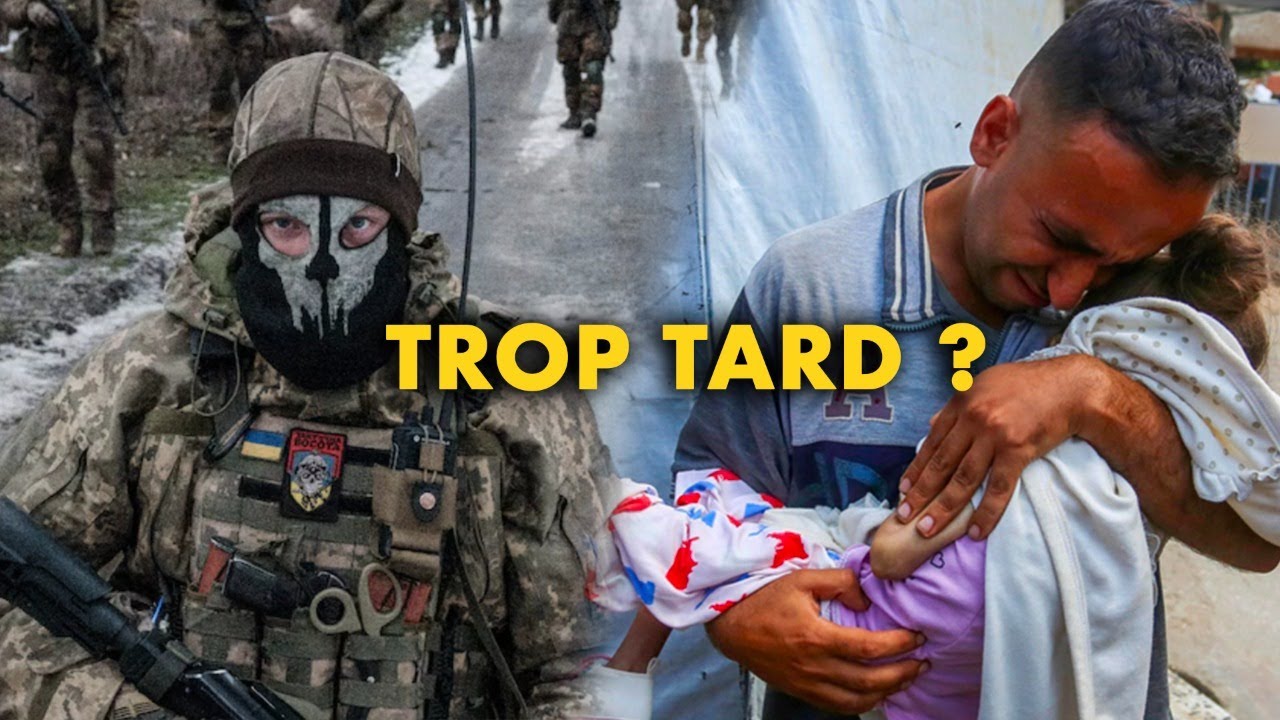
English translation of the French transcript, made with AI and not yet proofread — click a paragraph to jump to it. Show the French original
Presentation of the session and of the Italian general's interview 1:07 Good evening everyone. Should I apologize for this umpteenth postponement? But well, I mean, this time, the live session we no longer believed in has arrived, half an hour late.
1:40 Thank you for your patience. I'll start right away anyway by introducing someone who no longer needs introducing. Most of you know Victor Sarkis. We've already appeared together on screen in a video where Étienne was at the controls. Étienne Burle. It was about the relationship between Hegel and Marx. And I can't recommend it enough to those who haven't seen it yet.
2:10 There you go. And last time, you know I had decided to base our shared reflection—to have as the basis of our shared reflection, sorry—on the very important text put together precisely by Étienne Burle and Victor Sarkis, about the elections, I was going to say the disastrous ones. No, it's not so much about the elections as about the disastrous ones.
2:42 That's what our president does with it, isn't it? Well, what our executive does with it. Let's not give too much importance to the ridiculous. So, this time, last time, I wanted to have Victor live, if you remember. And Pierre-Alain reminded me that it was a bit late, that he had to be warned beforehand, that in the middle of a live broadcast it wasn't possible. And since I was frustrated, this time, right, I sent a helicopter to pick him up at his place, manu militari, and now we have him at hand, so to speak.
3:18 Well, you have him before your eyes and especially before your ears. So, we were struck together by a text that just appeared in a blog that I also recommend to you, which is run mainly by Jean-Julien on Facebook, which is for a prolonged peace, sorry, I'm butchering the title, mainly for an exit from NATO.
3:49 And the link will be posted, you'll have the link below the video. And it's in this blog that there's the interview, whose original is in Italian, the interview of course with an Italian general. An Italian general, an almost fascist government, well, I mean absolutely fascist as far as the most decisive figures are concerned, even if the regime is not entirely so.
4:25 An Italian general, yes, except that he's a communist general, that happens. There are still Italians like that, it happens. And a general about whom we can't say that with him we're conveniently pulling the blanket to the other side, because he's a general who served NATO. You know what I call NATO? It's what's called 'the West' in the media.
Concepts that show and occulting concepts 4:57 I'm tired of that word. Even our general can't get rid of it. See in his text, one of the few criticisms I make of him, is that he keeps talking about 'the West' without quotation marks. I'm making a reminder here, because there are always, and I'm glad about it, new arrivals, so sorry to those who've heard it many times before, but I remind you that if I don't like that term, it's not that I don't like the West, Westerners, I don't like what it designates. I simply remind you that there are concepts made to show things, to reveal them to us, to give them a presence when they're not there.
5:32 If I say to you 'the sandstorm in the desert,' it's not there, but there you go. You have a representation in your head, that's what concepts do—wind, sand—they show you things, right? Now if I say the bottle, the microphone, the camera, the two keyboards, mine on the piano, like that, not for long. There, you see. And then there are concepts made, on the contrary, so that we don't see, so that we don't hear, to hide, to conceal, what are called occluding concepts, that's exactly what it means.
6:12 'The West,' for me, is part of that. It's made to not name what we're going to talk about today. The unnameable. I'm sorry to have interrupted, it was still more captivating, the quest for the Grail, wasn't it, than the horrors piling up in the most recent news, whether they're new or have been going on for a good while, but they only keep getting worse and more severe.
6:43 And getting worse, sorry. I regret having interrupted the quest for the Grail, but I'm talking about the unnamed, do you think I lose my thread every time? No, no, that's exactly where I was. It's not the concept that's made to not name, right, to call by their true name. Now, Parsifal, when for the first time he hears his name, when for the first time we hear his name, while the drama has already begun two hours earlier, in the middle of the second act, at the moment when Kundry, the chief seductress, pronounces his name, while he's still busy frolicking with the flower maidens, trying to break free to continue his quest for the spear, we suddenly hear 'Parsifal'—what does he say?
7:32 He says, 'You call me, I who have no name.' You see, there is indeed a continuity there. So, 'the West,' I remind you, for those who aren't used to it, the properly philosophical approach, the approach of our patron Socrates—yes, he's our patron, like Saint Christopher, who's the patron saint of drivers, it's a familiar sense, not our boss in the sense of the employers' federation. He's the one who initiated what is properly philosophical. I'm not saying there's nothing profound before Socrates—Taoist Chinese thought, the thought of the Bhagavad Gita, the Vedas—the Vedas are extraordinary, they predate Plato by quite a bit for some of them—and the Egyptian Book of the Dead, which is the oldest, there's also the Tibetan Book of the Dead which is admirable, the Bardo Thödol, to speak—one has to show off a bit in Tibetan, of course—but that's wisdom, that's not philosophy.
8:31 It's not that it's bad, it's excellent, that's why I prefer a profound thought to a superficial philosophy, I'm not doing philosophism here, but philosophy in the strict sense, the one that doesn't question things but questions the words through which we're in contact with things, the one that begins with 'what do you call' and not 'what is it?' 'What is a star?'—an astronomer's question, I know these are reminders for those who've already heard them—'what do you call a star?'—a philosopher's question.
What the West is not, and the question of too late 9:02 We could say 'what is a war?' and 'what do you call a war?' That's a bit the question for tonight. You're demoralizing me, because we're going to come back to the horrors, I'd like to talk about other things, but you're right to bring us back to the order of the day. Well anyway, yes, so, for 'the West,' I'm going to take a Socratic approach: if I ask what it is, I'll be told 'it's what's in the West.' There you go, but since the earth is round, the West is wherever you want it to be. I'll go fast, because I've already said it a thousand times, you know it. You do like the Little Prince on his planet, you pull up your chair and you're in the West.
9:34 We're always to the west of something, it's a matter of reference frame. Well, for you, there you go. So, it's not the West that gets me. No, well, don't worry about Pagani, you know very well, don't do like Victor there, splitting hairs, and I'm being polite. I thought the leader of the West was the United States of America. Darn. Oh, that's not in Europe, that's true. Shoot. Oh, come on, it's the developed countries, the industrialized countries, that's ridiculous, what.
10:05 The industrialized countries, oh really, Japan, then, is the main Western power after the United States. Japan, which, by the way, is rearming for the first time since the Second World War. That's terrible, you want to make me talk about the worst, but no, I'll get there because we're arriving at that. It's a bit more... He's right, Victor, that's what leads me to choose. When I say 'too late,' which is the title of our session tonight, it's a real question. Don't think I have the answer. I think I'm telling you, teasingly, that it's too late.
10:35 No. I hope it's not too late, but it's terrible that we have to ask ourselves the question. Maybe it's already too late. Because, and Victor just reminded us, right, Japan is rearming, Germany has put 100 billion, 100 billion euros back into the arms industry. The United States of America, for the first time, has taken the step and installed medium-range missiles, that is, ones that can reach Moscow in three minutes, in Germany, crossing a taboo that hadn't been breached even in the worst crises of the Cold War.
11:14 Should I talk about Gaza? I have trouble talking about it, it's unbearable. But everyone doesn't give a damn. Apparently it's bearable for a lot of people. Well, actually, we support it because we don't talk about it. Or when we do talk about it, people say, oh no, you're antisemitic, that's serious. What's happening is serious. It's serious. So yes, Japan, nothing, but watch out, Japan, Germany—doesn't that remind you of something, Japan, Germany?
The German-Soviet pact and Ivan Maisky's book 11:49 They're in the process of replaying the Second World War, except that this time, the Americans will be on the side of the losing Axis powers. It's the revenge of the frustrated ones talking about it more, in a geopolitical version. Yes, this time—last time, they weren't so opposed to Hitler, as long as what? As long as—there weren't the communists who'd gone all out, let's say. No, no, but let's be precise. As long as we hadn't reached the German-Soviet pact, by which Stalin told Hitler: listen, if you want to make war, my friend, I can't stop you, that's your problem, but let's make sure it doesn't start with us.
12:29 That's it. Because we have the five-year plans, we're coming out of millennia of misery, we have work to do, because I'm here. A reminder to our listeners also of the excellent book republished by Delga, by Ivan Maisky, the Soviet ambassador, on the German-Soviet pact—that the German-Soviet pact comes in 1939, after 10 years during which, in fact, the Soviets tried to make a pact with the English and the French, who refused, who did everything to make it fail, and that the German-Soviet pact came in the end to prevent the English from screwing over the Soviets.
13:06 Well, Victor, you're telling me this. No, but I don't know what. Do you not know? No, but seriously, don't you know? Because you don't know. I'm saying this for our listeners, the younger ones who might not know. I'm sorry for Delga, because on the contrary, it's entirely to their credit. I said 'republished' because I know you have the original edition. There you go, but you know it was me who introduced this book to Delga. Ah, I didn't know that. Yes, because I had the Moscow editions edition, all the more reason, whose title was already 'Who Helped Hitler.'
13:36 That's it, 'Who Helped Hitler.' That was the title, by Ivan Maisky. I remind you that he was ambassador of the Soviet Union to Her Britannic Majesty. It's an important post. Go get it because it'll actually help you understand everything, including, moreover, about France. There's even a moment—I'll just give this little anecdote because it's incredible regarding the current situation. Maisky has just taken up his post and in fact he arrives a bit after Hitler's rise to power, so he takes up his post in June '33. Full of humiliation for the world. There, in England, and at one point, before heading back to Moscow to report to Molotov, he makes a detour through Paris and spends an evening with the Soviet ambassador in Paris, while he himself is the Soviet ambassador in London.
14:19 And there, they have an absolutely incredible discussion, I nearly fell off my chair reading it, we're in the middle of 1933, halfway through the year. And he says already, roughly, what the Soviet ambassador in France says—he says, you know, France, we tend to consider it a great power but it's more out of habit than in reality, in fact it's rather a power of second or third rank that in fact just follows the English. He says, there are people in the French government who would be interested in making a deal with the Soviets but they're so cowardly that since the English don't want to, they follow them.
French diplomacy aligned with England since Waterloo 14:52 Well, you replace the English with the Americans and you basically have the whole explanation of French geopolitics for the last 70 years, and you see that this was written by the Soviet ambassador in 1933, in fact—that is, it's an old problem. Excellent reminder, which allows me to dig a bit deeper so that we have some historical depth to what we're saying, so I'll go back a bit beyond all that. It's perfectly true that France aligns its entire diplomacy—has aligned it with English diplomacy since when?
15:26 Since Waterloo. That's it, I said it. The French bourgeoisie is still in 1815. There you go. There was an attempt to return to sovereignty with Napoleon III, it ended in the catastrophe of the war with Prussia. The emperor himself, Napoleon III, taken prisoner at Sedan. Right? And the Third Republic forced itself, then, to be the shadow of English France, to the point that—excuse me, it's the African speaking here, if I may put it that way. Right?
15:56 To the point that, if you look at the map in a historical atlas of colonial empires, you'll see it in purple or pink. Generally, the English are in pink, the French in purple, I don't know why. The French, it's west-east from Dakar to Djibouti, you see? And the English, it's from Egypt to the Cape. Right? Passing through Rhodesia, you see, through what's called Eastern Africa, then Central, then Southern.
16:30 Where am I getting at with this? It's that the two lines intersect—at some point they had to cross. Well, that happened in a small town in Sudan. The English go up the Nile. The sources of the Nile weren't known yet at that time. Right? They're in unexplored territory with Lord Kitchener, the one who carried out the repression of the Mahdi's revolt in Sudan. We're in the unknown. In the unknown—suddenly, bang! What do they suddenly see on a rise? A French flag!
17:01 Oh, darn! It's Commander Marchand's column—if I may say so, my paternal grandfather was in it, I mean, coming from the West, from what's now called Mali, Chad, Niger, etc. And who, inevitably, was bound to arrive on the banks of the Nile. And Kitchener says 'Oh, oh, oh!' They see a messenger saying 'This belongs to the British Crown, everything we discover is for Her Majesty.' And Marchand:
17:36 'There's no question of that, I'm a French soldier.' And there you go, 'I was here first.' Tension rose, and in Paris, Marchand was disavowed. You see, this is to illustrate—when I tell you that it would have caused a war between France and England over less than that. And there, no. And when Marchand disembarked in Marseille, afterward he was carried in triumph by a few supporters, like that. Often somewhat to the right of the right.
18:06 There you go. No, no, I'm not for one side or the other. It's to say that French diplomacy—no, I'm saying this because there's nothing more current. I don't know—no idea—people talk about Sarkozy. Look at the absurdity. About Macron. Right. The important thing, Macron leaving. Get rid of him and then tomorrow there might be someone worse. Even talk about those who put him there. They're puppets. It's been a long time since France had an autonomous foreign policy. Since Sarkozy, absurdly enough, had France reintegrate what's called NATO's integrated command.
NATO's integrated command and the decision of war 18:40 That was the ultimate stage. I remind you, because we're going to talk a lot about military matters. I remind you that de Gaulle was anti-Atlanticist but not anti-Atlantic-alliance. One must be nuanced. One must not be sectarian. De Gaulle never denied France's membership in the Atlantic Alliance. The best illustration is the Cuban Missile Crisis, where he immediately told the Americans, we're on your side if things heat up, with our nuclear weapon. Good. He was loyal.
19:10 But de Gaulle refused—he abolished the integrated command. What does that mean? It means that the decision—which is tonight's subject—of war or peace, of the apocalypse, if such a decision is made, then it really will be too late—not for you or me, but for humanity. I recall Einstein's quote: there won't be a third world war, or rather, the fourth one will be fought with sticks and stones. That's Einstein.
19:40 We could go back 15,000 years if you like. So, the integrated command is this: something as serious—when I'm in charge of a people, me, head of the French state, when I'm in charge of a people, in this case the people of France—it's not possible for the decision of war or peace, in the nuclear age, to come from outside, to escape us, and for us to be dragged into a generalized conflict.
20:13 I'll make a metaphor, if you allow me, which illustrates, moreover, what many don't want to say, whether right or left—it's the colonial situation of France, in fact, that France is a colonized country that doesn't even have—by the Americans—doesn't even have sovereignty over its weapons and over deciding war or peace, and it makes me think of the French colonies in 1914, I believe, in North Africa, the Middle East, Africa, which, following France's decision to enter the First World War, found themselves de facto also dragged into the First World War, with workers working for the war effort in Europe in '14, soldiers forced to go, etc. And France today finds itself in this situation, in fact, where it's a country colonized by the United States, and if the United States ever decides to enter via NATO—because you're right, we shouldn't talk about 'the West,' these are very concrete institutions, it's the IMF, it's the World Bank, it's NATO, it's the European Union, etc.—these are very concrete things, not metaphysical—the whole secondary hierarchy of the UN, when it's secondary, I'm not talking about the presidents or those in the front of the stage, that's it, all the directorates, and that's what really constitutes the arc of the UN, the Americans placed them there.
21:23 There you go, that's it, and that means that France today, tomorrow, if the United States decides that we go to war, we'll be forced to go, just as, moreover, the colonies—I don't know, French West Africa or French Equatorial Africa in '14—were forced to enter the First World War, and these peoples had asked for nothing. The difference is that there was no nuclear weapon then—true—but at the level of the political situation, whether or not in the integrated command, it's all the more, it's all the more unforgivable that we reintegrated, so to speak, the integrated command since Sarkozy. Absolutely, and that neither Hollande nor any of them removed it. No, no, that's for sure—what kind of left is that, as they say. There you go, so I come back—so I said what 'the West' fails to make say something real, it's neither the West geographically, nor Europe, nor Japan, of course—it's the Far East, Japan, Australia—think of Australia, which is still—I'll come back to it—the West—I'll come back to it—there's one thing we never say—I don't know, I want to come back to the Echelon network, but that's another story.
Atlanticist imperialism, not Russia against Ukraine 22:33 I don't want to think—if I tell you to talk about the Echelon network, I haven't said what should be said in its place. Let me take away one word from you: Atlanticist imperialism—if we apply it—already every time we use the term 'the Westerners,' but I'm one myself, Victor too, what is this business, honestly, I don't know why I'm going to flagellate myself—I'd even add that an Arab who went to China or India would feel Western compared to the Far East. Listen, you're a better Arabic speaker than me, it seems to me that 'Maghreb' means West. Yes, exactly, indeed it's the setting-sun sense—the Maghreb is the most western part of the Arabic-speaking world—there you go, up to Morocco—there you go, and the opposite is 'Mashreq'—that's right, exactly, Egypt, Syria, that's it, the countries of the Levant—there you go—so why did I decide to devote this session
23:43 to this question of whether it's not already too late—it's that things have accelerated even since the last time we saw each other. Look, I'll say the admirable poster made by—I don't know, I like to flatter him—Pierre-Alain, but I mean, from an iconographic point of view it's excellent, but well, from the point of view of reality it's unbearable, except that we see what? We see death, nothingness, suffering, from Ukraine to Gaza. Starting tonight, I'd like to remind everyone that we must stop with fictions. I denounced one—'the West'—it's not the first time, it won't be the last, but there's another one, for the first time, which I insist on, that we must renounce: that there's a war between Russia and Ukraine. There's a war between Atlanticist imperialism—yes, I don't say 'the West,' Atlanticist imperialism—and Russia. If I want to be pessimistic
24:54 to the very end—I'll give you the floor right after, I'll just finish on this—it's a war, unless it's already the occasion for the Apocalypse, I hope not, but if it isn't, it will in any case be the prelude to the other war, an even more serious one, that the United States is preparing against China. It's in all the files, I'm not making amalgamations here—listen to American officials, that's all, read the American press, inform yourselves, never believe me on my word alone, I hate gurus. So, what did you want to say? Yes, just to complete what you were saying—in the same way that there's no Russia-Ukraine conflict, there's no Israel-Hamas conflict, or even Israel-Gaza, or even, in fact, Israel and Iran, because that idea is often floated, that it would be Iran, etc.
25:43 There's a war between Atlanticist imperialism—because Israel is only its mask, and this needs to be said—Israel wouldn't last 48 hours without arms shipments; if the Americans stopped delivering bombs, in 48 hours there'd be no more conflict. Yesterday afternoon, the American Congress once again voted 75 billion dollars in military aid to Israel—all while diplomatically saying, still, that Israel is overdoing it, that there absolutely must be negotiations, but at the same time, 75 billion in aid, including 25 F-15 planes, all while telling them, moreover, to avoid hitting civilians too hard, while supplying the weapons—it's like a guy who's committing a massacre in a shopping mall, at an airport, shooting innocent people, and then you give him weapons, ammunition to shoot the guys, and at the same time you tell him 'stop shooting innocent people'—the accomplices say, 'it's not me, it's him.' That's it. So it's not a conflict with, on one side, Israel—because in fact it's only the mask of Atlanticist imperialism—nor Hamas, nor Gaza, nor even Palestine, nor even the Arabs, nor even the question of Iran, etc.—in fact it's a global war between Atlanticist imperialism and, in fact
26:53 China and China's allies, in fact, notably in the region—that is, Russia or Iran, why are they attacked so much? It's because, in fact, behind that there's China, in fact—it's the great battle being prepared, it's the great battle, and in fact all these conflicts are not different conflicts, they're the different aspects of the same conflict, and what's important is that everyone realizes this, and moreover we clearly see it recently, since the strike, the death of Ismail Haniyeh in Tehran, Russia is delivering more and more weapons to Iran—that is, we're beginning to see a unification of the fronts on both sides, in fact, and it's escalating more and more—yes, well, it's not reassuring either, it's not reassuring either, but in any case things are becoming clearer, it needs to be clear for the listeners, and it's better than the balance—that's it, that all the weapons are on the same side, more than an imbalance—exactly, whatever that side is, I quite agree, but for now it's not reassuring—exactly, but it was to clarify the semantic question. It's serious because there's a tendency, especially in the mainstream media, etc., to segment things, when in fact it's the same thing—it's that the fact of reminding that the
Justifiable anti-Zionism and anti-Zionism as a mask for antisemitism 28:11 What matters is to recall this, because it makes the difference between the anti-Zionism that is justifiable — entirely, we've already discussed how Zionism came about historically and ideologically, that's another debate — and the anti-Zionism that isn't justifiable, that serves as a mask for antisemitism. Let me explain the difference, you see it right away: the antisemite is the one who will say that Israel is everywhere. Sure, they're the ones running the United States, with the Israeli lobby over there being powerful — careful now — but they're not the ones in charge; it's not Israel that arms the Pentagon, it's the other way round. So, they're everywhere? No — look at the number of American bases there are around the world, it's derisory next to that, there are Israeli ones too. That's where the difference lies. I say this because I've come across people who often seem to be on our side of the divide but who give themselves away, of course, when they say that Israel is behind all of it. No, no, no, no, no, no. There is...
29:26 ...this anti-Zionism that is a pretext for antisemitism, it gives itself away when it minimizes — I come back to this, I'm disappointed, aren't I — the role of Atlantist imperialism behind all this, and also behind Zelensky, which is why what Pierre-Alain had the intelligence to do was such a hit. I'll come back to your distinction, because it's very important, and I place it also within the Arab debate, because the question you're raising is very important in the Arab debate — you have a lot of, broadly speaking, anti-Zionism that's something of a consensus, at least rhetorically, in Arab politics. But it's defensible — why not — except that there's precisely a fault line on exactly what you just said: who dominates, the United States or Israel. And I really like — how should I put it — Hassan Nasrallah's reasoning, the Secretary General of Hezbollah, because he makes exactly the same argument we do, by saying: look, there are those who say Israel is the puppet-master, that Israel controls the United States, etc. Nasrallah says not at all — where are the banks, where are the big...
30:37 ...oil companies, where's the arms industry — all of that is in the United States, so it's the United States that controls everything. And even more interesting, he goes a step further — this is what I wanted to add to complete the point — by saying: those who claim, notably among the Arabs, in the Gulf countries etc., that Israel is the stronger power, and that therefore we just need to influence the United States — for instance, 'the United States is not our enemy, in fact it's Israel who is our real enemy behind it' — what does Nasrallah say about that? He says that in fact these people, these Arabs — when I say 'the Arabs' I mean the Gulf countries — want to place their money in the United States, saying: let's compete with the Israelis, let's invest our money in the United States, and that way we'll be able to bend American policy. That way, in fact, it's also a strategy for avoiding confrontation with the United States. So you see the connection here, and I wanted to underline how crucial the distinction you're making really is. Absolutely. Well, sorry, but — I'm searching without finding it — what Victor just said reminds me of a text which, parallel to the one we haven't tackled yet...
The dead of Korea and Vietnam and the social frameworks of memory 31:48 ...by our Italian general — a text by someone very familiar to most of those who follow us, I'm thinking of Bruno Guigue, who made a post that's excellent in itself about the link between — well, he says 'the West' — I make the same criticism as of the Italian general, except that he comes very close to seeing that it's a fantasy — no, that's not the right word — but he's perfectly right to show that these are not accidents or blunders, missteps — I'm playing on the words on purpose — when there are 3 million dead in Korea, 3 million dead in Vietnam, 10,000 km from the United States, a country decides to go with a communist option — it's not going to go unanswered. It's still extraordinary, isn't it. No, but we get used to it, we get used to it as if it were normal — rather, we don't get used to it, because it's camouflaged by our media, who'll talk about the Tiananmen massacre — how many dead, I ask you all — well, certainly not 3 million.
32:58 And especially not 6 million once you add Korea and Vietnam together — and we haven't even started on Iraq, Syria, the permanent bloodbath of the dictatorships in Latin America. It's interesting, by the way, about the Tiananmen photos, because everyone knows the famous photo of the protester in front of the tank, and nobody knows that the tank actually drove around him. Oh, you're being very Platonist there, excuse me, I'm teasing you — you're the one who accuses me of being Platonist while claiming to stay within Marxist orthodoxy by being Aristotelian. No, that's my little caricature, and besides it's completely false. No, but it's true that Marx himself is Platonist — of course — when he says — wait, let's be precise — not when he talks about the world-soul in the Timaeus, no, when he says: if the essence and the appearance of things were one and the same, all science would be useless. Of course, there's something Platonic there, of course, but there's philosophy there, of course — what's irreversible in philosophy: if the essence and the appearance of things were one and the same, all science would be useless. If the stars were that little 3mm point I see twinkling up there in the sky — I'm telling you this because I told you last time, my big sister, when I was little, used to tell me: you know it's bigger than our earth, the stars, and I'd say...
34:08 'But that's crazy' — actually it's a billion times bigger. Yes, no, I'm just saying some might argue that Aristotle is just simplified Platonism. So, well, that's another debate, the Plato-Aristotle debate. Aristotle, yes, that will be another debate, parallel to the debate, also — it is — and it's not going to end, nor begin either — at least it hasn't caused 6 million deaths, nor 3 million, that one — at least it's likeable. No, but I bring it up, I bring it up because it's important to recall this — we were talking precisely about what's constantly camouflaged, about what isn't present outside the back of the cave, so to speak — it's what's repressed, in fact — there we really need to use almost Freudian terminology. Yes, except it's not a psychological repression. Yes, it's a geopolitical repression. Exactly, meaning there are the media, there are the structures, there are the priorities — that's the very principle of consciousness, of ideology. And here I refer, for the first time, to that beautiful title that appeared in the fifties, I think, by Maurice Halbwachs, the sociologist: The Social Frameworks of Memory. I say this because your generation — sorry, I'm addressing the younger part, which is still the biggest contingent of our audience...
35:19 — it's not the only one, thankfully, but still — you're so used to biologism, not to biology, what am I going to say against biology, me, what do I know about it, I wouldn't even be alive if — I'm not going to spit in the soup, no, I'm talking about biologism, you see, Foucault, biopolitics, you think I'm conflating things? Biologism, which would reduce everything to physico-chemico-biological determinations, isn't it? But where am I getting at?
35:51 Memory — well yes, it's enzymes, and besides there are the regions of the brain, there's a link between memory and the brain, that's not what needs to be denied, but at the same time there's also — how does he put it — the social frameworks of memory: things we're never told about end up disappearing from memory. Who remembers what we're saying right now? Everyone remembers Tiananmen, nobody remembers there were 3 million dead in the Korean War — well, specialists in the region do, but the public, especially young people, wait, they know Michael Jackson better than the 3 million dead. Well, still, that's serious, what we're witnessing. Memory isn't only what brain imaging shows, or what the so-called cognitive sciences say about it — no doubt by antiphrasis, since they deprive themselves of the essential part of knowledge, which is the relation to the other and not only the relation to the thing — not only, it's also the relation to the thing, but not only, that's crucial — it's the history of memories, moreover, of dates — you can see it in everything that's happened in the media around the conflict that started in Gaza around October 7th.
37:02 Does it start there, or before, and so on — very clearly there's a media tendency to organize forgetting, to make people believe everything starts on October 7th, that there's no before, no after, and so on, and then afterward you can build on that. You're absolutely right, but we can see it's a bit harder to hide that it's been going on for 70 years. Oh yes, of course, it's been easier — whoever is subjected to violence — it's been easier, moreover, to hide it for Ukraine — who gets expelled — actually I think that the Palestinian conflict, being old enough, managed to anchor itself somewhat in memory, because at the time there was communism, there was the USSR, etc., there was a real labor movement. Now it's interesting to compare: the Ukrainian problem, so to speak, really started to explode more recently — well, there was the Orange Revolution in 2004 with Yushchenko — oh yes, sorry, actually no, there was a first Orange Revolution where they got rid of Viktor Yushchenko, and then it fell apart, and then there was indeed the 2014 Maidan coup — which means, roughly, it's been 10-20 years, that is, the moment when there's no more left, no more world communism, etc., and so this one has really slipped completely under the radar — which is interesting, in public debate, I might be a bit provocative but you can be.
38:12 In public debate, it's still possible on the left to defend Palestine — that still works, well, in the media you get called antisemitic, etc., but still, on the left it's possible — on the left there's a part that calls you antisemitic, of course, but there's still a part — take LFI for example — that's a part that considers itself left, for me that's not the left, I mean, whether you're at the PCF or at LFI, defending Palestine is consensual, you see. That is to say, there's a unanimity that's even stronger there, precisely because the social frameworks of memory are even more destroyed, and because the conflict was born at a moment when — you're not going to compare, well, you're not going to compare, because on the other side there are the white n-words, there are the Russians — but yes, I know, it's the Russians, no pity, of course, I know, it's the subhumans, that's it — what are you going to compare — but of course, it's interesting what you're saying, it's the land of Christ, what's interesting, moreover, is that the Russians, what are they — you can see here, it's the Slavs — but what are they, you can see here, it's interesting what you're raising, it's really very detached from all this history of imperialism today, from the question of racism, that is, we can clearly see that it's not that the Palestinians are Arabs or that the Russians are this or that — it's that racism, in fact, is class contempt on an imperialist scale. I can already see your Marxist reductionism there.
39:22 I'll do worse — listen, some of you have already heard the tune, but what's happening now is so serious that I'm obliged to recall some fundamentals, hoping that this time I'm waging a battle against the social frameworks of memory to — you mean — no, no, against what prevents this from being memorized, what I'm about to say now. Of course they'll say, 'that's true, it's not stupid what he says,' but we'll forget it because there's no media relay — that's how amnesia forms, it's not at the level of polite conversation, it's not that obvious. So I'll recall, despite everything, that Arabs have never been so well received in France — there, I have an accent ready to lynch me when I say that, and they're right — if I stop there. No, no, wait, actually here's something concrete: I was on the Champs-Élysées, at the Hôtel Georges V, I saw the Emir of Kuwait arriving at the hotel, they rolled out a carpet for him, you should have seen the hotel staff — down-to-earth French folk who don't exactly vote left, in my opinion — I watched, the maître d', all that, the hotel manager, 'Your Majesty,' etc., but it was perfectly...
Racism as class contempt, from the Sahel to Latin America 40:32 ...welcoming. And three weeks before, I had seen the King of Morocco — don't even get me started, you should have seen the welcome. Wait, that's two Arabs — now I can see people jumping on me: stop, that's an amalgamation, it's scandalous, you see, it's not the same. I wanted to hear you say it: it's not the same. Ah no, it's the rich and the poor — there we go. Ah, the King of Morocco and the Emir of Kuwait, they're Arabs, but rich — super rich. There's tension in the South China Sea, there are near-daily clashes between Chinese and Philippine boats, which are encouraged — the Chinese boats are encouraged by the Chinese government, no mystery there — but the Philippines have also been made to believe that there's a conflict between China and the Philippines — no, no, there's the largest American base in the world, it's in the Philippines, you should know that.
41:44 You should also know, since we were talking about medicine — I mean to talk about everything at once — about the massacres carried out in the Philippines by the Americans before the war of 1914 — that's another story, if we had to tell it all. So I come back to it: there's a whirlwind, there's no connection at all between Ukraine and Gaza — oh really? If it's the same conflict — no, no, wait, but not in the Sahel either? What are you going to do now, bring in the military dictatorships — how do our media put it — the juntas, the Malian ones, the Nigerien ones — those same Franco-French powers — and I know, I know, let's not confuse this with denouncing France from an Atlantist standpoint, badmouthing France in order to camouflage the British Empire, that's a classic, but well, we understand each other — those same Franco-French leaders who carried out coup after coup, military coup, to liquidate all the generations of independence in Africa with their Marxist leanings — the immense Modibo Keïta in Mali, forgotten — not only was he for Malian nationalism, he had abolished the border...
42:54 ...with Senegal, and he created a trans-regional entity, mocking the colonial borders. Lumumba, of course, the immense Lumumba, martyred, tortured, told 'you can leave,' the anti-Cuban parties — they finished him off with a bullet in the back, with the Belgians giving the instructions for it, to the future dictator — the one who had the biggest account at UBS, sorry, the Union of Swiss Banks — Mobutu. Yes, of course. Yes, but he's one of the torturers — it's us who put all these military men in power, and now it's the same people denouncing the juntas, and now democracy — listen, it's atrociously funny, it's terrible, it's indecent. On the Sahel, by the way, I'd like to point out how, not only in the mainstream media but even in the alternative left-wing media, you never hear about what's happening in the Sahel, whereas what's currently happening politically and economically in the Sahel, notably with Ibrahim Traoré, etc., objectively, from my point of view...
44:04 ...is one of the greatest revolutionary processes of our time — that is, they're industrializing at breakneck speed, trying to develop this region which has historically been one of the poorest in the world. It's quite incredible what they're doing — they're grappling with problems, war problems, but there are projects being carried out with the Russians, with the Chinese, to extract raw materials, refine them, process them, etc. — but no, they're plundering — no, Victor, I don't agree — as you never hear about it, unless — if you say that, it's because you don't follow the Marxist café — if you didn't have it — no, but you did well — but apart from a few specialized media outlets, well, I don't know, when I say I talk about it, I know I'm throwing glasses of water on a forest fire, that's it, that's what I wanted to say — this forest fire is what I called earlier the social frameworks of memory, when it's one of the most important events of our time — no, but on top of that it's one of the most important events of our time, and it will have absolutely incredible repercussions, because, well, once this region — which has after all never industrialized — does so, it will have incredible ramifications. Yes, but despite all that, Victor, some will say, listening to us: still, it's an inadmissible amalgamation, the Ukraine conflict...
45:14 ...has nothing to do with what's happening in the Sahel. Oh yes, of course — you're just not informed, listen. Wait, because we must have said it quickly, but I have to repeat it — how many times before it starts to sink into memory and stabilize a bit — there was a very serious, a very serious clash between the rebels in Mali and the Malian army and its Russian allies — here they say Wagner — no, it's the Russian army, Wagner doesn't exist anymore, it's the Russian army — there are diplomatic exchanges, the Russians had contacts with Mali half a century ago, some think they just landed on us out of nowhere. Well, there was a very serious clash, and we found out — Ukraine itself even boasted about it — that the Ukrainians had organized this clash. They didn't get there with their own resources, the Ukrainians, when they show up at our place — when I say 'our place' it's ironic — in French-speaking Africa, we have all our own setups...
46:24 ...especially in the Sahara, where every trick in the book is used. So no, it's not an amalgamation — the war supposedly between the USA and Russia, and Ukraine — why does it suddenly turn against the Malian government? The conflict is exporting itself. Isn't it already too late? I don't like the concept of globalization when it's misused, but alas, when it's pertinent, it is — the globalization of conflict at present. I mentioned the clashes in the Philippine Sea, look at what's happening in Latin America, look how Maduro's election, you see, is completely scandalized — I don't know him myself, he's not my idol, I'm not saying that, but I know these are — what do you call those dogs — pit bulls, pit bulls or not, who have never stopped, since Chávez — I find it intolerable, don't I, that Venezuela is no longer an American colony and that Venezuelan oil is no longer the property of the big American firms — it was the — there's only the diluted Atlantic...
The rising death toll since Valmy 47:35 ...it's of excellent quality — I couldn't resist a thing like that, so I'll come back to it, and maybe we'll start — yes, the reading, I'll ask Pierre-Alain — I'll ask you questions along the way and turn it into commentary — right, right, but before, before, if I'm sounding a bit of an alarm about this context of warmongering gangrene starting to occupy the whole planet, I'd just like to point out the progression in the number of deaths. I won't go back to Vercingetorix, I'll start from Valmy, that's the beginning of our era, of modernity, roughly 1792, of the French Revolution which allowed the founding of the Republic — right after, that's certain, no matter what — I should say in passing, since you insist on digging a bit into that beautiful night — you're right to — it's hardly an innocent date that old Hegel, as for the first time, in good German — the Germans, they had trouble leaving Germany at the time, they weren't travelers like the English, like the French, they had no colonial empire, so when...
48:45 ...old Hegel finally answers Victor Cousin's invitation, he's 60 and travels to Paris, by stagecoach, and there, in the dead of night, he passes by the Valmy mill. He writes a letter to his wife, saying — among the ghosts of my youth — it was a splendid dawn, magnificent. There, you also recall what Goethe said, because he was at Valmy, I believe — Goethe — he wrote something too, afterward — go on — but I don't quite remember exactly — you remember better than I do — you get along very well with Goethe — well yes, that's why I'm telling you — these are Germans who are wary of Germany, and they're right to be — do you remember exactly what he said, it's one of the few positive points — and Nietzsche too — yes, he said, roughly, a world begins at this moment — that's it, the reference to the horror is that a world begins, etc. — of course — and what's interesting is the scope of the event, and as the listeners can see, the derisory number of dead compared to other conflicts — you know why, there are several versions, but most of the time it's said it's because they were so stupefied to see what was then called the French army — the army of the barefoot, of the cobblers — they were so ragged compared to the Prussians...
49:55 ...booted, helmeted, with all the money of the coalitions — the Austrian Empire, England, of the Austrian Empire, England, Russia — they were stupefied, they thought the battle wouldn't even take place. When they saw that a first cannon shot had been fired from the French side, it caused panic — that's the first version. Others say a somewhat shadier but interesting version, that Danton supposedly converted into cash the diamonds stolen from the British crown at the time, and bought off one of the Prussian generals so he'd pull out of the battle — interesting as a theory of the conflict, I'm not a historian, look it up. I'll just add a small aside on what you're saying about the aspect that ultimately it's the French who win and go on to make the Republic after Valmy — so the French, barefoot army, etc., and the Prussians, over-equipped, facing them, thinking they'll make short work of it — that makes me think a bit of the conflict...
51:05 ...well, all proportions kept, despite the number of dead in Gaza, but it makes me think of that a little, that is, the over-equipped Israeli army thinking they'd defeat and conquer Gaza in three weeks, etc., and it's an operational failure, strictly militarily speaking, because massacring civilians becomes reckless — that is, no, but it becomes reckless, especially, I mean, from a military point of view, massacring civilians isn't a success — it's not hard to kill civilians, from a military point of view. Your contention up to this point — militarily, it's a failure for Israel, and how it's becoming popularized even within Israel — we're not going to call all the Israelis who demonstrate practically every day in Tel Aviv antisemites — and so we see here a bit the way you really have the barefoot army giving, to put it in military terms, a hiding to the over-equipped, technologically superior army — and that should serve as a lesson to all those who might think that a war against these 'yokels' — Iranians, Russians, Chinese, etc. — would be easy just because we have Western technology. There you go, to whoever has ears to hear. I'll let you continue on the rest — and the inflation, 500 dead, well that's a somewhat unique exception — just a bit later, Hohenlinden, that's it — if I'm not...
52:16 ...the first Republic, it's the Directory — Hohenlinden, General Moreau, who was somewhat at odds with Bonaparte — even a bit at odds, because he was one of the rare military men who could have overshadowed him, he was an excellent strategist — Moreau won an admirable victory at Hohenlinden, well, 1,000 dead all the same, it's starting to climb, that's double — and then the admirable victory of Marengo — you know, they were waiting for Napoleon — yes, of course, because there's a listener who posted the Goethe quote I had in mind, let me read it to you: 'From here, from today, begins a new era in world history, and you can say you were there.' Yes, like Bonaparte will tell his troops, 'you can say I was at Austerlitz' — that's it, sorry for the amalgamation, but I'll let you continue on Marengo, 13,000 dead. Yes, no, no, I'm staying on Goethe — Goethe has the sense of what's decisive and what isn't, historically, when he says — look how this resonates as a counterpoint — with, with Voltaire, a world ends, with Rousseau, a world begins — yes, that's exactly it. Voltaire, that's the termite gnawing at the whole building, the struggle against intolerance...
53:26 ...that's it, but Rousseau is the one who really installs the new relationships, once the house has been gnawed away, for instance, and has collapsed — what do we build on top of it? That's the Social Contract, right — you've seen this, Rousseau — so yes, Hohenlinden 1,000 dead, Marengo 13,000 dead, the Italian campaign — that pretty much ends the Italian campaign, well — Austerlitz, 15,000, Wagram, 70,000, and that's a change of scale — Leipzig, we continue, 100,000 dead, the Battle of the Nations, 1813 if I'm not mistaken, which is euphemistically called, in our French history books, an indecisive battle — in Germany it's a victory, I won't decide — Verdun, sorry, yes, Verdun — so I move on to the war of '14, I don't know — the Chemin des Dames, 300,000 dead, kids sent to the front line, second line, officers up on the ridge — that's Stalingrad...
54:38 750,000. We will never forgive the Soviets for Stalin's victories. No, that's Russophobia, even though they overcame the — I'm not demonstrating anything, I'm sure we understand each other very well with a good part of the audience — and Leningrad, then, there are 500,000 dead on the battlefield, the soldiers, and there's 1 million dead of starvation because of the siege carried out by the Germans — one of many so-called 'hero cities' in the Soviet Union — it's true. There you go — but no, the victory against the Nazis, that's the Normandy landings — yes, yes, of course, wait, I take very seriously the sacrifice of the twenty-year-olds who fell on the Normandy beaches, I would even have wished they'd come earlier — yes, as the Soviets urgently asked, 'open a second front, we can't take any more' — no, we waited until the Soviets were at the gates of Berlin — no, but listen...
The landing, Hollywood, and the memory of the war 55:49 ...don't take my word for it, check the dates — in 1944, it's over militarily for the Reich, they're coming to pick up the crumbs, there's still the Battle of Berlin left — what's striking is that it was so that Europe wouldn't become Soviet, communist that the Americans intervened in Normandy, of course. No, I say that because — what's happening right now, I'm talking about what's happening in the present, it looks like we're raising a whole past. No, there were the celebrations on the Normandy beaches just a few weeks ago, right before the Olympic Games — what a masquerade, all that, all the same — the Russians weren't there. If you visit, moreover, the American cemetery at Omaha Beach in Normandy, it's impressive, it's very large — but what you have to tell yourself visiting it, and saying this really shocked me, it's immense, and you say Stalingrad, in fact in terms of Soviet losses it's a thousand times the number of white crosses there — that's it, so you see the thing, and you tell yourself, to imagine Stalingrad you have to multiply that by a thousand — it exceeds understanding, as Pascal says: if our sight stops there, let our imagination go beyond, it will grow weary before nature grows weary of providing — he doesn't say that exactly, he says that nature...
56:59 ...of providing, there you go — of course, but as a good Hegelian, you understand it's the same thing — but yes, we agree, there's perhaps — if you'll allow a very quick parenthesis on nature — we always think I'm anti-eco — yes, I'm anti-eco, not anti-ecology — the eco-warriors, you know, it's like they say 'the fachos, the gauchos' — that's not the left, true — and then 'the fachos,' that's not fascism — yes, that's true, fascism is serious, read Victor and Étienne's paper on that — I often say 'fascisant' myself, to be careful — yes, of course — that means, watch out, if we don't stop we're heading toward fascism, of course there will be points — no, but I come back, I come back to this, it's not — it's the total opposite of amalgamation, but when you see the number of dead, as you say, on the Normandy beaches, and when you see the Soviet Union's figures...
58:10 ...I was talking about this with someone once, who told me, 'yes but the Soviets' — no, no, but I've said it all along, it's true the Americans didn't collapse there — 'it's the vodka's fault' — yes, of course, yes, it's like, you know, in Hollywood American films, they love spreading rumors, you know, about Soviet soldiers going to the front with one rifle between two, etc. — what, wooden rifles, yes, exactly — well, there's also this power, you see, of Hollywood managing to impose a narrative on historical things, the war etc., which is incredible — and, well, you see it with the kids, etc., that's what stays with them, because on top of that, what we give kids, it's not really about that — it's Leningrad, Stalingrad, etc., the history of the Second World War, well, you've got the landing, you've got the Americans saving — it's 'Saving Private Ryan,' basically — meaning history class becomes Hollywood, in fact. I'm serious, I'm not going to badmouth Hollywood, which is a fountain of masterpieces, especially in the fifties — that's in passing, before, before the films of your generation, I don't remember — before films like what they call disaster movies, the big productions, Jaws and other Towering Infernos, like the avant-garde of numbness — no, but they were well made...
59:21 ...Titanic, I'm sure professionals find it very well made, that's not the point, it's crap, excuse me, next to what the Americans were doing in the fifties with much more sobriety — you see, there's a lost valley in the Far West, a guy arrives, solves a problem there in that valley, then rides off at the end on his horse — no, it was just to say — I don't want, but of course we're not doing primary anti-Americanism, we agree on that — I'm anti-Atlantist — the worst Atlantists right now are the Baltic states, Poland, soon Finland and Sweden while we're at it, Japan, etc. There you go — you're right to say that primary anti-Americanism is a right-wing theme, an old right-wing theme — we're not anti-American — read The Picture of Dorian Gray by Oscar Wilde, written in the 19th century, you'll see, there are jokes about Americans being poorly-bred Englishmen — pragmatic — no, they're not English, first of all they're mostly Germanic in origin — Norwegians, Austrians, Germans — the role of immigration, look it up — WASP immigration, White, Anglo-Saxon, Protestant — I'm not talking about the Latinos...
German root of America and immanent violence 1:00:31 ...and the Blacks, of course, but the role of white immigration, it's Germanic, and for instance you find this in the fondness for superlatives — the English aren't into superlatives, no, that's true, they're more into litotes, understatement, phlegm — whereas 'colossal,' isn't it, 'amazing,' then Americans, 'for the first time in the world,' isn't it — you see what I mean — yes, I see, absolutely, the Big Mac — yes, it's true, next to it, the inflation of superlatives — the Germans too, it's true, I don't know — the Germanic root of white American settlement, I'm serious — what's the most emblematic food of the United States, the hot dog, the sausage, or the hamburger from Hamburg? And when it's not the hot dog, it's the hamburger, of course — Hamburg isn't a city in Connecticut — no, certainly not — there you go, no, no, this matters, what we're seeing — so what's there, you're in Iraq now — no, it's to point to staggering continuities, that's part of what I'd like to look at tonight — it's not us just playing at — listen, I'll quote the Bible, I'm thinking of the Apocalypse...
1:01:45 ...and I'm thinking of the Apocalypse, of what's said about the beast, the beast of the Apocalypse — but no, I'm not going to scare you, I'll be — after you I'll say it's not too narrow to scare you, that's not the point — no, but it's said in the Bible — no, but I'm not a mystic, don't worry, I'm not saying they can already be seen in a crystal ball — no, that is to say there are historical processes that are often recurring, a bit like what's called fractals in mathematics, you see, which reproduce not identically but analogously, if you will, even if not identically — namely that the beast, for a while, will play extra time, so to speak, even though it's supposedly already defeated, but it can still occupy power. Oh, what is the white American people — a bunch of little zealots embarking on a ship called the Mayflower, fleeing the Netherlands because they find the Dutch Protestants still too lax — no, but look at all that carefully, still, they arrive on a continent, and there, 'God has given us...
1:02:55 '...a virgin land' — I've got the gun in my left hand because there are bison, gotta eat, I've got my dick in my right hand, and then there's nothing left to do but conquer the West — that was a legend, that — there were people there, it's not a virgin land — well, we wipe them out. I say this because I interrupted myself while quoting Bruno Guigue, whose posts, and I'm not the only one, I greatly appreciate — they're often relevant, documented, and more than documented — there are qualities of analysis I find in that text there — I'll try to give a link, if not this time I'll give it in the coming days on my Facebook page — where he says that the violence, even the almost genocidal violence, is not an accident belonging to some particular person, to some particular moment in history, that it's immanent to the very notion of the West. Well, I've already dismissed...
1:04:05 ...the notion of the West — since we're on it, can you remind us about the first series of videos you did on Ulysses and that cycle of the Odyssey of carnage, with Homer as the first hero, from fifth grade — I didn't dare, I didn't dare bring it up because it's rare for me to quote myself, I'm not here to repeat myself, but let me first finish my quotation — not verbatim, I don't have it in front of me — of Bruno Guigue, who says precisely how much this violence is immanent even to the executives who govern what I call, what we must call, Atlantist imperialism — which allows us to do a thousand things regarding anti-Americanism. There's just one thing that gave me a little pause, if I may, Bruno, is that it repeats exactly a cycle which, moreover, Victor just alluded to — I thank him for it — of talks I had given around...
Ulysses, first hero of carnage, starting from Nerval's Angélique 1:05:15 ...the character of Ulysses, named by Gérard de Nerval in a short story, the first of the stories in Les Filles du feu, called 'Angélique' — all the Daughters of Fire have a female first name, Angélique, Sylvie, Octavie — so people say, 'oh, he's not going to get over that damage again' — no, I'm absolutely not saying that, all the same, Bruno could quote me — no, that's not my style — since ideas circulate, whether I'm named or not, it's all the same to me, what a joy that they circulate — well, my ideas, I don't know what's called 'my ideas' — I often say I'm not a creative person, and that I transmit, don't I — I transmit, I try to transmit, the literary, philosophical, musical testimonies I've had the chance to come into contact with, in order to make them a shared good. That said, the risk we take in not reminding each other, one and all, is that if each of us...
1:06:25 ...goes off on their own, isolating themselves like that, that plays into our adversaries' hands — we'll never get anywhere. I'm not talking to Bruno, I'll say the same for myself — that's why I answered the invitation from the Café Marxiste to give a talk — I'm not 100% PRCF, but they're not adversaries, they're comrades, so everything that can go in the same direction on the most important issues, I'll be very careful not to drag my feet. So there — and since Victor is kind enough to recall this cycle, let me recall that it alludes to several video series — the first, the longest, is 'Angélique' by Nerval, you'll find it on our site if you look at the whole set of our videos in chronological order — that's the famous Angélique by Nerval — I recall, it's an almost line-by-line reading, if I may say so, of this story that opens the collection Les Filles du feu, where it turns out that at the end — I won't repeat the whole analysis, but at the end, the gist of it...
1:07:37 ...is that Nerval was searching, through an entire library of France and Navarre, of Paris above all, then of Compiègne, well, anyway, he's searching for a book he'd found at the Frankfurt fair — that's what he was doing there in 1851, I'll go to Frankfurt, it starts like that — and he sees the books on the quays, I think with emotion of the quays of Paris, you see, he's not someone who beats the drum, but you'll see what you'll see, me, I'm the avant-gardist — he's someone who kind of drowns in the crowd, who tries to go unnoticed, which is why it took time to be thought about, well anyway — and there, this book, he manages not to find it. So the story goes on, he makes digressions, he talks about something else since he'd promised the newspaper director he was supplying a regular serial to that he'd tell the stories told in that book, and since he can't find it, he tells something else — it's poorly suited, so that the reader ends up growing impatient, it keeps changing plot, place...
1:08:47 ...we're in Paris, then in the Valois, we're in Compiègne, we're in Senlis, we're at the bureau, at Rousseau's tomb, and at the end, the last page, well, at the end, the last page, we still haven't found the book. What is it? And there's a voice that Nerval stages, a voice that interrupts the author, saying 'come on, get on with it,' it's the reader who's had enough — you imitated Diderot himself, who imitated Swift, and there's a kind of comic device, we go back in time — who imitated Swift, who imitated Sterne, who imitated Merlin Coccaie — look it up, this Merlin Coccaie is, moreover, much older — so that you understand that by going back through the history of so-called Western literature, you eventually run up against the matrix, against the Homeric epic, if only through the author of Ulysses, the author of the Odyssey, Odysseus, that is, Ulysses in Greek, the author of the Odyssey...
1:09:57 ...who drags his hero around for ten years around the Mediterranean while the queen was weaving and unweaving — you know the rest — except that the reader who can't take it anymore, all these references — I talk with him when we've been fed up, at least in the story — he says, 'yes but Ulysses did eventually get back to Ithaca,' and Nerval says, 'and I've finally found the Abbé de Bucquoy,' that's the title of the book, the Memoirs of the Abbé de Bucquoy, which we've been searching for since the beginning — which is proof, I never force an interpretation, I analyze a text — proof that Nerval's quest and Ulysses' are the same. Yes, but he did get back — and I, he got back to Ithaca, and I got back the Abbé de Bucquoy — that's the end of the quest, that's where we can stop, we found Ithaca. So why do I bring this up?
1:10:49 Because now I move from Nerval to his character, to Ulysses — and what does that have to do with, since we were on serious matters, Gaza, Ukraine, China, but well, still, the events in the Sahel, you'll see — happy is he who, like Ulysses, made a long journey, then returned, full of wisdom and reason, to live among his family for the rest of his days — that's the emblematic happy ending, well, something that comes to an end. No, that was a bit long, the detour — 10 years, 10 years of war in Troy, then 10 years wandering around the Mediterranean, pretty women who bring no luck — Nausicaa — no, but none of that is by chance, every single time during his detour there — excuse me, there's a siren in the courtyard — every single time, at every stage of the Odyssey where he thinks he's finally saved from the waters, so to speak, thinking of someone else, there's...
1:11:59 ...an island, there's fresh water, there's a woman — Nausicaa, Circe, Calypso, etc. — there's suffering, and every time, there's what? What I can tell you about is this: it started, the Odyssey, at the outset, with the end of the Trojan War — and what is the Trojan War? A carnage, the sack of Troy — 'I think of what this city once was, so magnificent in ramparts, in heroes, so fertile, mistress of Asia — and I look now, what was Troy's fate, and what is its destiny — I see nothing but towers that ash has covered, a river dyed with blood, deserted countryside, a child in chains, and I cannot think that Troy, in this state, aspires to avenge itself — everything was fair game then, old age and childhood in vain leaning on their weakness for defense, and victory and night, crueler than us, urged us on to murder and mingled our blows' — I'm quoting a 17th-century poet, I don't remember who, which is far from the real horror it must have been...
1:13:09 ...can you imagine, and that's already not pretty. Now, this carnage stems from Ulysses' cunning — the Trojan Horse, that's where the warriors come out, at night, that's it, that's the total nightmare — you think you're home, that everything, you're inside the walls, at night, outside the ramparts, it's the nightmare. That's right, we'd forgotten — 'oh look, someone else died' — we'd forgotten that Ulysses begins with a carnage, and at the end — well yes, but at the end it's the worst, Dominique — well, really — but you know the text, at the end, when he gets home, well, the palace is occupied by all those who want his wife — yes, I'm being a bit crude, excuse me, but that's roughly what happens with the massacre of the suitors — ah but wait, look at the detail, there's blood on the walls, there are pieces of brain, there's an arrow in the eye — no, but look, it's abominable. In other words, everything happens as if the immense ten-year detour on the waves, on the great blue, was an unconscious way for Ulysses...
1:14:19 to elude the return of the carnage, the fatal return of the carnage, without being able to avoid it. Ulysses is the first Western hero, and there I agree with Bruno Guigue, he's emblematic and matrix-like, in a sense both chronological — he's the first who illustrates the Western exploit, isn't he — it's the compulsive side of carnage. Now let's move on to the text of our Italian — sorry, that was a long preamble but things are serious, it's necessary, let's go. Pieraccini, right, so maybe — is it big enough, can we just increase the font size a bit — Pieraccini, or is that not possible — perfect, thank you. So this is an Italian general, as I told you earlier, who was a member of NATO, who was a member of NATO, now I know that
The Ukrainian incursion, a heteronomously directed operation 1:15:30 Yugoslavia on behalf of NATO — I'm not going to look for someone from a camp opposed to NATO — and we can, we can scroll down, Pieraccini, we can scroll down, let's go, I'll stop you, that's fine for the speed — he's a leader who hasn't — that's good, we're starting, I wanted to start on 'incursion, counter-offensive,' very good, incursion, counter-offensive. So, you know, for a week now, isn't it, it's quite unexpected — the Ukrainians who, on Russian soil, isn't it, are finally starting to have some successes, whereas until then it was desertions among Ukrainian soldiers, it was Zelensky's political status becoming more and more unstable, more and more contested, it was recruitment which had become unbearable, you know the streets are empty in the cities because young people no longer go out for fear of being taken away for the slaughter, that was it, and then suddenly, it's not that Ukrainian flags reappear — let's not be sectarian
1:16:42 let's stick to the facts — news coming from Ukraine, and among these words a general who does semantics, if only everyone could do the same instead of taking his moves — deliberately exaggerating a phase of combat on the ground which, like all the other actions undertaken by Kiev over the past year, is rather a hetero-directed initiative — but it's not who's maneuvering — I repeat what I said after that long detour, but you see, it's to bring us back to the center, that we must stop talking about the war of Ukraine against Russia, against Ukraine, and of Ukraine against Russia — it's a hetero-directed and hetero-conducted war. When we say that a Ukrainian missile shot down a radar 200 km inside Russia, in the sorry state they're in — the Russians having destroyed practically all their power plants, all their energy sources — you can well imagine that to achieve that precision you need American satellites, you need soldiers
1:17:53 you need British MI6 advisers who are over there, however many, I don't know — I'm not even talking about the volunteers, you'll see that our general puts it in quotation marks, he's right — so-called French, English, German, Swiss volunteers — you can listen — in fact it's the official armies that are there, it's not just mercenaries — all the other actions undertaken over the past year is rather a hetero-directed, hetero-conducted initiative aiming to trap the West — what we're seeing is serious. So he takes up that word, he hasn't taken the distance that I tried to take with you — in a long and bloody war, obviously the Americans — I think we should perhaps pause here to explain to listeners why the offensive toward Kursk makes no sense militarily for the Ukrainians — I'll say it afterward, of course — obviously the Americans are careful
1:19:04 not to call it an offensive — new approach, the current Ukrainian incursion into Russia is technically not that, says a military man when he says 'technically,' given the level of forces involved, and it must not be that, so as not to turn Ukraine from an invaded country into an invader — so already a diplomatic reason. There's also a reason of scale — if we say there's an offensive, that means they're attacking, but how, especially at that level — there will be about 10,000 soldiers sent, that's not serious, 10,000 soldiers to go as far as Kursk — surely Europe and NATO are unbalanced when they claim that the offensive onto Russian territory is a defensive right. Fine, I'll skip that — we can skip this paragraph, all right, I'll move to the next one — isn't it, the United States — right, that's what you were just saying — the United States also refrain from attributing any strategic value to the ongoing operations — in fact there was tactical success but certainly not strategic, in fact like the other pseudo-offensives that ended in fiascos
Unanimous media, Putin, and the idealism of environmentalists 1:20:14 the incursions cost Kiev a great deal in terms of manpower and weapons systems and bring only meager results — that's your tax money I'm talking about, by the way, Ukraine's weaponry — on the contrary they worsen the situation, as Russian reactions show and as President Zelensky notes, responding to every aid granted in missiles, planes, artillery and munitions with the usual 'but it's not enough.' There too I noticed that our media — but for months now, these last months, and there I'm talking about what you know since we have the same mainstream media — we have lots of choices, for me it's the first time, I'm 80 years old, the next ones — I've never seen round tables like this where there's always the same point of view, we never see a pro-Russian defend anything, ever, or even someone who would try to balance things by saying we should still mention that there was a coup at Maidan in 2014 — no, not even that, never — or even someone who wouldn't be in open contempt of the adversary, whether Russians or Iranians, and who say basically they're worthless and we can do whatever we want with them — and then, for me, that's not
1:21:24 my cup of tea, Putin — me, I'm a communist, Putin is an anti-communist, I mean I'm not a house agent — yes, it seems to me two days before the invasion of Ukraine he had said that the attack on Ukraine was justified by the fact that it needed to be de-communized, since Ukraine would be a communist creation — to show just how much — normally we're not supposed to have — I won't repeat, once — if I were in Russia, careful, that's a lot of ifs — if I were in Russia, if I were a Russian citizen, if Russia weren't surrounded by nuclear missiles, isn't it, from the Baltic states all the way to Vladivostok practically, isn't it, through South Korea — it's there to interpose — and if, and if I had to vote, I'm not sure I'd vote for Putin in those circumstances. On the other hand I would always defend him against NATO, because we're not dealing in idealism, in what would be best — I come back to my criticism of the environmentalists, they're always in idealism, they always find a flaw in the solution — there's carbon — wait, with nuclear it's fine — yes but there's the waste
1:22:34 we never get out of it, you understand, that's idealism, it's imaginary, he wants something that doesn't exist, that is, eating without defecating, basically exploitation without a negative — no, I'm not like that. So just as I say that when I defend the Soviet Union, that I would have been the first to be shot under Stalin given my face, I'm not — on the question of Putin, there are always criticisms from the right, notably our opponents in France, and even sometimes people in left-wing organizations — it's never criticism from the left, they always attack him from the right. That's still something, they're ungrateful, in fact — yes, on top of everything, yes, completely — I don't know if you remember, I just mention it, he's badly defended by the Trotskyists — it was you who put up this excerpt, but I'll remind our listeners of Medvedev's reaction, who was at the time president of the Russian Federation, the day after the Maidan coup, since Putin was prime minister — right, we saw those hooded guys with Nazi uniforms who had chased away
1:23:44 the pro-Russian president of the time, who started attacking people in the streets, taking things over — no, no, they're not Nazis, they're boys, hotheads — yes, right, guys a bit worked up, as they say — and Medvedev's reaction, really such a moderate reaction, I've never seen anything like it — he says, well, if these people stay in Kyiv, discussion could become a bit complicated — we're not dealing with people who were a priori the most aggressive toward NATO — as you say, they managed to alienate him — so there, no, but we're seeing incredible things, like an Italian general who was part of NATO forces in Yugoslavia, in Kosovo — wait, so, the vulnerabilities — and now, yes, the Russian vulnerabilities that the incursions demonstrate are also highlighted, in particular Russia's anxiety about containing the attacks and the discomfort of these border populations — that's really the most immediate current news, we learn this morning that Belgorod itself, the head of Belgorod if I may say so, the mayor, the director, the person in charge of the region, has himself requested
The Russian plain, without a natural border 1:24:54 the preemptive evacuation of its residents. Now here it's a military man speaking, look closely — in reality the idea of a sealed, impenetrable, inviolable border between Russia and Ukraine, such that Ukraine could never penetrate Russia, from the Baltic to the Black Sea, but you see the distance, military men know what they're talking about there, they're in their own domain — has always been a mystification. All of Europe is at war — just make it, since he doesn't mention it — a geographical reminder of what lies between Ukraine and Russia, and even the whole space, in fact, of Eastern Europe, from Germany to the Urals — what is it geographically, why can't it be — a great plain, that's it, it's a great plain, it's a plain open to all the winds, right, it's a huge plain and it's gigantic, it makes no sense to secure — I almost want to say the metaphor, where there have been far more invaded people than invading people, we've gone through it with the French, with the Swedes — the metaphor of the — it would be the metaphor between Mali and Algeria, something huge with desert, and you want to monitor that. In that case I remember, face to face, what there was between Bernard-Henri Lévy, who was young and dashing already
1:26:04 with shirt collars already, you know, he was already fascist-looking in his manner — no, no, no, that's rubbish, that doesn't count, his arguments — he talked like that, yes, and facing him was old Sanguinetti, a baron of Gaullism, admiral Sanguinetti — and of course what did BHL do, he devoured the Soviets, the Russian Soviets, whoever, at the time it was the Soviet, the Philippe-off — Sanguinetti, who was a right-wing guy, well a Gaullist, told him: sir, you're forgetting that you're talking about Russia, open to all the winds — that's the expression I hear from him — you know what the Russian plain is, likewise China, you know the Great Wall was built against invasions from the north — these are countries that have more often been invaded than invaders, that's the case. So I come back to what our military man sees — there's everything, that's what he's digging into — all of Europe is at war against Russia, you see, it's not Ukraine — in reality the idea of a sealed, impenetrable, inviolable border
1:27:14 against Russia and Ukraine, from the Baltic to the Black Sea, has always been a mystification. All of Europe is at war against Russia, and along the borders there have always been spaces where Russian defense forces were sparsely or not at all concentrated, and many zones where military movements from one side and the other were possible along minor routes — we can pull off something there because the Russians, look, they had their troops withdraw over there on the side of, I don't know, of — another, no, but what he means basically is that there are no natural geographical borders, it's not like the Rhine, it's not like the Channel — well, already the notion of natural borders is disputed by geographers — yes, of course, but I saw quotation marks because for it to be 'natural,' why wouldn't there be, in that case, a France to the left of the Rhône and a France — well, to the left, to the left of the Rhône, and another France, that's another country, of course, but what I mean is that guarding the border, for example the Alps with Italy, well, that's the Alps, you can monitor a certain number of points because you don't get through just anywhere in the Alps, still, that's an ancient thing, right — no, but I mean the same for the Rhine
Rommel, the Munich men, and the bill for proxies 1:28:24 it's an open plain, the Rhine can't be crossed just anywhere, at any moment, etc — of course. So there have always been spaces where Russian defense forces were sparsely or not at all concentrated, and many zones — well, even the so-called strategic targets of the incursions represent more of an unnecessary risk than an advantage. Let's continue, Pieraccini — thanks — sabotage or an action against the Kursk nuclear plant, well now that becomes more serious, could trigger a very serious reaction, whether it's an act of terrorism or an act of war — Ukraine knows it, that's the strategy, moreover. However, something different but not new can be glimpsed — oh good, that's interesting, different but not new can be glimpsed. On a tactical level, Ukrainian actions seem to be reprising the procedures of Rommel's desert warfare — so what is this comparison, it's explained — in North Africa Rommel, the Desert Fox as he was called, who with every battle conquers objectives in depth — that's what Ukraine is doing — but loses 90% — loses 90% of its forces
1:29:34 including the Italians — it's Zelensky lying to his people, I don't know if that's his main problem — one, two — I'll take the opportunity to remind you that Macron, right between the two rounds, dared to say that pacifists are defeatists — as if, instead of worrying like us about the danger of war, of nuclear war — it's not the one currently being prepared with all this whirlwind I'm talking about, it's not Vietnam, it's not Afghanistan, it's not symmetrical Iraq, it's not Iraq, it's not Syria — no, no, no, no, no, it's serious for our children, our grandchildren, for our parents, whatever you like, it's serious — and there, being for peace, warning against these dangers of war, that's being a defeatist — but that's a word from a head of state of France, that's one of the — Munich types now — what he says, I'll remind you, is a little — well that you keep talking about the Munich types every time, isn't it, we say we mustn't
1:30:44 we must remember that the Russians are a nuclear power, we mustn't play with fire too much, they say — yes, they're Munich types, recalling, isn't it, how much the so-called Western leaders caved before Hitler — yes, what we forget to say is that those who were the Munich types, those who signed the Munich agreements with Hitler, were anti-Soviets — that's what hasn't changed, they were already anti-Russians, rather Hitler than the Popular Front — and Mr. Chamberlain — Daladier was just a puppet, I think I said it earlier, yes, that's it, who watched what the other one said, right, he tried not to clash with Chamberlain — it was him who shed a tear when he came back, you've seen all the photos, like me, the British people flooding the airport, that's it, he saved us, he brought us peace — what did he say, Mr. Hitler is a gentleman — he's not a gentleman — that's not the West, said — I recommend Bruno Guigue because he illustrates that side very well — we always have a
1:31:54 good-natured side, a side that moves the masses, isn't it, when we're at the worst of world criminality. So you see, we talk about Rommel — how is it — a tactic that worked for a few months, then, due to lack of manpower supply — that's exactly what's happening with Ukraine, that's why there are so many foreign soldiers in Ukraine now, isn't it — and that's why the so-called Ukrainian operations can't hold for half a day without Western command, English, American, French, mostly American, for manpower and equipment, and the massive intervention of the Anglo-Americans led to defeat, sir. Right, just a quick moment while this scrolls, to remind our listeners — if you take today the men of fighting age in Ukraine, interesting to do a bit of demographics because we're talking about human material after all — today you have 25% who are in Russia or in territories occupied by Ukraine, so they can't fight for Ukraine, you have 25% who are at the front, 25% who are working
1:33:05 and 25% who are the remaining half — 25% remain mobilizable and the other half are wounded or out of combat — you're talking about Ukrainians, the Ukrainians, you're not talking about the ones in Parisian cafés — no, no, I'm talking about Ukrainians in Ukraine — ah okay — and the rest is abroad, so that in fact, if you really take — no, those are the children, the children who are of the nomenklatura who are in the West — but of course — but the point is that if you take today the — how to say — the very structure — there's a problem with Ukraine, there are no more men to fight, in fact — yes, yes, that's starting to be said, before this so-called counter-offensive, of course — but no, but I'm underlining that, that is, launching a counter-offensive without having the manpower means, well, onto Russian territory, given this first structural problem, that's insane, in fact — yes, but every time the counter-offensive fails it makes things worse, that's why it's the strategy, it's the 'well, look, the Ukrainians didn't manage,' so we need to get more involved, English, French, American, get more deeply involved, it's the strategy of chaos, it's extremely serious — us, yes, it's serious, and by the way I note that the Israelis, at the regional level, have the same problem, they'll draw the parallel — right, they have the same problem, absolutely need to create chaos
1:34:15 to force the Westerners to get more involved — yes, of course, but I don't want to waste time because we need to bring in the essential before we let our audience get some rest — in 2003 some American academics — we can skip this paragraph, sorry, I made a mistake, Pieraccini, we can skip it and go to the next one, right, here Ukraine doesn't have enough men and means for a large-scale offensive, but it has space support, local air coverage, weapons and means provided by the United States, NATO, the European Union and other countries, contractors and pseudo-volunteers paid or provided by the West — that's a NATO general speaking — and it allows, and it can, sorry, exploit the gaps between deployments while avoiding the areas occupied by Russian forces. There's also something different at the strategic level — that's more political than military — Ukraine must maintain — that's political — a military and political visibility so as not to be forgotten in the face of other crisis theaters — to Zelensky, damn it
1:35:25 they're all talking about these Gaza Arabs, how annoying, we need to stay at the center of the news, isn't it — we don't know, it's Gaza, it's the election in Venezuela, and then the Sahel, we're fed up, we need to only talk about the martyrdom of Ukraine facing the Russian ogre — so Ukraine must maintain a military and political visibility so as not to be forgotten in the face of other crisis theaters like the Middle East, Africa, South America. It must itself take advantage of the uncertain American political situation — me, I'm old, I've never seen a situation like this in the United States, I've never seen such a divide in American society, that must have existed during the Civil War but still, we're not there yet, but still it doesn't work and I fear the result whatever it is — it's true especially since the fact that Biden withdrew from the race reshuffles the cards — right, right, it must take advantage of the situation, Ukraine must take advantage of the uncertain American political situation, not so much because it fears no longer receiving the promised aid, but in order to involve even more directly
1:36:35 the United States and the European Union in the conflict against Russia. You'll say, yes, that's a Ukrainian tactic — not even admitting that we managed to convince our audience that it's Ukrainian cynicism — no, let's come back to Atlanticist imperialism, the current involvement, also tactical, pushes even further toward war, it's not reassuring — the incursions serve to show that Russia can be attacked with weapons — that's exactly what we're being told in the media currently, you see, they're not so strong after all, Macron's right, they're defeatists, the pacifists, we can wage war on Russia, it's a — how do you say — a teddy bear, I don't know, a paper tiger, that's it, a paper tiger that killed 3 million people in Vietnam, that's fine — so the incursions serve to show that Russia can be attacked with weapons, that small tactics can be amplified by disinformation, and above all that Kyiv can't wage war alone, even as a proxy for the West, since the West, if they said, well, we're not in it, it's Ukraine, well we arm it
1:37:45 because it's under attack anyway, so we help it because we're for the grand principles of humanism and all that, but on the other hand we don't fight, so we leave it alone — no, no, we realize it can't manage on its own, given the failure of all the previous counter-offensives, of course. So it cannot wage war alone, even as a proxy for the West, despite the fact that the United States and Europe are already involved up to their necks in the conflict, and these days' incursions clearly demonstrate it — Kyiv wants direct intervention from your children — no, that's not what's written — from the whole West, the children are in it — what some countries have already promised — you know, I come back to it, the Baltic states — we say it's not won — outright, they denounce — the anti-states — wait, we say we must understand them, well, they've experienced — they're anti-Russian, well, they're a bit extremist sometimes, or barely, I mean they hold Waffen-SS parades, they tore down the statue of the Soviet soldier that was erected
1:38:57 in tribute to the hundreds of thousands of dead through whom it was necessary to go to liberate this Baltic region from Nazi occupation, and they replaced it with the statue of a former SS man — they're barely Nazi, barely — and then above all the social frameworks of memory never recall the carnage that took place in Lithuania and Latvia, of Jews, of communists, the deportations — it's the highest number of deported Jews per capita, along with Hungary, in all of Europe — yes but we must understand them, they suffered under the Soviet Union — there are others who suffered when they were in power — so it's those who used to keep their heads down when the Soviet Union was strong and who now say, oh yes, we must wage war on Russia, it's fine — it's the return of the frustrated revanchists of the world war, right, as you quoted Clouscard earlier, exactly, frustrated revanchists, or the prophets of doom you referred to, that's it, not bad, that's it, after two years
1:40:07 of war waged — so where I was, yes, direct intervention by the whole West, what some countries have already promised, yes — Macron said, as Macron is the most advanced in this direction among the properly Western countries, he had said in February 'I might have to send guys to Odessa before summer' — and I want to note, since you mentioned the Baltic states, that at that moment the Estonian prime minister said Macron would deserve Estonian citizenship — there, that's beautiful, that's the tribute I'll leave him — bravo for recalling that, after two years of war waged in the name of and for Western interests, Kyiv wants the West to fight in Ukraine's name. Now the hefty bill presented by the proxies, here we go — and he's a bit more right, since Israel demands, you see, that it's not only the conflict reduced to what's presented to us, Moscow versus Kyiv, and since Israel demands and obtains the same thing from the entire West — all Western countries, isn't it, none has come out in favor of an immediate ceasefire, I note
1:41:17 — on that, because Ukraine has often said that we give to Israel and not to Ukraine, etc — I don't remember which American general had a somewhat crude and vulgar remark but which well illustrated the situation, saying Ukraine should learn the difference between a mistress and a lawful wife — well, that's a real old warhorse — right, there it's a great old warhorse, but that puts the case a bit — that is, Ukraine imagines it will be supported like Israel, whereas it's much less important — I'm sure we haven't seen the MeToo movement come after him — no, I don't think so, there they left him alone. Ukraine has always demanded, obtained the support of the West, has always wished, without obtaining it entirely, the direct involvement of NATO or its member states against Russia. It's new and worrying — why did I have to prioritize these subjects tonight — it's new — it's new and worrying that, unlike Israel, it abandons Ukraine — the idea of being autonomous and free — because Israel might say, well, the Americans aren't going to hold me back, I do what I want — no, that's a sketch, of course — it abandons the idea of being autonomous — yes, the reason to recall it
1:42:27 Victor — the Americans, as we've already said, if the Americans stopped their arms supply it wouldn't last 48 hours, Israel's power — it abandons the idea of being autonomous and free, but politically that's true — and the idea of being autonomous and free to decide its own destiny, of being independent and sovereign. Proxies present the bill sooner or later — Ukraine has already presented it several times and has been paid — you've followed all this, the progression — at first they said no lethal weapons, then it was tanks, anti-tank missiles, then planes, now there are the long-range missiles that can strike inside Russia — the West, Ukraine's new proxy, still hasn't done it, and the only thing Ukraine can spend, and that's the punchline, is its sovereignty — that is, they say openly, Ukraine doesn't matter, whether it's Ukraine or Mali or the Philippines, everywhere, Russia must be weakened, and then we'll turn around once we've deprived China of its most powerful ally, we won't have any trouble with it — the salami tactic — yes, I'd like to remind you, thanks anyway
Between war and crisis: escalation and the reassuring discourse 1:43:37 for giving me the occasion to recall the repetition of Carnage in Ulysses — I would like to urge, if I may, our editors to review this series to remind that if I apparently make detours, it's always to come back to the most immediately burning current events. And it's already been about ten years — if it's ten years ago, I'll give as the first title of the first cycle of my talks, of my chats, the title 'Between War and Crisis Philosophized' — can you imagine how the danger of war has evolved since then, in the last ten years, in the last two years, in the last two weeks, it just keeps accelerating — right, please, I don't know if you wanted to conclude or not — just before, I'd like to give maybe a small conclusion on the article, maybe a minute or two, but quickly — it's mostly aimed at the listeners, and it's a bit of an extension of the article — the discourse that, in my opinion, we must fight the most today is because it's served to us
1:44:48 by the press, by the dominant bourgeois and imperialist media, it's the reassuring discourse, that is, the idea that there won't be an escalation because, I quote, that's the argument that keeps getting brought back, and it's really important to attack it because when you watch the TV channels, because people get informed a lot that way, when you look on the internet or in the press, well what's left of the written press, or the radio, there's always that idea: don't you worry, my good lady, or my good people, the worst won't happen, there's no 'too late,' it's in no one's interest — right, Sarkis isn't entirely wrong because it's in no one's interest, there won't be an escalation — how do you mean, there won't be an escalation, escalation isn't in anyone's interest — why are we witnessing continuous escalation, right, it's still quite striking, and in the wrong direction — and there are two reasons, and that's why I'd like to just briefly take these two points, two reasons why we absolutely must worry, because in fact escalation — I'll have a somewhat provocative thesis but — it's not that it's in no one's interest, it's that it's in everyone's interest, so, to reassure you, one of the two has more interest, but I'll try to quickly explain my thesis. Escalation is in the interest of Atlanticist imperialism because it's cornered
1:45:58 facing the rise of China, it's cornered facing the rise of China, which now occupies an extremely important economic position, technological etc, political, and therefore it wants to have the political place that its economic weight would legitimately give it, and imperialism won't let that pass, because current imperialism no longer produces anything, it relies in fact on control of the flow of goods, and the dollar, financial flows, especially financial flows, the petro-dollar system — and the nature of financial flows is not to create new wealth but to transfer wealth from one point to another — exactly, and by the way the very principle of the dollar nowadays is almost a kind of tax, a tribute, that is, the Americans produce nothing, I'm exaggerating but almost, and in fact they levy a tax on the entire world since every transaction made in dollars — it's not the Americans, it's the Atlanticists — it comes down to the same thing — yes, the Atlanticist capitalists on that — and so in fact the Americans are going to preserve that system, the only solution they have is war, they have every interest in it, it's the principle of imperialism, that to conquer new markets you have to go there, and they've never had as much interest as now. On the other side, facing them, with the heterogeneous alliance
1:47:09 that the BRICS are, what's sometimes called, even though I don't particularly like this expression, the Global South — no, it's true, contrary to what's often said, they have an interest in escalation, in confrontation — not in the sense of the primary interest that the Americans, well the Americans and the Atlanticists really have, but these countries have an interest in confrontation in order to reshuffle the cards of the international game, because in fact the world we live in, the world of liberalism and libertarianism so well described by Clouscard, what does it consist of? Basically, roughly speaking, two countries — I'm exaggerating but well — two zones in the world, the Indian world and the Sinicized world, so China and India, roughly produce 80% of what everyone on the planet consumes — that's an imbalance — and incidentally without having any political weight at the international level, and basically the Americans and Westerners have the right to do anything, it's the master race, Herrenvolk as the Germans say, and the others are asked to keep quiet — it's a situation which of course is intolerable, not only morally but even materially, it no longer works, and so the only solution for the countries that produce, so China, India etc, which are industrialized countries, countries that have many natural resources, I'm thinking of Iran
1:48:19 I'm thinking of Russia, I'm thinking of Venezuela, I'm thinking of Algeria, I'm thinking of plenty of countries in the South, etc, sanctioned countries, North Korea, Iran, now Russia, etc — all these countries, what's their only chance to get by economically at some point, it's for the imperialist grip to loosen for them, and since the imperialist debt system doesn't want to release it willingly, of its own accord, but nolens volens it will have to do so — the only solution will be conflict, in fact. These countries, the Global South, are for the moment the factor of peace, the BRICS, because they have no interest in war, it would cause too many deaths immediately, but if American imperialism persists there will be no other choice anyway, they're the ones who will be cornered by American imperialism into doing it, and that's why escalation unfortunately has an almost inevitable side to it here. And so reassuring discourses of the type 'no worries, it'll all go fine' etc are absolutely catastrophic, we absolutely must fight them, not asleep, but that said, you weren't there, but in my last talk I said clearly, let's forget the other divides, I don't know
The decisive divide: those who have an interest in war 1:49:30 religious, racial, gendered, as long as we're all — those we talk about on TV panels more than ever — the decisive divide, the most relevant dichotomy now, is the set of nation-states that have an interest in war versus those that don't have an interest in war. When you're like China, currently — I keep seeing programs about construction sites happening in remote corners with machines I didn't even think could exist, at a staggering level of technology — there's nothing more catastrophic than a war at that point, it's the countries for whom time is on their side. And by the way the imperialist countries know it, why does Israel, for example — we should make clear that the real divide is there, we shouldn't glorify war either — no, but I'm not glorifying war at all, but precisely, why does Israel absolutely want to attack Iran, it's because in fact time is on Iran's side, if things are left as they are, if things are left
The Axis, Hitler, and Atlanticist benevolence 1:50:40 as they are, Iran strengthens itself, produces plenty of engineers etc, and is capable of defending its sovereignty etc and its interests in the region, and time works against Israel — same for the United States, same for the countries opposed to China etc — these countries form what we might call the bloc of declining powers, for whom, how to say, time doesn't work in their favor — exactly, but I don't want us to overlook our audience, of course you're right, I see here these two which have gotten quite a few stars, we can start with those and then move back up to the others — what does that mean, stars — it means people have given them good ratings — ah okay, okay, so you can read them out loud to me. So I read the first one from CNR Soviets — the Axis, so I believe that's referring back to when we talked about the Second World War, did the Axis become Atlanticist or was it always Atlanticist — so basically, was the Axis during WWII always Atlanticist or did it become the Axis in the WWII sense, but that was Japan, Italy — yes, that's it, at what point did they become Atlanticist, or were they always — that was roughly the meaning of the question — ah well, I said it earlier, no that's not it, it's that the Atlanticist powers
1:51:52 supported it, that — well maybe not yet NATO, but the United States, England essentially, with France following of course — and viewed rather favorably, of course, the rise of Hitler — of course, let's not forget Hitler always had a portrait of Henry Ford in his office, and that his favorite film, which he had screened several times, was Walt Disney's Snow White — I'm not saying it's a bad film, let's not mix up aesthetic and comedic criteria — no but it's so Germanic, Snow White, I understand it brought tears to the other one — but no, favorably, I mean you have to look at the exports of the main German industrialists and above all the financial capital investments in Germany from the moment the Reich is established, I mean, right, I don't know if that's the question that was asked — yes I think that was it, of course they were always Atlanticist, but at some point did they have to become completely so, give up their own interest — no but
1:53:02 I answered, I understand now — I'm telling CNR Soviet that I've answered his question when he was very precise, he's quite right to ask it, when precisely — earlier, this gives me the opportunity to repeat it, it's true — up until the German-Soviet pact, there the Soviet authorities threw the whole so-called Western strategy out the window — let them both wage war on each other and we'll reap the benefits, that's Hitler and Stalin, and us, there can only be benefits — and then bang, damn, Germany doesn't start — it starts with France, it continues with the Battle of Britain, and very quickly it turns against the great old enemy which is international Judeo-Bolshevism — isn't it — the Allies, so I'm forced to use these Western-style terms, but the Allies, basically Western ones, so the United Kingdom, France and the United States, dragged their feet a lot to go after — even after the German-Soviet pact — to go after Germany. France still armed expeditionary corps to support the Finns fighting against the Soviets. We had to wait until '44 of course, in Normandy — and then Roosevelt waited
1:54:12 until Pearl Harbor to declare war on Nazi Germany — that was a bit before — no, no, he didn't wait for Pearl Harbor, he provoked Pearl Harbor — no, no, all the services know it, all historians say it now, he was aware, that Japan — it was a bolt of lightning out of a clear sky, when he was aware, he needed a provocation because he had a public opinion that was America First, we don't get into the war — okay, yes, no but of course — no but wait, there's a heavy history there, so, I'll answer, that's where you see we mustn't be on one side or the other in a sectarian way. We can say there was benevolence toward the Third Reich, which I sum up with the formula 'rather Hitler than the Popular Front,' which is roughly the formula of all the reactionary Euro-Atlantic classes at the time, and that collapses when the German-Soviet pact happens, and suddenly England finds itself all at once mortally alone, you see, facing — we must tip our hats to the English aviators, careful, I mean if there is
1:55:23 a nation that resisted the German offensive the most, it's certainly that one. But well, we point the finger at the German-Soviet pact, but there are 20 pacts we never talk about, prior to the German-Soviet pact, made by the Swedes, the English, the Americans, the most important being the naval pact made in the early '30s between the Germans and the English, and there they're not non-aggression treaties, they're full-fledged alliances. So, right, I'll answer the essential part — thanks, thanks to CNR for the question — next we have a question about Gaza from Mylène Abon — yes, so let me read you the question — yes, about Gaza, do we see that the pseudo-left — you say, you say that because I'm a Black, lesbian woman etc, is caught in its own game with the media rhetoric, you criticize Israel therefore you're antisemitic — so this must be a question precisely about this accusation of systematic antisemitism as soon as you criticize Israeli imperialism, that's what I see
Identities that divert attention from the gravity of the moment 1:56:33 on TV panels, it's systematic, of course, and the question was about the contradiction, if she was talking in fact about the left in general, or the intersectional case — yes, is she part of it — no, she's not part of it, but well I don't think so because she talks about the pseudo-left, but she says, isn't it caught in its own game, in fact, with the anti-Zionist equals antisemitic association — ah I think that's roughly the meaning of the question — but where they have a lot — I'll be a bit solemn because the hour is grave, I've said it — generally speaking, I don't want to waste too much time, I'm very happy with all the questions, I'm glad you're attending this chat, but the questions being debated on all the TV panels, this is no longer the time to ask them, what's happening is much more serious. Dittor showed well earlier that it's not the Jews against the Arabs — yet it's never been that — it's not men against women, it's not the young against the old, it's not gays against straights, it's not lesbians against matrons, wives, or vice versa
1:57:45 let's be clear, you know they're both — don't say it either, those too — let's leave it, let's leave it private, let's leave in peace whatever is private for each person, as long as it's not detrimental to the interests of the community or other things, of course. I'm not saying we should leave alone someone who gropes a woman's backside on the subway — no, as long as it's happening between two individuals who find something good in it, I mean let's leave them alone, because talking about it constantly distracts from the gravity that threatens us. How many times have I said that when the Vietnamese were bending under a deluge of phosphorus bombs, of napalm bombs — in both cases it was terrifying, incendiary — you burn alive, do you think anyone was asking whether the guy at the controls of the plane was gay or straight, was black
1:58:56 or white, was trans, or I'm getting lost — yes, that's it, deliberately, I'm getting lost on purpose because really I can only get lost in it, right. So if there's a question here that interests me, I can answer it because it takes up, in my opinion, something that seems to me quite wrong — I repeat, what's the name, I don't know, he's called Alan, M0726, that's fine — so let me read you the question, a bit provocative but that's often the case — and Nazi propaganda in the Middle East from 1933 on, what do we make of it, for the question of Arab and Nazi antisemitism, it's a fact, period — so there I'd like to question something, something regarding Nazi propaganda directed toward the Middle East and the Muslim world, I just want to specify one fact, that there were divisions of the Waffen-SS, well there was one mainly composed solely of Muslims, I note that almost all of it was composed of Bosnians and Albanians, so that's the Balkans after all, right, the Balkans, so we're not at all in the Middle East there. On that subject there were very, very few volunteers from the Middle East in those divisions
2:00:06 and we're always given the example of the Grand Mufti of Jerusalem, who indeed met Hitler a few times, that's not false, but we're talking about one or two aristocrats, basically Arabs, it's extremely marginal. There's an undeniable antisemitism that we don't find in the Middle East when we find it throughout the entire French bourgeoisie, but the idea of saying there would be an antisemitism — that's for the Nazis, one — and then above all the idea that there would be an ontological Arab antisemitism, it's one of the dimensions of Nazism, antisemitism, it's not the only one, of course, there's also anti-communism — no, it's anti-Judeo-Bolshevism, you have to read the Nazi press of the time, I'm not interpreting, but there the comment seems to me — that's why I wanted to answer it — the comment seems to me to be reprising the idea that Nazism would have had, among Arabs, a kind of absolutely delirious success, which at the time didn't strike many people. Some pan-Arabist movements may have been marginally seduced by the discourse because the Nazis used a bit of anti-English, anti-American discourse etc, they worked at it, right, but that's what stirred up a lot, but it didn't have much success, and by the way I note that, and there we come back to it
2:01:16 The two countries in which, on the other hand, Nazi discourse had success in the Middle East were Mustafa Kemal's Turkey and Reza Shah's Iran — in other words, first, the only two countries in the Middle East that are not Arab, and second, the only two countries that were engaged in an anti-Islamic process, and which, in Reza Shah's case, were even facilitated by his anti-Islamism and his fascination with Zoroastrian polytheism. And here, going back to Alan's question, following up on what you just said, one has to denounce that European far right which has had orientalist complacencies since the 19th century — I'm thinking of the Comte de Gobineau, whom you know well. Absolutely. And moreover, precisely in the case of Iran, there's always the temptation to play polytheism off against monotheism — monotheism being seen as somewhat Jewish after all, whereas polytheism, well, Zoroaster and so on, that's fine, that suits the Nazis quite well, you see. So you can't speak ill of Zoroaster either. Today, I don't know, because they're still Manicheans after all.
2:02:26 Well, still — no, but those were historical progress, whereas today they'd be regressions. It's as if you told me to go back to the cult of Bacchus or something. I don't know about that — but I'm telling you this because in the Iranian diaspora, for instance, which is very anti-Islamic-Republic and very pro-Shah and monarchist, you get a kind of complacency, a sort of Avesta revival — there's always a somewhat regressive side to claiming an ancient, pre-monotheistic past, in the West as in the East. On that point, monotheism is always progress, that has to be said. We're more for atheism, but monotheism is still progress compared to — some people won't agree at all. There was a guy once for whom all evil comes from monotheism — well, listen, he has the right to be a Nazi. No, no, no, he wasn't a Nazi. Well, almost. There is still a progressive side to polytheism, so I wanted to answer on that point to set things straight, and how to put it, when there are so many Nazis and antisemites in the West, I see why people would point fingers — yes, the idea that there'd be some particular ones, of course, sweep in front of your own door, that's what I mean. Yes, that doesn't mean there was never
2:03:36 antisemitism in the Arab world — no, that shouldn't be said, of course it's not the question, but the question, you know, is that it's an instrument. I find that the question — because what I reproach her for, it's not so much — I see well where she wants to go with it, it's not my position — but what I reproach her for above all is being ahistorical. Completely, that's a big problem. And then with the conflict in the Middle East, the Palestinian who says: I was expelled from where my ancestors always lived, and I find myself in refugee camps — I easily become antisemitic, of course. Yet I have intellectuals who tell me: be careful, it's not the fault of the Jews as Jews. And what's greatly to their credit is that most of them don't fall into that confusion, they don't fall for it, whereas the whole imperialist strategy wants to make them fall into it, and so on.
2:04:24 in order to then be able to demonize them, and 95% of them don't fall for it. Actually that's why it's still — on that point Netanyahu's military action does everything to try to give rise to antisemitism, you see. Objectively, antisemitism is Netanyahu's best ally — that is, his goal is precisely to create it, to demonize the Palestinians, and so on. I find that we talk too much about Semites, antisemites — excuse me, but I think that's a victory for the adversary, to talk about what people already talk about a lot without us; they don't need us to talk about that, of course. I mean, come on. What else do we have — it's like I told you, as if we talked about gays against straights, women against men, and young against old, yeah, and Bastia against Marseille against the OM. Let me look at other questions — ah, here's a good one, you can answer — 'question from Téflon at 11:30pm, simple and direct: what to do?' — I gave that title for the videos, 'What to do?' at the Tropiques bookshop back in 2014 and 2015, there you go.
What is to be done, Modi's India, and the 1947 partition 2:05:34 No, no, but it's good to ask the question. No, no, but first we have to militate for peace, that's first. And second, we have to militate against what I called the reassurance-mongering of the media — that is, we really need to warn people and workers that at some point, well, things aren't going to go well, and that the situation isn't under control. Look at Biden — we're not even sure there's a pilot in the plane, when it comes to the leaders, and the other one isn't much better either. So that's already not great. There you go, I think if we already have that, that's not bad. Let me look at what else there is — no, there's a question about India that interested me. It's not really a question, I think, it was more a comment: the current Indian government is nuanced. That's what I like, I'm not sectarian — it may well be far-right, but that's undeniable, I have to give it credit there. Célestin Malin is right, of course Modi hates Muslims completely, that's actually the only reason for his support of Israel — it's not that he particularly hates Muslims, but he holds this whole fantasy of Hindu Brahmin identity, it's Moussvague, it's terrible, we're in full delirium there. All the European far right
2:06:44 and the German far right in particular, was mad about Brahmanism and Buddhism, let's never forget, starting with Schopenhauer. We're back to polytheism, you see — oh, no, no, that's not polytheism. No, Brahmanism isn't polytheism, it's henotheism or kathenotheism, I know my categories, but well, no, no, as far as I'm concerned, I only know polytheism, yes, yes, still. The Atlanticist imperialism — no, that's another question, but you can add something else — ah yes, there, sorry: 'it may be far-right and rather Atlanticist' — you can just say far right, that's enough now, why do we go easy on the far right, when we readily call Mélenchon and La France Insoumise 'far left'? In both cases I find that quite excessive — when you come out of Mitterrand-era PS, calling it far left — well, he's not talking about the far left, I'm talking about the far right — no, no, I know, I know, but I mean, people don't hesitate to say 'far left' about those who aren't far left at all, yet there are all these prudent turns of phrase for the actual far right. I'm telling you, this guy is far right, that doesn't stop him from being a diplomat, and that's what's
2:07:54 interesting about what Célestin Malin says — rather Atlanticist at first, because his enemy was traditionally China, so that brought them closer to the Americans, and Pakistan too — watch out, China, Pakistan and the United States were thick as thieves back then, during the Cultural Revolution, against the Soviet Union, Vietnam. But that's why India is in a very awkward position with the current situation, because its sworn enemy, of course, is Pakistan, which is still allied with the Americans, though less and less, you see what I mean, but at the same time it's increasingly opposed to the Chinese, who are themselves increasingly opposed to the Americans — which means India, in a very strange way, fully supports Israel but has excellent relations with Iran, in order to outflank Pakistan. Yes, it buys Russian oil at — yes — via excellent rates and passes on the difference to us, that's it, and it buys it via Iran, yes. So we're almost in complete opportunism there. Absolutely. No, but wait, he's afraid of a coup, that's what interests me.
2:09:04 Yes, there he says something new — he's afraid of an American coup, given what happened in Bangladesh, after what happened in Bangladesh in the last few days there — he's right. No, but we were talking earlier about a whirlwind engulfing the planet — thanks for reminding us that even that front is falling apart, yes of course, in Bangladesh nobody paid attention — I recall, because here again I have to fight against the social frameworks of memory, so, to restore collective memory, that the divide between India and Pakistan is a British creation, of course, speaking the same language, as you know — but how many of our listeners don't know that? It's astonishing. And they don't know the number of victims that divide caused — millions of displaced people when, in '47, the British finally threw in the towel and said, well, Gandhi actually played it well, he had public opinion on his side, we'll grant India its independence because we have no choice. Philip Mountbatten, the future Prince Consort, the future husband of Elizabeth — right, I won't shoot the ambulance, let alone the coffin —
2:10:14 but I do recall that Philip said, well, we're not going to just leave them everything, we'll play on — you see, identities — why do I resent identities, whether sexual, racial, colored or regional, whatever you like? Why? Because the worst kind of politics always insists on those divides. He says: in the India of before, before independence, in the British Empire of India, there was no India-Pakistan divide, there were Muslims and Hindus — I'm not saying they kissed each other on the mouth every day, but it didn't produce millions of deaths. In '47 the British imposed a partition, with all the Muslims grouped into a separate state which would henceforth be called Pakistan — and at the time there were two of them, East Pakistan, which is present-day Bangladesh, and West Pakistan, which is present-day Pakistan. A million dead within a few weeks, in both communities. That's what I wanted to recall on the occasion of the
2:11:24 justified remark by Célestin Malin, of course, since they speak the same language — in the north, Urdu exists, it's the same language, two different names, exactly. But I saw a few questions earlier, I don't want to — well wait, I saw some questions that seemed simple to me, not just questions, comments too — wait, we shouldn't move the thing too much because I'm not from that generation — well, I'm looking at you — there haven't been peace marches in a long time, I'm glad to read this from Sonia Mehdi — Soria, Soria Mehdi, Soria, sorry, my apologies, Soria, yes, of course she's right — it's my old eyes, stop moving, sorry, sorry, sorry, I'll let you develop — no, no, wait, I'll do that — ah, go ahead, I'll let you move — 'if France has been stripped of its wealth and abandoned' — I see it better there, thank you — 'by its investors, one might think the countdown has already started' — yes, well, Abderrahim, we're great friends and I always appreciate your comments, but the situation is so serious that we have to stop pointing at France. Well, of course, we're in France, but still—
France governed by NATO and its identity of mixture 2:12:34 I mean, France is nothing now — it's NATO that governs France, France will do whatever it's told by, what's his name, the young playboy from the State Department — ah, Blinken, yes, there it is, Blinken arrives, a great Francophile, tells Macron 'stop your nonsense and say this instead,' or he tells the head of French intelligence, 'you're coming, Macron, and you're taking this one,' there you go — I'm sorry, it's worse than that even. France, unfortunately — well, the French executive isn't much. The peoples of France — yes, I'll say it again, the peoples of France, the peoples who make up the French nation-state — what's unique about it is the incredible diversity of its contributions, because when you arrive at Brest, that's it, Finistère — no, no, but I'm serious there, it's true — no, you're right, right, that you arrive from the depths of the steppes, from the Germanic countries, from Italy, from the East — you can't go any further west, it ends in France, yes or no? So that's where there's the most mixing — that's beautiful as dialectics, France's identity is its non-identity.
2:13:44 No, no, that's not wrong in a sense, it's magnificent — well, it's not wrong, at least it wouldn't be wrong to say it's not wrong — find me an equivalent nation for that, among the great nations, I mean — I'm not talking about a free port, which brings up, let me make a small digression, a bit of political-science history, but what makes it so that, unlike England or Germany, a whole part of the French nationalist right has always been very resistant to pure racialism — I'm thinking in particular of a famous phrase we all know, from the beginning of Bainville's Histoire de France, from Action Française — you're saying that? — no, I'm just quoting the first three pages, and in it he says France is better than a race, it's a nation, etc.
2:14:25 for that reason — which means this has still influenced the mental structure of part of the French right, yes, rightly so, I'm sure — there, you're glad to recall it — but in any case, objectively, when you look at Germany, which I know fairly well, more than the average Frenchman, in Germany there are Turks, mind you, there's whatever you want, massive migrations, but there's a Germanic homogeneity, yes of course, we don't see the equivalent in France — in France there are Latins in Provence, in Corsica, at my place, I mean among the Catalans in Perpignan, there are Bretons, there are Ch'tis who are Flemish — which means the linguistic unity of France came late, there are even Germanic peoples, no, but there are Alsatians — the linguistic unity of France came very late, I'd even say it's a consequence of national unity, whereas in Germany it's the reverse — first you have linguistic unity, and then they never managed to achieve national unity, even today, where there's still Austria, even today Austria speaks German and it's not a single state. But we shouldn't forget
The Sahel, Niger's uranium, and the army as national unification 2:15:35 that the two states that produced Nazi fascism, Italy and Germany, achieved their political unity very late, at the end of the 19th century, with statesmen like Cavour in Italy and Bismarck in Germany — that's not a coincidence. So these new nation-states have the excess of neophytes, that's it. But yes, there's an interesting question that should interest you, I think, it's for you, from Alan M026: 'I wanted to say this is linked in particular to Wagner's setback and to the Malian government — apparently the Tuaregs had kamikaze drones that could support them' — yes, first of all, there's no Wagner setback, there were Russian losses, Wagner isn't a state, it's not a people — you have thoughts on the Sahel conflict in general? Yes, but no, let me start first, we're going to talk about — I don't want, there are ambiguities — no, but to be an auxiliary of Atlanticist propaganda, of course, which only talks about Wagner, as if there were no Russians, of course — well, that's a nation, there you go.
2:16:45 whereas right now in Burkina, throughout the Sahel, there are contracts being signed with the Russian state — I lived in Niger for quite a while, that country from which France has drawn most of its electricity for half a century, a bit less in recent years because we diversified our sources, but I mean, our nuclear energy comes mostly, not solely but mostly, for its biggest share, from the immense Arlit mine in northern Niger, in the middle of the desert. Why am I mentioning this, in response to what Alan says, quite rightly — for the rest, I'll make a semantic remark about Wagner, but I don't want to reproach him for not speaking like the rest of the media, overall he's right, we draw the bulk of our electricity from there, and right now, as I speak to you, Niger, which is called the poorest country in the world — that doesn't mean much, one of the ten poorest countries, they could fight over the title, they're not far from each other — unfortunately one of the poorest countries in the world, 87% of Nigeriens
2:17:56 don't have electricity at home, and now Russia has just concluded an agreement to build a nuclear power plant in Burkina — but we should have done that 60 years ago, what's called development aid, cooperation, I know something about that — I call it aid to non-development, as you were saying — do you know a country that would help another become its competitor? Who's crazy enough — that's an expression in Côte d'Ivoire — but you're right, who's crazy enough to do that? I'm going to cooperate with my shopkeeper across the street, my rival, my competitor? No, no, that doesn't work. I always use the example of Nigeria's exports, which has almost 160 million inhabitants and one ton of oil per inhabitant, and I want us to help it enter the game, become strong like us, turn it into a great industrial power? It'll no longer be your customer, and then it'll be your competitor. That's what's at stake — so let me finish anyway, since he's kind enough to attend and take part: 'what do you think of the Sahel conflict, notably with the Wagner setback and the Malian government, apparently the Tuaregs had kamikaze drones'
2:19:06 that could support them — I said earlier, but I think Alain must remember, unless he arrived partway through, which happens often, that I recalled that the Ukrainians themselves answered this question — they admitted it themselves afterward, it was a blunder, they got their knuckles rapped for saying it — they admitted that they were the ones behind that setback you rightly point to, because it is a setback, but a one-off one, I mean. 'Apparently the Tuaregs had kamikaze drones' — that said, I won't speak only of the Tuaregs, there are the Peuls too, there's all that, you know, the enemy always uses identities — afterward it becomes revenge, a village where Peuls were slaughtered, then it's the Peuls who go slaughter — I knew those areas, they were among the poorest places, I'd never met people as kind, as welcoming, as tolerant with their neighbors, and now it's fire and blood. So that doesn't come from the region, that doesn't come from the region, that's important — I answer Alan seriously here because I see he's asking questions that trouble me too, he's quite right — it's vital for Atlanticist imperialism
2:20:16 to make, generally speaking, the region — I mean the Saharan region, there's no one at the center of the desert — but also the Sahelian, sub-Saharan fringe region, into a permanent conflict zone as much as possible, in order to justify a French military presence — that's over, we got swept out with a broom, it took a while — an American presence. I was asking myself questions about the coup in Niger — you know, I'm not sectarian, I wondered: isn't this just another way of chasing out the French to install a more reliable, more popular, more Atlanticist government, plugged in differently? And then they also kicked out the Americans, saying that's enough with the base too. So I judge on the evidence — something is happening there in the AES, the Alliance of Sahel States, that's what's worth following, I'm not married to them, I don't know how it'll turn out, it's not exactly my cup of tea either, regiments in uniform, but I'm quite glad they're there. I'd point out that in countries
2:21:26 like Niger or Mali, the army doesn't have at all the same status as here — it's an opportunity for national unification that we don't have, because there, proximity identity, like everywhere, there's poverty — it's a Corsican speaking to you — when the Corsicans didn't have tourism, not so long ago, when they were fleeing poverty, Corsica, you leave the sea, it climbs like that, you go grow acres of wheat on slopes like that, and on top of that, when you had to flee, not just poverty but the vendetta, when you'd gotten a girl pregnant, you had to flee the brothers and go to Marseille — it was the clan that supported you, the family, the mafia, all that isn't very distinct at the root. I'm not making an apology for mafias, I'm saying that the rational is real — if there are mafias, it's because there are abandoned regions, that was the case with Sicily in Italy, to take one of the most mafia-ridden places. Elsewhere, in countries like West Africa in particular, and in Arab countries,
2:22:36 recruitment has nothing to do with that either — a lot of kids join the army because it's a means of social advancement, of course — which means you find a lot of soldiers, for instance, with very left-wing ideas in those countries, but you can find many soldiers with plebeian origins who have very left-wing ideas in those countries. Thomas Sankara is one of the best examples, before the conflicts — but even before Sankara, we talked about the regimes of young colonels, Nasser in Egypt, Gaddafi in Libya, and so on. I note that in Niger, whether it's Hausa or Zarma — that's the main one — or Fulani, and I'm leaving some out, or Gourmantché, Gourma means the West — well anyway, it's a matter of being Nigerien for these new nation-states, and for that, a captain from the far east of Niger who is, I'm just making this up, Toubou — there aren't any in that area — could be posted to Agadez among the Tuareg, so that creates a national consciousness that didn't exist before, so the uniform
2:23:46 is, rather, more progressive than the other statuses, especially with respect to corruption and everything that goes with it, isn't it, it's not them who control the — that's right, because in France and in the West we always tend to imagine that a military regime, with that kind of recruitment and so on, is far-right — exactly, exactly far-right — which isn't actually the case for many Arab or African countries, there you go, thank you very much for the question. Ah, no, Daniel Arias, I don't want to skip him — ah, of course, identities are used even in Slovakia to put pressure on the government, yes, yes, thank you Daniel Arias, he's an old comrade, if I may say, and whose origins, in the literal sense, lie in the Spanish Civil War, and that's what he's talking about, and that's the cost of playing with identities — yes, Slovakia, I remember Aymeric Monville, my publisher, our publisher, who had gone to meet Lukács's family
Seeking allies, not clones 2:24:56 for royalty rights in Hungary, and since he was quite close, he said he took a trip, crossed the border to go see the first town in Slovakia — a bookshop, a publisher, it's a term — I look at eggs full of Hitler, that's what filled practically two-thirds of the bookshop. No, but that's terrible. Yes, but it's a bit less so now, as it starts to shake off Atlanticist tutelage, yes, that's the good surprise, indeed. Abderrahman — Abderrahim, Abderrahim, sorry, good, we correct ourselves right away — 'currently France can no longer count on anyone, but that could change if...' three dots — well, I said I wouldn't talk about France specifically, I thank Abderrahim, very multicultured, but that's his problem, not tonight's. Ah, an interesting question from comrade Anatole from the PRCF, whom we greet here: 'What do you think of movements like Solidarité et Progrès' — that's Jacques Cheminade's movement, for those who — yes, I've been approached by them — 'Gaullists said to be of the left but anti-totalitarian, given their role against Atlanticism and for preserving peace,
2:26:06 could they be made into circumstantial allies?' Let me just make a small digression — it's true there can be some anti-totalitarian aspects, I don't know, just for Solidarité et Progrès, but Jacques Cheminade is an ally, well, a very old friend of China, and China recognizes him as such, so, as a certificate of anti-totalitarianism, we could do better honestly. I think being a friend means... that China is totalitarian, or? Ah, well yes, the CCP, for today's media, is the height of totalitarianism, but if we go back to the vocabulary, in second place after Atlanticist, I find that what has happened in China over the last 40 years is a promotion of the people such as we've never seen in human history, it's incredible, on this scale, hundreds of millions — when I was born in Vietnam and people talked about China, it was people with bare feet pushing human manure into rice paddies, now they're in a three-room apartment in polluted cities, they've lost touch with nature, Dominique — so basically, the question, the tactical question, notably about France, from Anatole, is what to do with
2:27:17 let me just react — the only thing that bothers us in what Anatole says, whom I like very much, is the word 'anti-totalitarian' — beware of anti-totalitarians, of course, the notion of totalitarian was created by the groupie of the most Nazi of philosophers — once you haven't understood that, well, once you've understood it, you'll avoid taking it up for yourself. I don't think Anatole lends himself to the concept of totalitarianism — for himself, I'm thinking of those who read him and might misread what Anatole means, isn't that right? But otherwise I quite agree that Cheminade is someone interesting, of course, first of all I mean often I could co-sign quite a few paragraphs in a text of his, sometimes there are certain insistences — he has an Anglophobia — ah interesting, that thing, yes, is it always the question of whether it's antisemitic then — that's for me to suspect — well, I don't know him, that's the only point where I'm wary, sometimes those aspects a bit — I'm not making the right-wing critique of Atlanticism, no, of course, a recent critique moreover, because the right used to be delighted to be Atlanticist
2:28:27 not so long ago — there was a time, yes, when I was 20, the whole right was for the Americans crushing Vietnam under bombs. I think we could give Anatole Marx's favorite answer — you know Marx's favorite answer? I see Engels asking him a question a bit like that, how to put it, the subject is convoluted, Marx always answers in French: 'ça dépend,' you know, meaning, basically, it depends case by case. And there, on Jacques Cheminade, insofar as he's rather pro-CCP, well, that doesn't seem to me to make him a real anti-totalitarian — for me, he can be an ally, that's how I reason, but you see, a hysterical anti-totalitarian who'd throw the Glucksmann line at us about China and whatever you like, well, that's an absolute enemy, there's no — yes, no, but I'm trying, I can't remember the name of a communist official I once tangled with, at a section meeting in the 12th arrondissement, it was — before Christ, it feels so long ago — no, no, it was in the early '70s, and he gets up like that, right in the middle of the section meeting, he goes up to the mic
2:29:37 he says, because I would like to live in harmony with my party — I allowed myself to intervene, I told him right away — he came to see me afterward one day, he admitted he'd been very touched by what I said about harmony. I said, I'm not in the Communist Party to be in harmony, I'm there to look for allies — because we were talking about Cheminade — I'm there to look for allies among comrades, of course. I don't come from the working class myself, but I certainly see the good fortune I have in relying on the conquests of the working class — what it's done for me, if my medicine gets reimbursed and all that, that's thanks to the miners, of course, it's '36, it's '47, all of that — if there are paid holidays, if there's — so I mean, I look for allies, of course, and not people who agree with me on every single point, that's where I'm going with this. When I say I'm not sectarian, it's not a formality, of course. Let me interrupt you just a moment — I'm not Hegelian, I'm not Marxist, I'm not Clouscardian, and I'm even less Paganist — well, a bit, one has to be — sorry, let me interrupt you just there, Dominique, because I see it's turning around
2:30:47 it's two o'clock, the livestream has been running for two and a half hours, so there are a few questions left but maybe we can save them for another time, I don't know, because there's a lot of stuff — always a lot of stuff on Algeria and Morocco and Mali, the relations — when it smells of identity politics, I'm telling you, I'll be more and more brisk. So, there's still quite a lot of things, but since it's been two hours — there it is — she says 'yo-yo', that's an interesting contribution then, Pauline — no, generally she's very philosophically relevant, so there you go. Then there's a lot of stuff, I know there are a few left — 'do you have enemies, I just talked about that, and if so, how, can you make peace with them, sorry for the' — excuse me, but I mean, that's a bit vague as a question, I think we can stop there, it's been two and a half hours. Well, there are a few minutes left, of course we'll keep the relations between Mali, Algeria, Morocco — the ox quickly, the Queen of England, the head of the drug trafficking, I don't know, but Cheminade scares me a bit sometimes, well okay, that's all — that lacks precision, yes, yes, there — we're glad you're here, but we encourage you to be even more precise, well, I think we can, yes absolutely
2:31:57 do you want to say something to conclude, perhaps? I want to say, thank you to Pierre-Alain who stayed up for us, of course — well I'm giving him away here, but he's right in the middle of moving in, after an exhausting move between 5-6 flights in different directions, and he took the time to organize this livestream for us, on top of everything, and so I give him huge thanks, there you go. And as for Victor, is it going well with the young — he's got strength, he's — no, I'm very, very, very happy, Victor, we don't agree on everything, thank you for inviting me, as I just said a moment ago, I look for allies, I don't look for clones, yes of course, there's my conclusion, thank you all, each and every one of you.