English translation of the French transcript, made with AI and not yet proofread — click a paragraph to jump to it. Show the French original
Opening montage: Foucault and Pétain's appeal 0:00 What idea of man do you have? Well, I believe that man has been, if not a bad dream, at least a nightmare, or at any rate a very particular figure, very determined, historically situated within our culture.
0:36 You mean it's an invention? Man is an invention. Confident in the affection of our admirable army, which is fighting with a heroism worthy of its long military traditions against an enemy superior in numbers and weapons. I therefore fail to see how an awareness, a political attitude, could follow from your working stance. Of course, that's no doubt the question asked of all forms of reflection that are in the process of destroying a myth and have not yet rebuilt one.
1:08 Sure that through its magnificent resistance, it has fulfilled our duties toward our allies. Sure of the support of the veterans whom I had the honor of commanding. Sure of the trust of the whole people, I give France the gift of my person to ease its misfortune. I believe that until now, our own knowledge has never been considered a phenomenon foreign to ourselves. In these painful hours, I think of the unfortunate refugees who, in extreme destitution, are roaming our roads.
1:45 I express to them my compassion and my concern. It is with a heavy heart that I tell you today that the fighting must stop. We are here in a situation that is obviously very complex. It takes a whole twisting of our reason upon itself for it to manage to grasp itself in this way, as a phenomenon that would be foreign to it. It has to pass outside of itself. In a way, it would have to be turned inside out like a glove finger. So we're going to move on to serious matters with our eminent preface-writer Dominique Pagani, who is going to give us the preface presenting the book.
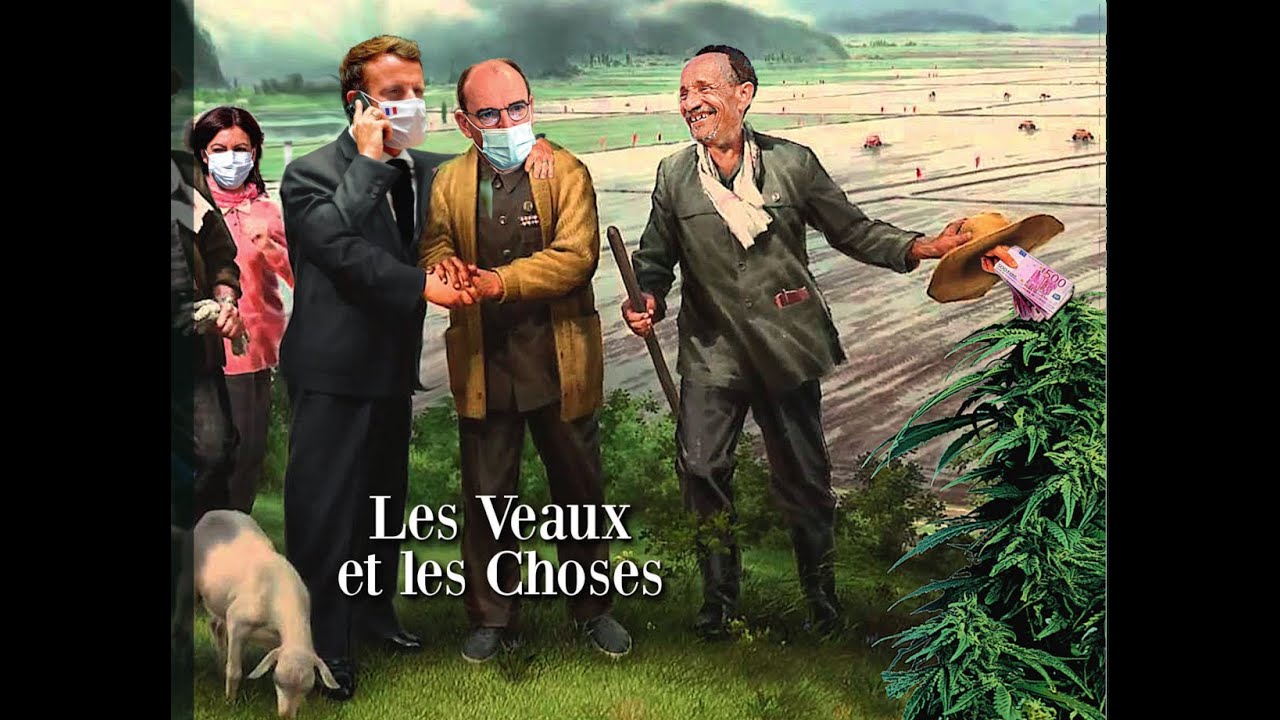
Ecology, resilience, and "green Khmers" 2:25 A gray eminence, right? We've been waiting a long time for Dominique to give birth to the volume in question today, Les Veaux et les Choses [The Calves and the Things], which is a book—the first epithet that comes to mind to introduce it, and it's not what I say in my written preface, but well, oral and written genres are distinct. You buy the book.
2:56 Yes, absolutely. So, in order not to give away the text, the first word that comes to mind is the word courageous. Several times over. First, when you see the... I'm not going to recite ecologist violence. The violence exerted by the almost single-minded thinking of ecologist ideology.
3:30 The terrorism it exercises. Even if this violence takes forms. Yes, yes, yes, sometimes, right? You know, it started with flowers on shirts. It's... Don't make war, make love. In the richest countries in the world, California, the Scandinavian countries, that's where ecology started. Those aren't coincidences. At the moment when the real contestation—the one carried out with Soviet SAM-6 and SAM-7 missiles sent by the Vietnamese against American planes—at the moment when real resistance was raging, we had the first stirrings of resilience.
4:14 And yes, the vocabulary has changed since then. Resistance sounds... too red. So it's a courageous book because we underestimate... Yes, I reiterate the violence of this ideology. I'm in the Indochinese peninsula, with my Vietnamese reference. I'll stay there to slide a bit further south, to Cambodia. It's still the biggest genocide of the postwar period, along with Rwanda a bit later.
4:50 And on top of that, it serves as a banner—since a film you all know, The Killing Fields, I believe it was called—as a banner of the anticommunism of the time. It hasn't calmed down these days, but now capitalism has other fish to fry besides anticommunism. There's fire at the gates anyway. But at the time, it was unleashed. It was the era of the New Philosophers. As if it had been communism that was in power in Phnom Penh during those years, or the Khmer Greens, as I call them, were in Phnom Penh.
5:33 At the time of Democratic Kampuchea, as it was called. I remind you that all the Atlanticist countries, all the countries of the Atlantic Alliance, precisely, voted at the UN for years in favor of the Democratic Kampuchea regime. When you thought they were communists. That is, NATO—the war machine built to fight, and not only with words, against communism—always saved the government of Democratic Kampuchea in exile in Thailand.
6:07 You know, when the pro-Soviet Vietnamese delivered the country and the world from that horror, they [the Khmer Rouge] took refuge not far away, on the Thai border. I remind you of all this, for the younger ones anyway. I'm announcing ahead of time that I'm going to do this year's workshop on anamnesis and amnesia. That's why I try to recall certain elements. Now, what was the first, almost emblematic act—I'm speaking like journalists—symbolic act, of the Khmer Rouge in power?
6:39 The very first one! In the first days, the first nights, yes, it was to empty Phnom Penh, to empty the city and send everyone to the countryside. That's why I call them Khmer Greens. I'm not inventing anything! When I talk about the violence of this ideology, you tell me, yes, but wait, you're making amalgamations, connections, that's a bit of a stretch, that's 15,000 kilometers away. No, but... The leaders of the Khmer Rouge studied in Paris.
7:10 It was in Paris that they learned anticommunism, anti-Sovietism. I'm saying this under your scrutiny, you can check, you should never just take my word for it. These are things too important to leave only to the spoken word. So, it's a courageous book because this ideology has multiple benefits. And so that you don't think I'm a rabid anti-environmentalist, that I don't lie down under cars breathing in their exhaust pipe, their exhaust fumes with delight, let me lay out my point of view on the question very quickly to show just how courageous the book is, once the problem is posed in the way I'm going to describe it, in three parts.
Science, then the symbolic order: pollution, mother nature 7:59 For me, to speak seriously now, not polemically but seriously, about ecology—I no longer say ecology, but about problems related to our environment, I include myself in this—must be approached on three levels. The first, scientific. What is really happening? Regarding warming, the share of man's role in this warming—that's not my area, I can't dwell on it, but one must be serious about science. Now everyone improvises as a scientist, starting with Greta Thunberg.
8:31 Listen to the scientists, listen to science—what does she know about it? How can she assess it? Well, I'm lucky enough to have some very brilliant young comrades at the scientific level, some of whom are here, and I try to pump them a little for whatever I can understand of it, but one has to be modest, I mean. First, there's a scientific approach. There's an antithesis, I mean, the opposite approach—not one that contradicts the scientific approach, but one that the scientific approach never addresses because that's simply not its function.
9:12 It's about speaking of ecologist discourse, this time, in terms of the symbolic field, the symbolic order. Well, one has to speak the way people do at Lacan's, or elsewhere, but also just as much at Marx's. In what way does ecological discourse most often express, unbeknownst to itself, fantasies as old as the world. In other words, that the so-called new struggles, as they've been called since '68, when talking about ecology, about bourgeois feminism. And the other, I'm directly involved, especially having lived in the Third World, and women need the other.
9:47 And not to mention Corsica? I was talking about the Third World—my God, that's recorded, I'm going to have problems with my compatriots again. You'll explain that to Marlène, won't you? I'll say it quickly, yes, I'm fine. Nietzsche—Nietzsche writes to Peter Gast, he's in Nice, as often in winter, and he says we should go to Corsica. Already, we should go to Corsica. I sense—and my genius is in my nostrils, I quote word for word, which isn't false by the way, he has a nose for it—that between Nice and Corsica the African sphere begins.
10:21 Bravo for the Third World. And then he adds—what a fool anyway—he adds, we should go to Corte, because according to my calculations, that's where Napoleon was conceived. Nietzsche's fascination with Bonaparte's sperm, that's... that's science. There's already pollution in the air. Yes. All right, back to the subject. When I was the age of my young listeners, the word pollution didn't appear, wasn't used—Dominique is between the two generations, but he must remember it a little.
10:54 You mean nocturnal pollutions? Exactly. Whether for polluted waters in fountains sometimes, or for nocturnal pollutions. Nocturnal pollutions. Doctors would ask, with laborious circumlocutions, have you had nocturnal pollutions? Well. That dates back to the era of the Church Fathers. But of course. It's very old, nocturnal pollutions. No. For those who doubt it, you'll find traces of it in patristic works. I'm so right that in the Confessions—I can't recommend enough that you read it.
11:26 I'm a perverse Marxist. In Saint Augustine's Confessions, which is one of my bedside books, you actually find a Saint Augustine sometimes in despair, saying, my God, why are you doing this to me? I've renounced the flesh and everything, and I wake up and I've been dreaming and my linens are soiled. Terrible. In his sleep, poor man, poor God. There you go. That's what the word pollution meant. You can clearly see it has an origin. We're not in scientific language here. It's not X equals F2. No.
11:56 Pollutions—there are metaphors, there are images, there are words that come into everyday language from agriculture, others from butchery, charcuterie, I don't know. This one comes from a strange domain, from the libido, basically. And so there's the symbolic order. Even those who try—I'm thinking of comrades from the PRCF, for whom I often feel friendship, at least for the members, for the militants.
12:32 Gastaud recently wrote a very interesting piece where he defines an ecology—and I could sign off on four-fifths of what he said—except that he's surprised there are Marxists, I won't name names, but I pricked up my ears a bit, who criticize ecologism. Really? Yes, but a very intelligent article. I note that even the leaders of the PRCF never put on trial...
13:04 And yet there is material, the presence of the symbolic order in the fantasy-content, in what must be called ecological fantasy. After all, Mother Nature, that's all we hear. Already, Mother Nature—you see, that's not an innocent expression. Mama, Gaia, etc. We need to put an end to this sort of thing. We're in the clinic here, not in science. I recall that among the many examples Freud gives in the...
13:36 Deutung... Deutung. In the... Traume... What's it called? The Interpretation of Dreams. The Traumdeutung, sorry. I recall that Freud, at one point, talks about one of his patients—analysand, analysand, I never engage in verbal terrorism, call it what you like. One of his patients who tells him, I had a relapse, I had a palpitation attack—I was calmly digging my field at home under scorching heat and suddenly I had an attack of anxiety and palpitations.
14:11 Freud says, you don't say—you're digging into your mother's breast under your father's watchful eye. Because the sun centralizes—you see, we're in the symbolic order. The sun centralizes the sky, unlike the stars which are multiple; the sun centralizes, it has something of a dictator about it, paternal, a terrible father. We're in the symbolic order here. I don't mean to say it doesn't exist.
14:41 Far from it, it's terribly concrete, but we're no longer in the knowledge of things, of objects, we're in the knowledge of the subject, in the logic of the subject. This isn't the domain of the so-called hard sciences, but it's a domain completely unnoticed by nine-tenths, or more, of ecological discourse, and in any case, by the entirety of the dominant ecological discourse. Apparently Macron is going to hold a gathering soon, you've seen it, with environmental officials, and there, measures are going to be taken.
Degrowth, MEDEF, and democratic planned ecology 15:15 Wonderful measures. For MEDEF [the French employers' federation], it's a blessing, this discourse. There, you see, I'm sliding from the symbolic order to something that carries real weight. A discourse that says we produce too much. You're bastards wallowing in consumption. That's why the earth is warming. I'm borrowing a bit from the little Swedish girl's terms—I don't hold it against her, poor kid. She says her youth was stolen from her, and someone rather well-inspired said, I'm afraid it's rather her maturity that was stolen from her. Greta. Wallowing in consumption.
15:49 MEDEF hears that, and rubs its hands together. It wants to put you out of work. And here we have a discourse that thinks of itself as left-wing, that's validated on the left, and that says we produce too much, we consume too much. But there you go, factories have to close. Factories pollute first, don't they? You see? So, first part: the scientific approach. Second part: the symbolic order. I'll stop there because you can see all it contains. We've barely lifted a corner of the veil. Third, finally, a serious ecology.
16:19 I'm no masochist either. That is, a rational, democratic approach to ecology, which would assume not that we produce too little or too much and that we should shrink or grow, but that it would be up to a democratic assembly to define priorities. Because, in my view—and I believe this is the opinion of nearly everyone here—there are things we produce too much of and others we don't produce enough of. That doesn't mean anything by itself. Those words, too much and not enough, are value judgments.
16:50 May I just—one very brief point. The first major decision in this direction of a reasoned, reasonable ecology on Macron's part... The appearance of your book. No. He's just appointed—renamed—a new High Commissioner for Planning. Bayrou. Yes. The Commissioner for... Planning. There you go. It's renamed. There's no longer any planned economy at all, but we have a planning commissioner. So there you go. We're heading toward what's ordinarily called a reasoned, reasonable, and democratic ecology.
17:21 Absolutely. And so planning, which apparently is no longer anything totalitarian at all. Yes. But here we reach the obscene. We reach the obscene because I've just brought back into fashion an accursed Bolshevik term. Stalinist—the plan. There you go. The planned economy—where are we headed? You see? But in fact, there could be a serious ecology there. I would take part. I would participate in the action. But first we have to develop everything that remains unformulated in the dominant ecological discourse.
17:52 And that's the subject of Les Veaux et les Choses, which should really be called Answers to Pauline, subtitled Essay on Ecology. In terms of page count, the Answers to Pauline take up a great deal of space. There's a long section of answers to Pauline and to a few others... Yes, no. It's a tribute to the young men and women who challenge us and allow us to refine our thinking. Well, there you go.
18:22 Starting from there, I presume you have things to present about your book. I simply wanted to show that this book intervenes precisely in the second major part of my tripartite division. You see, that is, it denounces everything that is the unformulated truth of the dominant ecological discourse. And I'm sure Dominique wouldn't oppose the founding of a rational, democratic ecological collective that would define priorities—priorities that wouldn't correspond, as those of degrowth do, to those of MEDEF.
The author: defining ecology, Marx was not an ecologist 19:07 There you go. So, no, I certainly don't demonize—I certainly don't participate in that kind of thing. But nevertheless, and I explain why in the book. So read the book, you'll see, it's argued at length. So, thank you, Dominique. So actually, what I could say is in the book, to present the book. So it's about encouraging people to read it. So I'll rather hand the floor to those who want to take it, actually, whether they've read it or have already been concerned with the questions we've been discussing for a long time.
19:47 I just wanted to say, as I mention at the start of the book, that originally there was a text called Already, the Calves and the Things, which I wrote at the publisher's request in 2015, at the time of COP21, and which was meant to do two things. First, to say what not even the ecologists I knew—and I knew quite a few, since almost everyone is an ecologist these days and has been for some time—in any case, those who claimed to be left-wing, and there are still many of them, and even especially those who claim to be Marxists, of whom there are still a few, could tell me, on the one hand, what ecology actually is, since they were unable to tell me what it was, to give me a definition of it.
20:31 So I tried to take on this task, and the second motivation was to explain, to refute the perfectly absurd theses—which rest on absolutely nothing from a theoretical standpoint or from the Marxist corpus—according to which Marx would have been the first ecologist. So that's one of the main axes of the book, or rather of the first part of the text, which consists of saying, from a dialectical point of view, what exactly we're talking about, what we're going to develop with all its contradictions as good Marxists and good dialectical materialists—what is ecology, and up to now no one, including ecologists, has refuted the description I've given of it, a fairly methodical one, and I mean absolutely not in the mode of reproach or value judgment—I describe what it is, and in the second part, I therefore deploy, I develop, the whole set of contradictions. That was the object of the book, independent of the fact—that's why I was a bit surprised that Gastaud,
21:41 who I believe still calls himself a Marxist, last I heard—Gastaud, yes—could be surprised that one could criticize the ideology which, and this is the third object of the book, became the object of the book over time, which explains why it grew—and I'll be quite honest with you, Bachelard said to be precise is to commit oneself, so I'll be more precise—no, he says very clearly, and on this point I don't think he's wrong, that too often, including in left-wing circles, including Marxist ones, the entire ecological discourse is treated as a bunch of backward, reactionary bourgeois-bohemians. That's it, I mean, he criticizes this reductionism, implying that there could be an intelligent discourse about the environment.
22:28 Yes, I still haven't personally heard it, nor have I—that's exactly what I meant to say earlier. So it could exist, yes, but then, at that point, it will have to emerge, and one of the good ways—it's one of the purposes of the book—is that it could precisely, in reaction to our book, since many of you, including you, took part in it in one way or another, we're posing the thesis to them, inviting them to propose an antithesis to us, to demonstrate to us that no, an ecology corresponding to what you just described, and which seems to be Gastaud's pious wish, can exist.
Dominant ideology and the ecological paradigm 23:06 The problem is that, up to now, it's about as common as the sardine that blocks the port of Marseille [i.e., practically nonexistent, per the old Provençal joke]. The possible is not the real. There you go. So the third part consists of showing that, fundamentally, the phenomenon that has really manifested itself clearly and massively since 2015, that is, since COP21, is that this ideology—because in the book, among other things, I explain that it's simply an ideology in Marx's sense, and all this is made clear with quotations from Marx in the work—that this ideology is simply the emerged part, the most visible part, the common denominator of the dominant ideology, the dominant ideology being the ideology of the bourgeoisie—but here it's a matter of the ideology by which the bourgeoisie ensures its domination over the middle classes, who therefore do not have the bourgeoisie's own ideology.
24:05 The bourgeoisie has no need at all of an ideology to be convinced to defend its own interests. On the other hand, it absolutely needs a way, to use Marx's terms, by which individuals of the middle class—since it is, for now at least in our countries, demographically and electorally the most significant group, incidentally also economically—by which they become aware of what constitutes the social conflict, in other words the class struggle—here I'm quoting Marx's precise terms—and carry the fight through to the end.
24:43 That is to say, ideology is going to allow all these middle strata to position themselves in the class struggle and to know which interests they are going to serve and how. And the absolutely predominant element, now massive, since virtually the entire political class—essentially a political class made up of middle strata and middle classes, one would struggle to find the working classes, let alone proletarians, represented today, not only in the National Assembly, but in the political class in general—well, the way in which they must wage the struggle, which struggles they must wage, in the service of which interests and with what type of representation, that is the function of ideology.
25:27 And there, there is what I call, what I designate by the term paradigm—it's explained at length in the book too—one of the words, one of the portmanteau words that have emerged in recent decades: really the massive paradigm shared by all of them is that they are all environmentalists. Now, they are so in very, very divergent, very different ways, and this isn't about saying they're fools or passing a value judgment, but it's simply an approach, an observation, from an ideological point of view: the massive ideology they all claim, absolutely all of them—it was particularly striking during the last elections—I mean, all those who stand for political office, at whatever stage, at whatever level of the representative apparatus or the state apparatus, well, they all claim to be, more or less, environmentalists, even if with variations, since it has even become a mode of division today, one that has moreover replaced the old social divide.
26:32 So there, that's about everything I can say to extend your preface, and now I hope that maybe some of you have things to say, objections, questions, comments. I have other things to specify. Go ahead. I'd prefer to do it in response to the questions that are going to be asked. All right, well, there's someone ready already—you'd need to come closer if you can, but anyway, we hope the microphone will work well.
A participant presents the structure of the book 27:02 Go ahead, the microphone works well enough. Yes, that's fine. No, no, no, please. So it happens that I did indeed read the book, and just a little piece of advice, since I tried it myself: I read it straight through, and it's very interesting because it's structured—I'm talking about the form, we'll talk about the content later—it's structured in such a way, I read it over an extended weekend with interruptions of course, it's structured with extremely short chapters and with, in addition, key words in italics, a number of quotations from Marx that are extremely well integrated into the text's argument and that actually broaden it. And the advantage is that questions you might have about one chapter get answered two or three chapters later.
27:49 So, a kind of feedback, if you will—excuse the term, but I used it—of understanding at the level of the whole. So the fact of reading it straight through means you don't forget what was said earlier. So I wanted to note that Les Veaux et les Choses is structured, structured in two parts. The large section is the irreligious critique, which is actually the metaphor built around the opium of the people, the opium of the people, as Dominique Pagani puts it.
28:19 Irreligious critique, and then afterward we move into a secular critique. And then afterward there are long developments that branch off, following the method that, in the foreword, Dominique specifies—the dialectical method—of first positing the phenomenal object, then afterward criticizing all the, I would say, negative analyses and the contradictions one can draw from them. And then afterward there is also a long section that sheds a lot of light, in the responses to Pauline, which are extremely well structured, and the responses to Pierre.
28:54 You thought it was Pierre, but it's not the same one. It's a different Pierre. He's here. He's arrived. And these are extremely interesting. So, what I simply wanted to say, in the irreligious critique section, it's very well introduced by Dominique Pagani, who—I'm just quoting a sentence from his preface—when he talks about the opium of the people, has a sentence that, in fact, well, it reminds me of people I knew in my youth: you really have to have never been in contact with the victims of addiction to alkaloids, opium then morphine, heroin, to find yourself so completely at odds with this formula, endlessly repeated in a reductive and offhand way.
29:40 That is to say, when we talk about the opium of the people, or opium, it becomes the opium of the strata, the middle—sorry, the middle strata, excuse me, I don't use "middle stratum" lightly, it's serious. And it's serious. And so there is indeed—I won't go into detail—but there is a build-up, after Dominique's foreword, which is in fact a build-up of various concepts that are put forward, and so on. And for me, the peak is in the chapter called Nature, Culture, Politics and Religion.
30:14 I'll read you a sentence that, in my opinion, sums it all up. I noted it down, you see, this, and then I found it again, wonderful. It is in this sense that man is the principle of activity in the face of natural passivity. Man's environment is not nature, it is his social relation to nature, determined as social by the modes of production of his environment and the generic relations that this induces. There, we have the, there, the climax, so to speak, the peak, and then afterward he draws from that and comes back down to the secular critiques, and so on.
30:50 and at a certain point—I won't go into detail because you need to read the book, you need to read the book first—but it's extremely well argued and we get to the heart of the matter. Mother Earth, Gaia, what is this thing? And we're not, as you said earlier, we're not even in science, we're in animism, we're not even in some religious thing from the wisdom religions of the Far East, or the transcendental religions of our cultural sphere.
31:27 No, we're in animism, in shamanism, in the predation of nature. There is no nature in itself, there is a humanized nature, and that, they haven't understood. And afterward, we derive all the consequences of the secular critique, so political, of what it involves, which is introduced by the political—I'm pronouncing it badly, sorry—politikon zoon, I never studied Greek, sorry.
A crisis of halted circulation, not of overproduction 31:59 And, and so, and at a certain point we have something that was updated afterward, which I found perfect, an opportunistic infection of capitalism, but well introduced, not the way I'm doing it, but introduced within the argument. Yes, just an aside, I forgot to mention that there are elements of political economy in the book, indeed, which are developed, including regarding the current crisis, absolutely, and especially the theses of the degrowth advocates.
32:30 Absolutely. I bring up simply the fact that a Marxist analysis of the current crisis, I mean the economic crisis, obviously shows that we are not at all in a crisis of overproduction—quite the contrary, we are in a crisis of a deliberately chosen halt in circulation. That is, we are truly in what—I explain this in the book, so I won't elaborate—in exactly what the degrowth advocates call chosen degrowth.
33:01 That is, it's not at all for economic reasons, factual reasons, of material necessity that there's this crisis, it's because, for political reasons, and on an absolutely globalized scale—imperialism, the final stage, from that point of view, was not the final stage after all, since we're pointing out, and here it's a quote from Dominique Pagani, that the final stage of liberalism would rather be environmentalism, well, so, in this final phase, so, in this globalized perspective, we have a crisis of a new kind, which is not at all a crisis of overproduction and a lack of outlets in relation to that overproduction, it's quite the opposite, we have a total halt of circulation, and since circulation—as good Marxists we recall—simple circulation is production-circulation, and on top of that is triggered the second movement of circulation, which is the circulation of capital, starting from realization—so there, the whole process is interrupted, the whole contradictory process, by political decision,
34:11 ideological decision, at the stage of circulation, and we've seen the results, we've already, empirically, observably, seen the consequences of what the degrowth advocates, by choice, call for by their own wish. And you're right to have made this reminder, firstly, because, as Dominique just recalled, I'm making explicit here what was implicit in what he said, in what he summarized, in Marx it's very clear on this: there isn't production, then, of a commodity, then, its circulation—in Marx, circulation is continued production.
34:50 If you look closely, circulation, in Marx, is still a moment of production. A truck driver who transports a commodity to the other end of France is carrying out production. It's a determination, to use Marx's pure logic. Well, it's not immaterial, circulation. Now, it is so true that it's not a crisis of overproduction, but a crisis of circulation, that this morning—you're going to tell me I'm truly the most perverse of Marxists—because I'm going to quote Saint Augustine, and now, I'm going to quote BFM Business. That's worse.
35:20 This morning, I recommend you listen, in replay, to the show called Les Experts, every day at 9 a.m. You see, I'm addicted. There's a show on BFM Business where the great experts of capitalist economics gather. It's worth its weight in gold, but I recommend it because it's confined, no pun intended. I mean, it's not the audience of BFM in general, of BFM TV. So people can say true things there because nobody's listening apart from those who've saved money and want to know what's happening to their capital, all that.
35:53 There, they say things. You see, it's only on this kind of channel, to finish my little aside, that you can learn that such-and-such an Estonian bank is on the verge of bankruptcy or things like that. There are truths of capital. This morning, one of them was saying exactly what Dominique just said. That is to say, we remind you—an expert, we, us. And yet we hadn't coordinated with BFM Business. That's why I'm delighted to point it out. So, listen to the replay of today's show, 9 a.m., Les Experts, where Jean-Pierre Petit tells the other experts, I remind you, but you all know it, that capital has been on an investment strike for 25 years.
Leftism in the service of the Atlantic Alliance 36:33 Right? So, it's not a crisis of overproduction, it's the opposite. Do you understand now why the environmentalists are degrowth advocates? Because capital itself is shrinking. Its material production is shrinking. It prefers finance, you see, over industry. I'll take the opportunity to say that often, the anti-environmentalist discourse from the left, which Dominique rightly demolishes, because everything that's wrong in our society—here I get a bit more solemn, but I owe this to Clouscard—dresses itself in the colors of the left while actually being to the right of what Gaullism used to be, for example.
37:08 I mean that what's called leftism isn't a defamatory label for me, it's very precise: the union, in the mathematical sense, the union of three subsets, in chronological order, so as not to upset anyone: the anarchists, and the oldest, the Trotskyists and the Maoists, for example. Right? I'm not talking about the Long March, I'm talking about the Maoists of Paris. Let's be serious, let's be serious.
37:38 And so, those people considered themselves to the left of the Communist Party, that was their common point. They judged the Communist Party to be bourgeois, metro-boulot-dodo, how can you care about pensions and wages? As Mussolini said, the true revolution is the bomb in one hand and the flower in the mouth. Sounds like something Cohn-Bendit would say. Mussolini. '37. And so this leftist component was in fact playing into the hands of the Atlantic alliance, which wanted to get rid of both De Gaulle on the right and the communists on the left, that is, the only two forces opposing its planetary domination as it has been exercised since.
38:20 And the operation succeeded quite well on that front. And so that's why I'm a bit solemn when I say that Dominique is courageous in demolishing especially those Marxists who call themselves environmentalists, eco-Marxists. Rather the environmentalists who claim to be Marxists. Absolutely. Even if among them, wait, they're not all the same, there are clowns, but there are also serious people. I'm thinking of Ariès, for example, who is a serious guy. Right? Now, Ariès, I met him at the Tropiques bookshop, you see.
Exploitation or environment: the question put to Ariès 38:51 In person, I mean. And I had asked him a question to which I've had no answer to this day, whereas everything else, the whole presentation, was excellent. You know what he answered me? No. I asked him the question, I even had an exchange about it. So, let me briefly restate the question and its context. At the end of the presentation of his book, someone asks him, but what you've told us is flawless, you've spared us from reading all the nonsense produced by the so-called—the whole system of haphazard correlation, starting from the fact, one of the things I discuss in the book, moreover, that they spend their time making measurements and comparisons between things that are totally incommensurable.
39:31 and, well, as for the details on commensurability... That is, strictly speaking, you can't measure it, right? No, you can't, they have no way of being measured and compared with one another because they have no common measure. And that's the essence of scientism and the pseudo-positivism of environmentalism in its pseudo-scientific version. So he's told, that's all very good, but what are you tacking on then, when you're demonstrating the opposite, the idea at the end, which is no small thing, that the future is ecology.
40:03 So, he's so... So he doesn't answer anything, you can check by watching the video. He answers nothing at all. So, after that, he told me, I was so... he explained to me. In fact he was speechless because he was so stunned that anyone would dare say that to him that words failed him. Well now, we have the words and the things [Les Mots et les Choses / Les Veaux et les Choses pun]. He might be able to formalize, articulate, find the rhetoric that will allow him to answer. That justifies the epithet "courageous" that I'll allow myself to apply to your book.
40:33 I should specify though that I had asked Ariès this question. I had said, what does the term ecology add to the rest of your analysis? For me, it's mainly that. Let me take a very specific example, the miners' disease, silicosis, for those who remember. Silicosis, terrible, I mean, silica particles in the lungs, that's it. It's Zola-esque, there you go. Even in the coal mines and so on, silicosis, there you go. And there were struggles, there were terrible struggles.
41:07 It ended up disappearing because there came protections, masks. I say, at the time, we didn't talk about ecology when we talked about those struggles. Today, it would be classified as ecology. No, we said, it's the struggle against exploitation. So, Ariès might answer me, yes, but you don't see, you're splitting hairs, or as the French would say, screwing flies if you prefer plain speaking. Never mind. No, it does matter, because look at the semantics. When you say, when you attack exploitation, when you denounce exploitation, it's man who is at the center of the debate.
41:39 So, when you say it's an assault on the environment, suddenly it's nature and the planet at the center. Which, mind you, will still be there when we're all dead a billion years from now, it'll still be there, it doesn't fear anything. Try to hurt a rock. Just try. A rock, it fears nothing. That's what nature is. Try to hurt a rock. Wait for it to say "ouch." So, let's get back to serious matters and to people who suffer.
42:09 And so, what does it add? As for me, I only see what it subtracts from the political debate. It's more what it conceals. Yes, yes, that's it. That's it. It's what it abstracts from reality, in the sense of subtracting. There you go. Sorry, I don't want to monopolize. Yes. All right. Did you want to add something? I just wanted to add something. In this idea of the opium of the middle strata, there's a dimension that the opium of the people, the religions, didn't have, and that is present in ecology: social contempt.
42:50 Absolutely. And that, I come from Carcassonne, I can tell you, it's starting to be felt. Absolutely. As soon as they open their mouths, we've clearly seen the mayors who showed contempt for both the Tour de France and Christmas trees and a number of other things—as soon as they open their mouths, it oozes the social contempt of this middle stratum that's afraid of seeing its future disappear. And that, in my opinion, is a very new dimension compared to the opium of the people, which was, after all, the protest and dignity of the suffering creature.
43:26 Thank you.