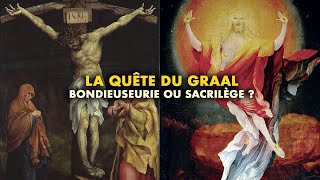
 Season 12 · 1 Apr 2024The quest for the Grail, sanctimony or sacrilege?
- 30:50At the end of the Platonic ascent, there is no more logos: the good is beyond discourse, and the sun offers itself only to a somewhat passive theoria.
Worked through in 5 videos · 7 passages.
Dominique Pagani understands contemplation first of all through Platonic theoria. He describes it as a vision, a relation meant to be immediate, without mediation, and as the silence earned at the end of the journey1. He places it beyond discourse and, on this occasion, recalls the original meaning of the words "theory" and "intuition"2. At the end of the ascent there is no more logos: the good escapes discourse, and the sun offers itself only to a somewhat passive theoria3. He specifies that it is not a cold vision: since the good gives growth and nourishment, theoria is akin to suckling4. He also approaches the contemplation of nature from a historical angle. In his view, nature becomes an object of contemplation, and then of worship, only when it recedes before technology and man becomes a threat to it5. For the African peasant, it is not a spectacle but a terror6. Finally, regarding Mallarmé, he notes that the poet can no longer contemplate the horizon without stepping over the workers7.
Summary produced automatically from 7 of the passages below, to be reviewed; the numbers link to the moment in the session.
Season 12 · 1 Apr 2024The quest for the Grail, sanctimony or sacrilege? Series · 31 Jan 2023Mallarmé, or class struggle on the lawn - Readings on the Spot
 Season 5.2 · 26 May 2019#5.7 Nature or Landscape?
 Season 3 · 1 Aug 2017#3.5 From Ulysses to Daedalus
 Season 1 · 28 Jan 2016#1.8 Between crisis and war: Philosophising?