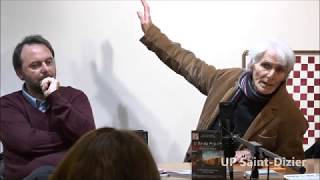
Dominique Pagani places Prokofiev among the Russian composers whose masterpieces became known in Paris. He regards him as the greatest Soviet musician, one of whose cantatas expresses the immensity of Russian suffering1. He returns several times to Peter and the Wolf, an example of a Russian genius that knows how to speak to childhood and is tied to the rural tradition of the folk tale2. He sees the "Classical" Symphony as a work written the way Haydn would write it today3. He also takes up Prokofiev's remark that one can still make beautiful music in C major. By contrast, he describes the Scythian Suite as aggressively dissonant and barbaric4. He situates Prokofiev through comparison: at moments one can mistake him for Ravel or Poulenc, he is close to Roussel in certain motoric aspects, but one does not mistake him for Schumann. He discusses a 1944 work in which Slavic lyricism is hampered by a metallic world, before a finale that is a cavalcade across the steppe5. Finally, he compares Prokofiev's collaboration with Eisenstein to that of Molière and Lully6.
Summary produced automatically from 24 of the passages below, to be reviewed; the numbers link to the moment in the session.
Who is this?
Sergei Sergeyevich Prokofiev (27 April [O.S. 15 April] 1891 – 5 March 1953) was a Russian composer, pianist, and conductor who later worked in the Soviet Union. As the creator of acknowledged masterpieces across numerous music genres, he is regarded as one of the major composers of the 20th century. His works include such widely heard pieces as the March from The Love for Three Oranges, the suite Lieutenant Kijé, the ballet Romeo and Juliet—from which "Dance of the Knights" is taken—and Peter and the Wolf. […]

 Season 10 · 27 Jan 2022#8 Philosophising under threat