English translation of the French transcript, made with AI and not yet proofread — click a paragraph to jump to it. Show the French original
Mondanité, a contribution proper to Clouscard; announcements 5:04 Good evening everyone, delighted to be back with you, more and more delighted, especially since it's the beginning of September. In August it was cold in the last days of August, and in September it's getting hot again. We can't make sense of it anymore, they tell us all sorts of nonsense. Well, let's be serious, we'll have other occasions to talk about the climate.
5:35 But tonight we're picking up this series which, as I told you, needs a certain length of time, given what's at stake in the inexhaustible echoes of the concept of worldliness in Clouscard, which, I repeat, sorry for those who've already heard it 36 times, isn't—I'm not saying it's the most important notion, nor the one that appears most often under his pen, but it's the one that belongs to him properly, it's his specific contribution.
6:20 Obviously, because when he talks about productive forces, relations of production, praxis—well, he didn't invent those, of course, they're the fundamental concepts, but they're not specifically and properly Clouscardian, they're Marxian. But he introduced this concept of worldliness as constitutive of our consciousness, of our unconsciousness, of the structures of what Marx calls ideology in us—that is, I recall Marx's formula, I'm not jumping abruptly into the subject, I have some preliminaries to go through first, but just to give a bit of context, and also for those kind enough to join our regular habits, Marx says that superstructures—one shouldn't think that superstructures in Marx are something one can set aside, that it's the realm of nonsense, of the illusory, of representation, whatever you like, it's often linked to illusion, if not to the illusory, but that doesn't mean
7:32 that it's unimportant, because Marx says that these forms—he calls them forms, the content being the infrastructure—but the forms under which men become conscious of this conflict—of which conflict? Of the conflict between the productive forces and the relations of production. That's ideology. Because if we content ourselves with saying, I'm going back down—no, actually going back up in time, sorry—from Clouscard to Marx, to recall the essentials of what he shares with him, if we content ourselves with saying, look, down below there's the infrastructure, up above the superstructures, down below is the essential thing, up above is nonsense—it's not only that this is quick, abstract and reductive, it's that it contradicts what Marx says, because in that famous passage where Marx develops these two concepts of infrastructure and superstructure, he goes to a new line after giving the standard version that I'm in the process
8:43 of warning you against, if we stick only to it—if we reread the text at that paragraph, full stop, new line: at a certain level of their development, the productive forces—I'm quoting word for word here, quoting his French translator—the productive forces come into contradiction with the relations of production within which they had moved until then. There's a temporal dimension, precisely a gap; it's not that one is the reflection of the other—me and my reflection in the mirror, that's simultaneous, but that's not the case here, it's not that kind of reflection, you see, we're talking about Marx, let alone Lenin—first of all the reflection is inverted, which already, mind you, presupposes something other than mere mechanics, but above all, there's this gap: not only do superstructures not express the infrastructure, superstructures take longer to change than infrastructures.
9:50 than the infrastructure. And so there's always a gap, and it's into this gap that the importance of worldliness, in the Clouscardian sense, infiltrates itself. So I'll come back to that, in case some of you find that I was a bit elliptical and unclear—don't worry, we'll get right back to it, but I have a few preliminaries to deal with, in no particular order.
10:22 First I'd like to thank Pierre-Alain, who's always out and about, all over the five continents, for having agreed to come to Cachan tonight so we can have this direct exchange between us. It's always more humanly and more interestingly done, even if technically more demanding, than a pre-recorded session. Besides, I should mention, this has nothing to do with tonight's program, but Pierre-Alain has just made a very beautiful—I call it a clip because I don't really know the terminology, but you'll see—a video that will be available tomorrow on YouTube, staging, directing, a magnificent song by Björk.
11:24 So, don't miss paying attention to the release of this clip tomorrow, titled "Victimhood," like Robin Hood, H-O-O-D. Also, for those of you in Paris or planning to come to Paris these days, there's a magnificent exhibition by one of our faithful followers—I'm not returning a favor here in some formal way, it's just that I was…
12:00 if I were listening to "African music," I would say I was flashed, I was literally fascinated by the quality of this exhibition titled "The Night of the World." And yes, those among you who are attentive—and I know there are many—know well that this is a quote from Hegel, in that incredible early text, one of the first Philosophies of Spirit, hard to find, but well, it was published by PUF, Presses Universitaires de France, the 1805 one, mind you, and in which Hegel talks about what happens when you look a man in the eyes, he speaks of negativity.
12:51 It's this night—because it's a text where the word "night" recurs obsessively six or seven times in a single paragraph—it's this night that we discover when we look a man in the eyes, a night that reveals to us a dreadful world. It is the night of the world that advances here to meet each one. End of quote. So, this exhibition shows only portraits, precisely of gazes, of eyes, made by Julien on copper—they're paintings, not engravings, paintings on copper.
13:28 So, I won't say more, because I can't talk about the visual arts the way I can about music, at a technical level. I'll leave you to it, and I hope you'll feel the same shock I felt in front of this incredible gallery of portraits. There, I'll leave the details on our Facebook page—it's called "The Night of the World" and it's happening in the third arrondissement, right near Beaubourg, at Galerie Art Concept.
14:06 There, impasse, impasse—what's it called? Sainte, Sainte-Avoie, Sainte-Avoie, A-V-O-Y-E, Impasse Sainte-Avoie, third arrondissement. So there. Now I'll turn to another subject. The subject seeming abstract as it does, the world, the abstraction from many details and many particularities in order to take up this globalizing, holistic notion, as others would say—which isn't quite my approach.
From the object of desire to the subject of desire; which modernity? 14:49 But to avoid the danger of falling into what Hegel dismissively, always pejoratively, calls the abstract universal, I take care to embody it in a series of texts that we're going to look at together. And I'd first like to illustrate tonight's problem, tonight's particular variant. My title may seem a bit strange.
15:21 It's made up of a double question. Desire of what and by whom? In other words, who desires what, if you prefer. In philosophical terms, we're going to reflect on what the object of desire is. Now you understand that the world isn't the Earth, it's the relations between subjects and among subjects. You can well imagine, I don't need to spell it out, that the notion of desire isn't at all peripheral, that it plays a central role.
15:51 So, what moves us? What is at the bottom of every human desire? The question may seem ambitious—in other words, what is the Object, with a capital O, of Desire, with a capital D? We're going to raise the question—I'm giving you the plan in advance—and we'll see, throughout tonight's session, that this question about the object of desire will lead us to ask the real question, because we never start with the real question. For example, Marx: mystification doesn't come from the answers, but from the way of asking the questions.
16:26 It doesn't come from the solutions, but from the way of posing the problem. So at the outset, one must first be spontaneous—we ask ourselves, what is it? Is it money, is it health, is it love, is it… You see, there's plenty to choose from. And not only among philosophers—people discuss it at the corner café too, it happens. Or among friends. And the question is going to shift until it formulates the real question hidden by the first one, namely, what is the object of desire?
16:59 What is the subject of desire? Whom does it desire? And perhaps even what? There isn't only someone within us. If I have… It's the same for you, for all of us—if I need to eat to live, if hunger catches up with me repeatedly, that's a process, that's something.
17:29 That's not what makes us recognize someone—it's not just an earthworm either, which also needs to feed itself. We don't say that's someone. You see? So, from what is the object of desire? we're going to move toward what is the subject of desire? But I wouldn't want to do this arbitrarily. I'd like first to remind you that I've been talking for quite a while now about what I call "our modernity," stressing the word "our."
17:59 Because… I'm not going to apologize every time for repeating certain things, but please be kind to those who are joining us for the first time, for whom it may not be obvious that—when I speak of modernity, to be honest, I'm not imposing one modernity, I specify which one I'm talking about. Some say that modernity begins—not when we stop hunting and gathering and start agriculture.
18:31 We don't have to go back that far. It depends on what subject we're dealing with. Some say that modern times, for historians, officially, begin at the end of the Middle Ages—their birth is the 16th century. Yes, that's already quite different. Some say it's when writing appears, that prehistory ends and history begins with writing. No, I'm talking about "our" modernity. Yours, mine, the one that took us from the countryside to the city, that produced bourgeois civil society—I recall that "Bürgerliche Gesellschaft"
19:08 as translated by "civil society," is a notion that comes from German historical-political thought. I recall that "Bürger" simply means citizen. "Berliner Bürger" simply means an inhabitant of Berlin. It doesn't mean a bourgeois inhabitant of Berlin. "Bürger" comes from being part of the "Burg," the town. So, one can play on the expression "modern civil society," the one found in cities that came after the Industrial Revolution.
19:39 That's where our modernity begins. I won't repeat it 36 times, with the English Industrial Revolution and the French political revolution. The two together produce the world in which we live. Whether one is still in the revolutionary current or has fought against it, whether there's been a restoration, 36 restorations, undone by 36 returns of the revolution and 36 counter-revolutions—we've already seen that. There will be other occasions to illustrate it. But let me return to this notion of modernity.
20:11 Ours is that one. The one that begins roughly, you see, at the end of the 18th, beginning of the 19th century. Ah yes, that's Hegel's time. Ah yes, that's Hölderlin's time. Some of them were born the same year, weren't they? That miraculous vintage of 1770, which saw the birth of Hegel, Hölderlin, and Beethoven in the same year, one year after the birth of Bonaparte. What matters isn't all that. It's calculated. It's all those who were about twenty years old at the time of the storming of the Bastille.
20:42 It's this modernity I'm talking about. So I'm going to take texts situated precisely at the moment when—when we ask ourselves, "but what is the object of human desire," on which people didn't wait for modernity to reflect. You read Plato's Symposium. That's already quite something. Well. Eros, quite extensive—even if Plato doesn't only speak there of so-called Platonic love.
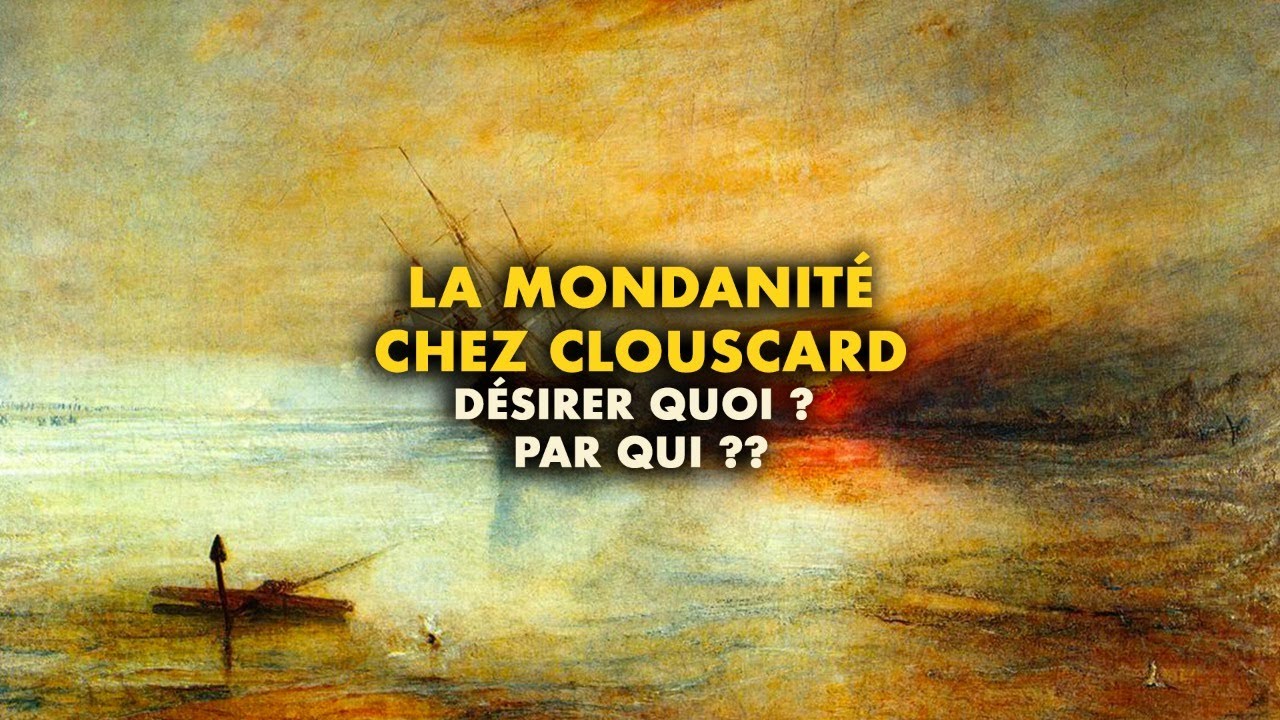
Turner, money, and Faust: an infinite desire 21:16 We mustn't take Plato as the frame of reference for the year. But modern reflection on love begins in this period. And I'm going to start right away with a text that will show you that the object of desire—I'm telling you in advance so it's clear—what will characterize it starting from modernity is its indeterminacy. And even before reading the text, I want to point to the beautiful photo that Pirella kindly kept as the card for tonight's session.
21:56 It's a painting by Turner, who is an exact contemporary—well, from the first third of the 19th century—of this birth of our modernity. I chose it because, from a pictorial, graphic point of view, what's called the object in painting—well no, in painting we call it rather the subject.
22:26 The subject is a bird, a flower, a portrait, a face, a landscape, whatever. In short, the opposite of so-called abstract painting, figurative painting. There's a well-determined figure, the opposite of indeterminate, quite precise, which is, mind you, the subject. What characterizes modernity is precisely the way in which the contours of objects, in the ordinary sense, in the philosophical sense, of "somethings," and pictorially of subjects, the contours become blurred.
23:02 You might say, yes, that's a bit later, that's the end of the 19th century, you're right, that's Impressionism, when contours blur. But all the more credit must go to the immense Turner, who made this incredible painting—British indeed, the painting, at least as regards the theme, if not the subject. Since we see in it, roughly, it seems we can recognize at least a boat—that's the only thing that lets us make out a subject, and even a boat of which not much remains—so it seems that almost everything else, if you remove the boat and the little rowboat, everything else is what would be called, starting from the 20th century, abstract painting.
23:47 That's why I chose this illustration, to illustrate what we now need to talk about, because it's not obvious—because plenty of people will tell me, "but of course, I know very well what I want, what I want is a pay raise, you're quite right, I don't always agree with you." But yes, let me recall my little sequence, so there's no misunderstanding. Pierre says to Paul, "why are you working there right now? Why are you doing your homework?"
24:20 He says, "because I have my exams to pass." "Why do you want to pass your exams?" "Well, to go on to further studies." "Why do you want to study further?" To make money, to get a job, to have… And the money, what's it for? And from there, from there, things start getting confused. Try the experiment. In fact, you know, the game: you win 100 million euros in the lottery tomorrow, what do you do with it? The answer isn't immediate.
24:51 Or if it is immediate, it corrects itself right away. "Oh no, I'd rather…" "I'd buy my mother a house." "Oh no, but that would annoy her." It's complicated. And that's where we see the depth of Hegel when he talks about money. In his first Philosophy of Spirit, he says that money is the indeterminate form of desire. Precisely. That's why it drives us mad. It's that we can't be disappointed yet, with the money still in our pocket, precisely because we haven't done anything with it yet. But there's the potentiality of doing all sorts of things we couldn't do before having it in our pocket.
25:26 I've just drawn a link between this apparent blur—of impeccable rigor—in Turner's painting, and the indeterminacy of external reality; he didn't retain neat, geometrical contours, that's the least one can say. And I'm connecting that with money, the indeterminate form of desire.
26:00 So now that I've clarified a bit better what the object of desire looks like in our modernity, in its indeterminacy, I'll move on to the text—no, not without giving one last preliminary reference, which isn't a text but a reminder, pointing to an extremely famous text, the most famous in German literature, Goethe's Faust. Goethe makes a pact with the devil, that's the pitch, quickly told.
26:34 And the devil, as you know, we always know what he asks for, it's the soul—that's not where the mystery lies—it's the soul of whoever makes the pact with him. He wants to swell his battalions of the damned, and those he snatches away—it's not "the devil and the good Lord," to borrow the title of a Sartre play. And Faust says all right, but on one condition: that you make me feel a pleasure, a happiness, a moment—well, a moment of such intensity, in the positive sense, that I could suspend time—he doesn't put it that way, that's me clarifying for you—suspend time, and here I quote Goethe, that I could say to the instant, "Verweile doch, du bist so schön"—stay, you are so beautiful—that I could freeze time, a moment that becomes an eternity. Try to find an object of your desire, your favorite dish to eat—take, say, a coarse desire, food, though—we're in France, we can refine the coarse, and move from need to desire—and I take your favorite dish, and I make you eat it every day, every day,
27:44 noon and night, you'll end up throwing up eventually—there, some of it won't take long, you see—so don't rush to say, "but of course, I know what I want." There, that was my last reference, and of course I'm making a small allusion to Faust—Goethe's genius was to show that the devil, with all the means at his disposal, is someone who has the means to procure pleasures, that's precisely the devil—and despite all these means, he can't manage to give Faust a moment such that he could say, "stay, you are so beautiful." There. And Faust is there to illustrate, not some exceptional hero, but you and me—it's the infinity of human desire—infinity, finite, finished, infinite, indeterminate—well, that's clear, a bit clearer now. First text I'm borrowing, then, from someone right in the middle of that period, end of the 18th, beginning of the 19th century, but a gentleman,
Reading of Senancour's Oberman: enjoying is not being happy 28:54 who comes after Rousseau, and is a contemporary of Chateaubriand, roughly speaking—we'll see a short excerpt from Chateaubriand a bit later—and if I'm choosing him, it's because he's far from the best known: Senancour. Sainte-Beuve, the literary critic of the first half of the 19th century, said, "Monsieur de Senancour will have a discreet but faithful posterity." So, this excerpt from an epistolary novel—very fashionable at the time, as with Rousseau's La Nouvelle Héloïse, a novel in letters—he writes to a friend throughout the book, and I recommend Obermann to you, it's a text of staggering richness in terms of content—and here, I'm taking a letter, far from the longest, one of the shortest, letter number 18, dated 17 August, Fontainebleau, of Year II, the revolutionary calendar—"O soldiers of Year II"—all right, I'll read the text: "Even here, here at Fontainebleau, even here, I only love the evening,
30:05 dawn pleases me for a moment, I believe I would feel its beauty, but the day that must follow it will be so long. I do have a free stretch of land to roam—he's a gentleman, he doesn't have many material problems—but it isn't wild enough, imposing enough; the low formations, the small, monotonous rocks—the bulk of the novel takes place in Switzerland, by contrast, in Rousseau's country—the vegetation here doesn't generally have that force, that profusion which is necessary to me; one hears no torrent roaring here, in inaccessible depths; this is a land of plains; nothing oppresses me here, nothing satisfies me; I even believe my boredom is increasing. It's because I'm not suffering enough. So am I happier? Not at all. To suffer or to be unhappy, that's not the same thing; to enjoy or to be happy, that's not the same thing either. A good reminder—when I tell you that, several times I've tried
31:15 to use the term happiness while giving it a bit more determination, more definition—as I generally do, reminding you each time—but this applies much more broadly than just to the case of happiness, it's practically true for all concepts that raise problems—so listen carefully: when we want to clarify a concept, we have to do it in relation to what it could be confused with. Again, I won't repeat it a thousand times, but I have a piano in front of me—we'll never confuse a piano and a duvet cover, there's no risk of confusing those—but an African elephant, an Asian elephant, wherever things resemble each other, that's where confusion could occur, that's where we need to bring more precision than usual. So, happiness—often we say happiness, we could say pleasure, enjoyment—and here Senancour helps us: to enjoy or to be happy, that's not the same thing either. Let me remind you, to go quickly—we'll have occasion to come back to this, we already have—that happiness,
32:25 when we really want to clarify it a bit better, must be combined with two determinations inseparable from it. The first is a temporal determination: happiness requires a certain duration, whereas enjoyment can be of infinite intensity but fleeting, evanescent, gone as soon as it appears. "Almost capture, ever gone," as Eric Dolphy said about music.
32:59 First determination of happiness: a certain temporal thickness, something that lasts or that repeats itself, right? Which is why, as I often say, as those who speak of happy periods often write, they often speak of them in the imperfect tense—every evening I would gaze, every morning I would go for a walk—it was the imperfect precisely, because we were taught in class, from primary school onward, that this is the tense to use when we want to express something other than what happened once, in the simple past.
33:35 Or in the past tense ("passé composé"). He took it, I came, I saw, I conquered — that's brief. There you go. So, a temporal dimension, temporal thickness, and a positive relationship to the world. To the world — that's where it connects with our subject. But yes, the world Clouscard is talking about when he evokes modernity is, for example, salvation.
34:05 One might confuse happiness with that. Salvation, the beatitude of saints, or of certain ascetics, or I don't know, Brahmins who live in holiness up in the heights of the Himalayas, why not, in solitude, right? Or saints, but ones who are waiting for the beyond, the beatitude promised after death. So it's not the world — it happens beyond the world. I respect that, it can be very profound, it can be very interesting, but precisely, that's not happiness, that's salvation.
34:39 It's the beatitude of the saints, as they say in theology. And Islam also speaks of the Blessed, referring to Allah, the Merciful. We're no longer in the world there. That kingdom is not of this world. Happiness has to be of this world. It has to have smells, flavors, colors, nuances. There you go. Thanks to Étienne Pivert de Senancour for reminding us of this fundamental distinction.
35:12 To enjoy, to be happy — that's not the same thing either. I'll remind you that this text follows the French Revolution by a couple of years, two years, and one of its greatest actors, one of the youngest, one of the most remarkable — I'm thinking here of Saint-Just — said, and we'll never repeat it enough: happiness is a new idea in Europe. But yes! You think... No, men have always sought happiness. No, men have always sought pleasure, if you like, happiness.
35:42 Happiness with this notion of world. That is to say, if I'm the only one who is happy, I won't be happy for long. You all have memories — during those vacations, you must have spent excellent moments with the right company. If everyone had been seething with rage, or in the midst of collapse, romantic or financial, or both, I mean, those don't make the same memories. There you go. So, happiness being a new idea means it must not be reserved, as has been the case since the origins of history up to us, up to the French Revolution, for a small minority.
"A need I do not know": the infinite and the death drive 36:27 I'll continue. "My situation is gentle." That's why I chose an author who belongs, as we'd say a bit vulgarly today, to the establishment, if we absolutely must speak French. Because it's all the more extraordinary, isn't it, that he feels what will be called, throughout the 19th century, the "mal du siècle" — the sickness of the age. I'll remind you, in the parallels I allow myself to draw, that this century of the sickness of the age, the 19th, will be followed by the century of evil itself, that of the death camps.
37:04 I'm talking about modernity, about the world, so I'm deliberately choosing an author who one might say — well yes, he's unhappy, poor guy, come on, he's on minimum wage, struggling, always unemployed. Here, that's not even the case. And here, we could even — listen to this. It'll be much better than anything I could say about it. "My situation is gentle, and I lead a sad life. I am here, in Fontainebleau, couldn't be better, free, calm, in good health, not even health worries, without business, indifferent to the future from which I expect nothing, and losing without pain a past I did not enjoy."
37:48 "But there is in me" — listen carefully, this is where modernity begins to speak — "there is in me a restlessness that will not leave me. It is a need I do not know." It's not hunger, it's not health, it's a need he doesn't know, that commands him, that he doesn't know, indeterminate. Otherwise it would be named — well yes, it's the need for money, how silly, there, just take that. No, it's a need he doesn't know, that commands him, that absorbs him, that carries him beyond perishable beings, that is, beyond everything that is finite, finished, determinate.
38:29 "You are mistaken" — he's speaking to his friend, writing to his friend, but it could be addressed to us, the reader — "you're mistaken," well, that's because you're between two loves, you'll fall madly in love tomorrow, meet a girl with real substance, and then, bang, you'll speak differently. "You are mistaken, I was mistaken myself. It is not the need to love. There is, granted, I admit it, a very great distance between the emptiness of my heart and the love it has so desired."
39:05 It's a young man speaking. "There is a very great distance, but there is the infinite between what I am and what I need to be. Love is immense, it is not infinite." That's from the text. And that echoes a line of Pascal's which I've perhaps quoted too rarely and which should interest mathematicians as much — who honor me by being among my listeners, there are a few, and not the least — as well as mathematicians as philosophers.
39:39 Of course, all the rest. As Pascal says — and he was one of the greatest mathematicians of his time, perhaps of all time — the finite is annihilated before the infinite. 100, 1000, a million, a billion, ten billion, all of that is zero, annihilated when set against infinity. That's it, that's Pascal. I'm not saying he's right, that's just what it says. And here again is where it echoes love, love.
40:11 What more are you going to ask for? Do you remember, in Wagner's Ring, right? To get the gold that gives power over the world, you must renounce love. And that's the drama — nobody wants to renounce love, no living being. "You are mistaken and I was mistaken myself." I'll take up this little paragraph again and continue. "There is a very great distance between the emptiness of my heart and the love it has so desired. But there is the infinite between what I am and what I need to be."
40:41 "Love is immense, it is not infinite. I do not want to enjoy." Enjoyment — that's not so difficult. "I do not want to enjoy." This isn't libertinism, though it's the century of libertinism that's coming to an end. "I want to hope. I would like to know." You can feel him hesitating. "I need boundless illusions that recede so as to always deceive me." One can't be more precise, more lucid, more frank, more honest than to say: I know full well these are illusions, but after all I still prefer that, it lets me keep on desiring.
41:19 The dread is to stop desiring. And that — any inert object desires nothing. I won't even say "he," it, that thing, desires nothing. The dead don't desire. We see things, we revisit them. Right, let me take this opportunity to bring in Freud's final topography, which is familiar to those acquainted with the analytic field, but still, I'd like to restore its logic here, not to determine whether its psychology is well-founded.
42:04 Far from psychoanalysis being a form of psychologism, there is a logic to it. Doing as in mathematics, it's not... All Freud asks for at the outset, before his reasoning, like all mathematicians, there's an axiom at the start, is that inert matter preceded living matter. That's not hard to grant. No mind even slightly aware of the scientific data could oppose that. Whereas the religious viewpoint might oppose it, and that too should be respected. But from a purely scientific, materialist — materialist in a material sense, not philosophically materialist — point of view, inert matter, that is, galaxies, gases, stars, preceded bacteria, then fish, then amphibians, then ourselves.
42:55 Inert matter preceded living matter. That's the axiom. That's all there is that isn't demonstrated, even if it can easily be shown by experience — I refer you to the natural sciences. Second, every desire consists in returning to a prior state. Aims to return to a state prior to what? To desire. When I'm hungry, I want to eat to make the hunger stop. For example, I'm taking a basic example on purpose, before things get complicated.
43:29 He doesn't let things get complicated. So, every desire of a living being ultimately wants death, that is, a return to the inertia that preceded living matter. That's what Freud calls the mysterious death drive, which is trans-biological, which runs through the living but doesn't come from the living. There you go. It's a bit dizzying, so I'll content myself with an allusion, I don't need your agreement on this point, but I wanted to show that it has a rigorous logic.
A contradiction internal to the subject 44:06 "I would like" — "I need boundless illusions that recede so as to always deceive me." This is someone who doesn't hesitate to say he seeks to deceive himself. When I tell you that the very notion of dialectic only truly takes on its meaning, not simply when we say "dialectic" whenever there are contradictions — like when the lava from a volcano in Hawaii, which made the news not so long ago, or elsewhere, wherever there are volcanoes near the sea, as is the case in Réunion too.
44:42 When that lava arrives incandescent into the icy water, it makes a terrible contrast, but I mean, the water and the fire aren't confronting or insulting each other. Whereas here, it's the subject who is trying to deceive himself. The contradiction is internal to the subject. That's the difference from the contrasts we can see in nature, in matter, if you like, which are contrasts only for the one observing them.
45:21 I'll linger a bit longer on these issues because it's so simple that some people still can't grasp it. Let me take another contradiction, like my volcano — a mountain, a plain, you can't get more opposite in terms of relief, can you, either it's flat, like Poland — Poland comes from a Slavic root, "polie," meaning plain — either it's flat, or it's the Himalayas or the Alps or a few hills, whatever, but there you go.
45:53 But when erosion reduces a mountain's altitude until it becomes a plain, over thousands, millions — rather millions, tens of millions of years, which is quite common in geography, it's called a peneplain, that is, a plain that was once an enormous mountain that has become a plain — I mean, one could say, well, that mountain has been flattened, but we won't say that, will we? Because it takes an outside observer to set the moment it was a mountain against the moment it is a plain — something that survives beyond the instant, which is not the case for matter, which is never in the instantaneous.
46:33 I say this because some of you are quite sharp, I say it because it's what allows what I've just said — matter, or nature if you like, matter, all the more so when it is natural and not like a hammer or a book, a work, a work of music, that is, not matter that has taken on a form, thus artificial matter — nature and matter are not in time.
47:05 There are transformations, of course, but they only hold true for someone looking from outside, right? The pebble itself, I mean, is no less or more a pebble before being ground to powder, before being pulverized, or before being reduced to a liquid state when the volcano makes lava, right? So, all this to note that Senancour is talking about something quite different — he's showing us what is specific to the human animal: internal contradiction.
47:39 "I do not necessarily want either my truth or satisfaction. I do not want to enjoy, I want to hope, I would like to know. I need boundless illusions" — the opposite of determination, of limit — "that recede so as to always deceive me. What do I care about what can end. The hour that will come in 60 years" — you can see he's young — "is right there next to me, I do not love what is being prepared, approaches, arrives, and is no more."
48:10 "I want a good, a dream, a hope finally that would always be ahead of me, beyond me, even greater than what passes. I would like to be pure intelligence, and that the eternal order of the world..." And here there's an ellipsis, as there was a caesura in a verse, "...30 years ago, the order was in the old regime and I was not." When you're modern, you can't, right, act as if the Revolution hadn't happened. Ignorance cannot be learned.
48:40 Isn't that so? I like to quote this line from Nerval. There you go. We can no longer hold the illusion that everything has its place and there's a place for everything. That doesn't last long, those kinds of things. Let me check what follows to see whether I keep it. No, that's fine. Let's move on to the second text. No, it's here. The last passage of this paragraph.
49:12 "Happier no doubt than I, than the man who suffers from the sickness of the age. Happier, no doubt, the one who cuts wood, who makes charcoal." The aristocrat who comes to envy, right, the one who, instead of all his overthinking, is absorbed by the tasks that absorb him and who takes holy water when the thunder rumbles. "He lives like a brute." No, but he sings while he works.
49:42 I'll tell you afterward, when we look at another text by Chateaubriand, to hide nothing from you, why I wanted to linger just on this passage. "I will not know his peace, and I will pass away like him. Time will have made his life flow by. Agitation, restlessness, the ghosts of an unknown greatness lead mine astray and hurry it on." There you go. That's the first text. Let's move on to the next text.
Baudelaire, "Anywhere out of the world" 50:14 A poem by Baudelaire, but for once, it's not a poem in verse, so it's not taken from The Flowers of Evil, it's taken from what's called his collection of prose poems. You know that Baudelaire is one of the initiators, if we set aside Nerval a bit earlier, of prose poetry. So it's taken from that collection titled Paris Spleen, and it brings us right back to: "What is the object of our desire, we moderns?"
50:56 "This life is a hospital" — very Bulgarian, that, it doesn't quite make sense — "this life is a hospital in which every patient is possessed by the desire to change beds. See? This one would like to suffer facing the stove, and that one believes he'd be cured next to the window. It seems to me I would always be well..." You can see it's an impersonal game that anyone can make their own at times. "It seems to me I would always be well there where I am not." And as for this question of moving house, I won't dwell on it, I'll skip the commentary, it's fairly obvious.
51:29 "And this question of moving is one I discuss endlessly with my soul." Let's go now. "Tell me, my soul, poor chilled soul, what would you think of living in Lisbon?" There you go, we're starting to review objects of desire. I'll remind you that Baudelaire is, after all, the author of one of his best-known pieces, a musical masterpiece, "L'Invitation au voyage" — Invitation to the Voyage. The theme isn't the voyage itself, it's the invitation to voyage.
52:00 It's not about leaving, it's about staying, on the desire for travel. It's a poem about ports. In the port, one can dream the voyage. Which is what Marius does at the start, isn't it, of the eponymous play by Pagnol. "Yes, and what if we went to Lisbon? It must be warm there, Parisian, and you'd perk up there like a lizard. This city is by the water. They say it's built of marble."
52:31 There you have Baudelaire's aesthetic, very Parnassian. You can see Romanticism is over, because the Romantics would want trees, nature, greenery. You don't get that here. "This city is by the water. They say it's built of marble, and that the people have such a hatred of vegetation that they tear out all the trees." And this isn't a thing of the past. "Here's a landscape to your taste," he says to his soul, "a landscape made of light and mineral and liquid to reflect them."
53:02 How does he put it in "L'Invitation au voyage"? It's the refrain: "There, all is order and beauty, luxury, calm, and pleasure." Order — that's not Romantic, that's classical. It's neo-classical. "Since you love rest so much, along with the spectacle of movement" — rest, that's subtle, happiness, with the spectacle of movement, the ports, the ports — "would you like to come live in Holland?" In Holland, you're driving along, you see a field on the left, a field on the right, and suddenly you see a boat right in front of you, a barge going by; there are canals everywhere.
53:36 It's extraordinary, you're always right by some waterway. "Would you like to come live in Holland, that beatifying land? Perhaps you'll find some amusement..." We've gone from more than 1000 km south of Paris, right, to 300 km north — the indeterminacy of the object of desire. "Perhaps you'll find some amusement in this land whose image you have often admired in museums." Baudelaire was the greatest art critic of his time, of pictorial art, and he knew admirably well, of course, that glorious page in the history of painting above all others, Dutch painting, or Flemish painting, whichever you prefer, to which there are as many Belgians — I'm thinking of Rubens — it isn't only Dutch painters.
54:23 "What would you think of Rotterdam, you who love forests of masts?" Yes, now, when you think of Rotterdam, you think more of oil refineries, it's the largest port in the world, but that wasn't the case at the time. "What would you think of Rotterdam?" I recall that wherever there's "-dam," it's simply the dike. The dike — Amsterdam is on the river Amstel. "What would you think of Rotterdam, you who love forests of masts? Guided by your scent toward charming climes, I see a port full of sails and masts, still weary from the sea swell."
55:01 It's in "Flowers of Evil," a poem called "Exotic Perfume," he's speaking to an exotic creature he met during his travels, and he says: "Guided by your scent toward charming climes, I see a port full of sails." There's a genuine poetry of the port, the place from which one dreams of travel, and where there's stillness, the jetties, the town, the movements, the boats that also sit unevenly on their keels — read that poem about the ports, read the prose version of "L'Invitation au voyage," won't you?
55:38 And you'll see Baudelaire analyzing that very subtly. So — "What would you think of Rotterdam, you who love forests of masts and ships moored at the foot of houses?" Home sweet home, nothing moves. And then, ships moored at the foot of houses. Concrete dialectic — now that's concrete. "My soul remains silent." So, if our object of desire is the indeterminate, then all of this is still too determinate, isn't it? Or, implicitly, we've done it, we've tried it, but we can't do without it, it doesn't work a second time.
56:14 I won't spell it out for you. "Batavia might smile on you more perhaps. There, moreover, we would find the spirit of Europe married to tropical beauty." Batavia is the old name for Jakarta, capital of present-day Indonesia, which was for a long, long time a Dutch colony — hence the Dutch East India Company, right? And that touch of Asian antiquity you often see in shop windows when walking through Dutch streets, because it's a Puritan world that wants "transparency,"
56:51 as they say among Protestants — no curtains, the room is visible from the street. Well, this actually happened to me, I had a girlfriend, look, I even thought it was an antique shop window, it was so beautiful, there were little blue Delft objects, Japanese porcelain, and then suddenly I see a guy in his underwear on his couch — in fact it was a living room — and she pointed out to me that the whole street had no curtains. "There, moreover, we would find the spirit of Europe married to tropical beauty."
57:22 Not a word. Could my soul be dead? Have you come to such a point of numbness that you take pleasure only in your own misery? It is the author of Flowers of Evil who says that. A small parenthesis. Alfred de Vigny, who is of the generation before, a Romantic, at the time when Baudelaire had that trial, while the boulevards were full of pornographic postcards in the least defensible sense, right?
57:52 Even if, as a friend wisely said, pornography — because there are those who say "No, I don't like pornography, what I like is eroticism." Yes, pornography is other people's eroticism. There you go. But anyway, I mean, to have condemned Baudelaire for a few admirable poems, right? But very unpuritanical ones. He had been rather dropped by everyone or regarded as a literary bogeyman, and then someone from the establishment — and here it really was Vigny, from a great family, recognized, well-established literarily — had the generosity to write to him, to tell him, to support him, after his trial, he'd been condemned, and to say to him: "I will make only one reproach against you, that you did not call them the Flowers of Good."
58:38 I have found what we need... Yes, if that's how things are, let us flee toward the countries that are analogies of death. I have found what we need, poor soul, we shall pack our bags for Tornio. Let us go further still, to the very furthest edge of the Baltic, further still from life, if that is possible. Let us settle at the pole. When one looks for the places where death, where life is least likely, there is the pole, and then there is the Sahara, there is the desert, or the deserts of Australia. And it is since that time that I love so tenderly the desert and the sea, and find a smooth taste in the bitterest wine.
59:16 There, the sun only grazes the earth obliquely, and the slow alternation of light and night suppresses variety and increases monotony. This half of nothingness — monotony, this half of nothingness — how he anticipates what Freud says, the death drive, we find it again in the repetition compulsion. Remember the fort-da child, I say it without elaborating, I think some of you remember it, and in any case we'll come back to it.
59:48 There, we shall be able to take long baths of darkness — baths of darkness, well, that can't be much of a bottling, all the same — while to entertain us the northern lights will from time to time send us their pink sprays. I take this opportunity to tell you that Pyraline makes me dream when she speaks of the northern lights beneath her window in Iceland. There you go, where they are, it seems, splendid. The northern lights, we shall send from time to time their pink sprays, like reflections of a fireworks display from hell.
Out of the world: Poe, Le Voyage, and satisfied needs 1:00:22 Well, I hope that this time the soul will say "That's what I need. At last, my soul explodes," and wisely it cries out to me, "but anywhere, anywhere, as long as it's, Anywhere out of the world." And yes, I say it in English, not to betray my love of our beautiful language, no, but because it was inspired to him — hence the quotation marks — by a text of Edgar Poe. You know he's the one who introduced Edgar Poe to France, even though Nerval was the first to speak of him in Les Nuits d'octobre, let's not complicate matters.
1:00:57 Nerval wasn't yet very well known at that time. He translated Edgar Poe, an American author then, an English-speaking author, and there's a text where Edgar Poe says precisely that desire is only satisfied outside this world, well, anywhere, as long as it's outside the world. Let us not forget the last two lines of the last poem of Flowers of Evil, The Voyage. I'll say the stanza first and then slow down on the last two lines. O Death, old captain, it is time, let's weigh anchor, this country bores us.
1:01:32 O Death, let us set sail, if sky and sea are black as ink, our hearts, which you know well, are filled with rays of light. Pour us your poison so that it may comfort us. We want — so much does this fire burn our brains, this fire, this desire, we don't know what — we want to plunge to the bottom of the abyss. And there, here are the last two lines. Hell or Heaven, what does it matter — that is exactly what man says — Hell or Heaven, what does it matter, at the bottom of the unknown to find something...
1:02:05 And the word is underlined, the last word of Flowers of Evil, of the poem that opens modern literature: at the bottom of the unknown to find something new. Well, I hope that the first part of our reflection this evening on the object of desire, you've well understood, that the more our needs are satisfied — which presupposes social conditions that not everyone benefits from, but let's think about it, let's admit that in classless societies tomorrow the question will arise again, right?
1:02:42 It's interesting. Let's admit that our needs are satisfied, for most of the people I spend time with — and I live on very little, I won't dwell on my economic situation, but I mean, I can guarantee you that most of the people I spend time with, even, live on a bit more, good for them — but it's incomparably better equipped than the citizen of Mali, of Togo, of Niger.
1:03:18 90% of Nigeriens, sorry to come back to current events, especially since it's today, right, that there was a big sit-in facing the compound where the 1,500 French soldiers present in Niger are confined, while a sovereign country is asking them to clear out. There you go. Well, let's leave that for now, but 90%, that's official figures, look it up, of Nigeriens have no electricity.
1:03:53 I can't complain. I'm not going to say one shouldn't complain, I'll put it in relative terms: given the production of my country, one can't say I have no electricity. So when needs are satisfied, the problem of the object of desire really starts to arise. We no longer have any excuse not to raise it. Because as long as I'm in need, I can tell myself, damn it, all this is because I don't have a job. But once I get my pay, I'll do this, I'll do that.
Chateaubriand's René: autumn and the shepherd's sad song 1:04:25 Yes, it's this, it's that, that we're now watching happen. There, so, a short text by Chateaubriand, less precise, less surgical than that extraordinary one by Senancour just now, who is undoubtedly the one who most clinically expressed what has been called the mal du siècle, of which he is doubtless one of the very first expressions. We saw Baudelaire, who had the merit of being clear, right, in dialoguing with his soul, that the object of desire is anything at all, so long as it's outside the world — if it's a desire to travel, for example, tell your travel agency: take me anywhere, as long as it's out of the world.
1:05:12 And here is an extract from one of Chateaubriand's most widely read works, his novel René, more or less autobiographical, but it is a novel, where René speaks in the first person, right? And I keep it because it begins with the season we are entering now. Autumn caught me in the midst of these uncertainties — those we just saw with Senancour, with Baudelaire, the mal du siècle has begun — Chateaubriand. Autumn caught me in the midst of these uncertainties.
1:05:45 I entered with rapture into the months of storms. One has to dwell a bit on sentences like that, because we slide past them — the enchanter, that's beautiful, the months of storms, I entered, autumn, the uncertainties. No, no, but it's not only that. You don't see the philosophical problem this poses. But this had never been seen before — it's the bad season beginning, and he's delighted. That's modernity, that's you and me. How can one love the season of death?
1:06:17 Death, death — I don't want to be tragic, but still, a falling leaf, falling, cadere, cadaver. I'm not joking. The philosopher doesn't rule over words. I won't stop myself. It's the moment when vegetation dies. Fine, all right, we're lucky, we know it will come back, and we survive it, that gives us a little pleasure — we've lived longer than that foliage strewn on the ground beneath our feet. But still, we breathe in the scent, that delicious scent there is when picking mushrooms, that musty smell of decomposition, let's be clear.
1:06:57 I adore it, myself, the smell of the undergrowth. I entered with rapture into the months of... I breathe in death with rapture. Sometimes I would have liked to be one of those warriors wandering amid the winds. I say this for the literary-minded among you, so I won't dwell too long on an allusion to an English-language author of Scottish origin. I'm thinking here of Ossian, who was devoured by readers of the time — epic tales like that, where heroes, warriors, clash amid storms, gales, there you go, Scotland, right.
1:07:40 I would have liked to be one of those warriors wandering amid the winds, the clouds, the phantoms — pardon, the ghosts, the manors with phantom heads. Sometimes I envied — look closely here — those were the heroes, and then, right down to the fate of the shepherd — you understand why I wanted to go all the way back to that little passage in Senancour, alive, the one who sings while working. Sometimes I envied even the fate of the shepherd, the lowest rung of the social ladder. I still remember that at one time people used to say 'I have seen men, and a shepherd.'
1:08:12 Sometimes I envied even the fate of the shepherd, whom I saw warming his hands at the humble fire of brushwood — you know, in Brittany, yes, nothing is more harsh than winter there, but still, it's not Lisbon — whom I saw warming his hands at the humble fire of brushwood he had lit at the edge of a wood. I listened to these melancholy songs which reminded me that in every country — he's a great traveler, you know, much of this novel takes place on the banks of the Mississippi — I listened to these melancholy songs which reminded me that in every country, the natural song, meaning spontaneous, the natural song of man is sad, even when it expresses happiness.
1:09:02 I'll finish this little paragraph and come back to this sentence, you'll see why. Our heart is an incomplete instrument, a lyre missing some strings, on which we are forced to render the accents of joy in the tone consecrated to the sigh. There are friends steeped in the great classical repertoire who tell me it's strange, sometimes when they listen — always the same reference, Mozart or Schubert, very different, even though both are Viennese.
1:09:34 I can't dwell on this here, but there is something in so-called Viennese music. Even Beethoven, who is not from Vienna but lived there a long time, was not insensitive to it. Yes, namely, there are moments when I can't tell whether this music is sad or happy. You see? We've often been told, in the rare times this kind of discussion comes up, right, that the major mode expresses more confidence, happiness, radiance, and the minor mode is always a bit sadder, a bit more melancholic.
1:10:11 Think of Verlaine. "While singing in the minor key of conquering love and opportune life, they don't seem to believe in their happiness, and their song mingles with the moonlight." There you go. Well, Schubert — I'll stop the musicological parenthesis there — Schubert is never as overwhelming, never brings us so close to tears, as when suddenly he returns to the major key, when it lights up — it's strange.
1:10:41 Schubert arrives in a clearing. "Our heart is an incomplete instrument, a lyre missing some strings, on which we are forced to render the accents of joy in the tone consecrated to the sigh." I return to the fact that he listens to a shepherd who reminds him that in every country — let me reread the sentence — "the natural song of man is sad." I was struck by this, far from Brittany.
1:11:12 But, to hide nothing from you, in Niger — I'm brought back to current events again — in Niger, where nomadic peoples are numerous, just think, when you're at the edge of the desert. You have to migrate, you have to move the herds toward wherever there's still a little water, because the dry season has begun and drags on immensely. Of course these are peoples like the Fulani, right?
1:11:43 The Poular, the Fulfulde, whichever you prefer, those are just variants of the name of the language. The Bororo, the Wodaabe, all of that are subgroups of the Fulani people, right? Who are characterized, a bit like the Maasai in East Africa, by the fact that they are cattle herders, hence nomadic, because there's such a degree of dryness that one can no longer farm in the sense of cultivating fields, vegetables, fruit, but all that's left is herding with the little grass there is across these endless horizons, right?
1:12:22 Abraham grazed his flocks on a boundless land. There you go. So why am I talking about this? Because we find again this shepherd's song. And indeed, it always has a sad undertone, including among the Fulani, the Wodaabe — you can find all this on YouTube, type in "music of the Bororo Fulani," B-O-R-O-R-O, Bororo Fulani, sorry, maybe you don't need an S — and you'll see these laments, passing through Corsica too.
1:12:56 What is more overwhelming than the song of a lone Corsican shepherd? And you understand why. Precisely because he's isolated, he thinks of his beloved, who is no doubt far away, who must be somewhere in town or on the farm or in the village. And he is there, with his flocks, in the inhuman — where there is only the mineral, and the bare sky and earth.
1:13:26 So you see, there's a continuity, that's why I wanted to come back to this sentence. There's a structure here around the shepherd. And I tell you this because Schubert's final work, I come back to it, is Der Hirt auf dem Felsen, The Shepherd on the Rock. If anyone ever expressed distance and separation in music, it's certainly Schubert in The Shepherd on the Rock. And by the way, I'm going to leave the frame again — that made one of my commenters laugh, who said I was dying of laughter because I kept leaving the frame to go get a book.
Hölderlin, "To Mother Earth": the collective song and the one who sings alone 1:14:02 But that won't last long because I know where it is. There, you see. I continue my story from the shepherd to the object of desire and the subject of desire. We're starting to get there with the shepherd, right? Well, in Hölderlin's great hymns, there's one I speak of rarely, but which is among the most interesting, and it's called "The Song of the Three Brothers."
1:14:32 But there it is. So, sorry, the elegies, I'm skipping to the elegies. There. There, there, there. Sorry. Excuse me, let me put on my glasses because the Pléiade edition isn't printed in very large type. I wasn't thinking of it, that's why I ask your forgiveness, it makes a little break, but it's so — since I'm speaking of the fitting shepherd, and of Schubert, of the Fulani, and of the one who listened to Chateaubriand in Brittany.
1:15:20 There. 859, that's right. I wasn't sure. So. Yes, it's a poem in three parts, three short parts, don't worry. There.
1:15:54 859, it's not there. Excuse me. There. What is this? 800. My goodness. Even with glasses, I read poorly. So. I need to change my prescription. There. "To Mother Earth," that's the title.
1:16:25 "To Mother Earth," "Song of the Three Brothers," Otmar, Hom, Tello. You can forget all that. "Otmar" is an allusion to "Atem," which is breath in German. I say this for those who dabble in Eastern mysticism. But the soul, the absolute subject in Brahmanism, in Buddhism, is "Atman." I'll go quickly because those in the know will see at once what it's about. "Atman." The breath. In German, "Atem."
1:16:55 When Christ is asked in the Gospel, "What is the Spirit? The Father?" Well, God the Father, fine, we roughly see what that is. The Son, the poor fellow — that's clear. But the Spirit, what is that? Christ answers: "You hear the wind, you do not know whence it comes nor where it goes" — the wind, the breath. So it is with the things of the Spirit. Well, all right. So yes, I take up this poem precisely because there is the collective and the individual.
1:17:28 And I make this detour to anticipate an answer to some questions that were put to me during our last live session. And you'll see the connection when I answer that question at the end of the session. I'm counting on Pierre-Alain to tell me not to run over too much, not to encroach too much on your time for answering questions, the time I owe you. First, the first of the three parts, it says: I sing of an open community — the collective, right — thus resounding, as though touched by radiant hands, a magnificent musical development.
1:18:06 a string first, a string — a guitar, a lute, a harp, whatever, a lyre — a string first. But in its joy, more gravely soon, the master bends his head over the harp, and the notes prepare themselves for him, full of wings as much as they are, and this resounds together at the touch of the awakener, and full, as if from the ocean, there springs and rises infinitely the cloud of knowledge — sorry, of consonance, I'm not sure — which comes to resonate with the sound.
1:18:42 But it will be something quite other than a sonorous harp: the song, the heart of the people. For, listen carefully, what follows is incredible. One says, oh fine, it's theologians, always talking about God. But no, it's rare that this is said of God. But it will be something quite other than a sonorous harp: the song, the heart of the people. For though he has — this concerns God — enough signs and floods in his power, and flames of storm as thought, the sacred Father would indeed be inexpressible and nowhere manifest among the living if — if what?
1:19:20 If the community did not have a heart for song. God will have no existence among us if we were not there. Good, and so, second part, the antithesis: spare, however, the one who sings alone from the powerful one, and give us enough songs until it is said, as we hear it, the secret of our soul.
1:19:57 For often I have lent my ear to the canticle of the ancient priest. Thus my soul prepares itself in turn to give thanks. But in the arsenals, men, hands idle in leisure time, pass by and gravely contemplate the armor. And someone tells how the fathers of old drew the bow, sure of the target from afar, and everyone believes it. And yet none can attempt it. A small allusion to Ulysses's bow, which the suitors cannot manage to draw, right?
1:20:29 Men's arms fall back. Likewise, festive attire does not suit every day. The columns of the temples still stand. In other words, we have the summits, but for a long time now the blood has been draining away. The columns of the temples stand abandoned in the days of distress. And modernity? No doubt, the echo of the north wind resounds deeply upon the forecourts, and the rain purifies them. The moss grows. The swallows return in the days of spring.
1:21:01 But within, the God remains without name. And the cup of gratitude, the vessels of sacrifice, and all the instruments of worship, the discreet earth refuses them to the enemy. There, we don't have to understand everything, it's so beautiful, it's not even necessary to understand it all. On the other hand, you understood well that there is the collective song, but it spares nonetheless the powerful one — the solitary singer, the one who is far from his own. Hence the fundamentally melancholic side of this solitary by function, if I may say so.
Oberman: the voluptuousness of melancholy 1:21:38 There we are. So, I think we've come to the end of our texts. Was there another letter? Ah yes, yes, ah yes. Yes, yes, yes. This is a session where Senancour weighs heavily. I started with him, and since he has this tone of elegy — well, of the mal du siècle gnawing at him, somewhat lingering — to space it out, I put him at the beginning and I'm putting him at the end too, as the last text.
1:22:10 We're going to read it now, still taken from the same novel in letters. He only wrote one work, really, though he did write a few essays that also exist, often as an appendix to this novel, by the way. You can find it in Folio, for example, Oberman, O-B-E-R-M-A-N. It came out in 1804, you see, the very year of Napoleon's coronation. So neither under the Ancien Régime nor under the New, but between the two. Still Fontainebleau. When the frosts recede — it's the opposite, earlier we were going into autumn, now winter is receding.
1:22:44 When the frosts recede, I barely notice it. Spring passes and has not attached me. In passing — it's the season of happiness par excellence, not of youth. Summer passes, I don't miss it at all. But, but, I like to walk on the fallen leaves, on the last fine day, in the stripped forest. Yes, you see, we're not in psychology here. One might have thought that Chateaubriand was the sick one. I entered with delight into the season of storms.
1:23:14 He loves the season of death. But no, no, here it's a very different tone. Senancour, much more discreet and less self-absorbed than Chateaubriand, less narcissistic. All these are tributes, I see, to Chateaubriand, the enchanter. But, I like to walk on the fallen leaves, on the last fine day, in the stripped forest. And as he realizes very quickly, there's nothing less foolish than Senancour, is there? And if you read Obermann, you'll see there's a great deal of reflection and philosophy in it besides.
1:23:47 Of what this work will say, on a properly poetic level, if you like — literary. Whence comes to man the most lasting joys of his heart, this voluptuousness of melancholy? And we come back, don't we? We come back to this inexplicable thing, this contradiction which only appears with this modernity I'm speaking of, which is yours, which is ours. And which makes us say, 'sing that song again for me, it's sad, but I don't know why I adore it.'
1:24:18 There's a reason for it. Look at 'Feuilles mortes' [Autumn Leaves], since we're talking about autumn. It's an inexhaustible song, isn't it? Even in the United States it was a huge hit, especially when Miles Davis covered it, just as it had been the great love of Juliette Gréco, even though it's called 'Autumn Leaves.' What a contradiction! The pleasure of being sad — whence comes to man the most lasting of his heart's joys?
1:24:48 That's exactly what we're looking for, what Baudelaire was seeking for his soul earlier — a pleasure that lasts, that isn't immediately deceptive, disappointing. This voluptuousness of melancholy, this charm full of secrets which makes him live off his own sorrows and still loved himself in the feeling of his own ruin. Before going further, let me remind you that this dates back to Rousseau. I always cite this passage from the third letter to Malesherbes, where, after showing, explaining to Malesherbes what one finds in nature—
1:25:24 We are, after all, better off with magnificent carpets by a good fire, pretty women and beautiful music in a salon at Trianon, at Versailles. And Rousseau answers — so you can imagine to what extent, what he doesn't hesitate to call these deliriums deep in the forest — but at one point he says: yet the nothingness of my chimeras suddenly came to sadden my soul. I wished to imagine, to dream, to desire still. We are right in the heart of the problem. It begins with Rousseau, this indefinite void.
1:25:55 If you don't like grand trembling words, you say indeterminate. I would have wished to dream, to desire still. And he adds, well, sir, that very thing was enjoyment, for I was pervaded by a sadness I would not have wished not to feel. This is the first time. But here is what is explored here, dug into by Senancour, as no one else has done. I attach myself to the happy season which will soon be no more. A belated interest, a pleasure that seems contradictory, as he is aware of the dialectical nature of what he feels, draws me to it, to the beautiful season, when it is about to end.
1:26:40 I have a friend who went through a hard separation, a great heartbreak, without which one is not really a man — so it must happen to everyone. It's part of, as Flaubert says, a sentimental education. But he said, I think I was never more in love with her than the moment I understood it was over, that she wanted to leave me. That's a bit late. The same moral law makes the idea of destruction painful to me.
1:27:13 That's the first term of the contradiction. And makes me love here the feeling in what must cease before me — the trees, the foliage. It is natural that we enjoy better. You see how deeply he digs — he's a surgeon of expression. We enjoy perishable existence better when, warned of all its fragility, its precariousness, we nevertheless feel it lasting within us. The leaves fall, but I am still here.
1:27:44 When death separates us from things, it goes on existing without us. But with the fall of the leaves, vegetation stops, it dies. We remain, for new generations. Autumn is delightful — how lucid he is — because spring must come again for us. It's not really masochism either. And here there's this sentence which you'll find, since you've often heard it already, but which suddenly takes on a whole new meaning, where there's a vertiginous sense of the abyss between nature strictly speaking, in which man plays no part, and what is properly human.
1:28:30 Spring, where I stand now — yes, spring is more beautiful in nature. What is spring? Love, it beats its wings across the whole sky, as Balzac would say. But man has done so much — and here you see the temporal depth, how history appears, and you no longer find only nature. Spring is, for example, more beautiful in nature, but in the past man has done so much that autumn — no, it is not more beautiful, otherwise it would go against time — it is gentler.
1:29:04 The greenery that is born, spring, the bird that sings, the flower that opens, and that fire, the fires of love, and that fire which comes back to strengthen life, those shades which shelter obscure refuges, and those fertile grasses, those fruits without cultivation, those easy nights which allow independence — season of happiness, I dread you too much in my burning restlessness, I find more rest toward the evening of the year.
1:29:35 The evening of the year, that's autumn, the season when everything seems to end, and the only one in which I sleep in peace on man's earth. There is the object of desire. How much time do we have left, roughly, compared to two hours — well, how much time have we spent? That's right, yes, well, I do have a little clock in my head, that's what it seemed like. So I'm going to come to the question, which isn't unrelated to tonight's theme — it's not the same, but you'll see how connecting the two will make us take at least an interesting step forward.
The collective exiles itself into interiority 1:30:14 Maybe we'll read the question, I don't know. Aurélien Marcadet — that's the pseudonym of someone kind enough to take part in our discussions — begins by quoting me, saying: 'the collective must sometimes exile itself into interiority.' I'll explain right away what this is about. As for me — now it's Aurélien speaking again — I consider that it is this collective which constructs each of our interiorities.
1:30:50 Aurélien, you haven't understood, and I understand that you wouldn't, because nothing is less obvious — it's exactly what I'm saying, we're in full agreement. We're in full agreement, aren't we? The collective must sometimes exile itself into interiority, but I should specify that I had added — I'm telling you this for those interested, and first of all for Aurélien, who is quite right to raise the problem again because it's not obvious — I should tell you that very soon the first episode of the resumption of our musico-philosophical sessions with Aymeric Monville will appear.
1:31:29 Right? We've recorded the first part, we'll soon record the second, probably next weekend, and from there it won't be long before it's published on YouTube — even though all this should eventually lead to a book — in which, I recall, the passage in the history of music that best illustrates this problem, of music in the service of the collective, which it had almost always been until a rather recent period historically — it's around the seventeenth century that instrumental music truly develops for its own sake, what is sometimes called, somewhat arbitrarily, 'pure music,' meaning music without words, not made to accompany a song, not made for funerals, nor for a birth, nor for a mass, nor for a requiem, nor to celebrate victory against the English or the English's victory against the French, a Te Deum, as was done throughout Great Britain after Waterloo.
1:32:36 Most of the time, pure music did not exist; music was always present in the service of something, even sometimes to exorcise an illness, an incantation — cantare, incantare — but there, the purpose is almost medical, in any case a therapeutic aim, isn't it? So the purpose is not itself musical; pure music, music for music's sake, that took a long time. It wasn't until the seventeenth century — you see in seventeenth-century paintings, often four or five people, often men, but sometimes with women too, gathered around a table, one with a mandolin, another with a flute, a third with a cello, and they make music, musica da camera, chamber music — and I'm not even talking about symphonic music, the large orchestra, of course.
1:33:27 And I make this musicological parenthesis in order to properly answer what Aurélien says. You see? It is the irruption of the instrument inside homes and the development of instrumental music that carved out this interiority I'm speaking of. The collective must sometimes exile itself into interiority, but — and I specify this for Aurélien, who perhaps, since I went too fast, didn't have time to see — that this is inseparable from this exile, but it's a ruse of reason, as I was illustrating, a ruse of reason illustrated by the history of music, where the collective, mind you, deepens itself by penetrating each individual — that's where I agree with him, of course, it's the collective.
1:34:18 I often draw on Michel Clouscard, who spends his time saying that the code precedes being. The code — what we share with others, mind you, which presupposes a codification, hence a relation to the other — precedes being. This is very hard to make understood, not to Aurélien, who agrees with it, and I commend him for that, but to those who think that there are individuals who come together and that's what makes society. No.
1:34:49 The individuals that we are, human individuals, are more than mere individuals — because three hundred frogs slobbering on one another during mating season, let's not even talk about it, it's disgusting — nothing disgusting about it really, it's just an example — whether there's one more or one less among them, you know, these are individuals in the biological sense, each of those frogs — but well, it's 'indifferent difference' as the other says, they're not persons. It's interesting that in the human world we use a negative term.
1:35:23 I am what no one else is — that's the human individual. Now, I'm trying to show that the collective, thanks to instrumental music, spread into interiority. And the best proof is that when this leads to the symphony — that is, the ensemble of all the instruments of the orchestra, but without voices, we're still within instrumental music — the final symphony of Beethoven, which will close the sequence I'm speaking of, that of the passage into individual interiority, his last symphony, the last movement of his last symphony, the famous finale of the Ninth Symphony that everyone knows since it was defiled by the European Union, which made it its anthem — a magnificent hymn to joy — Beethoven, with incredible daring, which surprised all his contemporaries, brings back the voice rising up from the depths.
1:36:33 silent, in the sense — not that there's no sound, a symphony can make noise, the orchestra — but no words, and here music recovers speech in the finale of Beethoven's symphony. This is the ruse of reason I was speaking of: the collective returns triumphant because it has undergone a cure of individuality, and I remind you what Hölderlin said, who begins with a hymn to collective song — yes, the continuity in his texts, they're not disconnected — a hymn to collective song, to the point of saying that God himself would be nowhere, I quote, manifest among the living if the community did not know how to celebrate him with one heart; but he adds immediately after, in the second part, 'yet spare the mighty one, him who sings alone.'
1:37:24 for the one who sings alone — the solitude of feeling experienced in solitude is the best way of returning to what is essential in the collective. There, that's the dialectic I wanted to illustrate, so I'll read his question to the end anyway, because his intervention, you see, makes us reopen files of great richness. As for me, I consider that it is this collective which constructs each of our interiorities.
1:37:55 150% agreed, my dear Aurélien. That otherwise, dominant ideology would not exist. 'I is another,' says one word. 'All the others,' adds Ristat. Ristat was a great companion of Aragon's and took wonderful care of his texts. See also the concept of the agent intellect in Ibn Rushd and in Marx. The concept of the agent intellect, borrowed by Ibn Rushd from Aristotle, of course, as opposed to the passive intellect — let's not go into that, it would take us too far.
1:38:27 It's fascinating. If you want to know more, look into Aristotle's Metaphysics on Wikipedia. At the very least, the notion of the social brain, whose deep connections he establishes, and in Marx, the notion of the 'social brain,' a striking expression of Marx's, whose deep links with fixed capital he establishes. But unfortunately, one he abandons as such in the development of capital. Well, there's a bit of a libertarian streak, it seems to me, in our friend Aurélien — why not. Still, this notion yields admirable pages concerning the passage of knowledge into the machine, this knowledge thus transferred, henceforth dominating man himself.
1:39:06 Ah dear, the wicked tool. Well, I prefer Marx to Heidegger. There. I thank Aurélien for this question. Let me recall that my answer involves three moments. Let's be serious now, and philosophical. First moment: the collective — but the collective that we all find at birth. The family, the clan, the ethnicity, the religion, we all go to Mass, we all go to the mosque — substantial society.
1:39:41 You're familiar enough now with this vocabulary to understand. Then the crisis in which the individual separates, takes on his autonomy with respect to this collectivity in which he is absorbed, submerged, dissolved, and in which he takes on his own contour. And finally, thanks to this exile — which I maintain — into interiority, the collective makes its return, but this time a collective extended to the universal.
1:40:13 And that is why I allowed myself to post, at this start of autumn, this magnificent, this magnificent conclusion of Rimbaud's A Season in Hell — when shall we go, we the first, to greet the new labor, the song of liberated men? I'm not quoting from memory, except for this passage: the first Christmases on earth — that's his — the march of the heavens, the song of enslaved peoples — let us not curse life.
1:40:47 And of course, this paragraph begins with autumn already, in A Season in Hell, which concludes this rather unique work. So there we have three moments — substantial society, where the collective dominates the individual; Clouscard would go so far as to say there's nothing more totalitarian than traditional society. In a village in Corsica when I was a kid — a bit less so even in a village — you speak, you're new to the village, you talk to someone in the village square, all the curtains are drawn, look, who's that, where's he from, and so on.
1:41:26 And it's said that many people, especially women, migrated from the village in Brittany or elsewhere to the city, where they're left in peace, where they can have the right to be an individual. And yes, we move from the family to civil society — we're not yet at the level of the State. There you have it, substantial society, which doesn't leave the individual much room — the individual, who can suffer infinitely if he stays there, for his truth lies precisely in his relation to the other — and the third moment, where he finds this other again in collective liberation, and that I can now only illustrate through the Beethovenian hymn.
A positive relation to the world and contemporary art 1:42:11 There, through the finale of the Ninth Symphony. I don't know, are there perhaps some questions? Yes, I told them here. There, there. So, I'm going to move the cursor over the comments. Yes, yes, no, but I forgot to click on the comments. Ah, you're going to put them below, yes, yes. There. Pauline. Ah, Pauline, that pleases me. I speak as though we'd been talking to each other for 20 years, but it's because she's a faithful follower.
1:42:45 I've started reading the Port-Royal Logic. That's right. And I read the Philosophy of Spirit, the first one, Hegel's, the last chapter on labor — that's pure Marx. Ah, we're in full agreement there, Pauline. I think Pauline must know this, or I'm not sure she was already following, but I believe so, our talks — when I titled one of my talks 'a chapter of Marx written by Hegel.' And of course, citing the excerpts you can imagine, in particular on the instrument — I know what I'm talking about — in the first Philosophy of Spirit.
1:43:23 There. Thank you Yacine — Saha, or Choukran, I don't know if that's Morocco or Algeria. It's nice to see you in such good, full form. Ah, well, I who complain all the time, feel every morning like I won't make it through the day, and if I give the impression of being in great shape, that perks me up. It means I'm doing much better than I think. And all the better. Thank you very much. Thank you very much, Karcha, who seems to know music well, and its history.
1:43:54 Pauline Sailly — is culture the first moment? Well, yes, culture is the first moment. And there I agree with Aurélien on that, of course. Are there others? The rest of the chat, Pierre-Alain? Can you display the questions? Yes, yes, of course, of course. Very willingly. There, there. So I'm going to enlarge it a bit, put it full screen. Excuse me. There. So, does anyone understand what 'Béni' means...
1:44:26 I like it when he addresses a third party... when he says a positive relation to the world, it's that a positive relation to the world. Or else, I have a relation to the world made of suffering, I'm in servitude, I feel I'm not paid enough, I'm in poor health, I have a negative relation to the world — negative in the sense of, 'well, that's not very positive,' in the everyday sense. And I, I have a relation, if you prefer, an agreeable relation to the world, one that goes in the direction of my desires rather than one where the world opposes my desires. As is also, some would say, and even more often the case. There.
1:45:01 Quite simply, no, no, Clomissi, who is a faithful follower and understands things far more difficult than what she's asking me about here. No, no, or maybe she thought I had some ulterior motive, but not at all. A positive relation to the world means that for there to be happiness — if, Clomissi, I think the best way to understand it is that when I say that, it's in contrast to someone who might have found a solution, a salvation — I'm not using the word happiness here — an inner peace, even in prison.
1:45:35 But he no longer, in prison, is deprived of a relation to the world, he no longer has a positive relation to the world, he has a negative relation, the world isn't there. There's nothing left but — or else he'd be reduced to the four walls of his cell, and that's not a world. It takes all sorts to make a world, doesn't it? So there you have it, a positive relation to the world means openness to everything around you, to everything life offers you in the relation to the world — not just to the earth, but to the world, to society, with its depth, with its geographical extent and its historical depth.
1:46:08 There we are. But when this relationship, the relationship to the world, can be terrible, terrifying, intolerable, and it can be inexpressible in intensity, in enjoyment, there you go. Everyone understands what I mean. And there was no ulterior motive, a positive relationship to the world, that is, when we feel a contentment that is due to something external to us.
1:46:45 There you go. Quite simply. Julien Belmond: "What do you think of contemporary art as culturo-worldly production?" A vast subject which I won't settle tonight. Thank you for asking the question, Julien. But it's all the more interesting because I went to an excellent exhibition yesterday, which I alluded to earlier, and which I keep recommending to you, called "The Night of the World," isn't it? An exhibition of works by Julien Audebert, who besides that has a first-rate philosophical culture.
1:47:24 The question is posed in an almost too general way. Contemporary art, first of all, is incredibly diverse. What relation is there, right, between, I don't know, the Peking Opera, the traditional Chinese opera? So you'll tell me, contemporary art, but there is contemporary Chinese music, there is contemporary classical music that is much harder on most people's ears than rock, and that is often more recent than rock.
1:48:06 Right? Because there are those who think that my criticisms of rock are because I'm behind the times — rock is old compared to a lot of contemporary classical music. There you go, look at what's happening over at IRCAM, you'll understand what I mean. Or listen to avant-garde jazz — here I'm talking about art, of course, I presume Julien is thinking more of the arts that are objects for the eye than those for the ear, but it's even more true for the eye, I mean, there could be an exhibition of African creators, of sculptures by tomorrow's Africans, that will seem at least as modern as a Picasso.
1:48:55 Besides, everyone knows the influence that what was called "Negro art" at the time had a decisive impact on several unavoidable aspects, to speak like journalists, of contemporary painting — I'm thinking in particular of the Senufo mask, northern Côte d'Ivoire, southern Burkina Faso, compared to, say, Modigliani, or the importance of the plastic form of the African mask in a work that was the turning point in the history of twentieth-century painting, like Picasso's Demoiselles d'Avignon, for example.
1:49:43 So it's a bit too vast to speak of contemporary art in general. Let's say I want to answer you first with a banality, which is that the worst and the best rub shoulders in it. So of course, if you're talking to me about what gets the most media coverage, well that's where you find the most of the worst. Well yes, obviously, but that's not just true for art. The most mediatized political discourse — it's not the one saying that in the latest poll 25% of Ukrainians declare themselves Nazi sympathizers.
1:50:19 Well, as for me, that's a poll — go check it. And what does that impose on you, all these billions we give, us, the Americans even more than the others, the British, etc., to go arm them. But no, they're not Nazis, no, they've got swastikas from here to there, right? Those who send them to the slaughter on behalf of their American friends. I had made a remark about Africa, I said, are we going to blacken the corpses to go punish the Nigeriens for living their second independence, but here, you see, we're now Slavicizing.
1:50:53 It's been more than a year that we've been Slavicizing the corpses, right? That's the dominant ideology. Well, there is a production, as Julien very aptly says, culturo-worldly — I presume that alludes to Clouscard, so with a pejorative connotation here — which is extremely... I won't name names, I don't like ad hominem arguments, but... I almost talked about Buren's columns but I won't.
1:51:29 But there you go, no, it's obvious that contemporary art cannot be reduced to a single form of expression. One mustn't be among those who say "it's over, today's art isn't what it used to be." I'll say... I already quoted Rousseau to you, it's rare that I quote Rousseau negatively, but when Rousseau, in one of his letters to Malesherbes I believe, tells him "you should come join me, we'd make music together"
1:51:59 Rousseau was a musician, chamber music, implying, "which would be a change from the modern racket." The modern racket was Rameau — there you go, one mustn't fall into that either. So there, that's the info. There's good and bad. I can't speak of contemporary art in the singular, especially at a time when the West... You know I hate that word, so if I use it, it's so that you know right away what I'm talking about, right?
1:52:30 I prefer to say the world, right, predominantly Atlanticist, dominated by political executives who are, in a very monotonous way, Atlanticist. But that means Japan is included too, which is why I don't say "the West," because the Far East isn't quite the West. This notion of "the West" makes me laugh when you look closely at it. It's the moment when these forces are declining, when China is exploding, when African countries are living their second independence, and when the BRICS, for the first time since last year — it's very recent — have a production whose value exceeds that of the countries that for a long time had a monopoly on being called "developed" countries.
1:53:21 Well, I believe that can't fail to have an impact on the quality of contemporary art. We are not condemned to an art that is declining, repeating itself in so-called transgression to shock the bourgeois, and which in fact only repeats the same easy tricks, I'd say, since the beginning of the twentieth century. That's quite a long time now. There you go. It's like rock, which no longer moves at the metrical level, at the timbre level, etc.
1:53:53 for more than 70 years now. So don't get upset, Bertrand. Bertrand, I know you're worth more than that. There you go. I pay tribute to Bertrand Pissigur, who strives to keep a cultural presence alive in a region devastated by unemployment in Haute-Marne, which supplied cast iron to the whole world and which now, right, is one of the most deindustrialized in our country.
Girard reread through Hegel; Adorno and the working class 1:54:30 Deindustrialized. There you go. Mago de Gaulle. There's a pseudonym. "Eudaemonic desire or mimetic desire. There you go, someone who has read a great Christian. The two poles between which men have been pulled since the mastery of the first tools." Ah, so I thought it was a question because there's a bit of a query in it, but no. It's a reiteration of the thesis, quite sensibly — there you go — why does his name escape me.
1:55:03 I'm sure Pierre-Alain will whisper it to me. There, that's it, you see, René Girard, of course. I'm far from skipping him this year. One of the most interesting contemporary thinkers by far — I use a word that broad. Eudaemonic desire, that is, the pursuit of pleasure, or mimetic desire, that is, I'm only satisfied when I get what the other person has, right?
1:55:43 The neighbor's wife, as a film puts it — the two poles between which men have been pulled since the mastery of the first tools. Yes, but that's descriptive, not explanatory, this business of the mimetic. I've never understood why those who read Girard — and who are quite right to read him — don't see to what extent it's a rehash, without the sharpest dialectical developments, of the struggle for recognition in Hegel.
1:56:16 Read carefully the chapter on the dialectic of master and slave in the Phenomenology, you'll see it's exactly — it's almost striking even — how each of the protagonists, Hegel says so, does, as in a mirror, what the other does, right? Mimetic. There you go. "It's a question in two parts." Ah yes, yes, Pierre-Alain, I gather I'm being told the question comes in two parts.
1:56:46 No, no, it's another two-part question. Ah, all right, all right. So, a question — this one is from Susanna Eden. Susanna, with two S's. "A question on the current relevance of the working class's revolutionary role. According to Adorno, it would have missed its historic moment. As for Goldmann, one must bet on it. ... up to the critique of value, it would be mystified. This role is no longer certain. Here is the question: how to affirm it, reaffirm it, or reformulate it?"
1:57:18 I'll take it from the top, if you don't mind, thank you. A question on the current relevance of the working class's revolutionary role. So, implied, this dates back — since Adorno, who says it would have missed its historic moment. Someday I'll explain myself about Adorno, one of the most intelligent men, one of the most musically cultivated, a composer, he even attended Schoenberg's school, right? But what nonsense he comes out with sometimes! I'll try to be fairer to him.
1:57:49 I don't know, it's ideological nonsense, not nonsense from stupidity. Far from it, I'll repeat that he's one of the most intelligent authors of the contemporary world. Adorno, I don't know, dialectic — he has nothing against it, that's already something. He doesn't talk about the "infamous dialectic" like Deleuze, but he likes dialectic when it's negative. And what he doesn't like about Hegel is that thesis, antithesis — that he likes. Ah, if only we could stay in the antithesis forever — but what he doesn't like is that there's a synthesis.
1:58:21 Implying, we must always stay in conflict. That's leftism, it's the standard leftist banality, of course, which finds a form of expression, developments, and a level of reflection that is not banal in Adorno. But the ideological substance means that as long as the working class isn't in power, it's serious. When it is in power, it's Stalinist, it only does stupid things. There you go, I'm telling you right away what I call Adorno's foolishness.
1:58:52 These aren't errors of unintelligence, it's the weight of class — the social class, the Frankfurt School, the German petty bourgeoisie. Yes, ah, neo-Kantianism. Kant has style, but neo-Kantianism, really, I don't know, going back to that after Hegel and Marx. "It would have missed its historic moment." And yes, the working class needs great thinkers like Adorno to regain its revolutionary breath. Come now.
1:59:23 As for Goldmann, who says one must bet on it — I don't know Susanna Eden, I don't know her gender, we don't say sex anymore, we say gender now, but never mind, all this identity business anyway. But I say that because, in any case, what interests me is that this is someone who is a fine reader, because to speak of "betting" in connection with Goldmann — Goldmann who wrote unforgettable studies on the Jansenists and thus on Pascal, Pascal's wager, there you go, I'm sure there's an allusion there.
1:59:57 Thank you very much, in any case, Susanna Eden. And now I'll take up the second part of her question. "One must bet on it, up to the critique of value. It would be mystified." That's it — maybe I'm not sure I understand. I'm not saying I don't understand, but I'm not sure. I can understand it differently. Is it the critique of value that would be mystified? "This role is no longer certain, here is the question."
The proletarian: a concept, not a representation 2:00:28 On the other hand, I do understand that, given what precedes, it's necessary to conclude with this question: how to affirm, reaffirm, or reformulate the revolutionary value of the working class. Thank you a thousand times for this question, which puts us right back at the center of the political debate. First, I'm going to answer in Hegelian terms, which won't surprise you, by bracketing representation in favor of the concept.
2:00:58 Let me explain, because if we stay in abstract terms, we won't get very far. I discussed this recently with Étienne Burle and our friend at the other end of the world, though he's from Burgundy — I'm thinking here of course of Sébastien, hoping he's listening to us even given the big time difference. So we were asking ourselves, we were wondering: what is the proletariat?
2:01:33 You see? Updating the question. It's not far from the question Susanna Eden was asking here. And my first answer is to forget representation. What does that mean? It means if you start seeing things in your head, picturing visual things, a guy in blue overalls, a worker out of Zola's time who's going to ruin himself at the drinking den, ruin himself or save himself, whatever you want to call it, that's his business. We're not here to moralize.
2:02:04 We're not here for that. But if you replace the image, the representation, with a statement, with concepts, a statement of Marx's — the proletarian is the one who has nothing to lose but his chains — then in that case, blue overalls or not, a teacher who's just been appointed or who's a substitute, precarious, who has to fight, with everyone against him — the administration, the parents, above all the ministry, right, which ruins all the curricula.
2:02:41 And when the students and parents can't take it anymore, he's the one who bears the brunt of it all. If that person loses, if that's all he has to earn his living, he has only that, so he's condemned to keep playing this almost unbearable role, right, of being thrown into the lions' den — but he is far more proletarian than the small shopkeeper who at least has a business, who owns a little kitchen machine, this or that, premises, or than the peasant who owns land, which is a means of production.
2:03:23 But the one who has nothing to lose but his chains, but his servitude, he's the proletarian. That's my answer. That's a starting point for answering Susanna's question, if I may. There you go. The working class, which those who really live in their own bubble claim has disappeared, has never been so numerous. Of course, if you only live in the 8th arrondissement of Paris, or the 5th, you get the impression there's no working class left.
2:03:58 You have to get out a bit — never has there been so many workers in the world, never have so many people abandoned their countryside. But go live in India, what's happening in India is fantastic. Undoubtedly the biggest strike in the history of strikes took place in India barely a few months ago, in total media indifference, from the Atlanticist world — and for good reason, better not talk about it. Yes, yes, look into it, look into Kerala, the Indian states, with what is doubtless one of the largest and best organized working classes in the world.
2:04:38 There you go, these are avenues I'm opening, I don't want to settle this question tonight, but the set of countries breaking free from Atlanticist tutelage — until now, to develop, they only had the International Monetary Fund or the World Bank, in short, development-aid engineering, as they say — have you ever seen a developed country help another become its competitor? That's crazy, as they say in the streets of Abidjan — I like the expression, it means don't take us for idiots — that's crazy: how can Nigeria, with more than 160 million inhabitants, with a ton of oil per inhabitant, you think we French, British, Germans, already fighting each other to sell our cars, our machines, our patents, you think we're going to help Nigeria get into the game?
2:05:36 No, it has to stay underdeveloped, we'll send in the environmentalists to tell them development isn't good, you have to live locally, it's cool — I'm not talking about real ecology — in these countries that would often really need it, when for instance they become the nuclear dumping grounds of a Western country. There you go, there you go, no, when those who want to tell them it's good to stay rural, the land doesn't lie, right, no — there they are, shaking off this yoke, the BRICS, yes I'm talking about the BRICS, who just joined — it's the hottest news from last week, seven new countries have joined and the GNP, the gross national product, of the BRICS as a whole now exceeds that of those who would like to confine them to underdevelopment while talking about development aid.
2:06:29 So, I'm betting positively on a near future, not a distant one, for the global working class, Susanna. I can't say much more tonight, but I'll be happy to come back to your question at some point, there will be occasion. Do you have one last question? Yes, John Wick.
Sève, Althusser, and the Tätigkeit: keeping the content of praxis 2:06:59 So, what do you think of Lucien Sève's recommendation in "L'homme"? I presume he's talking about his essay on... So, to no longer speak of the philosophy of praxis, but of the materialism of Tätigkeit as a major anthropological concept. I confess I'm not a structuralist. Neither was Lucien Sève, of course. If only because of his conversations with, or against, Althusser, as you like.
2:07:33 Aymeric Monville has given excellent lectures on this, which I recommend, on the relationship between Lucien Sève and Althusser. He says Althusser — because Althusser, I don't know, wanted to keep Marx but amputated of dialectics and of humanism, right? Whereas Lucien Sève is one of the greatest humanists of the postwar French communist movement. And he had the merit of directing Éditions Sociales, assisted, it must be said, by Bernard Lagache, who did enormous work alongside him, and to whom we owe the first communist edition of Michel Clouscard.
2:08:16 with "Le capitalisme de la séduction." There you go. Reissued by Delga, of course, the first edition being out of print. I confess, going back to what I was saying, not being a structuralist, I don't feel very concerned with questions of how things should be called. How should it be defined? Yes, yes, ah well yes, since Socrates, I've spent my time saying that philosophy begins with "What do you call...?"
2:08:46 Of course. Should we call it the materialism of Tätigkeit? I'll say it for the uninitiated, it's easy to see that "Tat" means "deed" in German, "deeds," "acts." I don't know — "Taten" is "acts." And so "Tätigkeit" is activity. This is an allusion here to the "Theses on Feuerbach," that very short work in which — I believe it's the eleventh —
2:09:18 Marx says, "Well, it was very good to start with the libertarian, as he's called, Feuerbach. I don't know. It was very good. One had to dare, I don't know, to attack what had monopolized almost the whole ideological field for a long time, namely the religious sphere, and denounce it as alienation. That was very good. Big work here. Only, yes, religion is the opium of the people. But watch out for this phrase."
2:09:48 You'll see why... That's my way of answering John Wick without dodging the issue. He put the second part of his question, if you'd like to read it. All right. Thank you. I'll get right to it. Yes, Pierre-Alain is right. I thought the question was complete, I prefer to have it in full. There you go, there you go, Althusser. "This allows one to fit into the acting of a material production. I think this may relate to Althusser's definition of practice, and thus substitute for praxis, which disappears from Capital."
2:10:23 Let's come back, finally, keeping the question in its entirety. I suspected there was an Althusserian dimension at the bottom of this question. So let me recall that I don't... First, that regarding Althusser, I don't want to be more Althusserian than he himself was, since at the end of his life he did a self-critique, as you know, of all those theses, all those theses that made him famous, all those theses that helped de-Marxify the university to the benefit of his friends Foucault, Lévi-Strauss.
2:10:58 It's not me saying it, it's him. On the first page of Reading Capital — I don't speak behind the back of authors, especially when they have the historical importance Althusser had at a time, or almost, when saying "Marxist thought" could only mean Althusser, full stop. We've moved beyond that. You know, he cites there all those who did better than all the fossilized Marxists before him. Ah, so, Althusser, that is to say, in short, namely, he cites them, it's not me, it's not Foucault, he cites Lévi-Strauss, he cites Lacan, and then he adds a note when he talks about the continents.
2:11:41 No, I don't want to talk behind Althusser's back. And there, I'll grant him the point. He saw very well that philosophy, in its history, often reacts belatedly to prior scientific advances, as with Descartes, right? All of Descartes's thought is a reworking, a reaction to that decisive advance which was Galileo's mechanistic physics of inertia — how, right, one could multiply the examples, how Plato's philosophy is contemporary, right, with the appearance of the mathematics of Pythagoras, of Thales, etc.
2:12:25 And so he speaks, rightly, Althusser, of the mathematical continent, then the physical continent, and then he adds in a note: we should also add the unconscious continent initiated by Freud — sorry, but read Hegel, I mean, and you'll see that the unconscious didn't wait for Freud to express itself; Freud gave it an unprecedented content, an unprecedented meaning, and that this is an unavoidable advance, I quite agree. But, if you want us to move from Hegel to Marx, it's to the social production of their existence — I quote Marx — that men enter into necessary relations, determined, independent of their will.
2:13:11 Mr. Althusser, there is no unconscious continent that only appears in the 20th century, no. So be careful, I mean, not to be hypnotized by the label. What matters is the content. In art, as in every human thing, says Hegel, it's the content that's decisive, not the envelope. Fine, let's stop talking about the philosophy of praxis. I'm quite willing to give up the word if you ask me to, but I keep the predicate: the transformation by man of natural matter into historical matter.
2:13:43 Call it whatever you like! But I don't want us to throw out the baby with the bathwater, because often people remove the word — the subject, grammatically speaking — in order to make the predicate disappear. The subject, what we're talking about, is removed in order to make disappear the predicate, what is said about what we're talking about. There you go. I'm not at all sure that's your case, but I warn against these temptations. Right? I note that Marxism collapsed at roughly the moment when Althusser became its virtually sole representative in the Parisian intelligentsia.
2:14:25 Sorry, that sounds a bit right-wing of me to say, because I... I love Paris, first of all, and I prefer Parisianism to Versailles-ism, right, which is coming back and which governs us these days, by the way. There. But I wanted to issue that warning. I'm quite willing, John, to stop talking about praxis, but I keep the content Marx gives to the transformation of natural matter into historical matter.
2:14:56 Marx is never regressive. He was tempted to be, in his youthful Feuerbachian and naturalist period. But what he reproaches precisely — and I'll finish on this to comment on what you rightly said quoting Tätigkeit — what he reproaches in his Theses on Feuerbach, after having paid tribute to Feuerbach's critique of religion, what he reproaches him for is that once you withdraw the investment that had been put into religion — that alienation, all the essence which makes up the whole richness of human history, having alienated it into that timeless, eternal figure which is God — you have to recover it, but for Feuerbach, to the benefit of nature, which you now merely have to go and gather, like a Tahitian who has only to pick the fruit — which is to have illusions about life in Polynesia, by the way, it's less fun than people think.
2:15:53 And there you go, I mean, whereas Marx says no, it's to the benefit of the riches accumulated by history. We're not going to skip over that. That's Marx's advance: it's when he stops being a Feuerbachian that Marx becomes Marx. There. That is to say, when he becomes a philosopher of praxis — a word you can understand in that sense, so as to save yourself a lot of trouble — productive forces, relations of production, material base, infrastructure.
2:16:24 I'm quite willing to work around that, not to reduce it to a single word. There is nothing more Hegelian, right, than saying it's never just a word, a thesis, a sentence, an aphorism, you know. The Nietzsche fashion is like that: there's supposedly more depth in a line and a half of Nietzsche than in ten volumes of Kant. Well, for the lazy, I admit that's a convenient way of thinking. That's not Nietzsche's own case, who was no lazybones. I'm talking here about the Nietzscheans who aren't up to his level, especially in the Cold War era.
2:16:55 But there you go, I'm specifying here that it's to sum things up that we say "praxis." But the content is Marxian. One isn't obliged to be Marxian, still less Marxist. But to be so, one must not skip over history, and history is the history of material production. And production consists in giving matter — which comes from everything I said this evening — to the infinity of human desire; there's plenty to work with there, you're right in the middle of it — desire which each time tries to embody itself in a material form.
2:17:35 The content is that infinite desire which passes through billions of forms, like everything that is infinite, precisely because it is inexhaustible. You see how that lets us come back to the whole sequence of this evening. And so he says, Marx, in that same Thesis on Feuerbach, one must give credit to German idealism — it's Marx speaking, it's not every day he grants the point to idealism, let's take advantage of it. I'm alluding to Mr. — Hegel, rather — for having insisted on the Tätigkeit, the activity of man.
2:18:05 And to be active is to be a subject who is a subject, and not merely a grammatical subject. How many times must I recall that when we say "the wind shakes the trees," the trees are the direct object of the subject "the wind" — but the wind is a grammatical subject, it is not a subject of Tätigkeit, because the wind is no more active — even if, grammatically speaking, you'd get your knuckles rapped by the teacher if you didn't say the wind is in the active voice when it "shakes the trees" — but that's a metaphor.
2:18:38 We personify the tree, as if it took hold — sorry, as if the wind took hold of the tree with fists to shake it — exactly what painters do. Painters are not physicists. That's what Botticelli does in Primavera — look at that painting where you see the winds personified, blowing, blowing on the gowns of the nymphs of spring. But that's metaphor. In physics, the wind is no more active than the trees. The wind is an effect, it is not the cause; it is itself the effect of differences in pressure, in temperature — ask the meteorologists, the physicists, who will be more precise than me.
2:19:15 And it fits into the endless chain of causes and effects, leading to this statement — I know it may be surprising — that there is never any action in nature. There is no action. For there to be action, a subject has to arise. There. That's what Tätigkeit is. So let's go all the way. But then we're forced to contradict Althusser, who says Marxism is not a humanism. There.
2:19:45 He may be right, I'm not settling the matter on the substance, but one has to be consistent. When he says it's not a humanism, he's not looking toward Marx, he's not looking toward Foucault — that Foucault who said, I quote, I don't speak behind these people's backs, it's too important, given the importance they've had and still have in the human sciences, though now it's really only at the EHESS or places like that where Foucault is still given much weight, right, far more than in liberated Black Africa or in China — namely, I quote Foucault: "Man is a recent invention, fortunately destined to disappear soon."
2:20:18 If you like, with that — there. I'm not settling the matter on the substance, but I'm asking for consistency. He can't be both Foucauldian and Marxist. A final question from Geoffrey Jo? Yes, yes, a loyal Geoffrey Jo — but still, just because he comes in late, I'm not going to shortchange such a faithful listener.
The development of the South and workers in the West; conclusion 2:20:48 Good evening Geoffrey. Thank you very much for being here. Do you think that the proletarians who cannot free themselves from the influence of Western countries — and for the Western lands then — I don't know how to finish the question, but it's well begun — are going to suffer because of the GDP slide awaiting these countries? So, going to suffer because... Ah! That they're going to become competitors, if that's what I understand correctly. Ah, but I believe the opposite. I understand the question very well, but I wonder if it isn't the opposite that awaits us.
2:21:22 On the contrary — I'll pick up what I said earlier — it's when those people were, because of the discriminatory policy of the IMF, the international war, and the World Bank, most of those countries kept in power by coup after coup — I say this in passing because it irritates me to see that we have the nerve to denounce "juntas," as people like to call them now, military men who seized power. I've never been a militarist, so I can afford to grant them that point.
2:21:52 In this case, namely that Western states have carried out the greatest number of military coups on the planet as soon as a regime seemed to them a bit too progressive — how many dictators, right — read Tintin, in Tintin there's always, in The Broken Ear, which is what happens in Latin America, the backyard of the United States — always a colonel getting toppled, a general getting toppled by a captain, I mean, regimes were installed — Argentina under the colonels, well, where they threw opponents out of planes into the Atlantic Ocean after torturing them.
2:22:34 And it's us who are going to give lessons in democracy. Someone was recalling on Facebook this morning what the two Opium Wars organized by the English in China were. He says quite rightly that there isn't a single Chinese student today, or anyone with the slightest education in China, who is unaware of the atrocity of the two wars by which the English forced the Chinese to become addicted to opium. And made war on them when they tried to resist.
2:23:06 And when the French came to join the English with the vile sack of the Imperial Palace in Beijing — so I mean, it's when those countries were under that domination that their labor was only a competitive threat to us because those who employed them, those who enslaved them, could sell us their goods; rather, the capital of developed countries could go there to exploit either the raw materials or even their processing, in order to compete against our own.
2:23:45 There, so there is nothing more win-win than the multiplication, the extension of social justice. I can't be clearer than that. If we take that path, it's bad news for the rate of profit. Not for the mass of profit — these are Marxian distinctions — but for the rate of profit, of course the rate of profit will decrease, but the mass of profit can grow. I'm not against profit when a part of it is taken by taxation, for example, right, to have free healthcare and free education.
2:24:24 There, we're coming back to fundamental things. But, if I understood your slide story correctly, I presume, I mean, but I don't believe the proletarians of our countries — and here I'm very glad you're thinking about it, because there are some, especially on the ecological, ecologist side, sorry, who say, fine, granted, we're not going to talk about degrowth to Nigeriens or Malians, 90% of Nigeriens who don't even have electricity — it's a bit obscene to talk to them about degrowth.
2:24:59 But still, yes, but here, at home — what do you mean, at home? Are there no social classes? He's right, Geoffrey, to say there are proletarians. And who's doing the dishwashing at the restaurant you went to tonight in Paris, do you think? There. Now, I'm not talking about rare things. Or in the restaurants where you spent your holidays. There. For the staff of the hotels. Thanks for the question, Geoffrey. I think my answer is that we're on the right track.
2:25:30 I'm very glad of this resumption, of this return. I hope to run into you in the forests soon. But yes, I'm the greenest person in Europe, that's well known. That's what Hugo tells me, right? Who says to me, come on, admit you're the greenest person in Europe, because we go mushroom-picking together and he knows me well. Well, yes, I'm not anti-ecological, I'm anti-ecologist. I only hold it against certain discourses, never against behaviors.
2:26:02 There. So I hope to run into you soon out picking porcini mushrooms. And otherwise, thank you a thousand times for being here. And we'll meet again soon. Don't forget there's musicosophy coming up very soon. And don't forget the Björk video clip directed by Pierre-Alain, tomorrow on YouTube.
2:26:33 I know it annoys him when I say that. But he well deserves it. And the exhibition "The Night of the World" by Julien Audebert in the third arrondissement. A Sainte-Avoye pass. A-V-O-Y-E, Avoye. Very good evening, very good night, and thank you all, see you again very soon everyone.