What Dominique Pagani says Dominique Pagani returns above all to the Lenin of the Philosophical Notebooks. In exile in Switzerland, Lenin reads Hegel's Science of Logic, first with suspicion and then with admiration. He judges the chapter on the absolute idea to be at once the most idealist and the most materialist, and holds that Capital cannot be understood without the Logic1 2 . Pagani nonetheless faults him for favouring the logic of essence3 . From What Is to Be Done?, he takes the formula "without revolutionary theory, no revolutionary practice", which distinguishes the revolutionary from the rebel4 . He also takes from it the praise of dreaming, provided one believes in the dream and works to realise it5 . Lenin closes his survey of revolutionary thought, from Rousseau to Lenin. Pagani cites Materialism and Empirio-criticism against empiricism and the mechanistic theory of reflection. He adopts the Leninist sense of "leftism", linked to the petty bourgeoisie6 . He mentions the NEP, the Brest-Litovsk peace and Putin's complaints about the autonomy granted to Ukraine.
1 #5.2 L’Odyssée du philosophe : La pensée révolutionnaire 21 Nov 2018 · 1:06:52 2 Rencontre Dominique Pagani - Bernard Friot - 1er Juin 2018 12 Jun 2018 · 55:26 3 Ce soir, on repolitise. 1ère partie 12 Mar 2018 · 1:22:23 4 Marx Plage 1/2 1 Feb 2016 · 31:29 5 La panzer-philosophie contre le cogito : néo-fascisme ou idéologie de la nature. Heidegger/Descartes 5 Mar 2022 · 36:55 6 Pour une apocalypse "fraiche et joyeuse" ? 24 Jun 2024 · 1:45:40 Summary produced automatically from 146 of the passages below, to be reviewed; the numbers link to the moment in the session.
Who is this? Vladimir Ilyich Ulyanov (22 April [O.S. 10 April] 1870 – 21 January 1924), better known as Vladimir Lenin, was a Russian revolutionary, politician, and political theorist. He served as the first and founding head of government of Soviet Russia from 1917 to 1924 and of the Soviet Union from 1922 to 1924. Ideologically a Marxist, his developments to the ideology are called Leninism. […]
Read the article on Wikipedia Text: Wikipédia , CC BY-SA 4.0 , excerpt · Portrait: Pavel Zhukov, Public domain
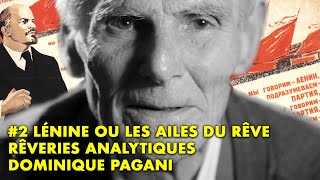
Series · 18 Apr 2021 #2 Lenin, or the wings of dreams0:50 What Is to Be Done? He presents the text, the end of chapter 5, where Lenin defends a newspaper for militants across all of Russia.11:37 What Is to Be Done? Lenin praises dreaming and imagines with irony his comrades disputing his right to it.26:41 Philosophical Notebooks Lenin judges the chapter on the absolute idea "most remarkable," at once the most materialist and the most idealist in Hegel.58:19 What Is to Be Done? Dreams that take account of reality are too rare in the movement, owing to legal criticism and to conformism.Season 5.1 · 21 Nov 2018 #5.2 The philosopher's Odyssey: Revolutionary thought1:06:52 Philosophical Notebooks Exiled in Switzerland, reads Hegel's Great Logic, first wary then astonished; notes 'and it's true!' before 'action is a syllogism.'1:36:41 What Is to Be Done? Defends the right to dream, provided one believes in one's dream and works toward its realization.1:43:26 Philosophical Notebooks Judges the chapter on the absolute idea the most idealist and the most materialist; one cannot understand Capital without Hegel's Logic.Season 11 · 19 Oct 2022 "Speech is the best and the worst of things" (Aesop)28:32 Dialectical materialist, not mechanistic; a militant without leisure, he leads the Bolshevik party then the Soviet Union against foreign intervention. 30:24 Philosophical Notebooks Exiled in Switzerland, he reads the Greater Logic and judges the chapter on the absolute idea to be the most idealist and the most materialist in Hegel.Season 5.1 · 15 Oct 2018 #5.0 Presentation of the 2018-19 Workshop Season8:30 He said "dreaming is necessary", provided the dreamer goes all the way through his dream. 15:03 Philosophical Notebooks He recouples Marx and Hegel: one understands nothing of Capital without having read Hegel's Logic.Talks · 19 Jun 2016 At the bistro with Pagani: part 216:27 His testament asks that Stalin and Trotsky be sidelined; he convinces Trotsky to sign the peace of Brest-Litovsk rather than punish him. 18:04 Philosophical Notebooks Reader transformed by Hegel's Logic: it must be read in full to understand the first section of Capital.Series · 2 Feb 2016 Hegel on the Beach 5/52:07:22 Philosophical Notebooks Reads the Logic in exile in 1915; the chapter on the absolute idea is the most idealist and the most materialist.2:12:58 One cannot understand Marx without having read Hegel's Logic. Series · 1 Feb 2016 Hegel on the Beach 1/530:49 A refugee in Switzerland in 1915, he takes the great theoretical detour through Hegel. 36:15 Philosophical Notebooks Discovers the relevance of Hegel and notes that Marx has been misread for lack of having read Hegel; "the best way to get a migraine."Season 14 · 4 Feb 2026 The return of fascism1:01:59 "Without revolutionary theory, no revolutionary practice": this explains why the Enlightenment preceded the French Revolution. Season 13 · 9 Aug 2025 The repression of the subject in bourgeois civil society24:08 At the end of his reading of Hegel's Logic, he judges that no Marxist has understood Marx and that this chapter is the most idealist and the most materialist. Season 12 · 24 Jun 2024 For a "fresh and joyful" apocalypse?1:17:02 "Without revolutionary theory, no revolutionary party": without a theoretical detour, revolt misses revolution. 1:45:40 Left-Wing Communism: An Infantile Disorder Shows the link between leftist ideas and the petty bourgeoisie.2:05:12 The theoretical detour. Season 12 · 2 May 2024 Neo-fascism and the ideology of desire - Clouscard, as relevant as ever (cf. Macron's ultra-warmongering remarks)7:41 Left-Wing Communism: An Infantile Disorder The meaning of the word "leftism" that Pagani adopts, used to discredit.Season 12 · 28 Feb 2024 Clouscard by you - Answers to your questions49:20 Neither a worker nor a peasant, like Marx. 1:08:12 What Is to Be Done? "One must dream": he distinguishes the dream that disregards real conditions from the one that takes them into account.Season 11 · 22 Jul 2023 Worldliness in Clouscard - The world as "cunning of reason"35:44 Philosophical Notebooks An excellent reader of Hegel: the passage on the absolute idea is the most materialist and the most idealist, contradictory but that is a fact.Talks · 27 Mar 2023 Interview with Dominique Pagani, praxis and psyche35:11 Philosophical Notebooks Annotates Hegel's Logic in exile; judges the chapter on the absolute idea the most idealist and the most materialist.1:00:36 Communism is soviets plus electricity. Season 11 · 3 Mar 2023 War, neo-fascism: libertarian liberalism21:22 Never despising any form of struggle, parliamentary or social, is hyper-Leninist. 51:38 Cited among the stages of revolutionary thought. 59:16 Left-Wing Communism: An Infantile Disorder From the 1920s onward, he led the communist fight against the leftists.Series · 3 Jan 2023 Why is Clouscard indispensable? (ENG SUBTITLES) And his translation into English too!0:19 What Is to Be Done? "What is to be done?" does not mean acting without thinking: without revolutionary theory, there is no revolutionary practice.Season 11 · 14 Oct 2022 Clouscard and the problem of Socrates25:53 Reading the Absolute Idea of the Great Logic, he sees there the most idealist and most materialist passage in Hegel. Series · 20 May 2022 Dominique Pagani - Who is hiding beneath the surfaces? Aesthetics and politics1:30:01 Philosophical Notebooks Self-taught, he reads Hegel's Logic and judges the chapter on the absolute idea to be the most materialist.Series · 5 Mar 2022 Panzer-philosophy against the cogito: neo-fascism or the ideology of nature. Heidegger/Descartes36:55 Against a newspaper that condemned escapism, he asserts that one must dream, provided the dream be realizable; this is the good sense of utopia. 50:00 "One must believe seriously in one's dreams." Season 10 · 24 Feb 2022 #10 UKRAINE: From the problem of "Edges" to the unleashing of war1:29:31 Putin attacks him more than he attacks Stalin. 1:57:28 He gives up territories to stop the carnage of 1914; his first decrees concern land and the emancipation of the nationalities. 2:01:30 The NEP encouraged a private market under political control. Season 9.2 · 28 Apr 2021 9 #20 From SIGNAL to SIGN • Einstein2:15 His text on dreaming, read in a previous session, reproaches us for not dreaming enough. 12:22 Materialism and Empirio-criticism The work targets Ernst Mach.1:09:21 Materialism and Empirio-criticism A fierce anti-idealist, he fights empirio-criticism; one cannot therefore invoke him to defend empiricism.Season 6 · 8 Jan 2020 #6.3 • The Logic of the Subject in the face of the reconstitution of Nazism45:48 Materialism and Empirio-criticism An immense book of philosophy: the field and the wave are no less material than the particle.Season 5.2 · 29 Jul 2019 #5.9 Kafka: An Imperial Message23:11 Invited to Italy to give a philosophical talk, he bursts into a laugh that the fishermen of Capri recognized as their own. 1:04:50 Reminder of the paradox: there is no philosophical communication. Season 5.1 · 6 Dec 2018 #5.2 ter FaceBookLive / Questions (2) following Workshop #5.217:54 Leninism goes beyond the death of Lenin. 32:17 What Is to Be Done? Says that dreaming is necessary: projecting oneself beyond the immediate, against narrow militancy.Talks · 2 Jul 2018 Tribute to Domenico Losurdo9:36 Philosophical Notebooks Reading the Logic in Switzerland, he discovers that the most idealist page is the most materialist: one cannot understand Marx without the whole Logic.33:29 He had understood that Hegel's logic is not abstract. Talks · 12 Jun 2018 In conversation: Dominique Pagani - Bernard Friot - 1 June 201855:26 Philosophical Notebooks A reader of the Logic in exile, he judges the absolute idea both the most idealist and the most materialist thing; one cannot understand Capital without the Logic.2:03:12 Recalled for his thesis on the idealism and materialism of Hegel; he strongly couples Marx and Hegel. Talks · 20 May 2018 Marxist Café - Work and the right to work11:03 What Is to Be Done? Play on words on "what to do" and idleness.41:27 Philosophical Notebooks Judges the chapter of the Logic on the absolute idea to be the most materialist in Hegel.Season 4 · 16 May 2018 #4.8 Angélique (by Nerval)1:23:16 Philosophical Notebooks The chapter on the absolute idea, the most idealist and the most materialist; one must read the Logic to understand Capital.Talks · 12 Mar 2018 Tonight, we repoliticise. Part 147:24 A participant cites his notion of imperialism. 1:08:20 He defends bourgeois culture against Bogdanov and 'proletarian culture.' 1:22:23 His error is to have believed that the most important thing in Hegel was the logic of essence; the Marxian conception of the state is more accurate than his own. 1:30:17 A participant presents him as the thinker of the weakest link, against Kautsky. Talks · 2 Aug 2016 Tribute to Jacques D'Hondt (1)45:03 Philosophical Notebooks Exiled in Switzerland, he reads the Science of Logic, at first suspicious then admiring: the absolute idea is the most idealist and the most materialist.Series · 2 Aug 2016 With Clouscard52:31 Left-Wing Communism: An Infantile Disorder The first to criticize leftism. His methods with Trotsky have nothing to do with Stalin's.Series · 29 Jan 2016 What is to be done? 1/31:45 His answer to "what is to be done?": without revolutionary theory, no revolutionary practice. 6:17 The theoretical detour is made in his wake. Series · 29 Jan 2016 What is to be done? 3/30:35 What Is to Be Done? His question "what is to be done?" goes together with the thesis: without revolutionary theory, no revolutionary practice.Series · 8 Dec 2015 Dominique Pagani on Michel Clouscard - The paths of praxis 2/22:26 Philosophical Notebooks In Switzerland he annotates Hegel's Logic; he judges the absolute idea to be both idealist and materialist and holds the Logic to be necessary for understanding Capital.11:59 What Is to Be Done? His praxis moves from "what must I do" to concrete "what is to be done."Series · 22 Dec 2014 H for Hegel11:51 Philosophical Notebooks In exile in Switzerland, he annotates the greater Logic; his admiration for Hegel grows and he judges that his readers were ignorant of Hegel.Series · 27 Sept 2014 #5 Libertarian liberalism, libidinal consumption and music...29:40 What Is to Be Done? "Without revolutionary theory, no revolutionary practice": theory is what is most lacking today.Series · 7 Jul 2012 Radio Galère - Michel Clouscard - 210:02 Rereading the Science of Logic, he finds the most idealist to be the most materialist and has dialectic taught after the Revolution. 11:37 Imperialism, the Highest Stage of Capitalism He describes the French bourgeoisie as one of the most intelligent in the world.41:28 Like him, Pagani thinks that the Hegel-Marx convergence gives revolutionary power its strength. Talks · 23 May 2026 NEO-FASCISM AND THE IDEOLOGY OF DESIRE: Is Michel CLOUSCARD still relevant? - with Dominique PAGANI12:47 Cited among the most exhaustive references. 36:53 Son of a schoolteacher, he would belong to the middle class. Season 14 · 28 Feb 2026 Their "Europe" means war.27:41 The word "leftist" comes from him and there designates the opposite of what the far right makes of it. 31:57 The Russian army, sent to the front with wooden rifles, rallied to him. Season 13 · 15 May 2025 Imaginary identity1:01:33 Putin accuses him of having given Ukraine its independence. Season 13 · 6 Feb 2025 On the anti-Sovietism of the Khmer Rouge-Greens39:34 He has nothing against Lenin; being Leninist implies being Marxist. Talks · 2 Dec 2024 "Napoleon, or the reasons of cunning", with Dominique Pagani52:34 Would call the freedom of the rebel a leftist conception of freedom. Season 13 · 2 Sept 2024 Clouscard: The metamorphoses of class struggle22:34 Philosophical Notebooks His Philosophical Notebooks close out the lineage of the philosophy of the French Revolution.50:14 The Russian regime reproaches him for having given Ukraine its autonomy. Season 12 · 11 Jul 2024 After the vote - Entering a zone of turbulence1:06:09 The concrete analysis of a concrete situation. 1:34:09 Putin reproaches him for the autonomy granted to Ukraine. Talks · 23 Mar 2024 SAHELIAN AFRICA AND IMPERIALISM: Mali, Burkina Faso, Niger - with Dominique PAGANI1:19:18 Putin reproaches him for having granted independence to Ukraine and Belarus. Season 12 · 18 Feb 2024 Secularism, the truth of religion?20:16 Leftism is defined in the Leninist sense. Season 11 · 3 Sept 2023 Worldliness in Clouscard: Desiring what? Through whom??9:10 No more than Marx does he make the superstructures a mere reflection. Season 11 · 29 Jun 2023 Worldliness in Clouscard: Aragon and the positivity of the negative58:00 Rightly saw the aging of the metaphysical question; his photo appears in the montage. Season 11 · 18 May 2023 Worldliness in Clouscard, or privileges for all2:27 Cited within the tradition of dialectical and historical materialism. Season 11 · 26 Apr 2023 Worldliness in Clouscard, or "The dominant ideology"1:41:37 Annotating the Greater Logic, he spoke of passages for "getting a headache." Season 11 · 28 Sept 2022 And what about the subject in all this? Hölderlin, Mallarmé and Baudelaire2:01:43 The NEP: tolerating a controlled capitalism. Season 10 · 7 Jul 2022 #16 Michel Clouscard: "There are no holidays in the concept!" - Dominique Pagani51:35 Putin reproaches him for having granted autonomy to regions; to invoke him is not to invoke Russian capitalism. Season 10 · 24 Mar 2022 #11 UKRAINE: Mathematics unites men, politics divides them (Aristotle)1:17:31 Putin criticizes his party for having granted too much autonomy to nations. Season 10 · 6 Oct 2021 10#2 Dialectics of identity and difference1:19:15 A term in the cycle "revolutionary thought from Rousseau to Lenin." Series · 14 Jul 2021 EVERYTHING IS ALLOWED, NOTHING IS POSSIBLE! Michel Clouscard, May 68 and the capitalism of seduction17:32 His portrait is held up by the students of the Sorbonne. Series · 14 Jul 2021 EVERYTHING'S ALLOWED, BUT NOTHING IS POSSIBLE! Michel Clouscard, May 68, French Theory & Capitalism17:32 Portraits carried by the students in the courtyard of the Sorbonne. Series · 22 May 2021 A chapter of Marx written by Hegel • Philosophical Q&A • Dominique Pagani14:46 Cited at the end of the lineage from Kant to Marx. Series · 20 May 2021 Cynicism of the extreme centre or epistemic heroism? The dialectic of the middle • Dominique Pagani44:35 He closes the sequence from Rousseau to Lenin. Series · 30 Apr 2021 My eco-cabin in the ZAD: autonomy or alienation? • Philosophical Q&A • Dominique Pagani8:52 Cited in the philosophy of the French Revolution. 16:18 A term in the lineage that gives freedom a historical content. Series · 25 Mar 2021 Musicosophy 17. Interpretation21:41 His complete works sold at Hountondji's bookshop in Cotonou. Season 9.2 · 4 Mar 2021 9 #16 How can sciences of history be real?1:43:05 "Without revolutionary theory, no revolutionary practice." Series · 9 Feb 2021 Musicosophy 15. Plato, Rousseau, Hegel and music26:04 Materialism and Empirio-criticism Showed that a field is no less material than a particle.55:13 Judges a passage of Hegel's Logic to be both the most materialist and the most idealist. 1:27:23 Known in childhood through a woman who had known Rilke. Series · 7 Feb 2021 Musicosophy 14. Mozart once more51:38 Accused by Heideggerians of containing the gulag. Season 9.2 · 5 Feb 2021 9 #14 How can sciences of history be real?31:34 He did considerable theoretical work. 1:44:10 The philosophy of the French Revolution runs from Rousseau to him. Series · 28 Jan 2021 Musicosophy 12. Nietzsche (right up) against Wagner59:20 Known as a child by that same elderly friend. Season 9.2 · 14 Jan 2021 9 #12 How can sciences of history be real?19:06 His texts contain political prescriptions, because he had power struggles to manage. Series · 11 Jan 2021 Musicosophy 8. Happiness and unhappiness in music1:10:39 Describes the French as coupon-clippers. Season 9.1 · 17 Dec 2020 #9 Benefits and harms of amnesia...26:51 In his time too, utopias were flourishing. 36:48 Associated with Marx and Engels in the homage paid through the efficacy of their discourse. Season 9.1 · 10 Dec 2020 #8 Benefits and harms of amnesia...21:09 His advances are part of the tools of knowledge. Series · 3 Dec 2020 Musicosophy 1. Schubert and the master singers45:42 Associated with Jesus in the Nazi formula of Judeo-Bolshevism. Season 9.1 · 30 Nov 2020 #6 Answers to questions1:04 What Is to Be Done? A listener's political questions point toward an answer to his question "what is to be done?"Season 8 · 23 Jul 2020 #15 • Return to the logics of the subject13:00 Leninism seeks to put knowledge within reach of the least well-off. Season 7 · 4 Apr 2020 #3 • Harnessed to confinitude1:43:57 One must use every means, strike, demonstration, election; not leftist. Season 7 · 30 Mar 2020 #2 - Harnessed to Confinitude4:56 Cited among the authors his long journey leads to. Series · 23 Mar 2020 Interview with Dominique Pagani: Introduction to the upcoming workshops1:21:48 "Without revolutionary theory, no revolutionary practice." Talks · 21 Sept 2019 Pagani without detours55:27 Mentioned in the book's conclusion on the political question. Series · 10 Sept 2019 D. Pagani / M. Clouscard's reply to C. Morilhat • Part Two29:48 It is claimed that the gulag was already present in Lenin. Series · 23 Aug 2019 D. Pagani / M. Clouscard's reply to C. Morilhat (1987)49:03 Emphasizes the temporal dimension in his work on the reflection. 1:35:39 Extends the philosophy of the French Revolution. Season 5.2 · 26 May 2019 #5.7 Nature or Landscape?0:38 Terminus of the sequence on revolutionary thought. 10:41 Metonymy that may also stand for Ho Chi Minh or Castro. Season 5.2 · 2 May 2019 #5.6 Nature or Landscape?24:45 Known through a lady who had also known Rilke. 1:27:49 Saw that the mechanistic conception of reflection is very reductive. 1:29:50 There is nothing concrete except through the abstract. Season 5.2 · 25 Jan 2019 #5.4 Introduction / Nature or Landscape?42:54 Endpoint of the journey through revolutionary thought. Season 5.1 · 31 Dec 2018 #5.3 The philosopher's Odyssey: Revolutionary thought1:24 On the syllabus: revolutionary thought from Rousseau to Lenin. 1:19:05 Moving on to Marx and Lenin for a materialist monism. Season 5.1 · 6 Dec 2018 #5.2 bis FaceBookLive / Questions (1)2:12 What Is to Be Done? Cited in the question as a continuation of the novel of formation; his dream as an example of telos.Season 5.1 · 2 Nov 2018 #5.1 bis FaceBook Live / Questions4:01 Endpoint of the sequence "revolutionary thought from Rousseau to Lenin." Season 5.1 · 24 Oct 2018 #5.1 The philosopher's Odyssey: Revolutionary thought0:00 Downstream boundary of the sequence. 38:31 What Is to Be Done? He cites a Russian proverb: do not spit in the well.54:58 He stresses that the dialectical method is Hegel's contribution to Marx. Series · 5 Jul 2018 Being and Code25:46 Lenin, reader of Hegel, at the end of the philosophical axis claimed. 1:02:31 The speaker cites his text on economic romanticism. Season 2 · 1 Aug 2017 #2.8 Between crisis and war: Philosophising?1:25:13 Philosophical Notebooks To understand Marx, one must reread the whole of Hegel's Logic.Season 3 · 1 Aug 2017 #3.6 From Ulysses to Daedalus1:02:12 In the sequence that traces the gulag from Stalin back to Plato. Talks · 17 Jun 2017 Adotevi: Negritude and negrologists (1)4:39 The word "gauchiste" is taken in the pejorative sense he gave it. Talks · 2 Aug 2016 Tribute to Jacques D'Hondt (3)5:44 he had made the negation of the negation the energy of dialectic Talks · 18 Jun 2016 At the bistro with Pagani: part 142:26 He too belongs to civil society. Season 2 · 18 Feb 2016 #2.3 Between crisis and war: Philosophising?5:27 The Heideggerians already see the gulag in Lenin. Series · 2 Feb 2016 Hegel on the Beach 4/51:58:55 We find in Mallarmé, and not in Marx or Lenin, this homage to labor. Series · 1 Feb 2016 Hegel on the Beach 2/549:40 There is nothing concrete except through the abstract. 55:16 Endpoint of a trajectory from Rousseau to Lenin, via Hegel and Marx. Series · 1 Feb 2016 Marx on the Beach 1/231:29 "Without revolutionary theory, no revolutionary practice": what distinguishes the revolutionary from the rebel. Series · 23 Sept 2014 #3 The myth of the noble savage in Rousseau!23:31 "Without revolutionary theory, no revolutionary practice." 
 Series · 18 Apr 2021#2 Lenin, or the wings of dreams