English translation of the French transcript, made with AI and not yet proofread — click a paragraph to jump to it. Show the French original
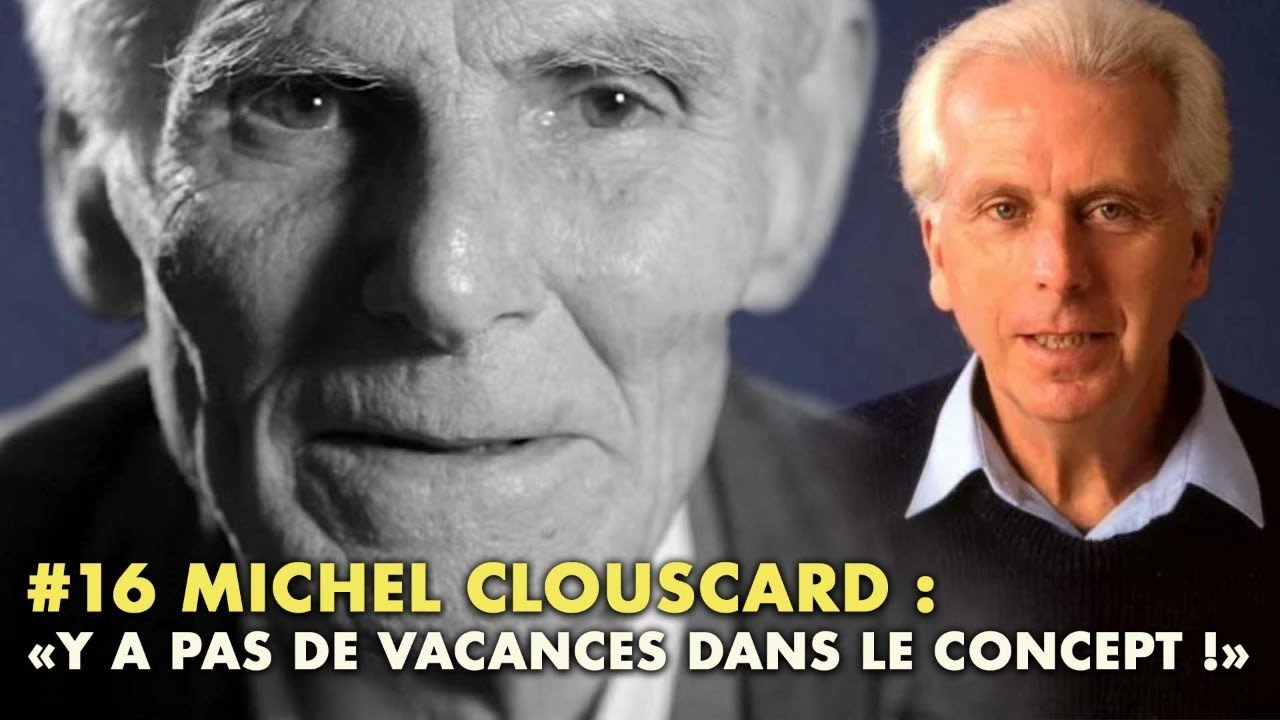
Clouscard's aphorism by a mountain stream 0:00 Good evening everyone. I'm sorry that my face makes the radiant face of my late friend Michel Clouscard disappear. If you looked closely at the photo that Pierre-Alain was kind enough to find, you'll notice that he's sketching a slight smile with eyes that are starting to sparkle, and that's when he's on the verge of bursting out laughing.
0:38 And why do I start with that? Because I'm telling you right away, this is a session where I'm announcing the suspension of our broadcasts. Not for very long, until a little before the start of the new season, just a little summer break. But that's precisely the connection with Clouscard, because I had already posted this a few years ago, even twice, so I won't repeat it in writing, but I'll tell it to you orally—I'll never forget that moment when we were having a little snack by a mountain stream, in the back country of the Balagne, that is, the region of Calvi and Île-Rousse in Corsica.
1:19 And there was the murmur of the stream, the wind in the Corsican pine trees—I don't know, a pine that only grows in Corsica, as is often the case on islands, there are quirks of fauna and flora, singularities. And I was saying banalities to Michel, like, still, vacations do you good, and that's when he starts having that smile, and then suddenly he bursts out laughing, saying—having time to say, before choking with laughter—there are no vacations in the concept.
1:55 There you go, it was a quip. It wasn't at all meant to instruct you that there's no question of taking vacations when you're a philosopher—it's quite the opposite, isn't it? And I'll give a second reference to tell you that it's nothing of the sort, that it's quite the opposite. I refer you—you can find it on Wikisource, you don't need to—to the admirable prologue of Plato's Phaedrus, not Racine's Phèdre, Plato's dialogue Phaedrus.
The bucolic prologue of Plato's Phaedrus 2:32 There is a prologue such as only this director, this stage-setter of genius that Plato is, knows how to craft before the properly conceptual discussion begins. Our two companions, that is, Socrates and Phaedrus, go for a walk in the outskirts of Athens, which is very rare—usually it always happens in the city, they hail people in the agora, in the street, Socrates does.
3:02 And they look for a place to sit down—we're in the summer heat, in Greece, so they look for a little spring, a little spot where there's a light breeze, a little spring. And there's my Socrates wiggling his toes, all this is in Plato, in the stream. And Socrates marvels—but look at these bees, this tree, this spring—and his interlocutor is surprised: but really, Socrates, we never see you in the countryside, you're no environmentalist—that's my addition.
3:42 And we never see you, so why don't you go to the countryside more often, if you enjoy it so much, and Socrates replies: it's because, my friend, my effort consists in asking questions. And when I ask questions of trees, rivers, and the sky, they don't answer me. There you go. Don't think this is some anti-environmentalist mischief of mine—I'm never anti-ecological.
4:14 On the contrary, environmentalism is often a disaster for the environment, but that's another story. I'm thinking of, you know, the German Greens who shut down nuclear power plants and are consequently reopening coal mines that pollute more than the whole of French car traffic combined for some time now. But yes, there you go. So, rereading this admirable pastoral prologue—that was roughly the atmosphere we were in.
4:45 I don't like the word "atmosphere," which still sounds too much like a nightclub, if you will—it was really the air we breathed and the breezes that graced us. That's when Clouscard uttered that unforgettable aphorism: there are no vacations in the concept. Implying, after all, maybe sometimes we'd like some, but what can you do? There you go. It's not in summer that we're going to stop being constituted.
The blackbird anecdote and summer announcements 5:20 Besides, I spent the whole summer in excellent conditions. Those of you who have read—not the biography of Clouscard, I'm thinking of "Avec Clouscard" by François de Negroni, which isn't a biography of Clouscard but part of the biography of François de Negroni, from the moment he meets Clouscard until the latter's unfortunate passing. And you'll see, for example, the famous blackbird anecdote.
5:51 All this to recall that he never stopped, in fact. Every day, I never once saw him, even on vacation, very relaxed—and a little guesthouse with a lovely terrace, facing the Gulf of Calvi, a stone's throw from René's house, who could see it from his window. That's important for understanding the anecdote that follows. And suddenly a blackbird—a blackbird is always a bit mocking, you know, the mockingbird—makes such a racket that Clouscard, in the middle of writing and searching for his sentences, wants to say, shut your beak, with a Toulouse accent.
6:33 And then René's window opened—it was just a small building not far away. He says to him, so now you're arguing with the birds? And Clouscard answers him: the guy didn't say a word, I shut his beak for him. That's to tell you there are no vacations in the concept, but it's not a labor camp either—all this happened in a very good mood, but I never saw him without working, without writing, let's say. But he loved relaxing, going for walks, all that—so I wish you vacations at least as happy, though I'm not sure that's possible.
7:05 And I'll take this opportunity to express immense gratitude for—not just your loyalty, that goes without saying—but for your participation, your engagement in the Q&A sessions. I'll take this opportunity to tell you that we're suspending the live broadcasts, but we'll continue. I can't tell you when it will be announced—each time a few days beforehand—but there will be some Q&A sessions, since we always have a backlog, I'm still behind, and I'm very happy about the number of questions that have been asked, and we've committed to leaving none unanswered.
7:54 So there you go, aside from that, that would be a parenthesis. But back to the thanks—I thank you all the more since, with the recent release of the audio podcasts, the musical podcasts made around Aliocha, where we find Pierre-Alain among others, who was kind enough to let you know that the latest one, about Beethoven, tipsy—to reuse Aliocha's title—has just come out, and that next week, early or mid-week, the next one will appear, about which I'll remain discreet as usual, so there's a surprise, and they'll continue practically until the start of the new season.
8:44 So you see, we're not abandoning you, far from it. So we remain in contact, and not only through the podcasts, not only through the Q&A sessions, which we'll continue from time to time, but also, let me remind you, you can always check the site michelclouscard.com—I think Pierre-Alain can display it, but anyway, I mean, it's easy to remember, but there you go, thank you very much—which has been considerably improved by Pierre-Alain, enriched, and is more and more comprehensive, and don't hesitate to post questions there, and of course, you can always keep sending questions to our email address avecdoumé.com.
9:47 There you go. So, I won't be very long tonight—I'll say I'll monologue, but I'll give you the floor, since this is the last time I'll see you before the vacations, so I'll be all the happier to hear from you one last time before you scatter off to the mountains or the seaside, or wherever you like, including Paris—Paris is open to everyone, there's a mysterious and often enchanting side to it—but especially since, at my age, there are reflexes I don't have, I always forget the importance of the cell phone, because now I tell myself, our friends won't be reachable, they're by the sea, camping, in a rental, but most of them, in fact, even in the height of the season, receive our broadcasts on their phones, so I'm delighted in advance.
10:55 There you go, so, I want to tell you, don't hesitate to keep asking questions—to start, I'll give you the floor right away, but I still wanted to, to begin, remind you of this relaxing moment, I send you this double reference, don't I? So, I will still, true to our habits, even for this last time, read you a short excerpt evoking vacation time, even if it contains a critical part, doesn't it?
Reading of Clouscard's "The country house" 11:33 And some of you have already guessed that there are many very attentive readers of Clouscard among our followers, as they say—I'm alluding to that veritable prose poem of several pages, which forms the almost last pages of Le capitalisme de la séduction, grouped under the title "La maison de campagne" [The country house], since that's what it's about, isn't it?
12:11 And rich in regions that could house, that could shelter every country house one could dream of—but here it was, as it happens, the Drôme, at the time when I was teaching there, to seniors of course, and then Clouscard had come to visit us, we were walking around the Drôme, and that's when he got the idea for the text that follows, so I'll extract at least this passage. Of course, here he's rather alluding not to you and me, but to those who own property in Paris and have their second home in the country, isn't he?
12:50 but who never leave, I don't know, their class position—but judge for yourselves. There you go, so, this moment—I'll read it now, I believe you have the text in front of you—it's the moment of the pause, in contrast to Parisian frenzy, of rest. The country house was necessary for worldly consumption. One likes to rest by a good wood fire—that's for the Christmas vacations—after the libidinal promiscuity of fashionable marginalities—that's the evenings in Paris, isn't it?
13:23 The wild countryside. The locals—that's quite a change from the faces of cosmopolitanism, of industry, of leisure, isn't it? You know, "how do you do, my good man," as one says to the local peasants. And then, at the country house, there's also everything one needs. One can, among intimates, on occasion, still let loose quietly. It was the era when, following the Marshall Plan, household appliances had even invaded the provinces, hadn't they? Having used and abused every kind of entertainment, ready to set off again toward new horizons, the new bourgeois—this is the seventies—rests at his country house, relay and pivot of his prodigious worldly migration, and here, listen closely to this crucial parenthesis, the inverted reflection of the migration of the rural worker who was displaced by him.
Parenthesis on warming and the shadow of war 14:19 For there was the most gigantic migration, wasn't there, of rural populations during those years. Conviviality, that word says it well—cordial mood, delighted, jovial—I'll linger on this, I'll tell you, because I alluded to it when I used a few clips from Alexandre le Bienheureux, and I saw that quite a few of you fondly remembered that film, some even saying "oh yes, my parents loved that film."
14:53 to illustrate the last moments of what's rightly or wrongly called the Thirty Glorious Years, because it wasn't happiness for everyone, but still, no mass unemployment, there was no AIDS yet, there weren't the terrors being dished out to us about the end of the planet—I notice that right now, for several days, you have to wait until about 11 a.m. to noon in Cachan, in the Paris region, for the heat to start coming, I mean, it's cool in the morning, but we were being told about the apocalypse and the end of the world from a heat wave, and I looked at the statistics because I always take everything seriously after all, and it's true that overall, the Earth is warming a bit more each year no doubt, but—and I want to make this clear—it's been warming for 10,000 years, well, for 10,000 years, even a bit longer than that, but I concern myself with it from the point when it concerns the humans who are there, doesn't it?
15:46 There you go, I mean, think of our ancestors who experienced the Ice Age—the cave paintings, they're not paintings, they're engravings, on the rocks of the Sahara, but over thousands of square kilometers, so in overabundance, depicting herds—the most recurring motif is cattle, but also rhinoceroses, but also hippopotamuses, but also elephants, animals that need almost a ton of fodder a day, because the Sahara, at the time, the Earth wasn't yet as warm as now, we were coming out of the glaciation, and we're still coming out of it, and that's what's called global warming.
16:31 I'll come back later to this strange and misleading way of calling it climate disruption, but it keeps coming back, we're still coming out of the glacial period, but at the start, it left marshlands—it wasn't the Amazon, the Sahara, but it was, let's say, an immense marshland, teeming with game—but at that time, one has to accept the consequences, the glaciers stopped somewhere between Lyon and Nice. You see, I mean, of course human activity, especially since the industrial era, has worsened, has accelerated this process—I'm the last person to doubt it, I've discussed it with all the greatest specialists on the matter, including someone, well, a great meteorologist, and each time I ask them: tell me the proportion that's really due to the solar cycle, to what comes from the Earth's internal magma, to the change in the Earth's axis of rotation which causes considerable seasonal variations over millennia,
17:41 because several times, I insist on this long parenthesis, several times, the Earth has been covered with glaciers, but covered all the way to the equator, or on the contrary, covered with deserts, hasn't it? Millions of years, hundreds of millions of years, before man, before, as they say in Tintin, the hand of man set foot there, didn't it? So, the forces at work here are so titanic—I'm the first to approve of taking measures to regulate, monitor, control, democratically, in a planned way, not fantastically, and not in the form of the apocalypse, as they say, the collapse—the part that comes from human activity, of course.
18:35 But anyway, I mean, I've seen hotter summers—I recall that in 2003, there were thousands of deaths, because there was a month of heat wave without a single rainy spell, whereas here, no sooner was there a heat wave than, ten days later, there was the first rain bringing the temperature down. There you go. Trend-wise, it's not going to get better. I'll close this parenthesis, and I'm sure you'll laugh at this apocalyptic side when you go—you know, well, if you're going—I go back to Corsica, I mean, the water is so clear, as it's rarely been, I don't know.
19:15 I crossed France, the Hexagon, with Aliocha, two years ago, to go near Montauban, to see our friend whom I greet, Michèle Clouscard, and our president. And I remember making this remark to Aliocha: but France has almost become a park, it's so... There you go, I mean, you're very lucky to be going on vacation in these conditions. On the other hand, I know some of you will have to cut back in terms of range, kilometers, and distance, given fuel prices.
19:52 And I do not forget that the sun of vacations does not erase the shadow of war. Forgive this rather grandiose expression, but I don't forget it, I follow it minute by minute, believe me. And I wouldn't want to darken this departure for vacation, but I still want to point out—I'm not saying I'm glad about it, I'd rather, on the contrary, on this point, have been wrong—but that I began my public lectures more than seven years ago now under the title "Between Crisis and War, To Philosophize" shows how long this has been brewing, all of it.
20:35 There you go. May that not stop me from wishing you the best vacations you deserve. There you go, that we deserve. Thank you so much. And now, I'll listen to your questions and get back to answering them. So, comments, there you go. Ah, there we go, hello Jean-Jacques.
Memories of jazz and paid vacations 21:14 Let me say—forgive me for forcing his discretion—but Jean-Jacques and I were in our senior year in Bastia together and the piece that... I haven't even thanked you enough yet for the interest that the podcasts have generated. I allow myself to speak well of these podcasts because the technical production, which I have nothing to do with, is so incredible that it deserves praise. And I notice that every time, you never fail to thank the technical team for the joy it's brought you.
21:52 but it happens that the second-to-last one, centered around the figure of John Lewis, founder of the Modern Jazz Quartet, and the somewhat favorite piece we played, Django, a composition by John Lewis—I'll never forget that when I discovered it, I was in my senior year with Jean-Jacques as a classmate, and I found myself in his parents' magnificent apartment near Bastia's town hall, and on a little record player like we had back then, I don't remember if it was a Teppaz or something like that, it wasn't worth much in terms of audiophile quality, but how amazed we were to discover these flashes of brilliance from an era when jazz hadn't yet started repeating itself, becoming academic.
22:48 I'll come back another time to this aspect of things, but on the contrary, it went from innovation to innovation, when Cool was chasing out Bop—well, alternating with Bop, wasn't it—when Coltrane was making a New Sound heard again after Miles Davis's Cool, wasn't he, and then Eric Dolphy and later Mingus were on the verge of Free Jazz—there you go, that's to say, it was an era of creativity, but I think it wasn't only in music, at that time—I'm also thinking of what Italian cinema was, French cinema, American cinema at the time, there you go, the era of the great Kubrick, the era of the great Visconti and other Antonionis, and there you go, all that makes me think of that senior year with Jean-Jacques, whom I greet.
23:46 Vacations are pointless when you love your work. Yes, well, that needs to be explained to those who really need to hear it though, I mean, there you go, I stand up for those who are quite happy to go on vacation, I agree, like Jean-Paul Legrand whom I greet here, with the point that not everyone has the chance to go away—those who always remind me of that couple I told you about who, in '36, it was they who told me this, I wasn't born yet, but it was almost ten years before my birth, said that when the first paid vacations came, they dared to go from La Courneuve to the guinguette on the Marne at Joinville—you see, it's as if those going now, aren't they, to Croatia or the Seychelles—so there we are, aren't we—and then, not so long ago, half of France had trouble going on vacation at all. Jean-Jacques points out to me that it wasn't a Teppaz, but a Pathé-Marconi,
24:56 a great happy moment, well, I'm glad we both have happy memories, in any case it's unforgettable for me. I'll take the opportunity to say, forcing his discretion again, that Jean-Jacques Marzot created a site in tribute to Boris Vian, which is the most thoroughly documented on the novelist, musician, trumpeter, jazz man—I don't know, he was a marvelous man, Boris Vian—but you'll see, with extremely rare documents, from unfindable vinyl records, demo tapes that were never duplicated, to texts, you have everything you could want about Boris Vian on the site I'm referring to, there you go.
25:52 So, let me look, there aren't many questions, there are a lot of comments. So, there you go. Ah, but yes, that's why I was late.
26:23 Symmetri, I'll start with him, because he was one of the first to arrive in the room before the show, if I may put it that way. There you go, that's what he says, by the way: hello, I'm happy to be in the front row and to be able to follow this precious golden chain, thank you for what you're doing. Thank you very much, Symmetri, and thank you for your loyalty. Ah, Tarek—so, Tarek is a social worker, well, technically also, because he works in the medical field. I greet him here—despite the distance, he never failed to come to our in-person sessions, as they say now, at the Goscinny center.
27:01 And now he's stationed in the beautiful forest, well, in this beautiful clearing that is Villers-Cotterêts, not far from one of the most beautiful forests in France. A town which had this importance for the French language, I don't know, and a stone's throw from La Ferté-Milon where Racine was born—there are regions like that. Well, so I greet Carole Zirich, I think everyone's here, we're even under the sign of Dionysus, whom I greet, and let me see, I'm not sure I understand, rather than vacations, the opposite of alienating labor seems to me to be liberating labor.
Rousseau: every idle citizen is a rogue 27:49 Will a world without capital be a world without vacations? I don't know if I understand—this isn't a rhetorical flourish when I say I'm not sure I understand, or rather I understand several things, but rather than vacations, the opposite, alienating labor seems to me to be that labor be liberating. Yes, when it benefits the one who works, doesn't it? The peasant who plowed his field to feed himself was rewarded for his sweat, wasn't he?
28:22 When the soup was hot, made from vegetables he had planted—but there is alienated labor, isn't there? But we are still far, aren't we, from the restitution of the fruit of one's labor to the benefit of the worker. But what I understand is: will a world without capital be a world without vacations?
28:52 No, what I mean. I'll quote Rousseau. Working is necessary for social man, rich or poor, powerful or weak — that's literal, rich or poor, powerful or weak — every idle citizen is a rogue. Idle doesn't mean there are no moments of rest. And for those who know, need I remind you, Rousseau praised farniente as no one else has, in the Fifth Walk.
29:24 So he's not the one who needs lessons in knowing how to appreciate the pleasure of having nothing to do, and the happiness of having nothing to do. I say happiness because he opens that whole passage in the Fifth Walk with this question: 'What did this happiness consist of? What did his enjoyment consist of? I'll leave it for all the men of this century to guess.' But in Emile, he says, 'Every idle citizen is a rogue.' That's far more profound and socially accurate than 'property is theft.'
30:02 There's also 'rogue' in Rousseau. But it would be too much if the guy who's worked himself to the bone at some job and finally buys himself his color TV when he reaches retirement age — back when that was new, the color TV, today I don't know, a flat screen, whatever, you know that better than I do — it would be too much for him to be called a thief because he owns an object, an appliance. I mean, that's an infinitesimal part of the value he produced through his labor.
30:36 An infinitesimal part. So Rousseau is right to say — not 'property is theft.' I don't see why the fact that I own my toothbrush makes me a thief. But on the other hand, every idle citizen is a rogue. So even in a world without capital, there still has to be — I'm quoting Rousseau again, he's never been more precise, which is why I want to quote him word for word, because every word counts.
31:07 outside of society, the isolated man — not outside of capital, outside of society — the isolated man has the right to live as he pleases. But in the society where he lives — listen closely to the adverb — necessarily at the expense of others, this is perhaps the most Marxian passage in Rousseau, he owes them, in labor, the price of his upkeep. This holds without exception, comma, powerful or weak, rich or poor, every idle citizen is a rogue.
Tourism, regionalism, and "climate disruption" 31:43 There, I believe, I hope, I've answered Tan clearly. There. A world without tourism. But what do you have against tourism? It's extraordinary. Well, first of all, there are regions that live off it, and that — there I'd agree — what's scandalous, and almost neo-colonial, is regions that have been forced into living only off tourism.
32:15 I'm thinking of certain regions of Spain. No need to draw you a picture. No need to draw you a picture. Regions deliberately kept underdeveloped, only benefiting those who owned the housing, the land, who then didn't have much left to do to become rentiers, right? So there. So the question isn't simple, but of course tourism can be regulated — but that concerns local populations first and foremost.
32:54 They can very well, democratically, impose their will on their regional administration. For that, we'd need a bit more regional autonomy. But I'm a Jacobin regionalist. That's called dialectics. I'm not a regionalist in the feudal sense, in the sense that this neo-feudalism came back starting with Mitterrand and Defferre — that is, regionalization, in short, of the anti-communist left. But on the other hand, I say that when the nation is sure of itself and when it is democratic, it can, it must, generally grant the periphery as much autonomy as possible in matters concerning the populations involved.
33:45 So there's Inès, who goes even further than I do. In my parenthesis, we are coming out of the ice age, she says, and then we'll enter a new ice age. That's clear. Not tomorrow. But it's clear there will be more ice ages, and also periods — not heat waves, but times when it will be so hot that even an earthworm will have trouble surviving, believe me. And since I'm being pressed on it, I'll remind you, yes, I did say I'd come back to it.
34:20 This new phrase, 'climate disruption' — what is that? Where is the rule? When the planet was a succession of little crusts floating on a planet of molten lava — it's almost a pleonasm, it is a pleonasm, especially at night — how was that any less normal or less natural than when, conversely, the earth was covered in ice, because that happened too, the whole earth, I mean, following, sometimes volcanic events anyway, but sometimes meteoritic ones — where is the rule?
35:07 That assumes a religious rather than a scientific point of view, one that supposes there's a harmony, a rule of nature that always brings things back to some happy medium that favors what? Favors whom? The mosquitoes that carry malaria, the leading cause of death worldwide? Really. Let's not forget that while we should be — and we should be — ecologically minded, that is, concerned about the environment, which all peoples have always been, I don't know of any people deep in the African jungle who says, if a cow dies, just throw its carcass in the village well so it stops stinking up my doorstep instead.
35:49 Of course not. Everyone agreed that everything vital should be protected as much as possible. We've never had so many means of ensuring that protection. But, I repeat, it's not the planet that needs protecting. It'll still be there once there's no more humanity. That will happen one day. I don't wish for it. I mean, unless — maybe Earth will become so uninhabitable, that can happen, or a meteorite will crash into it.
36:23 Anyway, let's move on. But the Earth won't stop existing because of that. What interests me is humanity, the world. The world is the relationship between men — that's not the same thing. Men among themselves on Earth, of course, in a given environment. So if you told me, fine, you're very kind, but what really matters is making sure that the balance necessary for life isn't destroyed — go all the way — for human life, and not for the life of every species, because there are shrimp, at this very moment, frolicking with delight at 400 degrees in underwater volcanic waters at the bottom of the ocean abysses, in sulfur and ammonia.
The anti-humanism of a certain environmentalism 37:12 And so, 400 degrees. When you think that water boils at 100 degrees, you see what 400 degrees means. We would already have been exterminated long ago. So there are no natural conditions on Earth valid for all species alike. Why be ashamed of being a humanist? It's strange, really. That's what I fight against. It's not the legitimate concern for our environment, for our community as humanity. No, it's the anti-humanism at the core of a certain kind of environmentalism.
37:45 There. I always remember this young man, a teenager, it was an evening, we went out on the balcony, I was calling someone, taking advantage of the lower noise, and he says to me, careful, when you hold your phone to your temple, you're close to leukemia. But — poor kid! I think of him because he told me the worst species is man, that's the species that needs to be eradicated. Even the Nazis, the Nazis only wanted to eradicate Jews, communists, people with Down syndrome, and Roma, and so on.
38:20 But here, he's talking about exterminating humanity. That's what I rise up against. I rise up against a discourse, not against measures I approve of — some, not all, but I do approve of some. I don't approve of shutting down the nuclear industry, far from it. Agreed? Especially when you're the head of the Green Party, right? When you're against civilian nuclear power but for war with Russia — that is, for military nuclear power — that's obscene in a way.
38:53 That kind of environmentalism, and you can clearly see where it's headed. There. You see how anti-humanism follows from it directly. Yes, yes, I'll go that far. And I hold back, because it depresses me, right before going on vacation, to stir up all this horror — I stay well short of reality. Don't think I'm exaggerating. It's unfortunately more worrying than that. I say this because in all the measures the new government is taking, it's nothing but talk of protecting the environment, clean industry, etc.
39:26 I'd love for it to go in the right direction. You'll see, we're going to be very far from it. There. Thank you, Inès, you're the one who inspired me, faithful Inès, our Brazilian, who I believe is still in Brussels. Thank you for giving me the chance to come back to this. Now, let me note — or rather let me read — the clarification that Pierre-Alain posted about the Michel Clouscard site, a new site that will be enriched over time and has just gone online, about Michel Clouscard.
The West, an abstract universal and an occulting concept 40:03 Triple-w dot Michel Clouscard dot com. There. Now, Île Vulgate — I don't know who that is, but never mind — tells me that ecology serves to reduce Westerners' standard of living in order to equalize it with emerging countries. I see this thesis often. It's already better than those who say we need to reduce the standard of living, degrowth for everyone. Go explain that to the people of Mali.
40:34 who would love to consume — not just a bit more, but legitimately a lot more. And so someone will tell me, fine, but us, the rich countries, we could cut back. But no — what are 'rich countries'? Those aren't social classes. What are 'Westerners,' dear Île Vulgate? I ask that as a real question. I agree it's better as a viewpoint than advocating unconditional degrowth. But watch out: as soon as you neglect the distinction — which I don't approve of, since I fight it — of society into social classes, in struggle, with dominators and dominated, you're forced into saying nonsense.
41:17 We're in what Hegel denounced as the abstract universal. 'The West' is an abstract universal. It's a fig leaf, that word. There are words that are useful. The statue, the screen, my mug — since I have a little coffee going cold, but I'd rather talk with you — the microphone, the keyboard: those are words that designate things, that have an objective usefulness.
41:48 But 'the West' — I've done this bit before, but I say it for newcomers — word for word it means what is to the west, but since the Earth is round, west is wherever you want it to be, right? Poland — Poland is west, yes, it's west of Russia, but it's east of Germany, well yes, that's how it is, it doesn't mean anything if that's all it is. Ah, but you're splitting hairs, and I'll be polite about it. Actually you know very well it means the European countries. Oh really, I thought the leader of the West was the United States and America.
42:20 Damn, that doesn't work either. Yes, that's philosophy — making habitual concepts problematic. And I'll quote a great Christian, not exactly from my camp apparently, a great poet, Péguy, who said: 'Dead wood is habituated wood.' Watch out — by repeating words, we come to believe they're things. 'The West' is not a thing. It's a concept — I'll tell you — an occulting concept, meaning it serves, unlike those I mentioned earlier, the microphone, the keyboard, which aren't made to hide things but to show them and communicate them — this one is made to hide things, to prevent them from being communicated.
42:56 But I still haven't — we still haven't seen what it's hiding. Come on: United States, Europe — does it mean the industrialized countries? No, because then Japan, which is more industrialized than France, more than any European country even, more than Germany, and that's saying something — Japan would then be a Western country. You see we don't get anywhere with words like that. Fine, does it mean capitalist? That's exactly why I call this word a fig leaf, because it's an ugly word.
43:27 I worked for firms — capitalist ones, to hide nothing from you — and one director, when I'd used that word in a very technical way, told me, 'You know, we don't much like that word.' Well, of course! In capital, they don't like being reminded that they're capitalist. So instead they say 'liberal' — already there's a connotation of freedom, though it's not the freedom of the wolf in the sheepfold or the fox in the henhouse. Well, you see I could go on. None of this is at all meant to diss, as they say now, what Île Vulgate said.
44:04 I'm very glad of her contribution, simply correcting the word 'West.' Come on, one step further. It's good that she saw that ecology, that reducing the standard of living, is scandalous to apply to all of humanity, especially to those who are the first victims of exploitation — and that's a good chunk of the planet. But we need to go even further, we need to abandon this concept of 'the West.' We need to say what actually is. I would now say bluntly: the countries of the Atlantic Alliance.
The Atlantic Alliance, Sputnik, and escape velocity 44:36 We're entering current events. At the head of it, the flagship, is a country that isn't even European, you know what that is? It's American. Which, the moment the first hints of peace negotiations came up — remember, a few weeks ago, Zelensky was ready to grant Putin almost everything Putin was demanding before the conflict. And let me remind you that if I lived in Russia, I would not vote for Putin. So let's not conflate all these different trials.
45:06 But all the criticisms I make of Putin — and I have some — I'll reserve them for those who first and foremost condemn the permanent bloodbath that NATO has inflicted on the planet since, even before its founding, since the start of the Cold War. And yes, there are those who rightly bring up Iraq, Syria, Libya, but why stop there, and why skip over the 3 million dead of Vietnam, the 3 million dead of the Korean War? All of that is contained in the word 'the West.'
45:40 But there are those for whom 'the West' means the industrialized world, the standard of living. No, no, no, it's not 'the developed world.' The first time man freed himself from Earth's gravitational pull, the first time a man-made device — you guess it, I'm talking about the first Soviet Sputnik — reached what's called, oh, isn't language marvelous, 'escape velocity,' I believe it's a bit over 11 km per second, the speed at which you can put an object into orbit around the Earth — it was not a capitalist country that did it.
46:12 It's an industrial country. And there are those who think themselves anti-capitalist, out of a kind of unhappy consciousness, and who resent industry itself. Yet they often owe their being alive, still alive, to it. I say that because the last African country I lived in, Niger, life expectancy is 42 years. A country that hasn't even begun anything worthy of the name industrialization. There.
46:43 Thank you for all the questions that let me make these points. Redrom, I send greetings, hoping he has a good vacation, because he's someone who works hard. I can see that, and he has a culture beyond our film and music workshops, anyway. I'm very happy when he's here. No vacation for the concept, but no vacation for the poor either. Well, that nicely counterpoints what our comrade Jean-Paul Legrand was saying.
47:16 There. And I'll take this opportunity to say, I say it to Jean-Paul and to a few of our comrades, and I also say it, I don't know if he's listening, to Jonathan, who's doing wonderful work in the Vaucluse, that they shouldn't hold it against me if I'm not as responsive as they'd like. I'm going through difficult times, as everyone can, on the family front. I have bereavements, people I need to console, and there are also sick people I need to look after. And so the little attention and psychic capacity I have left — no, no, I'm not being falsely modest.
47:51 I mean, I'm concentrating it on my work of transmission, which I try to make philosophical. There. And so I don't have an hour to... It would take me tremendous effort to respond to all the tasks they're kind enough to entrust to me but which I can't take on. I'm very honored to be in such demand. I promise that as soon as I free up some time — though I don't see that on the horizon right now — I'll get back to their activities.
48:28 There. 'In vacances (vacation), there's vacant,' says D.L. Minot. Well, I'm glad to have someone come back to that. Yes, vacuum, that's emptiness, in Latin. And so, a form of freedom whether or not one goes away. To be vacant — what a pleasure! Ah, here's someone with the intelligence to understand that you can be vacant, on vacation, without leaving your usual home. That's a new way of seeing it, isn't it?
48:59 And of inhabiting it. There. So, Inès confirms she's still in Brussels, which pleases me, even though I have fewer and fewer occasions to go there — it's been a long time since I've been, I only went there for the Commission, dare I admit it, back when it was they who were paying me. Russia — Russia is a capitalist country all the same, isn't it? Russia or the Soviet Union? I was talking about the Soviet Union earlier, we were talking about Sputnik, first of all.
Russia, the state as general will, and Soviet industry 49:29 Right? As for Russia today, obviously, even though — what comes out of it matters — because you could say the same of China, and the difference with the capitalist countries within the Atlantic Alliance is that in China, and this is exactly what's held against it, right, it's the Communist Party that rules. I mean, what interests me isn't the Communist Party, it's the fact that it is the State. The State as the general will in Rousseau's sense, not the state apparatus.
50:01 A state apparatus can be — there are gigantic surveillance state apparatuses in the United States, anyway — but they're in the service, I won't redo my whole demonstration, of the private sphere, that is, of the negation of the State — a dialectic I invite everyone to reflect on. That's the capitalist world: a gigantic state apparatus in the service of the negation of the State.
50:32 You see that 'the State' doesn't mean the same thing in the two cases. In the second sense, it's the general will. Look at MEDEF (the French employers' federation), it spends its time saying there's too much State, too many regulations, too much... Well, you see, that's where a certain kind of anarchism converges with the most capitalist elements. No, but let me get back to Russia. I get back to Russia. First, it's strange that the great Russian capitalists, the Russian billionaires, are called 'oligarchs' — there are 500 times more of them in California, but they're called 'American billionaires,' not 'oligarchs.'
51:09 You see, I'm careful, that's my job as a philosopher. I don't point my finger at people, I point at discourses, so to speak, with the finger of the concept. So the established rich... No, but it's good to point that out. Because, why won't I vote for Putin? Because Putin is an open anti-Bolshevik, he doesn't hide it. Look at his speeches. And the very recent ones — he made this one right before invading Ukraine.
51:42 He reproached Lenin's leadership and so on for having granted too much autonomy, even independence, to regions that had always been part of Greater and Holy Russia. I'm not debating the substance. I'm noting that this isn't my camp. When you claim allegiance to Lenin, you're not claiming allegiance to Russian capitalism. That's where you see there are too many people who confuse capitalism with the industrial world.
52:14 Because there are entire generations who we've done everything to make forget that, for a whole period before the collapse of the Soviet Union — or rather its disappearance, since it's not a collapse; it wasn't invaded by a military enemy — it's interesting, it was a suicide, if you can call it that, an interesting suicidal act — before its disappearance, there was one of the biggest industries in the world, one of the most efficient in quite a few fields.
52:50 In particular, I'll say at random: lasers, controlled fusion, research that's being done and that may definitively solve the problems of energy raw materials, since hydrogen is the one thing there's no shortage of in the universe. That is, the day it becomes our main energy source, we'll be out of trouble. I'll remind you that even now, those working on this, like those working on the ITER project in the Vaucluse, are working on a model that is still called by its Soviet name, Tokamak, developed by the Soviets.
53:27 They did everything so that your generations would completely forget this disjunction that exists within capitalism. There can be a democratic industry. Democratic, I mean, not built for private rapacity. That doesn't mean there was no corruption in the Soviet Union. Much less of it, though. I was talking about California earlier. You know, when I worked for a big capitalist firm, I worked in educational publishing, a subsidiary of Hachette that published schoolbooks for French-speaking countries where French isn't the mother tongue.
54:07 Essentially, of course, you can guess, sub-Saharan Africa. I'd find myself with businessmen, sometimes at meals, since we met the same political decision-makers who'd say anyway, we won't get anything out of them, the "tanned ones" — you know the style of the French in Africa — because they're corrupt to the bone. So one time, I spoke up, even though you're supposed to keep a low profile when you're abroad, but still, that was a bit much. So I said, look, if there are corrupt people, it's because there are corrupters.
54:39 "And the money doesn't come from here." "Where were you, you, the one who came to say that? Where were you this morning? You were like me, walking the corridors of the ministries. Let's not spit in the soup. Thankfully they're corrupt, otherwise we wouldn't be here." I threw a chill over the room. There you go. So that's the trifle of corruption that existed in the Soviet Union. There was especially a lot of it, actually, in the Caucasus countries. For reasons of solidarity, of proximity.
55:10 But that's a sociology problem. I'm thinking of Georgia at the time, things like that, which were rich because it had the biggest vegetable-growing production, if I may say, in the Soviet Union. So, there you go, I mean, no, it wasn't a capitalist country in the sense that it was still a democratic centralism, as it's precisely called, which decided, according to the plan, what needed to be done as a priority, and not according to the interest of this or that private entity.
55:51 Of course, all this with a gun on the table. All this while facing the most formidable armada of all time. I come back to NATO. So the money and the investments that should have gone, right, to agriculture, to health, to education — a lot did go there. And, well, it's tiring to keep reminding you of everything they hide from you, because it would take months and years of reminders.
Neofascism wearing a democratic mask and fantasmatic apocalypses 56:24 But I'll finish. This isn't a dodge, on the contrary it's the most recent news, for those who still say I'm being too lenient toward a country that was totalitarian. Oh really? Abortion was legal in the Soviet Union. The Soviets were the first to introduce maternity leave. And as for Russia today, which is much less collectivist than the Soviet Union was, I'll grant you that, I mean, abortion is still legal.
56:57 Whereas the leaders of the free world — I say "free" with a lot of irony, right? I need to finish my sentence. I'm coming back to all those freedoms. That was fine when the fight against communism had to be waged; now that the game seems won, they can drop the mask and come back. And that's it. I started with Clouscard, I'll finish with him. Neofascism and the Ideology of Desire, that's one of his titles. Today's fascism, neofascism, comes from people with a democratic face, a democratic mask, because they had to compromise, they had to hug the walls, they had to say "the West" instead of "capitalist."
57:39 And even "free world" is almost an antiphrasis. There you go. They came looking for me, they found me. Do I need to repeat that I would probably have been shot under Stalin, given my big mouth — I know that upsets these excellent comrades when I say that? But still, I can't go against the facts. In all probability, there you go. So I try to be fair.
58:18 And in today's world, they try to make us despair. Sometimes it's the apocalypse, the heatwave, sometimes it's Covid, sometimes it's war. No, not that, on the contrary. They'll say no, no, no, there's no danger of war. Yes there is — I'd even say that all the fantasized apocalypses they distract us with are meant to hide the one real apocalypse we must all unite and fight against.
58:49 Right? It's those who say — and this will be my conclusion, the conclusion of my conclusion — to the Ukrainians especially: don't negotiate, keep fighting the war. Especially since it's your citizens who are dying, we're just giving weapons, money. Behind that, we've got our apartments in Manhattan. There you go. Listen, I'm sorry to come to such un-summery considerations, but that doesn't stop me from wishing you, despite all that, on the one hand the best possible holidays, and on the other hand, I'd like you to understand how sincerely touched I am by your loyalty and your steady attendance.
59:36 And especially, by the comments I see on the podcasts, and by the fact that not everything is lost. Because if simply talking about music like this, revealing a few pieces of music that, sadly, our fellow citizens' ears — and especially young people's ears — are too often kept away from, if for some people that's sometimes such a revelation... I'm only passing them along, I take no credit for it, I'd love it in this music... I'm only passing them along, but if for some it's a revelation, that's good news to leave you with: capitalism hasn't won everything.
1:00:17 It hasn't captured souls yet. Very happy holidays to everyone, and thank you for your questions. I'll keep answering them during the break. There you go. Thanks again. Thank you.