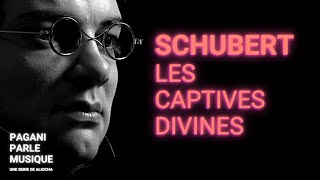
What Dominique Pagani says Dominique Pagani sees Schubert as the lyrical composer par excellence, whom he sets off against a Beethovenian background: he would like to be Beethoven and tries his hand at the large form, but his lyricism catches up with him1 . Yet he makes him one of the most modern musicians, because he subverts sonata form through the lied2 , and because of the recurring dissonant minor second and a hypnotic repetition, as Gould discovers on hearing Richter play the Sonata D. 9603 . He describes a music that oscillates between depression and ecstasy, a melancholy happiness, "sublime but deathly", with suffering even in the smile4 . He reads closely the Trio No. 2, whose cello theme returns like Vinteuil's phrase5 , as well as Die schöne Müllerin, with its clear water in which the miller drowns6 . He also compares the step of the Wanderer to Nerval's slow walk.
1 Musicosophie 1. Schubert et les maîtres chanteurs 3 Dec 2020 · 3:41 2 Musicosophie 6. La Variation Jazz... de Beethoven 15 Dec 2020 · 1:44:44 3 Musicosophie 3. Qu'appelle-t-on une musique moderne? 3 Dec 2020 · 55:57 4 Musicosophie 5. Bonheur contre pulsion de mort en musique 11 Dec 2020 · 1:08:54 5 SCHUBERT - LES CAPTIVES DIVINES • Pagani Parle Musique 3 Aug 2022 · 14:55 6 UN PRINTEMPS DES PEUPLES ? 18 Mar 2023 · 55:25 Summary produced automatically from 78 of the passages below, to be reviewed; the numbers link to the moment in the session.
Who is this? Franz Peter Schubert (; German:; 31 January 1797 – 19 November 1828) was an Austrian composer of the late Classical and early Romantic eras. He was immensely prolific despite living a short life, leaving behind a vast oeuvre of more than 1,000 compositions, including over 600 Lieder (art song in German) and other vocal works, seven complete symphonies, sacred music, operas, incidental music, and a large body of piano and chamber music. […]
Read the article on Wikipedia Text: Wikipédia , CC BY-SA 4.0 , excerpt · Portrait: Wilhelm August Rieder, Public domain
Series · 3 Dec 2020 Musicosophy 1. Schubert and the master singers3:41 Standing out as a figure against a Beethovenian background: a summit of lyricism facing the dramatist, whom he would like to be. 7:44 Impromptu in F minor Begins in a Beethovenian manner then, at measure 68, lets a lied emerge that occupies three quarters of the piece.12:56 Piano Sonata in B-flat Major His genius lies in hypnosis, as Gould understands upon hearing Richter play the first movement.17:26 Die schöne Müllerin The cycle ends at the bottom of the stream, with a lullaby sung after death: hypnotic song par excellence.22:19 Symphony No. 9 "The Great" The man of the clearing: in the second movement a ray of paradise appears, but for himself alone.Series · 3 Dec 2020 Musicosophy 3. What is called modern music?17:47 Proposed as perhaps the most modern musician in history. 55:57 Piano Sonata in B-flat Major D. 960 Considered conservative, he is modern through the recurring minor-second dissonance; repetition is hypnosis.1:00:12 Moments Musicaux Op. 94 The sixth Moment musical multiplies unprepared breaks and modulations: a clearing from which one does not emerge.1:04:30 The most modern of the lyricists, he loses the dramatic element; near-supernatural beauty like a song of the sirens. Season 5.2 · 2 May 2019 #5.6 Nature or Landscape?57:51 The Shepherd on the Rock His last work, the shepherd's song.1:03:38 Obsessed with Beethoven, he ventures into the grand form; his last works are artistically complete. 1:05:42 The andante, a walking rhythm, alternates interiority and panorama and opens the gates of paradise. 1:14:42 The horn call suspends the form: an attempt to step out of time. Season 12 · 4 Jan 2024 I am not who you think I am - The elusive identity14:08 The Erlking A lied as a condensed drama: the night ride in which the child arrives dead.28:15 Set Mignon's song to music; in general brought the lied to perfection. 1:05:34 Winterreise The lone traveler in the snow says: let your dogs howl in front of your masters' houses.Season 11 · 3 Sept 2023 Worldliness in Clouscard: Desiring what? Through whom??1:10:11 He is never more moving than when he returns in the major key. 1:13:21 The Shepherd on the Rock His final work expresses the shepherd's distance.Series · 9 Feb 2021 Musicosophy 15. Plato, Rousseau, Hegel and music1:28:34 The Swan Song Laborious in imitating Beethoven, excels in the lied: the melody flows, up to the last voyage.1:33:42 Piano Trio No. 2 Invaded by death, turns it into a liberating resolution; his finales no longer interrupt the song.Series · 15 Dec 2020 Musicosophy 6. The Jazz Variation... by Beethoven1:40:44 Piano Sonata D. 959 Imposes the lied form within the sonata; the finale pours out without conflict.1:44:44 One of the most modern musicians through this subversion of sonata form by the lied. Series · 3 Dec 2020 Musicosophy 2. From Lévi-Strauss to Nerval on music49:58 His themes are tunes one does not forget. 1:16:16 Unfinished Symphony The isolated individual ends up in an impasse of melancholy or paradisal ecstasy.1:23:04 Hypnotic repetition is better achieved there than in repetitive music, with small variations. Season 13 · 20 Sept 2024 Sickness, misfortune, evil18:05 In his work the stream is a wife. 1:37:06 Impromptus His impromptu illustrates the romantic ideal of the smile through tears; died at 31.Season 11 · 18 Mar 2023 A SPRINGTIME OF THE PEOPLES?55:25 Die schöne Müllerin His music is as transparent as the clear water of his lieder, where one risks drowning like the miller.Series · 3 Aug 2022 SCHUBERT - THE DIVINE CAPTIVES • Pagani Parle Musique14:55 Piano Trio No. 2 in E-flat major In the second movement, a theme stated on the cello is forgotten, then returns with an immortal and wholesome melancholy, like Vinteuil's phrase.Series · 25 Mar 2021 Musicosophy 17. Interpretation32:25 Died in anonymity and poverty. 37:57 Transparent, airy, melodic pianism. 1:13:53 Sonata in B-flat Major D. 960 He recommends Clara Haskil's interpretation.1:20:29 Sonata in B-flat Major D. 960 Through Richter, his rehearsals appear to Gould to be of the order of hypnosis.Season 9.1 · 23 Oct 2020 #2 Benefits and harms of amnesia...59:23 Piano Trio No. 2 in E-flat major Lyric composer; in the solar finale the cello melody of the second movement returns.1:29:30 Overtaken by his lyricism even as he strives to be heroic. Season 7 · 18 Apr 2020 #5 • Harnessed to confinitude57:25 Die schöne Müllerin Genius of the murmur of the brook, notably in Wohin?, the second lied of the cycle, accompanied from beginning to end by the brook on the piano.Season 4 · 15 Mar 2018 #4.6 Angélique (by Nerval)18:12 Piano Trio No. 2 in E-flat The Wanderer's pace, a muffled wandering rhythm, matches Nerval's slow walk.Season 4 · 15 Jan 2018 #4.4 Angélique (by Nerval)1:07:52 Symphony No. 9 "The Great" The walking rhythm of the Wanderer, found again in Nerval's slow obstinacy and in the second movement of his last symphony.Series · 2 Feb 2016 Hegel on the Beach 5/546:50 Die schöne Müllerin Music of clear water, effort toward light; the apprentice miller ends up at the bottom of the water.Series · 7 Feb 2023 Nietzsche, or the Great Ninny - Readings on the Spot3:14 A contemporary of Schumann, yet as different as day and night. Season 11 · 19 Oct 2022 "Speech is the best and the worst of things" (Aesop)13:03 In his work everything takes place by the side of small streams, the Bächlein, never the Amazon. Talks · 14 Jul 2022 From Plato to world revolution, by Dominique Pagani6:44 Example of the lyric: always caught in a feeling of despair or ecstasy. Season 10 · 24 Nov 2021 10#5 The figure of Antigone, such as into herself at last...10:20 A musician from the petty bourgeoisie, not from the aristocracy. Series · 4 Oct 2021 #4 Nomad and sedentary - The case of Nerval1:25:17 The walk through the woods evokes his music. Season 9.2 · 9 Jun 2021 9 #23 "Ruled like music paper!" • Bach • Nerval • Lévi-Strauss1:48:29 Sung by Kathleen Ferrier. 2:05:13 A Schubert sonata does not sound the same at two different moments. Season 9.2 · 27 May 2021 9 #22 Science and/or philosophy of "artificial intelligence" - Part 243:34 Kempff is a great Schubert interpreter; the complete sonatas are recommended. Series · 30 Apr 2021 My eco-cabin in the ZAD: autonomy or alienation? • Philosophical Q&A • Dominique Pagani19:10 Hungarian Melody in B minor, D. 817 Piece heard in the documentary.Series · 18 Apr 2021 #2 Lenin, or the wings of dreams33:54 His music in Barry Lyndon. Season 9.2 · 14 Apr 2021 9 #19 Twilight of the Gods, or from repetition to liberation • Part 217:07 Unmatched in the lied, but not the best for the Mignon poem. Series · 7 Apr 2021 #1 Mignon, or the song of silence50:38 Among the composers inspired by Mignon. Series · 25 Mar 2021 Musicosophy 18. What is musical in music38:49 Author of a lied on Mignon. 1:19:35 Schubertian song and its finales that vary an arioso theme: pure melody that flows. Season 9.2 · 4 Mar 2021 9 #16 How can sciences of history be real?11:38 Example: saying that Schubert is "someone" has a great extension and a poor comprehension. Series · 2 Feb 2021 Musicosophy 13. Mozart restored5:08 Contemporary of Goethe; breaks of discouragement as in Mozart. Season 9.2 · 29 Jan 2021 9 #13 How can sciences of history be real?2:24 Same list of musicians. Series · 28 Jan 2021 Musicosophy 12. Nietzsche (right up) against Wagner5:35 He is part of the sequence from Bach to Wagner. Series · 24 Jan 2021 Musicosophy 11. Modal and tonal music1:13:17 Nine symphonies; subverts sonata form through the lied. Series · 15 Jan 2021 Musicosophy 9. Romantic irony and the Vinteuil sonata1:18:04 Even in his cheerful music, there is a suffering in the smile. Season 9.2 · 14 Jan 2021 9 #12 How can sciences of history be real?1:54:55 Among the essentially lyrical romantics. Series · 11 Jan 2021 Musicosophy 8. Happiness and unhappiness in music1:18:18 Ecstasy and depression alternate in him, but not pleasure. Series · 11 Dec 2020 Musicosophy 5. Happiness versus the death drive in music6:59 His happiness has a melancholic, heartrending side absent in Tchaikovsky. 32:16 Example of music that is sublime but deathly. 58:41 In Beethoven's shadow, more modern than one thinks. 1:08:54 Level and floating, between total depression and ecstasy, opposed to Schumann. Series · 3 Dec 2020 Musicosophy 4. Sound ghettos19:04 Very simple melodies, objects of variation. 27:42 A lyrical composer, unlike Beethoven. 46:00 Takes counterpoint lessons a few months before his death. Season 9.1 · 8 Oct 2020 #1 Benefits and harms of amnesia...37:17 Ganymede Fine musical setting of Goethe's poem.Season 8 · 21 Jun 2020 #11 • Return to the logics of the subject11:03 Avant-garde that Hegel is said, by his exegetes, to have neglected. Season 7 · 11 Apr 2020 #4 • Harnessed to confinitude12:27 Died at 31 in anonymity and poverty. Series · 23 Mar 2020 Interview with Dominique Pagani: Introduction to the upcoming workshops4:30 Die schöne Müllerin His transparent music, like Nerval's sentence, makes one slide over the signifiers.Season 5.2 · 25 Jan 2019 #5.4 Introduction / Nature or Landscape?9:23 Impromptus A participant associates an impromptu with Friedrich's painting.45:43 Wanderer Nerval's wandering had been compared to Schubert's Wanderer metrics.Season 4 · 12 Apr 2018 #4.7 Angélique (by Nerval)1:36:31 The Erlking A lied written on Goethe's poem on the back of a brewery invoice.Season 4 · 12 Feb 2018 #4.5 Angélique (by Nerval)48:11 The walk undertaken on foot "à la Schubert." Season 2 · 15 Feb 2016 #2.2 Between crisis and war: Philosophising?34:53 Unfinished Symphony Died at 31; one who knows he will die does not write the same way.Season 1 · 28 Jan 2016 #1.8 Between crisis and war: Philosophising?1:23:50 Haunted by shadow, his music is a quest for light. Talks · 26 Apr 2015 The Music of History35:33 his quartets listened to in a country house 1:33:38 Germanic repertoire performed by the Russians 
 Series · 3 Dec 2020Musicosophy 1. Schubert and the master singers