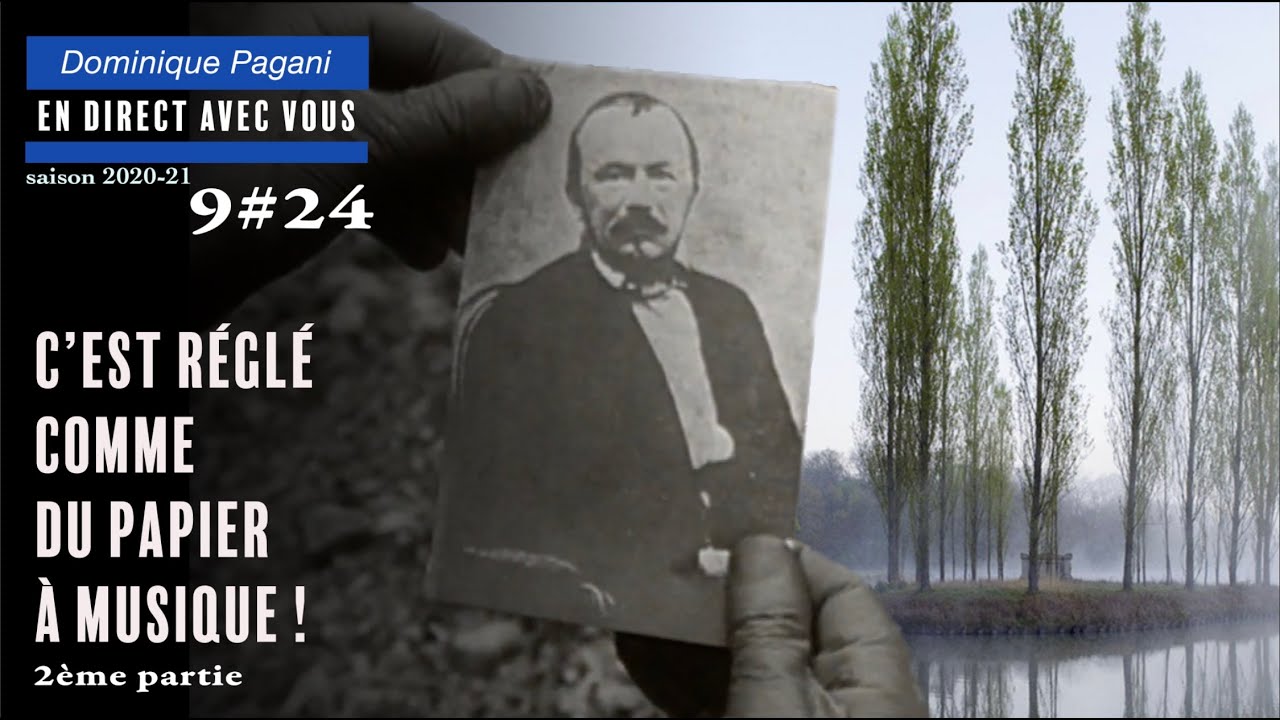
English translation of the French transcript, made with AI and not yet proofread — click a paragraph to jump to it. Show the French original
Pygmy polyphonies and the cycle's balance sheet 3:12 It is shared mainly between Cameroon, Congo, Brazzaville, and Gabon. Pygmies are reputed to be one of the least technologically developed peoples. There's no value judgment here, purely at the level of technical, purely technological power. So there are those who naively think that the culture or music of a people that is technically primitive — if "primitive" even means anything — must also be primitively simplistic. There have been numerous studies done on Pygmy music.
4:07 I want to salute here the musicologist Rouget de Lisle, as I call him — not only because he lived on the Île Saint-Louis and worked enormously on this kind of subject, and I had gone to interview him, he's no longer with us now, on the Île Saint-Louis — who studied this music in the field, but he's not the only one. And one has been able to note the incredible complexity of the polyphonies.
4:40 Here again, a prejudice: people believe there are beautiful things in extra-European music, but that, in the end, a privilege, an exclusive attribute of Western music — a phrase that doesn't mean much, ever since we've known the earth is round and that "West" is wherever you want it to be, and often serves as a way of not saying "capitalist"... but in any case, people say that the privilege of this music is that it's the only one capable of producing polyphony. And what is apparently paradoxical is that the polyphonies among the most complex, among peoples without writing, come to us from societies among the most isolated, the most cut off from any relations with the rest of the world — relations that could accelerate material development, technical input.
5:40 I'm thinking of the polyphony of the Solomon Islands, for example, where — here, of course, this is moving, it sounds like plainchant, but I'm sure some of you with a trained ear, I know it, and I'm glad of it, have spotted the writing — well, the "writing," the imitative procedure, as it's called for counterpoint and fugue. That is, the second voice takes up the structure of the first voice, a bit like in "Frère Jacques," to take the simplest possible example of a canon.
6:22 Why did I want to begin with this piece? First, it has a slightly melancholic tinge, a bit like those endless hours of the rainy season deep in the forest, when you feel the sun will never come back — just barely, just barely, it's a slight coloring, there's nothing morbid about it, and it's nowhere near a grand elegy.
6:53 And because this melancholy seemed to me to be in tune, even if it seems contradictory, with the happiness I feel at being with you again — tempered by a touch of melancholy at seeing you for the last time, at least within this regular cycle we've been doing, what's called biweekly, every two weeks, on Wednesday evening. Namely, that we are going to close this cycle, which was titled "Can the sciences of history be real?"
7:35 To what extent can the sciences of history be real? Well, we've done quite a lot of... I don't want to give a summary, because that would be a summary of a summary, but still, I mean, I spent a lot of time recalling that it's not logic that is lacking in human affairs, as opposed to the natural sciences, of course. It's not logic that's lacking, but a logic proper to subjects, one that is completely, radically different — I haven't gotten around to it yet.
8:18 In praxis, yes. In praxis, a marsh or a forest has to disappear for a cultivated field to appear. But from the strict standpoint of logic, there is no contradiction in the fact that we are animals and will remain so until the end of our lives, until our last breath. Until the end of our lives, we will need to eat in order to live, for example, right? That owes nothing to the logic of subjects.
8:52 But, in parallel — I say in parallel to show just how independent it is, that it's not at all the same logic — there is a logic not only of the sign, of meaning; that's how, roughly, I've characterized it to simplify. Now, we need to clearly distinguish, or even oppose, this to the logic of cause and effect. You see? With all the corollary differences that go along with this distinction, to sum up. Thus, the relation of the sign to meaning, of meaning to the sign, is a relation of immanence, whereas the relation of cause to effect is a transcendent relation — or transitive, if you prefer that term.
9:37 To speak as Spinoza would. That is, they are two different moments in time — first there's the heat, and afterward the expansion of the body. Whereas the meaning of a dream, for instance, runs through it from one end to the other. But it's not only the opposition between cause and effect on one side and meaning and sign on the other. It's also the fact that this is a logic of someones, not of somethings.
10:07 And that is precisely why millennia have still not sufficed to make it explicit. For we have seen, and not only during the cycle that ends tonight, but in previous cycles, like the one I did around the pairing of memory and amnesia — anamnesis and amnesia, if you prefer, recollection rather than memory, and amnesia.
10:38 You know that for Plato, all knowledge is recollection. We had seen that memory is not a faculty one either has or doesn't have, that some have developed it and others haven't, as though it were assigned to a slot from the start. First of all, it's trained like a muscle. The ancients knew this well, especially in an era when writing, and printing even more so, did not yet exist, and oral transmission played a crucial role, and one had to think of a messenger who must carry an important piece of news, not far from the capital of his kingdom or his country, and who must not forget the message entrusted to him — so there were, indeed, mnemonic techniques.
11:24 You will notice that in popular linguistic usage, versified, rhythmic, rhymed sayings are common, precisely because it is much easier to memorize a poem than a newspaper article, because of the recurrence, the regularity. So, the logic proper to the subject, in parallel to — I'm summarizing all the distinctions — a logic of reason, as opposed to, say, in astronomy or biology, a logic of the understanding: if Y equals F of X, that's the understanding.
12:15 I recall that the understanding, especially from Kant onward, occupies a middle position between sensibility, the senses, and reason, which aims at the transformation of what is — action — whereas the understanding aims solely at pure knowledge, hence its concern for objectivity, for not mixing it with the subject's interests, which is the least one can expect of a scientist. Just as one understands very little of human actions when one abstracts from the interests of the subject — precisely to the point that we had to rehabilitate a certain sense of teleology, certainly not theology, a pre-Galilean teleology, one that would already be inscribed in the order of things and of nature, a kind of providence — no, absolutely not, but rather finalities proper to subjects. And there, I don't want to develop this too much, because it would anticipate the text with which we're going to begin.
13:25 So, there you have it — I have a little touch of melancholy, because I'm very happy to be with you again, I'm very grateful for your loyalty, which has allowed us to make this journey together on this problem, and so I'm a bit saddened at having to leave you, at least as far as this cycle and our regular reunions are concerned, because I had a good talk with Pierre-Alain about it, who is wonderfully accommodating — the short formats we've been putting out for a while now, which don't seem to displease everyone, far from it, will continue, in a less regular pattern and on often unpredictable subjects. We'll have occasion to talk about that again with our upcoming short formats, which won't be long in coming, by the way.
From Bach's canon to Nerval's two superimposed texts 14:30 So, I return to the very beginning of tonight's session, to these childlike voices, to these Pygmy polyphonies which, despite their apparent simplicity — that of childhood almost, their clarity, their primitiveness — are, I repeat, upon strict musicological analysis, of a disarming complexity. I return to this to show that we are in continuity with our last session — it's regular as clockwork, as they say. We took a Bach fugue, a fugue in the form of a canon, exactly — "Fugue"
15:19 "Counterpoint" — that's Bach's exact title — counterpoint, in Latin "Contrapunctus," counterpoint by augmentation and diminution — that concerns tempo, I do augmentation and diminution — and in contrary motion, the second voice doing, backward, right, from the end toward the beginning, what the first voice does from the beginning toward the end. It's an extraordinary complexity.
15:50 The Pygmy polyphonies, or those of the Solomon Islands, have nothing to envy, at the purely formal level, in this kind of superposition and subtlety. And I'm sure that those of you with a trained ear noticed it even in the short excerpt we just heard. So, last time I wanted to begin with the Bach piece which, precisely in its title, expresses a contrary motion, as you can guess, to prepare our reading — the one we did last time — of the two texts by Nerval that we superimposed.
16:36 And it was in their superposition — which was not at all intended by the writer. The writer himself wrote one in a certain context and the other in a different one. These are contexts that have nothing to do with each other, and which even oppose one another, right, between the context of somewhat journalistic, often humorous accounts, "Filles du feu," "Angélique." And the visions, both ecstatic and terrified, right, of the patient in Dr. Blanche's clinic, in the process of writing that extraordinary document of pathology which is Aurélia.
17:22 And, oh, surprise, in superimposing them, we saw that the second is a contrary motion, that the second is the first multiplied by minus one, I had said — I was going to say, exaggerating just a little, but I think I'm not exaggerating at all. If you look closely at the attributes that got multiplied — and I'm sure some of you called me to tell me so — some of you had the intelligence to keep going through Nerval's text and noticed that the more textual material one gathers, the more this symmetry, or rather this antisymmetry, became manifest, became expressed.
18:00 And so, let me now sum up this introduction. I wanted to begin with the Pygmies to show — above all so no one thinks I'm privileging Nerval, our Eurocentric culture, here Romantic-centered — Nerval belongs to the Romantic generation, but he far exceeds it; the Surrealists noticed this well, the Symbolists too, and Proust, need I say more. So, to show that this symbolic logic is at work well beyond the examples I habitually use, which I take for convenience, because it's easier to produce texts for you and distribute them, right, than to take you on a tour of a picture gallery, or to find the time needed for sequences of theater or music.
Infinite desire or limited need: the economic stake 18:57 And as for the other human sciences — verbal expression is one of them, but I mean ideological expression — I'm thinking here of economic science. I deny it the status of being scientific — I'm not talking about econometrics — but the economic sciences do not escape these symbolic tropisms.
19:38 Let's take an essential question, philosophically speaking, but one with major stakes for economic science: if the object of praxis, of human technicity, since the earliest times, since the first knapped flints up to particle accelerators — if the driving force of this technological activity proper to man at this degree of complexity, if it is at the service of need, that does not produce at all the same discipline as if it is at the service of a desire with no assignable limit.
20:34 That's good news for union leaders worthy of the name — and there aren't very many of those these days, I know, well, at least among those who get media coverage, because there are some fighting obscurely in the shadows, I mean, and obtaining results and occasional victories. But it's very good news. Otherwise the employers would say, listen, there's a natural order to things, past a certain rate of increase, that's enough — I mean, if it's at the service of desire, and human desire is infinite, because it is above all negative, that is, because practical activity serves above all to avoid remaining in the contemplation of finitude, which is deadly — then, I mean, there is no reason whatsoever, not only in principle to advocate degrowth, I'm speaking in principle—
21:44 —that there might be objects whose production seems pointless to me, I'm the first to think so, but that's not the point, right, that the apostles of degrowth — when I watch their talks, written or on YouTube, however you like — I mean, it's quite appalling — they would like to keep the monopoly on enjoying technical progress for themselves while depriving the rest of humanity of it and making it go backward.
22:14 I sometimes support this after listening to them. That's not everything — I'm thinking of an environmentalist like Jancovici, I mean, while being very concerned about the threats weighing on our environment, I'm the first to say that nuclear power is a thousand times less harmful, right, than wind turbines, for example.
22:46 Not all environmentalists have this honesty. So, if desire — you see, an application of the symbolic order that we brought to light with the comparison of the two texts by Nerval, and on which we're going to make progress and conclude today — if the symbolic order, the logic of the subject, which is a logic of meaning immanent to the sign and not merely of the transitive cause in relation to the effect, or rather the effect transitive in relation to the cause — you see, the economic stakes in a labor conflict touching on the question of income, that is, we're in the process of attacking our pensions, we're in the middle of talking about it.
23:39 And in a context of near-provocation, right, just a few weeks before an election deadline, the European Commission is applying pressure, it doesn't let up, it's like a Doberman, right, that doesn't release its jaw pressure on the peoples. And if we show that what is decisive in human affairs is more a matter of infinite desire than of limited, repetitive need — I've already told you that I've often seen lions in my life south of the Sahara, and every time, they're dozing, it's repetitive.
24:25 I sleep, I wake up, I hunt, I sleep, I wake up, I mate, I sleep, I wake up, I hunt. Whereas Eros under Neanderthal man and Eros in The Princess of Clèves — there are, all the same, striking differences. Starting from a given that, from the natural standpoint, doesn't change much, right? There, I wanted to make these reminders, but, to stay in the abstract, especially for a last session, I'd like to recall what is precisely on tonight's agenda.
From determinability to determination; reading Aurélia 25:08 On tonight's agenda, we need to convert the try, as they say in rugby. Last time, we scored a try by bringing to light the incredible determinability, predictability that emerged from texts written by someone reputed to be a fantasist, a dreamer, even a madman, or all three at once. To the point that it can be formalized with double-entry tables, as we saw.
25:43 But this determinability, for now, remains mysterious to us. We don't know what establishes this logic. Is it a biological logic? Is it — after all, the child's relation to the mother does begin, after all, on a biological basis. Is it something proper to Nerval? Is it universal? Is it a determination we find elsewhere?
26:14 In other words, our determinability has not yet gone as far as determination. Let me remind you of the example of the detective who can well sense that someone has passed through the crime scene and slightly changed the arrangement of the objects, but still doesn't know who, or to what end. There you have it. And that is what we're going to try to clarify today. I move without further delay to our first text, again taken from Aurélia, the account of Nerval's madness, and it begins with the recounting, I was about to say, of a dream.
26:55 But no, he doesn't say "that night I dreamed that," as sometimes happens elsewhere in Aurélia. "One evening, I believed with certainty that I had been transported to the banks of the Rhine." I believed. That's precisely why he was interned — he says so very clearly himself, not far from the beginning of Aurélia: "here began what I would call, for myself, the overflow of the dream into real life." When you have the same logic as the dream, but awake, in broad afternoon, and within a social life that continues, it's no longer merely a dream, it's a vision, right?
27:36 So, "one evening, I believed with certainty" — I won't dwell on this, because for the moment it doesn't advance our search for the logic. "One evening, I believed with certainty that I had been transported to the banks of the Rhine" — let me first read the text in full. "Before me stood sinister rocks, whose outline took shape in the shadow. I entered a cheerful house, where a ray of the setting sun gaily crossed the green shutters festooned with vine."
28:06 "It seemed to me that I was entering a house I knew, that of a maternal uncle, a Flemish painter, dead for more than a century. The sketched paintings hung here and there. One of them represented the famous fairy of this shore. An old servant, whom I called Marguerite, and whom it seemed to me I had known since childhood, said to me: 'Aren't you going to go to bed?'"
28:36 "'For you have come from far away, and your uncle will come home late. You will be woken up for supper.' I lay down on a four-poster bed draped in chintz with large red flowers. Before me hung a rustic clock on the wall, and on this clock a bird that began to speak like a person. And I had the idea that the soul of my grandfather was in this bird, but I was no more astonished at its speech and its form than at finding myself transported, as it were, a century back."
29:11 "The bird spoke to me of family members, living or dead at various times, as if they all existed simultaneously, and said to me: 'You see that your uncle took care to have his portrait made in advance.'" Unfortunately, here, the transcription on Wikisource failed to note that the possessive "his" is in italics in the original text. "'Took care to have his portrait made in advance?'"
29:42 "Now, she" — again the same device, it's in italics — "now, she is with us." I'll repeat, without interrupting myself this time, what the bird says: "'You see that your uncle took care to have his portrait made in advance. Now, she is with us.'" I turned my eyes to a canvas that depicted a woman in old German-style dress, leaning over the riverbank, her eyes drawn toward a clump of forget-me-nots.
30:16 "Meanwhile, night gradually thickened, and the sights, sounds, and feelings of the place blended together in my drowsy mind. I believed I was falling into an abyss that crossed the globe. I felt myself carried, without suffering, by a current of molten metal, and a thousand similar rivers, whose hues indicated their chemical differences, furrowed the bosom of the earth like the vessels and veins that wind through the lobes of the brain." Let's go back over this from the beginning.
The Rhine, the house at Mortefontaine and the painter uncle 30:50 I'm sure that, with practice, some of you didn't need me to see that the fact that "one evening I was transported to the banks of the Rhine" — already, chance is eliminated, determinability is already there. Nerval's mother is buried, even as I speak, in distant Silesia, as he calls it, which was part of the Germanic lands at the time — well, at the border of the Germanic world and the Slavic world, and it belonged to the Reich, but it had the traditions, the peoples, of old Slavic traditions, as, moreover, did the region of Berlin when you look at it historically. But let's not complicate things.
31:35 One evening I am transported to the banks of the Rhine to go toward the tomb of the mother; Nerval's imagination, his thought, must cross the Rhine. His frequent trips to Germany — as has been noted, even though he never speaks of them — are so many attempts to try to find, to get as close as possible — it wasn't materially obvious — to the maternal tomb. It's on his last journey, a year before his death in 1854, that he will go the farthest, into the region of Leipzig, the gateway to Eastern Europe — isn't it Asian Europe that surfaces here — so already there is a symbolic order manifesting itself through the simple fact that the songe — one must not say 'rêve' but 'songe' — fulfills desire much more than voluntary, conscious memory ever could. 'In front of me were sinister rocks whose outline took shape in the shadow' — there, for the moment, we're in the logic of Romantic imagery.
32:48 of the period — when they evoke the banks of the Rhine or the German domain, it's rather for stories of spectres, of the Erlking, of ghosts and fantastical, rather dark things, stories that often end badly. So for now it's consistent: 'in front of me were sinister rocks' — that fits with the banks of the Rhine — 'whose outline took shape in the shadow.' 'But all of a sudden I entered a laughing house' — ah, the contrast — 'through which the rays of the setting sun gaily crossed the green shutters festooned by the vine.' Now, those familiar with Nervalian intertextuality know very well where this house is; it's perfectly identifiable — it's the one he speaks of in Sylvie, the maternal house at Mortefontaine, 40 km north of Paris. The maternal house is literally superimposed on the Rhine, which in the causal order is absurd, or rather nonsensical — you can't be at once in the Valois, 40 km north of Paris, 40 km from Notre-Dame, that's not very far, and more than 500 km
34:00 away, on the banks of the Rhine — but which, in the symbolic order, is an irrefutable logic, because it confirms that we are indeed within the maternal complex. For now, in this dream, 'I entered a laughing house,' since we are getting closer to it, 'through which a ray of the setting sun gaily crossed the green shutters festooned by the vine. It seemed to me that I was entering a familiar dwelling' — this confirms here that the memory of the one having the vision, but the memory of his unconscious, goes much further, as I was saying, than his voluntary memory, to periods that voluntary memory can never reach — for most of us, beyond 3 years old, 2 and a half at best, it's very hard to have memories — but memory can go back further, even to the prenatal period, deep in the unconscious, but through symbols of course. 'It seemed to me that I was entering a familiar dwelling, that of a maternal uncle' — well there you go — a Flemish painter dead for more than a century. We've already seen the figure — I won't dwell on it — the familiar figure of this maternal uncle
35:10 to whom she was not very attached, who is a kind of ideal father, whereas he has a rather hostile relationship with his real father. The maternal uncle, the mother's brother, here — beyond Nerval, one must know this, it gives considerable scope to our determinability and to our symbolic order in the anthropological sphere in general — all those who have studied kinship systems, whether deep in the Amazon, in Africa, in Oceania, or elsewhere in the countryside, know very well that the maternal uncle is almost always a positive figure in stories and mythologies, always benevolent toward the hero, in any case has a positive role, let's say, to stay neutral. 'It seemed to me that I was entering a familiar dwelling, that of a maternal uncle,' a Flemish painter dead for more than a century — you'll see why I insisted on the word 'painter' — 'the sketched paintings were hung here and there; one of them depicted the famous fairy'
The Lorelei, the clock and the talking bird 36:23 'of this shore' — everything is said, since he says 'famous,' as she was at the time. Heinrich Heine, Nerval's best German friend, was in Paris — his most famous poem — the lyric German poet, also with a corrosive humor that stands out from the average of German Romantics; and Hegel had clearly seen — because Heine comes at a late moment in German Romanticism — Hegel had clearly seen that humor or irony are always a sign of the end of a cycle in aesthetics, whether it's the aesthetics of ancient Greece, where the laughter of Aristophanes resonates over the ruins of the city, finally ruined by the Macedonian armies, or whether it's in French Romanticism an Alfred de Musset speaking of the moon over the bell-tower 'yellowed like a dot on an i' — that's not at all the fascination with moonlight — and who had himself called
37:34 himself Prince Phosphorus — a kind of self-mockery that we also see especially developed in his play Lorenzaccio, which was a kind of permanent self-mockery. So Heine, his most famous poem, which every German schoolchild recites, is the Lorelei. First, she's a fairy; second, she's a fairy 'of this shore,' a fairy said to reside on the rock located between Mainz and Koblenz on the Rhine, in the Rhineland, and who has, like the Undines, the Nixes, the daughters of the water, a reputation like Homer's sirens — we find the theme of the female voice again in Nerval here — of having a song so alluring and so magical that the boatmen lose all sense of caution upon hearing it. By 'boatmen' it's not a matter of sailors like Jason or Ulysses
38:44 here it's a matter of the skiffs, since it's river traffic on the Rhine, and the boatmen lose all awareness of vigilance in the river journey and crash upon the rock and often lose their lives. 'One of them depicted the famous fairy of this shore' — and one last determination, I'll go quickly, when I say last it's because we can't cover them all, that would take forever — the Lorelei is the title of one of Nerval's first relatively developed major prose works, when he stops merely writing reviews of plays or newspaper articles and starts writing for himself, signing his name — it's the Voyage en Orient, and the Lorelei, which is also precisely a travel narrative — and so one of them, one of the maternal uncle's paintings, depicts
39:54 the famous fairy of this shore. It's interesting to see that she's an ambivalent woman who attracts but at the same time embodies a danger. 'An old servant whom I called Marguerite' — so we're increasingly in the archaisms of childhood, an old servant — 'she says to me, are you not going to go to bed, for you have come from far away' — she speaks to him like a child. Ah yes, he has come from far away, Nerval, an immense traveler — he is worn out when he has this vision. There's something pathetic in the fact — I remind you that he died in an act of despair, a suicide is more likely, because I'll clarify this — more likely, because a hospice to which he had knocked — so a few moments before, he was rather looking for a place to sleep, he wasn't thinking of ending his days — and it was bitterly cold in Paris that night, January 25, 1855
41:05 the night of January 24-25 — they refused to open the door for him, there was no answer to his knock, and you know what followed. It's all the more pathetic to see that here, in the dream, it's the complete opposite — everything is reassuring, there's a bed, a place to sleep, but it's not just any bed, it's not a wayside inn like he'd known so many of, more or less dubious, more or less welcoming, but it's the familiar family domain, and at the center of the family, of course, a maternal figure, if only through this old servant. 'I stretched out on a canopy bed draped with large red-flowered chintz' — an extraordinary oneiric precision — 'there was in front of me a rustic clock' — and here, for the first time, an object illustrates the temporal instance, a clock, whereas we are outside of time, you see, and this being outside time will be confirmed by what the bird says — let's not get ahead of ourselves — 'there was in front of me'
42:16 a rustic clock hanging on the wall, and on this clock a bird that began to speak like a person. At the same period, Schumann writes a marvelous, pre-Debussyste piano piece, with incredibly innovative harmonies for the time, called The Prophet Bird. Here again, these are not fancies peculiar to this or that creator — take, for instance, the Senufo statue — a people straddling the Ivory Coast and Burkina, northern Ivory Coast, southern Burkina — and, like the Bambara, they share at least this point: there are often birds carved on the skull, on the head, always on top, like the Gauls or the ancient Germans with wings on their helmets, usually crow's wings. I believe I once mentioned to you, in other years, that I had once asked a Senufo sculptor himself why
43:28 it was systematic that there were birds perched on the heads of the statuettes, and he said: because the bird is the one who, in flying, will transmit your thought before you even have time to hold it back, will transmit your thought to the other. You see, a magnificent, magnificent metaphor for the unconscious expressing itself — no matter how much one tries to hide it, not to show it to the other or to oneself, to repress it, a slip of the tongue here, a dream will tell everything. 'There was in front of me a rustic clock hanging on the wall, and on this clock a bird that began to speak like a person, and I had the idea that the soul of my ancestor' — so the maternal uncle, the Flemish painter dead for more than a century, you see we are outside time, and yet it's on the clock — 'was in this bird, but I was no more astonished by its speech and its form than by seeing myself as though transported back a century' — a marvelous property of the songe, to go against the law
Simultaneity, dream censorship and two forces in Nerval 44:38 the most implacable law of time, which is anti-symmetry, irreversibility — here it's reversible. The proof, moreover, is that the bird spoke to me of members of my family, living or dead at various times, as though they existed simultaneously — this time it's stated explicitly, you see why I don't like to interpret the text, it says everything. Simultaneity is the opposite of succession, it's not 'now and then,' irreversible — here the past is preserved, remains present simultaneously. 'And he told me' — here it's the bird speaking, you see — 'that you should know your uncle, the mother's brother, had taken care to have his portrait made in advance, before she died,' of course, before this tragedy that meant his son never saw her again, the one he abandoned when he was two years old, out of love, to follow her husband through the mud, the ice, the snow of the Russian campaign. Now
45:50 she is with us — you see how this songe, for now, overcomes — for now I — the logic is so obvious that I won't dwell on it too much — 'I fixed my eyes on a canvas which represented a woman in ancient German costume,' again you see the German investment of Nerval is not altogether unrelated to the fact that his mother is drüben, as they say in German, over there, on the other side of the Rhine, at any rate her corpse is — 'a woman in ancient German costume, leaning over the edge of the river' — we find here again a little of the famous fairy of this shore, leaning over the riverbank — 'and her eyes drawn toward a tuft of forget-me-nots.' Nerval made himself famous at 19 by translating Goethe's Faust, I've already said this, in short he understands German well — forget-me-not is 'Vergissmeinnicht' in German, don't forget me — the eyes drawn
47:01 toward a tuft of 'don't forget me' — fidelity, memory, the most faithful memory is the one that reaches farthest back. 'However, the night grew thicker little by little' — that's why I took this text, it's for the passage that begins now, one might say very much cut off from everything preceding it, because it's the rupture that interests me, the moment when it's so clear that the dreamer, the visionary himself, is going to realize — well, this is true, but it's actually about my mother, in fact all my delirium, all my whole investment, it's actually because I am inconsolable over my mother's death, I don't need Doctor Freud, myself — it was a moment when these certainties were going to collapse into a terrible truth, that everything grows blurred — that's not me inventing it. 'However, the night grew thicker little by little' — until then, we were looking at the sharpness of details — 'I stretched out on a bed draped with large red-flowered chintz'
48:12 a clock made of rustic walnut, and the bird that starts speaking like a person, the sketched paintings, the detail of the paintings, the eyes drawn toward a tuft of forget-me-nots — and now everything grows blurred, as though it were urgent to censor the truth beginning to appear. You see how symbolic activity is ambivalent — I'm dwelling here because some of you, some of you especially, have told me — and these are the ones who ask the best questions — when someone says she doesn't quite understand what negativity within the subject means here, you have a magnificent example of it here: it's Nerval preventing himself from going all the way to the end of the anamnesis he was in the process of carrying out, of the gradual surfacing, little by little, you see, of the past truth into the present. He is in the process of recovering his truth, and now, you see, another force besides anamnesis, rather an amnesiac force, comes here to blur things. 'The night grew thicker' — and you can guess
49:22 I deliberately let the text run to the beginning of another, more cosmic chapter — whereas before it was very intimate, familial, you see, the old house at Mortefontaine, and the aspects, the feelings of the places, blended together in my drowsy mind. 'I thought I was falling into an abyss crossing the globe' — it becomes gigantic — 'I felt myself carried without suffering by a current of molten metal, and a thousand similar rivers, whose hues indicated their chemical differences, furrowed the bosom of the earth like vessels and veins' — and coming from someone who was being handled by the psychiatrists of the time, it's pathetic to finish this sentence — 'and like the vessels and veins that wind among the lobes of the brain' — there we go, that's what was missing here. Here we reach a determination — you'll say, yes, but then I don't quite see how the human sciences can be constituted, we don't arrive at the universal, at the law, you know, at the law of the fall of bodies
50:32 it is even the same on the moon as on earth, I mean it is formulated in the same way — the force is not the same, it's not quite a force, gravity, far from it, since Einstein we know well it's rather a property of space — but anyway, you know, you've read Tintin, that we are much lighter on a mass like that of the moon than on earth, and on Jupiter we would be so flattened that it's not even worth thinking about — but the law explaining all these differences remains always the same, the one formulated by Newton. There, we reach a singularity, the Nerval case, you see, tada tada — this is precisely where we need the text that follows, because I said two determinations at the start: we have an individual, animal determination
51:42 which we all have, this is not — and which means each of us has a destiny that is his own in some way — and then at the same time there is something collective that comes from history, proper to what we call a culture, for example, and more collective, more relational, where the relation to the other, you see, is more important there than the relation to the thing — I don't know, myself, to the acidity of my stomach, or on the contrary to its inability to digest for lack of acid. That's why I want to show that what is extraordinary in the adventure of Nervalian text, particularly of his prose, is that he doesn't stop at this pathology which is evident in what we've just seen, where we can clearly see there's a cyclical side, I spend my time getting closer and closer to my truth
52:52 by traveling through a whole series of symbols. 'Nature is a temple where living pillars sometimes let confused words escape; man passes through forests of symbols that watch him with familiar glances.' So it's not just about that, since we've seen — I refer you to the cycle I did on Angélique which you can find on our website of course, or on the YouTube channel — on Nerval's Angélique, and we're going to read an excerpt from Les Filles du feu, borrowed from Sylvie and not from Angélique, in the text that follows — what we had seen is that there are two forces battling inside the narrator: there's his maternal complex, which can only lead to despair, namely recognizing that at the end of the quest, where there should be divinity, the fairy
54:02 of this shore, Isis, the Virgin Mary, all the figures through which one must pass for the maternal incarnation — in fact there's a corpse, at Mortefontaine, you see, and then there's another force that pushes him not toward the mother's tomb but toward Rousseau's grave. 'A madman divides himself between the queen's tomb and the sage's grave.' Here we see a logic at work — I seem to be saying it gratuitously, well, let's go, since you know I don't like interpretations — complete change of context, we are no longer in the clinical narrative of a vision, we are in Nerval's best-known text, the text that most enchanted Proust, who held a veritable cult for it, this novella Sylvie, which is also marked by the forest — Sylve — especially when we know that Sylvie's brother is named Sylvain, and that in Angélique Nerval speaks of the peoples who existed in Roman times in these forests
The symbolic forest: Baudelaire's The Swan 55:12 and whom he calls the Sylvanectes, as anthropologists and historians do — we'll come back to the symbolic function of forests — oh, but let me say it right away, since I want to show that this goes far beyond Nerval. Take Baudelaire, who contrasts enormously with the gentle Gérard, as Nerval is called — Baudelaire has great fits of anger, he pounds the table, he's someone who doesn't mince his words, there you go, and what powerful, quivering sensuality, whereas Nerval is extremely discreet and modest on this level, at least consciously — on the other hand he says a great deal at the symbolic level, but he's not the only one. Baudelaire, at the end, the admirable close of one of his most beautiful poems, Le Cygne — it's about the bird here, you see — when he has this vision, which is also a vision, but a real one, a Parisian tableau, indeed it's in the Tableaux parisiens, moreover, in Les Fleurs du mal, he sees a swan that has escaped from a menagerie
56:22 which was on the present site of the Carrousel near the Louvre, inside the Louvre, on the square between the Maillol statues and the current pyramid, and a swan that has escaped from its cage. What crueler figure of exile than to see a swan, made to gaze at its reflection in crystalline waters, trying to shake itself off near a waterless stream, a gutter: 'The beast, opening its beak, bathed its wings nervously in the dust,' the dust of Parisian dirt, 'and said, its heart full of its lovely native lake: Water, when will you rain, when will you thunder, lightning? I see this unhappy, strange and fatal myth' — toward the sky, sometimes like Ovid's man — Ovid said that man is the animal that wants to look straight up, at the world of the gods — 'toward the sky, ironic and cruelly blue, on his convulsive neck' — a cruel image, 'on his convulsive neck, stretching his eager head, as if he were addressing reproaches to God' — that's the pitch, forgive me for this word
57:32 a bit crude here, which is going to inspire Baudelaire to evoke all the great exiles — Andromache, I think of the emaciated and consumptive negress — yes, of immigrant working women trudging in the mud and searching with a haggard eye for the absent coconut trees of splendid Africa behind the vast wall of fog. And well, this poem on exile is tempered at the end by a strangely soothing close, where the forest intervenes — I'm not losing my thread — 'so, too, in the forest where my mind exiles itself' — and there we see the symbolic function of the forest — 'an old memory sounds at full breath of a horn' — all of a sudden a rush of air, it's a horn, it's someone calling from far away, like Roland calling for help from far away. The poem is dedicated to Victor Hugo, whom at that time Baudelaire didn't hold very dear, because they weren't in the same political camp — Baudelaire was far more reactionary, you see, than
58:42 from the point of view of strict political ideas, than the Hugo of Les Misérables — but here he pays homage to the exile, who was in Jersey, Guernsey — 'an old memory sounds at full breath of a horn, I think of the sailor forgotten on an island, of the captive, of the vanquished... and of many others still.' You see, all this was a little variation I made on the theme of the forest. So I deliberately took Sylvie here, the forest, that's where I started from, excerpt from Sylvie — the plot is easy to summarize. So there we are, right in the middle of the seemingly autobiographical novella — well, the narrator, who must never be confused with the author, you know that well — the narrator is Romantic, whereas the author mocks him a little. The first sentence of Sylvie is, 'I appeared'
Sylvie: the actress, the nun and the return to Valois 59:52 every evening in the stage-side boxes of a theater, in full suitor's attire' — well, the Romantic must indeed start to go out of fashion — and he comes every evening to the theater because he's in love with an actress; we're in the banality, or rather statistically speaking, the triviality of Romantic habits. So, coming home one evening after going to the theater yet again, he suddenly understands that what attracts him to this actress is that she resembles a little girl he knew in his childhood, in the Valois, in the land of forests and ponds, at the time when he had a little sweetheart, a little peasant girl, Sylvie — so a country girl, a slightly tanned little brunette, as he says — but during a children's round dance he met a blonde, the opposite of Sylvie, tall and beautiful, belonging to the aristocracy, quite the opposite, and he suddenly realizes
1:01:02 fertilized by the vision of the actress and this childhood memory, that she bears a physical resemblance, and he says to himself, maybe that's why I'm in love with this actress, and he says this incredible sentence: to love a nun in the form of an actress, because the little girl he knew, the blonde, is going to devote herself to religious life, enter the convent — to love a nun in the form of an actress, an actress being almost a prostitute at the time — to love a nun in the form of an actress, and if it were the same one, there's enough there to drive one mad. It's Nerval who says there's enough there to drive one mad. When Nerval's doctor wrote to the Bishop of Paris, after the suicide, to ask for a dispensation, that he deserved to be buried and that there be a sacrament, despite the fact that it was forbidden at the time by the Church for suicides, the doctor has this marvelously generous sentence, saying: I can guarantee you that Monsieur Nerval saw his madness face to face — to love a nun in the form of an actress, and if it were the same one, there's enough there to drive one mad. Well, he decides
1:02:14 all of a sudden, in the middle of the night, to go find his little sweetheart again, even though he's now 30, all this is long past, there are all these slices of the past superimposed — thus he goes to find in the village, saying, but I can still make a success of my life, I'm going to marry this peasant girl, she's waiting for me, whom he would have married, she's so poor, I quote — in fact the bad news is going to be that she hasn't waited for him. She waited a long time, but as she had no news — Monsieur was traveling in the Orient, etc.
1:02:45 the little Parisian — and so she is already engaged to a pastry-cook, a good match, who is soon going to set up shop in Dammartin, not far away, on the outskirts of the region we're speaking of here, the Valois. So there you have the context. He finds her again in the middle of the night, because it's a night when no one sleeps, it's the feast of Saint Bartholomew, the traditional festival where people dance all night. He finds her at the ball, leaves her in the morning, she's with her family, etc.
A walk toward Ermenonville in the full light of a summer noon 1:03:21 and then — and I go on — 'full of the sad ideas that this belated return brought to mind, in places once so loved, I felt the need to see Sylvie again, the only living and still young figure that attached me to this land' — for so many years — 'I took the road to Loisy,' which is Sylvie's hamlet, 4 km from Ermenonville where Rousseau's tomb is. 'It was midday, everyone was asleep' — now, note this well, we were in the setting sun last time, let me repeat, if we're no longer interpreting, we're analyzing here — here we're at midday, we're at noon, and we'll see in a few lines that it's summer. We had seen spring, we had seen autumn in an earlier text, we hadn't seen summer. 'It was midday, everyone was asleep, tired from the festival; it occurred to me' — since Sylvie is sleeping and mustn't be woken — 'it occurred to me to entertain myself with a walk to Ermenonville,' where Rousseau's tomb is — I have to resort to this seemingly autobiographical novella
1:04:31 to see suddenly a development that no longer has anything to do with the personal story — another causality begins to take shape, much more collective. The tomb of the author of The Social Contract, that's where he heads, no longer toward the mother's tomb, look closely. 'It occurred to me to entertain myself with a walk to Ermenonville, a league away, 4 km, by the forest path. It was fine summer weather' — I'm not inventing anything, well, summer, well, the solar Rousseau — we're no longer in the crepuscular, in what is dying, declining. 'It was fine summer weather, I first took pleasure in the coolness of this road which resembles the avenue of a park; the great oaks of uniform green' — no longer the rusty leaves of elms and lindens spoken of at Senlis on All Souls' Day, the rusty leaves of elms and lindens, I quote — no, 'the great oaks of uniform green were varied only by the white trunks of birches with their trembling foliage; the birds were silent, and I heard'
1:05:41 the silence of noon — at noon there's a strange silence; in the morning it chirps on every side, it's a chorus, in the evening too, the blackbirds never stop, it's as if to stretch out the June days that don't want to end — and there, 'the birds were silent, and I heard only the sound made by the woodpecker as it struck the trees to hollow out its nest. For a moment I was in danger of losing my way, for the posts whose signboards announce various roads no longer offer, in places, anything but effaced characters' — the directions erased — 'leaving the Desert' — with a capital D, that's what it's called, it's nothing like a desert, but since there's heather and sandstone, it's a bit less humid than where the forest is, and it's been nicknamed the Desert — 'leaving the Desert on my left, I arrived at the round-point of the dance, where the old people's bench still remains' — there, all of a sudden, we see institutions — the Marquis de Girardin, the very one who invited Rousseau to come die — I was going to say, you see, to come be lodged on his estate
1:06:51 at Ermenonville — I find that Rousseau died six weeks later, but in a rare happiness, you see, at that time he spends his time in his correspondence saying he had finally found everything he wanted at Ermenonville. The master of the estate had begun to naively put the Social Contract into practice, in his own time, though being the Marquis de Girardin, he forced his children, sons of nobility, mind you, it's a rather constraining way of understanding Rousseau, to go fetch their breakfast at the top of a greased pole, to exercise first in order to earn the right to eat, and you can still see a fountain at Mortefontaine, a fountain on which there's an inscription, where it's the fountain that's supposed to speak, and says 'the flowery banks where I loved to spread the purest crystal of my waters' — it's not a very subtle century in poetry — 'passerby, I come here to answer the desire, the need of man and of the flocks' — aristocracy here in service, following the reading
1:08:01 of Émile and The Social Contract, of the populations — 'to the desire, the need of man and of the flocks, may I water with my fertile urn only peaceful and contented mortals.' You can see it, the inscription is still at Mortefontaine on the wall of the château. So all the memories of philosophical antiquity, of Longbon's Contrat social, blend with Plato's Republic — we'll see that later — 'resuscitated by the former owner of the estate whom I've just evoked, came flooding back to me before this realization' — it's no longer merely picturesque ideas from Anacharsis and Émile — round-point of the dance, you see, for the peasants, the old people's bench, watch closely, it gets more precise — 'when I saw the waters of the lake shine' — the lake in which lies the Isle of Poplars, in which lies Rousseau's tomb, Rousseau finally preserved from all the assaults of fate and of men, you see, preserved on this island — 'when I saw the waters of the lake shine through the branches of the willows and hazel trees, I recognized entirely'
The temple of philosophy and Rousseau's grave 1:09:11 a place where my uncle, on his walks, had often taken me — it's the Temple of Philosophy, all this still exists, you can see it by visiting the Jean-Jacques Rousseau park, which was nearly lost, which was privatized, which has just been returned to the public; in its time people came, people came from all over the world, there were Japanese visitors, and the master of the estate, Girardin, built, in the taste of the time, a temple in ruins — deliberately, a ruin from the moment of its construction — with columns, and on each column the inscription of a thinker, starting with Montaigne and ending with Rousseau of course, passing through Newton — the philosopher, the quest for knowledge, through Descartes and Newton, Montesquieu, Voltaire, all that, ending with Rousseau. 'When I saw the waters of the lake shine through the branches of the willows and hazel trees' — but listen, I won't say more
1:10:21 we're going to see this temple, I'll ask Pierre-Alain to scroll the text down a bit and go directly to the photo of the temple — there, there's the spot, there's the park, it's a marvel in its current state, you see Rousseau's tomb, we can't see it, it's to the left of the tree reflected — the golden tree reflected in the still waters of the pond, you see, and the temple is also reflected there, it's a bit to the left of the image, the Isle of Poplars, we'll see it afterward, but for now we see the Temple of Philosophy, you see the columns, and on the right the temple remains unfinished. I now return to the continuation of the text: 'it's the Temple of Philosophy that its founder did not have the happiness to finish' — a small misreading by Nerval, done on purpose, you see, this was what was called at the time the poetics of ruins — 'it has the shape of the Temple of the Tiburtine Sibyl,' there, it's the memory of Naples, of Vesuvius, of Pompeii, you see, Les Filles du feu, 'and still standing'
1:11:32 under the shelter of a clump of pines, it displays all these great names of thought that begin with Montaigne and Descartes and end with Rousseau. 'This unfinished building is already nothing but a ruin' — look now at the struggle between the edifice, as he says, the construction of culture, and nature — 'ivy festoons it gracefully, brambles invade the cracked steps; there, as a child, I saw festivals where young girls dressed in white came to receive prizes for study and wisdom. Where are the rose bushes that surrounded the hill?' — that's the great theme of elegy, you see — 'the sweetbrier and the raspberry bush now hide the last of them, returning to a wild state; as for the laurels, have they been cut, as the song says' — the song of the young girls who no longer want to go back to the woods — I'll make a small parenthesis — but Debussy wrote 'Jardin sous la pluie,' I couldn't recommend it too highly
1:12:42 to you, and in Jardin sous la pluie one hears surfacing from time to time the melody, the nursery rhyme you all know, 'Nous n'irons plus au bois, les lauriers sont coupés' [We'll go to the woods no more, the laurels are cut]. Listeners of the time asked Debussy, why this song, why 'We'll go to the woods no more'? And Debussy answered: because the weather is dreadful. There, I close the parenthesis. 'As for the laurels, have they been cut, as the song of the young girls who no longer want to go back to the woods tells me? No, these shrubs of sweet Italy have perished under our misty sky' — we find again, remember, the deciduous plants, there were questions about it 110 [minutes ago?] — 'fortunately Virgil's thyme still flowers, as if to bear out the master's word.' Virgil is the one who guides Dante through Hell, don't forget, he's the one who guides, you see, the central figure of an initiatory quest that ends in Paradise, passing through Hell and Purgatory, the Divine Comedy
1:13:52 fortunately Virgil's thyme still flowers, as if to bear out the master's word inscribed above the door — it's still there, it's verified there, at the entrance of this little temple, the column, there's written, engraved in the stone, in Latin: 'to know the reason of things.' Good heavens, one might think that this struggle between the temple and nature reclaiming its rights — the ivy, the festoon, the fatty bay, the bramble invading the cracked steps — but then, since the symbolic order leaves no detail to chance, how could one speak of chance — but if it were the cause and the facts, there would be nothing but chance, there is meaning — is Nerval really so anti-ecological, well anti-naturalist as possible? He laments that this temple falls and that nature reclaims its rights, look closely, you'll tell me if I'm interpreting, let's read, let's not interpret — yes, 'this temple falls, like so many others; men, forgotten or weary' — what would he say today — 'will turn away'
1:15:03 from its surroundings; indifferent nature will reclaim the ground that art disputed with it, in the eternal opposition of the natural and the artificial — 'indifferent nature will reclaim the ground that art disputed with it' — but the thirst for knowledge, rerum cognoscere causas, the ideal of the Enlightenment — this is no longer the post-Romantic, crepuscular Nerval fascinated by Germanic irrationalism like his whole generation — 'light comes to us from the north,' said Madame de Staël — well here his reference is French light, and it's Rousseau, the one who pushed furthest the demand for social justice and equality, which put him outside the law for the other Enlightenment thinkers, starting with Voltaire, let it be said in passing. So here, all of a sudden, this thirst for knowledge, to know the reason of things, Virgil intervenes here not merely as a mystical figure, as the one who guides Dante through Hell, or rather yes, who guides him to rise back up toward the light
1:16:13 by grace of the act of knowledge, good heavens, and to think it's a madman speaking, between two internments. Sylvie, this miracle of balance, this transparent prose, was written between two internments, with terrible visions. Yes, 'this temple falls, like so many others; men, forgotten or weary, will turn away from its surroundings' — I am showing that Nerval climbs back up the slope, the slope that leads him toward Mortefontaine, you see, he turns away from it to head down the road to Ermenonville, 3 km away, but it's as distant as the magnetic pole and the geographic pole, even though both are buried under ice not far from one another, but it's not at all the same thing. He climbs back up the slope, he collectivizes the problem, and so he can write, he can address us, readers, for it is not only his own problem that is at stake here but another's — 'indifferent nature will reclaim the ground that art disputed with it, but the thirst'
1:17:23 to know will remain the eternal driving force of all strength and all activity, and now we can move from the image of the temples of philosophy to the photo of the island of poplars, where Rousseau's tomb is. Here are the poplars of the island and Rousseau's tomb; we're going to see the island right away. Now, of course, this isn't the most beautiful photo—there are photos where it's in the mist, as Pierre-Alain had the good fortune to show us in the artwork that illustrates our opening credits, and which we'll see again at the end—but since he's speaking of a beautiful summer day, I didn't want to betray the text too much, because I don't like straying too far from the text, or interpreting it. Here are the poplars swaying in the wind that stirs them; you can see, way in the background, a small light patch—that's the château of Ermenonville, right at the end of the pond. And as for Rousseau's tomb, there it is, you see. So let's take up the text again, and here we're not at the end of our surprises: 'Here are the poplars of the island, and Rousseau's tomb, emptied of its ashes'—I'm not a fetishist.
1:18:33 I don't come to see the remains, or the bones, or the ashes, as he says. They are at the Panthéon—during the Revolution, one evening, at the Convention, by torchlight, on the order of the Convention, they came to fetch Rousseau's physical remains to bring them to the Panthéon, where they still are. 'O sage'—listen carefully to this; I pay tribute here to our comrade Michel Clouscard, who had posted about this, who had clearly seen the importance of this text, and whom I salute in passing, our comrade and friend—'O sage, you had given us the milk of the strong, good heavens, and we were too weak for it to do us any good.' Already, barely a generation after the Revolution is betrayed: 'we have forgotten your lessons, which our fathers knew'—the Robespierres, whom Nerval spoke of in Angélique, for Robespierre was one of those who used to gather at the château of Ermenonville and its famous suppers—'we have forgotten your lessons, which our fathers knew, and we have lost the meaning of your word.'
Ulysses and Daedalus: repetition and liberation 1:19:43 'Last echo of ancient wisdoms'—fantastic symmetries between Rousseau's Social Contract and Plato's Republic. Since Plato, we hadn't seen an initiative like the one with which Rousseau would reopen the whole political problem from scratch. But you see, this whole story had begun with 'I used to go see an actress every evening,' with the personal anecdote, the personal novel—and you see the cycle I had done on the odyssey of the philosopher, I was making that odyssey unfold in the literal sense, that displacement—the Odyssey is Ulysses's displacement—but I was making it unfold from Ulysses to Daedalus, from one hero to the other. Ulysses as a figure of repetition, Ulysses who, thanks to the ruse of the Trojan horse, is at the origin of the carnage that will be the sack of Troy. Look at what Racine says about it in Andromaque—you know, the reality must have been even worse. I imagine...
1:20:55 'What was once this city, so magnificent in ramparts, in heroes, so fertile, mistress of Asia; I look now upon what became of Troy's fate, and what its destiny is; I see nothing but towers covered in ash, a river dyed with blood, deserted countryside, a child in chains, and I cannot imagine that Troy, in this state, does not aspire to revenge.' And as for the carnage itself, when Pyrrhus says the child had to be killed before it was—when it was still time, during the night when everything was permitted, the night of the sack of Troy, everything was fair: 'then old age and childhood in vain leaned on their weakness for defense; victory and night, crueler than we, spurred us on to murder and confounded our terrible blows.' I say this because Ulysses's whole journey unfolds between two boundary markers which are two massacres. I will never stop repeating it: the first massacre is Ilion, which is enemy—its name gives the Iliad another name...
1:22:06 of the city of Troy—the sack of Troy. And it doesn't end in a happy ending, or rather, this happy ending is only achieved through a new massacre at the end, which is the slaughter of the suitors, which is in no way less horrific, even though one might think these are the bad guys, if indeed that has any meaning. In the end, we're spared no detail: there's blood spattering on the walls, bits of brain, and arrows and spears in the eye, everything you could want. Well, Ulysses is repetition, whereas here Nerval climbs back up the slope, comes out of the repetition of the fantasy that he takes up again each time because he never goes all the way through with it. We saw in Aurélia's dream that at the moment when he should reach the end and pass from certainty to his truth, he blurs everything, and so it starts all over again. That's Ulysses: each time, while he's searching for the road to Ithaca, each time he makes a stop—a stopover, as travel agencies would say—there's an island, a woman with whom he has a fling, Calypso, Circe...
1:23:16 Nausicaa, and so on—each time he thinks he's out of trouble, and each time the carnage catches up with him again; each time he stops, he's caught up again by carnage, until the final massacre—it's the cycle repeating itself. And so I oppose him to the figure of Daedalus, the one who climbs back up in the literal sense, the one who was condemned to the labyrinth, to the underground, the opposite of climbing back up. The one whom Minos, his master, asked—asked the slave Daedalus, the engineer—there's the ingenious Ulysses and the engineer Daedalus, praxis is the engineer—he made wings with springs, he glued them with wax—where I'm going to get to the ascent: Daedalus flies away thanks to his artificial, technological wings, flies out of the labyrinth. His son, his son will not have the same measure, his son...
1:24:26 Icarus will go too far, he'll have hubris, he'll be punished—but Daedalus is one of the rare mythical figures whose ending is happy; he'll end up peacefully abroad, living out his days. So I had opposed the bloody repetitiveness of Ulysses's journey to liberation from repetition—I opposed the liberation achieved by Daedalus. And here we find this general drive again, where he turns away from his personal novel of Mortefontaine towards Ermenonville, from the tomb of the queen—'my brow is still red from the queen's kiss'—towards the tomb of the sage, which, for a madman, is quite an achievement all the same. 'O sage, you had given us the milk of the strong'—the Social Contract—'and we were too weak for it to do us any good; we have forgotten your lessons, which our fathers knew, and we have lost the meaning of your word, last echo of ancient wisdoms.' And yet, let's not despair—all of this is written...
End of the cycle: "there is no vacation in the concept" 1:25:36 in the full midst of the political Restoration. And 'as you did in your supreme moment, let us turn our eyes'—not toward the night, toward the moon, toward fantasy, toward the dream—but toward the sun; let's return to the Enlightenment. There we are. Well, listen, since we're ending on a beautiful summer day, on the sun, it remains for me to wish you well-deserved holidays, all of you who work, and that's a lot of you—and I salute here, among our loyal listeners, a few who are more than on the honor roll. I'm thinking of our friend and comrade Simon Verdun, the author of this work, published by a press I couldn't recommend to you highly enough, which is the publication...
1:26:47 of a thesis that was defended at the École Normale Supérieure, in the holy of holies, since we're not even allowed to attend the defense—it's held behind closed doors at the ENS—a thesis, a research work that ended with honors from the jury. In other words, our comrade is a hero, like a hero of antiquity, since he managed to impose, in the holy of holies, recognition—honors from the jury—for someone until then banished from academic recognition: the work of Michel Clouscard. There you go, it's a major study on the generic aspect of neo-Kantianism, the neo-Kantian reaction—a reaction that betrays Kant just as much as it betrays everything else, moreover, within the contemporary dominant ideology. And besides, our comrade Antoine Auvé, who—hold on to your seats—has just taken first place in the concours général, you see my slip of the tongue, far from it...
1:27:57 whether it's the concours général at the high school level, or the agrégation in philosophy—first place in the agrégation exam in philosophy, Antoine Auvé. Long live our comrades, long live our friends! There you go, they've well earned their holidays, but so have all of you. And I've been asked to repost a text—I've already done it twice, I'm not going to do it a third time—but a text where I recalled, and I'll close with this anecdote, that Michel Clouscard and I were by the side of a mountain stream in Corsica, right in the middle of a holiday, and we were happy as could be, and were starting on some charcuterie—in poor countries, secretly, everywhere in those countries where food has to be preserved for a long time, it's not cheeses but charcuterie—and by the side of the stream, and in the world, we no longer knew whether it was the murmur of the stream or the sound in the tall, tall conifers, the Laricio pines, rustling in our ears with its laugh, softly, our friend Clouscard...
1:29:07 said: 'There are no holidays in the concept.' You see, you can very well go on holiday and still keep thinking from time to time, for pleasure, for happiness, and for exchange. Very good holidays to everyone, and thank you for your attention.