English translation of the French transcript, made with AI and not yet proofread — click a paragraph to jump to it. Show the French original
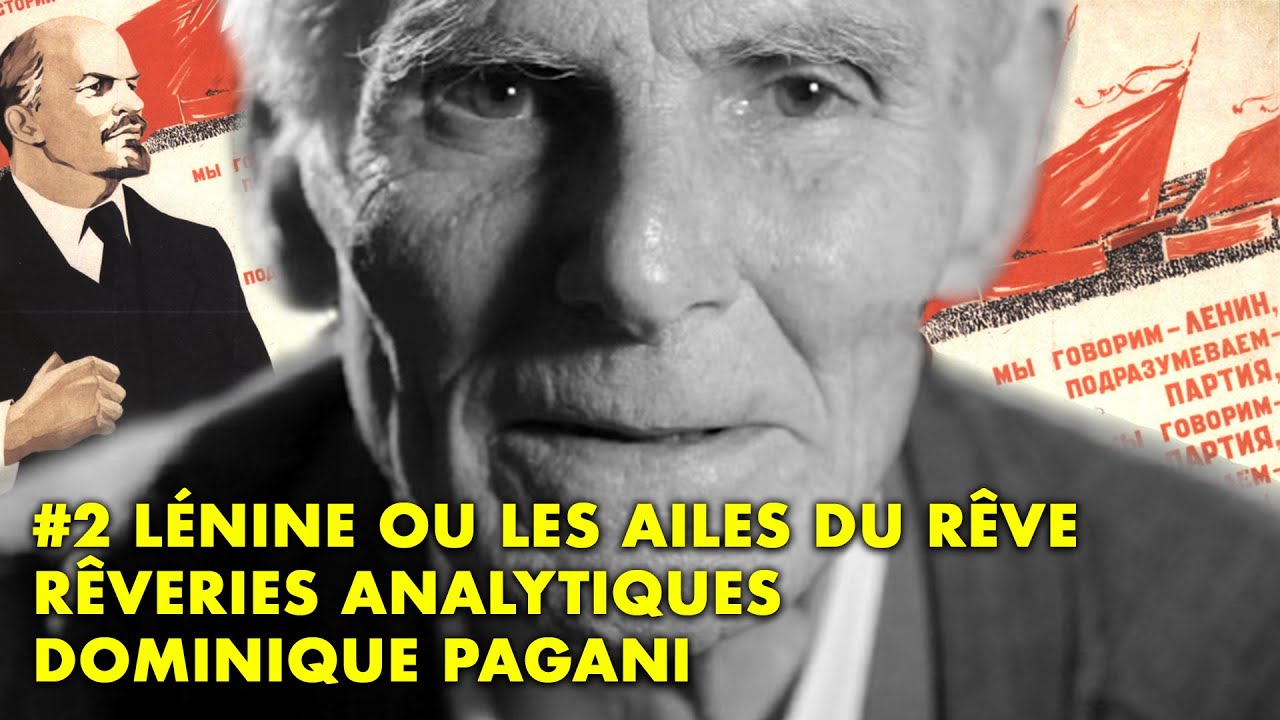
Opening and presentation of "What Is to Be Done?" 0:00 I, Lenin, write these words: one must dream, and suddenly I'm afraid. Because there are still some who ask themselves whether matter comes before spirit or after spirit. As if that were the problem of the day. It's a regression, we've gone back, haven't we, to metaphysical discussions, at the very moment when the most formidable armada of all time is closing in on Russia, for instance.
0:30 We have understood nothing about the history of the sciences if we content ourselves with saying, well, that was false, it's become old-fashioned, I throw the false in the trash, and here now is the true. All philosophical positions, whatever their diversity, can be subsumed under one of the following three. Good evening to all the comrades, to all the friends.
1:02 So first I'll give the reference: this text of Lenin's, you'll find it at the end of chapter 5, of a very famous work, since it is none other than "What Is to Be Done?", the one people often invoke simply by citing the title "What Is to Be Done?" question mark. It's rare for that question not to be topical, isn't it? A well-chosen title, and one that moreover was not originally Lenin's. Lenin takes it up himself—call him what you like, agitator of ideas, revolutionary, philosopher, writer.
1:35 I'm thinking of Chernyshevsky, for whom Lenin always had great respect and admiration, in whose work "What Is to Be Done?" designates a novel. A novel whose heroes, of course, move within that revolutionary ferment which would culminate in October '17, even though that's well upstream. Yes, chapter 5, so the last one, just before the conclusion of the work, you have this excerpt from the text, set within a passage—let me give you the context first, everything you need to know beforehand, it's quickly summed up—where Lenin simply speaks of, evokes the need to set up a newspaper, that will come later, you see, a newspaper that would be available to all the militants of immense Russia, all the Bolshevik militants of immense Russia, whether card-carrying or sympathizers, from Moscow all the way to the Sea of Okhotsk, all the way to Vladivostok—they say it's big.
Baudelaire, the spark, and the Wagnerian conflagration 2:37 Right away, I'm going to read the passage and stop at the theme that will be central, concerning precisely the relationship between action and dream. Now, a writer who apparently has nothing Leninist about him, I'm thinking of that reactionary, Baudelaire—reactionary in his political ideas, he belongs to the generation of disenchantment, I won't give a whole lecture on Baudelaire, that's a digression that would take us too far—but Baudelaire writes these lines which sum up our problem well: "I would gladly leave a world where action is not the sister of dream, may I use the sword and perish by the sword."
3:23 That's a fine introduction to the text we're about to deal with. So, let me turn to the text if you don't mind—it's quite a few pages, isn't it—where he insists on the need for such a newspaper, and he sums up the stakes, all at once, you see, the tremendous stakes of this debate: "This newspaper would be like a part of a gigantic forge-bellows that fans every spark of the class struggle and of popular indignation so as to make it burst forth into" an immense fire.
3:56 We left off last night on a cosmic conflagration, the one that ends the reign of the gods, in the Twilight of the Gods, you see, by Wagner. Wagner, who in his youth in Paris, during his first stay in Paris, at the time when he was in dire poverty, to the point of making, in order to survive, arrangements for cornet à pistons of various fashionable Italian opera arias, in particular from Donizetti's La Favorite. And it was at that time that he was seeing Bakunin.
4:27 I do this to show that I'm not making entirely arbitrary connections. I won't repeat the sentence, but I'll bounce off one word it contains, the word "spark," you see? A forge-bellows that fans every spark of the class struggle and of popular indignation so as to make it burst forth into an immense fire. "Spark" is said in Russian "Iskra," and that will be the title of the newspaper. That's why we're talking about it, you see? "Iskra," "Spark."
4:57 Around this work, still very innocent and still very modest in itself, but regular and common in the fullest sense of the word—well put by Lenin, common in the fullest sense of the word—there would systematically be recruited and trained a permanent army of seasoned fighters. You see, there is a concern, of course political, first and even last, but in between there's a pedagogical, didactic concern for training—not only of those who hadn't had the chance, and God knows there were many in Russia, you see, to be schooled, but even of party cadres, and even of intellectuals who sometimes need, more than others sometimes, you see—
Learning to unlearn: Hermann Kant and Brecht 5:40 —to learn how to unlearn. I'm alluding, of course, to that novel I've happened to cite before, that novel by Kant—yes, Kant wrote novels too, but no, no, no, it's not Immanuel Kant, it's Hermann Kant, a novelist of the former communist Germany, of the Deutsche Demokratische Republik, Hermann Kant, who wrote a novel so well crafted, you see, and so well constructed, that it even earned the honor of being translated into French and published by Gallimard, in the NRF, you see.
6:18 One had to believe it wasn't so bad after all. There weren't many East German writers who found favor, whose names were even mentioned, at that time, in French letters. Now, Hermann Kant brings up, at one point—I'm not digressing, I'm right in the middle of what Lenin says—about the training of intellectuals, those who apparently wouldn't need training, but who ought to train others, you see? In a certain mistaken conception of making-known in place of knowing-how.
6:50 Making-known to those who know how to do. Yes, in this novel, I recall very quickly that in this novel, the narrator is tasked by the party, at the end of the heroic era, at the time when there weren't even strings to tie up parcels and send them, Germany was still devastated, buried under the rubble of the greatest cataclysm in all history. And then the new regime, very early on, had made the decision to open higher education to those who had never had the chance to attend university, far from it, not even secondary school or primary school.
7:28 And so, it had created what was called the ABF—those are the German initials for something meaning the Workers' and Peasants' Faculty. So our narrator, our hero, was part of the first classes of this university; he comes from very working-class backgrounds. And there, he is tasked by the party—he has made his way in the meantime—with giving the closing speech, since this university is going to be shut down, because East Germany has moved past the pioneering era. I take the opportunity to point out that there's a front page of Le Monde Diplomatique from the late '70s—I'd have to find the exact year, you could write to the paper, you're better navigators than I am.
8:09 That front page said "the real German miracle is happening in the East." You could see the prosperity of East Germany. The real German miracle is happening in the East. No, no, I'm not talking about L'Humanité, I'm talking about Le Monde Diplomatique, which was not yet the rag—I don't mean that pejoratively—one of the few readable papers in French currently in the mainstream, wide-circulation, progressive, third-worldist, alter-globalist press, whatever you want to call it, I don't want to be too ironic, but I mean it was a bit more social-democratic, wasn't it, and had dared run that headline, "the real German miracle is happening in the East."
8:42 So, all right, they're going to close this university, he has to give the closing speech, and the pen falls from his hand, because he remembers all those founding times when everything was so hard, when everything had to be started from scratch, not only materially, that goes without saying, I won't dwell on it. My ex-wife, who knew that whole period well, said she'd asked for a block of butter for her 15th birthday, you see. And you know the song, don't you, La Butte Rouge, that song that goes back to the Commune, doesn't it—"for the bandits who cause wars never die, it's the innocents who get killed," it's always the civilians who pay the heaviest price, isn't it?
9:14 So the pen falls from his hand, because he can't see the connection between those pioneering times, everything they endured, suffered, took upon themselves—and good for them, he doesn't lament it—and this East German youth living in far more assured comfort, who sometimes can't even imagine all the obstacles that had to be overcome to get there. And he remembers their first history class—there, I was getting back to it, learning to unlearn, I haven't lost my thread. And that history class given by someone just out of the camps, by a progressive militant, you see.
9:48 The one who survived the camp, Rivenlam, gives them a rather surprising lecture, beginning with a poem. It's that famous poem I've often quoted to you, which begins like this, this poem by Brecht: they say the kings built Thebes of the seven gates, but did anyone see the kings hauling the stones? They say the Pharaohs built the pyramids, did anyone see the Pharaohs bending over the sand?
10:19 And when the Great Wall was built in China, where did the masons live? And that's where the teacher, stopping his reading, this poem by Brecht, says, well, you must start by learning to unlearn. Unlearn that history where they say the kings did this, that. So when I say training of intellectuals, that's what I mean, learning to unlearn. Learning to chip away, however little, at the ideological shell that weighs more deeply than the Freudian unconscious—and that's saying something, I'm not one of those who deny its existence—but which is even more constraining, insofar as it contains the other without the reverse being true.
11:07 The class unconscious contains the sexual unconscious and even regulates it—we'll talk about this another time; to know more, read the admirable Treatise on Mad Love by Michel Clouscard, of course. If you can find the original edition, that would be very good news. So, all that was to comment, you see, around this work still very innocent and still very modest in itself, the newspaper, but regular and common—what could be more regular than a periodical, as they say—there would systematically be recruited and trained a permanent army of seasoned fighters.
"One must dream": Lenin's irony 11:37 On the scaffolding, you see—we're speaking in the conditional, we're getting to the dream, aren't we—or the platforms of this common organization under construction, we would soon see rising up, coming from the ranks of our revolutionaries, Zhelyabovs—he's their predecessor in the revolutionary ferment that filled Russia throughout the second half of the 19th century—Zhelyabovs, Social Democrats, at the time the vanguard—and coming from the ranks of our workers, Russian Bebels, because Bebel was a German who knew Karl Liebknecht well, didn't he?
12:13 Founder of the German Communist Party, the KPD, and a great comrade of Rosa Luxemburg. Bebel was politically roughly midway between the Bolshevik, or near-Bolshevik, position of Karl Liebknecht and the more reformist one of Bernstein—and coming from the ranks of our workers, Russian Bebels who, at the head of this mobilized army, would rouse the whole people to bring justice against the shame and the curse weighing on Russia.
12:44 And yes, Marx had foreseen everything except that the revolution would break out in one of the most backward countries of Europe at the time. Full stop, a blank line, and here's what's going to occupy us. To dream is necessary—depends on the translations of Lenin—one must dream, here is what we must dream of. Dream—how can a communist leader sing the praises of dreaming? Well, he himself senses that he's going to be reproached for it, including by his own comrades.
13:20 I'm not saying this because I know some hold it against me for seemingly wasting time dreaming about Mignon. I think I've rarely had a concern as political as when I decided to devote a commentary to the character of Mignon, and I'll come back to that. One must dream—I give the floor back to Lenin. "I write these words. I, Lenin, write these words: one must dream, and suddenly I'm afraid. I picture myself sitting at the unification congress facing the editors and contributors of Rabocheye Dyelo," a workers' newspaper.
14:03 "And facing me the editors and contributors of Rabocheye Dyelo, and now Comrade Martynov rises and, menacingly, addresses me." He's speaking of his comrades, it's affectionate—"addresses me: Permit me—a resolution—permit me, dear Vladimir Ilyich, does an autonomous editorial board still have the right to dream without having referred the matter to the party committee?" Ah yes, Lenin—a caricature, isn't it, of what people call Leninist, that is, Stalinist, that is—I'll come back to that.
14:39 Then it's Comrade Krichevsky who rises, and deepening philosophically what Comrade Martynov has said—who himself has long been deepening Comrade Plekhanov, a great classic of reading Marx before Lenin—continues even more menacingly: "I will go further, I ask you: does a Marxist in general have the right to dream at all?"—the question is asked, you see—"without forgetting that, according to Marx, humanity always sets itself achievable tasks, and that tactics is the process of the growth of the party's tasks which grow together with the party?"
15:20 "The mere thought"—Lenin picks up again—"of these menacing questions I imagine gives me the shivers, and I can think of only one thing: where to hide"—of course this whole passage is ironic. Irony, benevolent, but still—"let us try to take shelter behind Pisarev." I'll come back to Pisarev afterward, but let me back up a little, all right? "According to Marx, humanity always sets itself achievable tasks," say the comrades interrupting him.
Pisarev: "there is discord and discord" 15:52 This is an allusion here to the famous 1859 preface where Marx says that humanity has never posed any problem except from the moment it had the means to pose it and to solve it. So, I continue: "The mere thought of these menacing questions gives me the shivers, and I can think of only one thing: where to hide—let us try to take shelter behind Pisarev." Now, Pisarev, a curious figure—I don't want to waste too much time, as I told you, so I'll just do a tiny little sub-note, a mini technical card, you see.
16:28 Pisarev belonged to—indeed he was connected to that Chernyshevsky whom Lenin admired, that philosopher-agitator of ideas—and Pisarev was also known for his talents as a translator. In particular, he translated from German, he translated Heine, and he translated an author whom practically no one reads in France, and perhaps even less in Germany, an author of the late 18th century named Klopstock, who wrote a quasi-religious epic called the Messiad, like the Messiah, the Messiad.
17:05 Klopstock was one of Hölderlin's favorite authors, I mention that in passing. So, this Pisarev did not, in fact, believe he was lost in the mists of mysticism; on the contrary, he's known for having said, "I prefer to be the Russian bootmaker rather than the Russian Raphael." In other words, he had a somewhat nihilist streak concerning art and aesthetics—the whole history of art is useless, only the positive sciences matter—that's not quite the Marxist position, far from it, it lacks a bit of dialectic, but still, he had the merit of not being among those steeped in the decadence, the fashion, of the symbolist poets—there are fine things there, but still, from a strictly poetic point of view—in which the ruling class of old Tsarist Russia luxuriated while the knout came down on the shoulders of the workers.
18:01 Now, this Pisarev, he cites him precisely regarding the dream, and he quotes—you'll see how nuanced Pisarev's reflection is, and why Lenin brings him in. "There is disagreement and disagreement," wrote Pisarev on the subject of the disagreement between dream and reality. In other words, there are several ways of posing the problem of the relation between dream and reality.
18:31 That deserves discussion, since there are several ways of posing it. "My dream," understood as the first hypothesis, "my dream may run ahead of the natural course of events," or else it may steer off in a direction which the natural course of events could never lead to. I repeat, "my dream may run ahead of the natural course of events"—anticipate a little to see what it might yield in the future, in short, suddenly set the imagination working, which takes over from what is in the here and now.
19:04 Or else it may steer off in a direction which the natural course of events, whatever happens, could never lead to—a logical, practical, real, technical impossibility, something that can never come true. In the first case, if the dream only runs ahead of the natural course of events but does so by extending it within the realm of what is possible, of what could become possible. So, in the first case, the dream does no harm at all.
19:34 That kind of dream, one can dream one's fill of it. Why? It can even sustain and strengthen the worker's energy. Nothing in such dreams can pervert or paralyze labor power. Quite the contrary. If man were completely deprived of the ability to dream in this way, that is, to imagine—listen carefully—if he could not from time to time run ahead of the present and contemplate in his imagination the fully finished picture of the work only just taking shape under his hands.
20:08 He's only at the beginning, but he tries to imagine the finished work. I'll pause the sentence and insert here a little remark of Mozart's that fits perfectly. Mozart said that every time he sets down the first note of a new work, he already knows what its last note will be. So, I continue: if man could not from time to time run ahead of the present and contemplate in his imagination the fully finished picture of the work only just taking shape under his hands, I would decidedly be unable to imagine what motive could drive man to undertake and carry through to completion vast and exhausting labors in art, science, and practical life.
20:55 Now there, there, no, no—but I insist, because you might think this is clear, simple, yes, but what is less clear is the immensity of what's at stake. That's where I want to insist. Because the stakes—well, they're of an urgent relevance today. Let me remind you that this whole cycle of talks I've been developing this year fits within what I recently called the return to the logic of the subject.
Return to the logic of the subject against neopositivism 21:27 What's the connection, you'll ask? Before saying what the connection is, let me recall the stakes animating this whole effort I'm trying to deploy to make familiar the notion of the logic of the subject, and the very notion of the subject itself. Why? Because the most dominant ideology of our time, the most crushing one, especially since the Berlin Wall came down and since the disappearance of the organized part of an alternative—organized and real, not just invoked as a utopia—of an alternative to imperialism and to imperialist capitalism.
22:08 Since then, there's been an ideology reigning, almost more and more unopposed, which I often denounce, namely what's called neopositivism. Let me remind you I'm not putting positivism itself on trial—I see its limits—but positivism was great progress when it came to fighting the delirium and resentment of religious sectarianism at the time when it raged against what they called "la gueuse," the Republic—it was called "la gueuse," the slut, you see, in the great reaction of the great Catholic bourgeoisie.
22:46 And I'm not bashing Christians here, I'm bashing priests a bit, but not Christians, if you look closely. I often praise, you know, the liberation theologians of Latin America, and I pay tribute here to their sacrifice. And you know, to those who said the problem isn't whether God exists but the problem is making him exist, making sure that he is not—not the origin, what does it matter that he created galaxies stuffed with ammonia and nitrogen, or black holes, no—but that God be not the origin, but the result.
23:24 And that each time we extend the realm of freedom by pushing back the empire of necessity—in other words, since I'm speaking of Latin America, each time we side with the guerrillas, with the workers confronting some of the most fascistic powers seen in the contemporary era, with the help and support of all the gringo and American intelligence services—each time we extend the realm of freedom against the empire of necessity, we increase a little more the existence of God, and we pose the problem differently.
24:02 Yes, I don't bash that kind of Christianity, but on the other hand, I mean, that spirituality, that pseudo-mysticism, that holier-than-thou complacency, as we say so well in French, which is neither the simple faith of the charcoal-burner nor what I was just evoking, liberation theology—that's what reigned when positivism appeared, in this sense, you see. When Auguste Comte says one must stop searching for first causes and final causes, not only do I agree with him, because there he's only extending, after all, that magnificent culmination of the Enlightenment which is Kantian philosophy—not the end of everything, one can do better than Kant—but which at least has the merit, you see, of putting a final stop to the vicious circle of metaphysics.
Materialism or idealism: a regressive question 24:56 I say that because it's topical, because there are still people who ask themselves: should one be realist or idealist? Materialist or idealist? I challenge you to find in the work of Marx, etc., pages and pages devoted to this kind of problem. Or even in Hegel. Yes, he does use the word idealism, but he never called himself an idealist, firstly. On the other hand, he did happen to say that the animal is the first idealist, without dwelling on what he calls idealism. He needed to point out that the animal consumes.
25:26 So that means it denies—that's the humor in Hegel, isn't it? It's so convinced of the unreality of external objects that it seizes them and consumes them. It's a regression, we're back, aren't we, to metaphysical discussions, at the very moment when the most formidable armada of all time is closing in on Russia, for example, on the borders of Ukraine, but also from the Baltic Sea. At a moment when humanity is running perhaps among the worst dangers, it's an old man speaking to you.
25:56 I have never seen war dangers as burning as right now. And what are people talking about in the salons, on television panels? A woman who was refused permission to translate a novel because she wasn't Black—I didn't say African-American, you see? I speak like Africans who say "the Whites," who aren't caught up in our wanderings. Or else, it's not those caught up in bourgeois feminism who say "you say that because I'm a woman" and so on, and who ignore all the formidable work of working-class feminists who made things move forward, believe me.
26:36 A very fine book from Delga editions is devoted to it. Or else, people talk about whether matter comes before spirit or after spirit. As if that were the problem of the day, right? I haven't settled it one way or the other, I'll be careful not to, and I come back to Lenin. Did you think I'd wandered off? When Lenin reaches the end of his reading of the Great Logic of the philosopher supposedly belonging to the current called absolute idealism, where he's the only one occupying that box.
27:11 I'll recall as a matter of schooling that German idealism is divided into subjective idealism—Kant, Fichte, as far as Kant goes, since it's an idealism that's already a misnomer. Objective idealism—Schelling, who sees the idea realized in the external world but in nature. Then Hegel, who sees it realizing itself, not being realized but realizing itself progressively in history. And that is what's called, in textbook terms, absolute idealism. That's absolute idealist.
27:41 At the end of the Great Logic, arriving at the chapter called precisely "the absolute idea" which closes the Great Logic. It sounds like we're in pious platitudes with titles like that. Lenin is stunned by the degree of lucidity Hegel displays, and the relevance Hegel displays in this chapter, to the point that he says—this chapter on the absolute idea, I quote him word for word, it's in the famous notebooks on dialectics—this chapter on the absolute idea is exceedingly remarkable. It's the most materialist and the most idealist passage in Hegel.
The naturalist viewpoint; nature is not landscape 28:16 It's contradictory, says Lenin, but it's a fact. Listen, if Lenin himself tells you not to waste too much time on this kind of contradiction—it can be contradictory but that doesn't stop it from being exceedingly remarkable. Well, let's take a leaf from that. These are the stakes I've been dwelling on, but that's not a waste of time, it's to come back to what is most topical. The reign of neopositivism, the reign of the logic of the object, whether that object be nature, being, everything that is posited outside of humanity as an already-there that precedes it, whether that be God or nature.
28:58 He would have to conform either to natural laws—biologism, not biology, I have nothing against biology, I'm saying he must still be alive like quite a few of us—or else not to nature but to the supernatural, God. In either case, I conform to the law of nature or to divine law, right? And let me remind you here, when we're a bit muddled in philosophy—I know I often take detours, so let me take this chance to be clear. And I say once and for all, not to be peremptory and claim the problem is settled, no, once and for all in the proper sense, that is, what I'm about to say, you can use it for whatever philosophical problem is being tackled—it's a pedagogical proposal.
29:43 All philosophical positions, whatever their diversity, can be sorted into one of the following three. The naturalist standpoint, which I just mentioned—it's nature that explains man today, this would be, for example, cognitive sciences, neurosciences, etc. I say neither good nor ill of it, I'm giving an example of what can be classed under the naturalist standpoint. It's the nature of man in the equipment he had at his birth—naissance, birth, the verb naître, to be born, natal, n-a-t, nature.
30:15 Think carefully about this, because most of the time you confuse—we confuse, even myself spontaneously when I'm not thinking too hard—nature and landscape. Nature is what's outside. Oh, how beautiful! What we see there is not nature. It's ten thousand years of effort to transform nature into landscape. That's what the Normandy bocage is. Oh yes, that's the terracing of rice paddies in Yunnan, in southern China.
30:45 No, no, that's not nature, that's landscape. I'm not saying there's no beauty that owes nothing to man in nature. The Amazon forest, the desert—and it's since then that I've loved so tenderly the desert and the sea, to quote Baudelaire again. But one mustn't confuse nature with what man has made of it, that is, landscape. I devoted a whole cycle to this, I refer you to it—forgive me, I quote myself a lot, don't I, but it's so as not to waste too much time.
The supernaturalist viewpoint: 2001: A Space Odyssey 31:18 So, first standpoint, the naturalist standpoint. There is an already-there, prior to man, that explains everything, that in the last instance is the only explanation that holds up. I didn't say the scientific explanation, the exclusively naturalist scientific explanation, of the natural sciences, which abstracts from the sciences of history precisely—those that allow the subject to develop. Secondly, the antithesis of the naturalist standpoint.
31:51 You see, I take the opposition into account, that is, the supernaturalist standpoint, of the supernatural, explaining man through divine intervention. Here it's the will of God—that I be like this or like that. And even when the religious reference isn't explicit, we recognize it very well. Think of 2001: A Space Odyssey, that admirable film to which my friend Aliocha—our friend Aliocha, to whom we owe, you owe, and I especially owe, the admirable short film La Fausse Note about musical consumption and what I call sonic ghettos—Aliocha revealed to me that there are specialized magazines that take stock each year of which film cinephiles rank at the top for a long time.
32:38 I remember, it's my generation, it was Battleship Potemkin. And then for a while it was Citizen Kane by Welles, right? There you go, Soviet then American. Well, it seems that for some years now, unconditionally, it's precisely 2001: A Space Odyssey, by our dear Stanley Kubrick. Now, remember the scene everyone recalls at the beginning, the monolith, the monolith that reappears recurrently throughout the film, right from the start, it's prehistory.
33:10 This monolith without which that sort of australopithecine agitating in front of the caves where they're threatened by the saber-toothed tiger and other perils of providential nature—suddenly the monolith appears, which suddenly allows them to move from organ to tool. You know, with a bone, they make the first tool which, as it happens, is also a deadly weapon. Isn't that so? In other words, man could not have broken free and taken off from the natural, animal world without this supernatural intervention that is the monolith, which comes from elsewhere, from other worlds, other galaxies.
33:49 Extraterrestrials. Supernatural, extraterrestrial—come on, it all goes in the same direction. And this monolith, right, which the film's protagonists, the team of astronauts, try to approach, and it's at that moment that we hear the admirable music—I always admire Kubrick's musical choices, I don't just mean the Schubert in Barry Lyndon, but also, quite the opposite here, twentieth-century contemporary music.
34:21 The requiem by—excuse me, I've had a memory blank, but it'll come back to me before the end of the show. I received his son in Paris, who was interested in African music and thought I was some kind of encyclopedia on the subject; I could only give him what information I had. Antithesis of the naturalist standpoint: the supernaturalist standpoint. Let's not lose the thread. All philosophical and scientific positions over the years can be classed into one of the three. I've named the first, the naturalist standpoint, cognitive science; the supernaturalist standpoint—I'm proceeding dialectically, I move on to the antithesis.
The anthropological viewpoint: man makes man 34:58 And now, the one that satisfies both, that is, that comes back down to earth, that is just as materialist as the first, but doesn't reduce matter to nature. Because a hammer is matter, it is matter, but it's not entirely natural matter. It's Aristotle who says somewhere that if axes hung from trees like their fruit, we would say that the cutting edge is their soul. Beautiful image. The form, the cutting form in which one can read what it's for—we'll get there—to what end, what purpose, what do I represent to myself, what must I do with it, go beyond what is here and now to imagine what lies beyond—telos, teleology, the end.
35:45 You see all the stakes behind this passage from Lenin and Pisarev. And so, the third standpoint, the one that is just as materialist as the first while taking into account the enrichment brought by the second, which insists only on aspects nature cannot produce—but at the price of falling into the anti-scientific and the unmeasurable and untestable.
36:16 It's the one that says: it's not nature that makes man—I'm summing everything up now—it's not God that makes man, it's man who makes man. And that is called, this standpoint here, the standpoint of the sciences of history. There you have it, not the human sciences. Marx was ironic about the formula "the rights of man and of the citizen"; he wasn't being ironic about "man" nor about "citizen" but about the "and." As if in the whole history of the human species one had ever seen a man who was not, a human individual who did not belong to a collectivity, who was not a citizen, even if it wasn't called that—it could be the subject of the king, it could be the citizen of Thebes or of Sparta.
37:06 But in any case, I mean, we've never seen isolated, individual, natural man. And that is what Rousseau was the first to see, which grounds the anthropological order—it's not the naturalist standpoint, I come back, you see, I repeat, which continues its antithesis, the theological standpoint, I'm replacing supernaturalist with theological, I think everyone understands here—but the standpoint that contains the richness of the two preceding ones without having their respective drawbacks, their respective one-sidedness, a very frequent term in Hegel, "einseitig," "Seite," side in English—that's the side, seeing only one side—that is, the anthropological standpoint. It's not nature that makes man—I'm not talking about the existence of a being there, an individual, without nature I wouldn't be here—I'm talking about his essence, what is it that makes this being have to be called a man, and not a monkey, and not merely an animal, which takes nothing away from the animality he retains within himself until the end of my life, having to eat to live—that owes nothing to history, nor to man specifically speaking,
Rehabilitating a teleology proper to the human world 38:17 but that's not what makes me a man, because that also holds for ants, and even for plants—they need a bit of oxygen, mineral salts in the soil—that's not what specifies man; don't confuse existence with essence, and don't sacrifice one to the other, in either direction; let's not sacrifice—when I allow myself to give a few guidelines like this, I try to apply them to myself too, right, well, so, you see, I was keen on this development, I'm going back to Pisarev's sentence which is admirable, isn't it, quite the contrary—if man were completely devoid of the faculty to dream in this way—dreaming, you see what that means here, it means having in one's head something that isn't there, what's called a telos—I'm in the process of rehabilitating a teleology that has nothing to do with a teleology that was rightly ruined by the emergence of scientific physics at the time of what's called the scientific revolution, the passage of the 16th or 17th century with Galileo then Newton, that is, when we saw the Aristotelian final causes collapse
39:27 which Aristotle placed even in stones, in trees, isn't that so, there is no finality in nature—I even said one day that there is no act in nature. I repeat the example I often use: when we say the wind shakes the trees, our schoolteachers taught us that the subject is the wind, that the verb is used in the active voice, so the wind is active and the trees are passive, there they let themselves be shaken by the wind. Well, that's valid, it's a metaphor, we're in poetry as often happens in everyday language, and yes, without our noticing it, all right, because it makes us think, it's a grammar that forces us to think that the wind is active and the trees are passive, but the wind is no more active than the trees; the wind is itself not a cause, ex nihilo like that, with only passive effects following after it—no, the wind is itself the effect of differences of pressure, of temperature—ask the physicists, the meteorologists, who'll tell you more precisely than I can—there you go, it's just as inactive as the trees, there is no act in nature, either it's nowhere, or if there is any, we must look elsewhere
40:37 than in nature. So there, you come back to God—yes, into the supernatural—no. Yes, there is a supernatural, but not in the theological sense, that is, without bringing in something that isn't material, all right, because, once again, going from the lair to the little house, to the cottage, or the house on stilts, isn't that so, from the Aurignacian era, the Magdalenian—to speak in prehistorian terms—that already is, of course, leaving the natural order, and to what a degree.
41:19 I am paraphrasing a sentence of Marx's that we would do well not to skip over. And yes, yes, here I'm targeting the neo-determinists, you know, those who take a mischievous pleasure in returning to a certain Spinozism that is not the Spinoza I favor, because I favor the Spinoza one reads to the end, that is, up to the fifth part of the Ethics, entitled "Of the Freedom of Man," after having spoken of bondage, exactly like Pascal.
41:52 And yes, I bring the two together, they are exact contemporaries. As Pascal says, "the misery of man without God," doesn't he? "The misery and greatness of man," right? "For man is neither angel nor beast," says Pascal. You know that famous quotation—"the trouble is that he who wants to play the angel"—the one who wants to impose the rights of man, right, in his head, on people who are a thousand times more democratic than he is, you see how, in passing—the trouble is that he who wants to play the angel plays the beast. So I am in the process of rehabilitating a certain teleology, exclusively anthropological.
42:29 Not a finality at work in the falling stone, of which Aristotle said that if it accelerates in its fall, it's because it wants to rejoin its natural place, which is downward, and it accelerates because, just as horses smell the scent of their bedding in the stable, they suddenly hurry to get there and so they speed up. There, he's talking about something as if it were someone. There you go. In other words, he makes the falling stone into a subject. But that finalism, I fight it like any scientist.
43:00 But in what way is it not only an error but, more gravely speaking—I'm doing philosophy tonight, thanks to Pisarev and Lenin and Marx—in what way is this ancient finalism an error, one that still resonated with many people. But still, one must say it collapses logically with the scientific revolution, with mechanism—mechanism against finality. These are textbook oppositions. For now, we're not being very dialectical. What's wrong with this finalism?
43:32 What's wrong is that what's only valid in the world of man—man makes tools. And here is the sentence from Marx at which I stopped, let me quote it first and resume speaking afterward. "What immediately distinguishes the worst architect from the most skillful bee"—because someone might say, but the bee too, you're talking about someone who builds on stilts, it makes admirably hexagonal cells. Yes, it makes the same ones for millions of years. Yes, of course. And everywhere. So what makes the difference? It's that man has his house in his head before realizing it in the external world, in reality.
The difference between error and illusion 44:06 In other words, man has what's called in his head an end. That's what a thought is. It's this teleology I'm talking about. Now, what does it show us? What's wrong with ancient finalism, which acts as if objects were subjects, is that it's not only an error denounced by the emergence of scientific physics, but that it is above all an illusion.
44:41 And here I'm going beyond simply noting that it's an error and tossing it in the trash without further ado. No, we haven't understood anything about the history of science if we're content to say: there, that was false, it's become passé, I throw it away and here's the truth now. A science without history. One wonders how it could have suddenly arisen, the Galileos and the Newtons—it must be in the genes, the naturalists will say again. You see where I'm going with this?
45:11 The difference between error and illusion is that when I say 5 plus 9 equals 17, oops, I'm mistaken, it's not serious, that's an error, I'm tired, I did the bookkeeping all day, I have a cup of coffee, we don't talk about it anymore, it's not serious, it doesn't persist for long. 9, it's 14, it's whatever. There you go.
45:41 But I'm not talking about that, I'm talking about illusion. Illusion—and I first state what's common to both; you know my listeners know that when you want to draw a decisive distinction between two things, you have to start by recalling their common point, otherwise the difference isn't understood. The common point between error and illusion is, first, that both state false things. So 9 plus 5 equals 17, that's false. That's an error.
46:11 But, the Earth is at the center of the cosmos and I am at the center of the Earth and therefore I am the center of the world—what prevailed until Copernicus is the scientific illusion. That's false too, completely false. It's not the same thing. You can feel the difference well. Here, the false is not merely different from the true, as 17 differs from 14—crossed out, that's all different. Once again, a cup of coffee, we don't talk about it anymore. No!
46:42 In the case of the relationship between geocentrism and heliocentrism, the true is not merely different from the false, it is exactly its inversion. There, it can no longer be chance. You see the difference? I come back to finality. There's something seeking itself there, wanting itself without quite knowing, without really knowing, unconsciously. And yes, it's still... I had an infinite number of choices, of numbers I could have found in the difference. It's as if I had said 9 plus 5 equals minus 14.
47:17 Well, I would have said exactly the right number, the right absolute value, but with the sign inverted. You see? That's illusion. So, I repeat, the false and the true. Let me sum up. In both cases, we have error and illusion. Difference between error and illusion. In both cases, we're indeed dealing with false statements. But whereas in the case of simple error, the false is merely different from the true, in the case of illusion, it is exactly its inverse.
47:47 And so, and so, here, error corresponds to an interest of the subject. And so it lasts much longer. We try as hard as we like, and that's why it's much harder to dispel an illusion than to correct a simple error. You see my vocabulary is trying to be precise now. It's much harder to dispel an illusion than to correct a simple error.
The anti-Freuds and self-consciousness 48:17 So, there are those who defend, like me, the subject, but who are caught in the illusion of consciousness, who reduce the subject to consciousness, who say "pfft, the unconscious, that's an invention of that charlatan Freud." These are people so afraid, aren't they, of facing themselves, who retain only what they are conscious of. Lest they find within themselves, inside themselves, what they're looking for. You know, when you want to protect yourself from a danger at home, you lock the bolts, you shut the windows, you're afraid of creaking sounds.
48:48 But all that proves useless if you've locked the night inside with you, the nightmare. This is well illustrated by a film I recommend to you, a cult film—science fiction, or "space film" as they'd say now—Forbidden Planet. I'll say no more, but I refer you to it, look at the plot summary on Allociné, you'll understand what I'm alluding to. Those who are so afraid, aren't they, of the subject that is inside them and that completely contradicts the image they have of themselves—and I quote Marx again, still from the famous 1859 preface: "Just as one does not judge an individual by what he thinks of himself, one cannot judge an era by its consciousness of itself."
49:36 Can you imagine if we had to judge an individual by the idea he has of himself, by his self-consciousness? Trials would go fast—when there'd been a crime, they'd say to the accused, "Defendant, rise! What do you think?" "Oh, Your Honor, in my opinion, I'm innocent." "Then acquitted, well yes, it's up to me to decide about myself." No, no, there must be a real trial, one must be objective. There, one must be scientific, not settle for that, right? One must say, "Now, why on Sunday do I insist so much on putting out a different tablecloth from the others when I invite friends over?
50:09 We need to shift a bit from ordinary thinking; I can't explain this by biology—I don't eat any more or any better, biologically speaking, when I put out a pretty tablecloth, when I put flowers on the little table when guests are about to arrive, and when I arrange the radishes in a circle around the sausage to make it look nice. None of that adds anything, no more than the paintings on cave walls do. And that's what man is. Man begins when we go beyond the vital minimum.
50:41 I haven't said that the vital minimum isn't important. Without it, there will be nothing—without existence and the vital. But if that's all there is, we still haven't entered anthropology or the human. All of that is at stake in what we're looking at. Because all of that is denied. This anthropological side is denied by those who wage a permanent trial against the teleological. They settled its account in the sixteenth century, teleology, which doesn't hold up.
Alienation of finality and the Spinozist theory of error 51:11 And now I'll be more precise. I come back to the history of science. Why, for thousands of years, did people tend to think we were at the center? Because it's much more reassuring to think that I live on the Place Vendôme rather than to learn that I'm in some rotten far-off suburb. Not all suburbs are rotten, but you get what I mean. Those who suffer from what happens in the housing blocks and the estates, and those who bear the material conditions of that in particular, understand what I mean.
51:44 Well yes, it's more reassuring to be at the center. In other words, man as creator of things to which he assigns a purpose—every time a craftsman, a worker, an engineer imagines a bridge, something, an object to which he assigns a function, an end, a purpose—alienation, that is, the act of transposing it onto something other than oneself, that's exactly Aristotle's physics: it's reasoning as if the objects around us were all the product of art and craftsmanship, as if they were the object of a creation, of, how do you say, 'intelligent design,' as they say nowadays, I don't know.
52:33 So, I'll recall that we haven't gone all the way through with the scientific revolution when we fail to make this trial. In other words, it's because man, denying his own reality, alienated himself in nature by imagining that it is animated by purposes, as if it were a people of subjects rather than a collection of objects. It's as if that man were going all the way through the scientific process that led to the scientific revolution, which is to put finality back in its place.
53:11 Here I am, I confess, a bit more Spinozist than those who claimed Spinoza during the Cold War, starting with Deleuze and company—and well, let's not waste time—namely, the Spinoza who produced one of the most beautiful theories of error, and especially of illusion, ever made, which I'll summarize very quickly for you. If, says Spinoza, error consisted in making exist what does not exist—say, I imagine, I don't know, a lamb with wings—well, if error consisted in thinking something that does not exist, we should consider it rather a proof of our greatness than a proof of our weakness.
53:53 Does that mean we're like God, that we can make things exist ex nihilo, things that don't exist? In other words, error does not consist in thinking what does not exist. Thought always thinks something that exists; it is driven by something that exists to think this rather than that, but it thinks something without thinking it in its proper place. There is what Freud will later call a displacement. A displacement. It's true, it's true that there is something that pursues an end, but it's not the stone that falls that pursues an end—it's us.
54:27 So, we've finished my long epistemological parenthesis by recalling that we must confine teleology and finality—not finalism, but finality—to the world of history and anthropology, and not attribute a finality to the things of nature. I set aside, in parentheses, the in-between, between the world of stones and the world of man; I set aside the world of stones—well, when I say the world of stones, I mean the world of inanimate matter, which is by far what dominates in the universe.
54:59 Because apart from the blue planet, as they used to say in Goldorak, I do wonder—there are certainly other places to inhabit, statistically speaking; it's probable, let's say, I don't know if one believes in the law of large numbers, to leave it at that and stay lucid. But I mean, that's not the most general and best-observed rule. So, between inanimate beings—galaxies, ammonia, supernovas—and the subjects of history that we are, who are also objects ourselves besides, there is the living world.
55:32 The vegetal and the animal. And so, I'm not deciding the matter—I leave it to you to think about whether we should attribute a finality to them or not. That's not our subject right now, but things needed to be put back in order and sorted out. So we must rehabilitate this urgent matter nowadays against neo-positivism, which would reduce us to a mechanism—which isn't coherent at all, is it? Mechanism, mechanism into which the Nazi scientists didn't hesitate to slip, did they?
56:06 When they try to reason everything in genetic terms, you know—races, superiorities, inferiorities, all that, it's the right gene or it's not the right gene, it's the right race or it's not... In short, everything to do with birth, with what depends on birth. The Jews were the first victims of this, because there it's by birth, isn't it, and not by political affiliation—because it was the 'Judeo-Bolsheviks' who could get roughed up in the Nazi world. But still, there were plenty of Jews who had nothing communist or Bolshevik about them and who were victims because of their birth.
The dream and life: end of Lenin's text 56:38 It's monstrous, isn't it, to judge everything in terms of nature, of what's natal. Think about it. In our time, this is coming back, coming back with a disturbing obscenity. So I'll continue, I'll carry on, I'll pick up and continue. The disagreement—I take the end of this page—the disagreement between the dream and reality has nothing harmful about it, provided that the man who dreams believes seriously in his dream. This was translated, it was attributed to Lenin when he's actually quoting Pisarev; it's often translated, simplifying it, as 'dreaming is necessary, provided the dreamer follows his dream through to the end,' which is roughly the spirit of the text.
57:22 Well, let's respect the letter of it. The disagreement between the dream and reality has nothing harmful about it, provided that the man who dreams—in other words, between the imaginary and the immediate, sensible real—he says 'if,' now, 'if provided that the man who dreams believes seriously in his dream'—meaning if he attaches to his dream a reality principle in order to realize it, if he observes life attentively, compares his observations to his castles in Spain, and generally works conscientiously toward realizing his dream.
57:55 'When there is contact between the dream and life'—this is Pisarev's most famous phrase—'when there is contact between the dream and life, all is for the best.' And it's the most nihilistic, the most anti-aesthetic, the most anti-daydreaming, so to speak, of the Russian nihilist movements that's expressing itself here. And Lenin takes up the phrase: dreams of this sort, of this sort—that is, of those who don't skip over the real, over realism and materialism, who take the laws of matter into account.
58:29 If Marx thoroughly studies capital, instead of dreaming about what the future communist society should be like and giving birth to chimeras, instead of... He begins first by thinking about what is, and not about what ought to be. If we want to get rid of capitalism—and Marx was among those who wished for humanity to get rid of it—if we want to get rid of it, we first have to know how it works, don't we? So we must return to the real. Dreams of this sort, of those who take the real into account—unfortunately there are too few of them in our movement.
59:05 Implying: either because there are those who are lost in chimeras, who dream but without the reality principle, to sum it up quickly, or on the contrary those who say that all dreaming is a waste of time, mere daydreaming, and that it's unworthy of a Marxist militant, isn't it, to resort to dreaming. So dreams of this sort—unfortunately there are too few of them in our movement. And the fault lies above all with the representatives of legal criticism and of illegal tailism, who pride themselves on their moderation, their sense of the concrete.
59:38 End of quotation from this admirable text by Lenin. Dreaming is necessary, provided that the dreamer follows his dream through to the end. There. So I can give you an appointment with other texts where we'll follow what amounts to these dreamings, and you'll see that it's in order not to let go, somewhere, of a stake—a stake that brings us to what is most current, what is most current and most pressing.
1:00:11 I'm trying to translate a Hegelian play on words: 'Spiel' and 'Beispiel'—'Spiel' is the stake, the play, 'Spiel'; and 'Beispiel' is the example. In every particular case, the 'Beispiel,' the example, there is something else at stake. That's what we'll see next time, that stake. We must pay great attention to the real in its materiality in order to determine it.