English translation of the French transcript, made with AI and not yet proofread — click a paragraph to jump to it. Show the French original
Defining philosophy: sophia, wisdom and knowledge 0:20 This little cell contains pretty much everything I've said, which is why I shouldn't have had much to say, it's a small thing this. From the beginning, in its logic, if you will, is that very quickly, we started from the classic problem of how to define philosophy in general. I recalled that in "define" (définir), there is "end" (fin), as in "determine," "determination," "definition," there is a notion of end, of determining. I recalled that concepts are like underpants. The more elastic they are, the less use they are for anything.
0:52 If a concept wants to say everything, it no longer means anything. And so we cannot call philosophy just any form of thought that seems a bit profound. And I added that this isn't a value judgment. There can be non-philosophical thought, religious for instance, more profound than a mediocre philosophy. And a Hindu-Chinese thought well prior to Socrates, I mean, of great depth, often great relevance, and which has nothing to do with properly philosophical inquiry. And so I made clear that I would insist throughout my talk here, at the Maillard by the way, on this — not on the internal disagreements within philosophy, we won't stop alluding to those, of course, but rather on what is specific to philosophical inquiry as such, compared to scientific inquiry, to religious inquiry.
1:46 I'm taking two very opposite fields, but which have in common that they're external to properly philosophical inquiry. There. To do this, I recalled that it's better to let words speak than to speak in their place, as we do at the corner café where opinion constantly replaces knowledge. I have nothing against the corner café, I like going there too to chat with friends, it's a genre that isn't the philosophical genre.
2:16 And so, when we let the word speak, who loves? What? Sophia. Sophia. And that's where the problem begins, because the Greek term Sophia carries a notion of wisdom, but also of wisdom that includes knowledge, which can also be seen in our old languages, I say this for those who weren't here at the start, and don't hesitate to sit down. Good evening. And I mean, we can clearly see it in the Anglo-Saxon Germanic languages, "Weise," the wise man, and "weiß," I know in German, right, I mean, there's a link between knowing and wisdom that's in the language, isn't there?
2:57 And when we say, oh yes, you have to go see the old man over there, he has great wisdom about these things, that means there's also knowledge involved. But still, I was recalling the disjunction between these two notions, which makes up the whole problem of philosophy, namely that the two notions can overlap, as mathematicians say, there can be an intersection of these two sets. But still, there's a large part of each that remains outside the other. I mean by that, there can be scholars who aren't wise at all, and even criminal. And conversely, there are wise people whose wisdom isn't measured by how much they know about the number of satellites orbiting Jupiter, still less the grains of sand in the Sahara.
3:37 So the two notions are disjoint. And that's precisely our problem from the start. The problem of philosophy isn't the problem of the scholar, nor of the religious person. The philosopher tends to limp, to hobble. And this from the very beginning, from his very principle. Since he pursues a concept that contains two notions that don't necessarily point the same direction. And we resolved — that was the beginning of the introduction — I spoke of Sophia there, distinguishing the two. We also need to interrogate Philo, who loves, francophile, who loves, therefore who desires, therefore who does not have.
The skeptic, the sophists' aporia, and Platonic anamnesis 4:13 We still need to recall this. The philosopher is neither a scholar nor a sage. If he seeks them out, it's because he doesn't have them. It's not the money that's already in my pocket that I go looking for. This is important to remember. But he's not alone in claiming not to be a sage or a scholar, but to be in doubt. There's also his old adversary, the skeptic. The philosopher always has two adversaries, two extremes, the skeptic and the dogmatist. We'll come back to that. We'll have so many occasions to illustrate it that I'm only passing over it now.
4:44 I recall this in passing, that he exists before philosophy and accompanies it and frames it throughout its development. So the skeptic also says he's not a scholar, except that he doesn't seek to be one. He even says that such a search is vain, the skeptic does. Truth not existing, why waste time seeking it? There was, by the way — I'm introducing this today — a little aporia. An aporia, a difficulty. A difficulty that prompts us to reflect. It was Ricœur who spoke of the "aperitif aporia," to make a pun, right?
5:18 Namely, those who said to Socrates: but Socrates, you can't seek wisdom. Because, in which direction? Where should you go if you don't possess it? And even granting that you happen to stumble upon it, what would guarantee that it is wisdom? Since you're ignorant to begin with. And in short, the sophists made Socrates understand that one can neither seek the truth because one already possesses it, nor because one doesn't possess it. So this little aporia, which moreover put Plato on the track...
5:51 I'm going a bit fast here, but I'll come back to it, allow me to move quickly. Just to spark your interest all the same. Plato said all knowledge is recollection. Anamnesis. The disappearance of amnesia. That's the essence of philosophy for Plato, anamnesis. For Plato, I mean, the teacher isn't someone who takes ideas he has in his head and puts them into the student's head. For Plato, the teacher is one who shows the student that he must become aware of the truth already in his own head. And that's why he claimed for himself...
6:22 What I'm saying is a bit textbook-ish, because some of you already know it, but... a discipline he himself called maieutics, making a pun. Because "maia" means midwife in Greek. And he says that just as the midwife isn't the one who creates the child, but the one who helps it come into the world — he says, and his own mother was herself a midwife, that's why he uses this image. Likewise, I mean, what I do is help the patient, that is, the one I'm speaking with. That is, a patient, he suffers. Because Socrates sends him doubts and asks him questions that shake certainties he had never questioned.
6:57 And I help the patient give birth to the truth he already has. So why do I bring up this reference to recollection today? Because when the sophists say one can neither seek what one knows, since one already knows it, nor what one doesn't know because one has no bearings, Plato said — look at this beautiful synthesis between these two extremes that seem to trap us in aporia — Plato said, no, but we can seek what we knew and have forgotten. That's recollection.
The linguistic unconscious: Rimbaud and Racine 7:29 I'd like to illustrate this point because it will matter for what follows, because I'm going to develop the question "what can I know" more than the other today, the difference from last time. Evening, that's you, don't be afraid. I'm not afraid to interrupt myself, I interrupt myself all the time. I'd like to illustrate the fact that we all have this knowledge in our heads, knowledge far superior to what we imagine we possess. I'll take a line, a line taken from a poem.
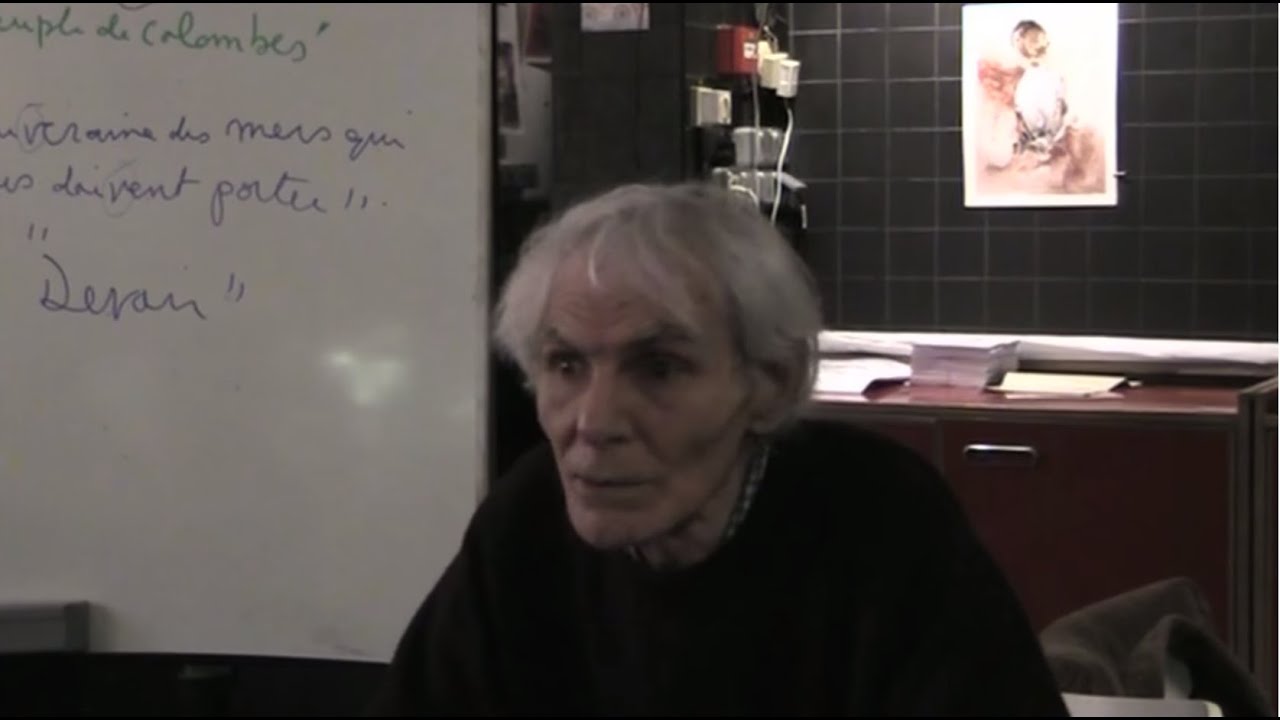
8:06 I'm writing it because we need it written down for the reasoning I'm going to make. You see it with your eyes. "The exalted dawn. A people of doves." Does that ring a bell? Yes, thank you, that pleases me for him. Yes, it's taken from Rimbaud's "The Drunken Boat." So why am I writing this thing? To show you everything we know without knowing it, to illustrate Plato.
8:36 Apparently it's a comparison. There's the "as" ("ainsi que"), right? By the position of the "as," I can make it permute, as linguists say today, "like them," "in the image of them," "as a people of doves." All that is equivalent, you agree? That means there's something in common between what's on the left and what's on the right. You know that as well as I do, in the linguistic unconscious. Yet it's not obvious. If he'd said "black as ebony," that has no mystery.
9:07 We understand it right away. But that's not poetry. As Baudelaire said, the beautiful is always strange. Black as ebony surprises no one. Baudelaire added, in case one confused it with what's exposed to fever, an egg thrown on a plank. Baudelaire added, but not everything strange is necessarily beautiful. But the beautiful is always strange, always disturbed. I return to my Rimbaud story. The "as," the "ainsi que," implies there's something in common.
9:39 Now, I don't quite see the common point between "exalted dawn" and "people of doves." "Strong as a Turk," I understand. "Black as ebony," I understand. "Black as ebony" and "black," implied. "Strong as a bull," "as a Turk," and strong. And here, what common point? Between what's on the left of "as," and what's on the right — well, I didn't have time to write "to the war." It's on a single line in the poem of course. There's no room. Well, look closely, look closely, look closely.
10:09 Doves — what color? Doves. White. White, no color. Or rather all colors combined, white. No color at all, that's black. All colors combined, according to Newton's prism. There, yes, doves are white. Dawn. "At the hour when dawn whitens the countryside," right? I'm not sure dawn is white. We're not in immediate reality, we're in poetry. We're not in immediate reality. We're in deep reality. Dawn. I don't want to be approximate here, I'm giving my interpretation, I'm not adding anything at all.
10:41 I'm analyzing what's there. Look closely. All these A-U's permute with A-L in French. You know, "aube" comes from "alba." Latin. And unconsciously, this is what I want to show you, we all as French speakers, not necessarily French people, it could be someone from Ivory Coast or Senegal, know very well that it's associated, and that everything that varies with "aube," with "alba," all the roots that produce, the words built with the root ALB, ALB — albino, albâtre (alabaster), albatross. You see clearly that in our unconscious, we know these words.
11:11 So it's linked to white. The poet plays with that. Dawn. White here, white there. We're starting to solve our equation a little. I'm speaking of a poem as an equation. And then, "exalted." Ah, ah, ah. ALT, what root is that? You see it needed to be written down for us to see it. ALT, where do you find it? If we build words with it, that gives "altitude," what else is there? Alto, "altesse" (highness), everything that's up high.
11:42 Either literally, altitude, or figuratively, or as "altesse" — that is, one who holds all their social class, the high side of the pavement. He doesn't walk in the filth that was in the middle of Rue Mouffetard at the time. In that era, there was a river that's still called the Bièvre by the way. You couldn't walk in it. So I'm in the process of showing that the only difference between poetry and mathematics is that poetry is an exact science.
12:14 I'm not saying anything bad about math here. I'm paraphrasing the formula of one of the greatest mathematicians of the 20th century, Bertrand Russell. I don't know — he's the one who wrote with Mr. Whitehead the Principia Mathematica, which stands alongside the emergence of set theory, which are the bible of modern mathematics. I'm being serious here. Now, what did Mr. Russell say? He, moreover, was a polemicist who had a lot of British humor. He said that mathematics is a discourse where one never knows what one is talking about, nor whether what one says is true.
12:45 That wasn't a criticism of mathematics. That's not what he's doing. It's a tribute. If you look closely. There. So you see, to be extraordinarily precise, I'm not saying that Rimbaud had a little computer in his head and said, I'll put "dawn" like this, they'll see there's whiteness, I'm priming their unconscious. Not at all. He does like Racine. Quite simply. They're probably, perhaps, the two greatest French poets. I take these examples. There.
13:15 That is, he doesn't think about it. The fact that he's a great poet, right? Is that what he said can be deduced afterward, but he doesn't think about it before writing. As he says very well in a famous letter to his rhetoric teacher — he was very young then, 18, not even, he was 17 — he wrote him, to comment on his famous formula "I is another," he writes: "If brass wakes up a bugle, it is not its fault." If I, Arthur Rimbaud, the matter, the brass, wake up as a bugle, if suddenly there's a poem I make, one cannot account for it.
13:52 But he does better than think it. He says it. And we know, we moderns, since Freud, that our expression says much more than the little we think it does. Because there are many people who think the opposite. The old system of thought: my thought is so sublime that it's a shame I have to go through language when addressing the other, which terribly reduces the depth of my thought, and only transmits a small part of it because of the infirmity of words. That's what we most often hear about the relationship between language and thought. My genius is unworthy of the words that will express it, right?
14:24 That makes me think of scuba diving. Some of you who've done a bit of it, even as kids, with a little mask, that's someone who sees a fish like that, under water, with his mask, when he brings it back up to the surface, it's a bit disappointing. Well yes, when you express it, you find a brilliant idea, it's no longer as brilliant as that, because the other starts to criticize it and so on, and it takes a hit. Well, there. So he makes... The poet, the great poet, is the one who does better than think the truth. He expresses it, he brings it into existence.
14:54 He doesn't leave it inside, he takes it outside, he expresses it, he externalizes it. On the notes of a musical score, on the letters of a poem, on the colors of a painting, and so on. I haven't finished the count, "alté," it could be... No wait, I'm getting there. So, "exalted," there's altitude, "Oh! The doves, there it is!" This line is perfectly logical. We see doves taking flight in the morning like that, going upward, well yes! In fact, this line says the same thing twice, in two parts. I'm doing this to show you that here an unconscious, in this case a linguistic one, reserved for those who master French, that's still quite a lot of people, I mean, is enough to account for metaphors so present.
15:38 Now, an excellent question... I always mix up first names... Excellent question from Gabriel, I'll set aside "people" (peuple). I'll keep setting it aside, I won't develop it today, because it's a bit more complicated. But I could develop the connection to "peuplier" (poplar), which is "populus" in Latin, but I won't complicate things. But I recommend visiting the Island of Poplars, where Rousseau's tomb is, 45 km from here.
16:08 That will already give you something to meditate on, you can see the leaves. Not now, it's not the season, there are no leaves left. But come spring, if you go there, you'll see why it's poplars that, like aspens, move like a people, like a people rejoicing in fact. The poplar leaves above Rousseau's tomb, which is the least deathly tomb in the world, since his ashes aren't there — for those who are fetishists, they'll be disappointed, his ashes are in the Panthéon, but his tomb is 50 km away. There, I used that to show what I meant when Plato said all knowledge is recollection.
16:40 I've only brought back to the surface, with my unfortunately explicit commentary, what we sensed obscurely as French speakers. And I'll speak of Racine in a moment, I'll give another example. "Sovereign of the seas," ah yes that's Racine, we'll get to it at the very end. One of the first words, which strikes you well, "des mers" (of the seas), it's a courtier, what do you do at court? Not war, you make love.
17:10 "Which must carry you," yes, Tristan succeeds the... it's a Mithridate, that. Like the collaborator, what's his name? It's a Mithridate, no, his brother, Pharnace, the one who collaborates with the Romans, while his father has been fighting the Romans for 40 years. Mithridate, who gave the Romans such a hard time. One of his sons collaborates with the Romans, and wants to steal his father's fiancée while his father is away.
17:48 The father is always absent, I don't know, Theseus is absent from beginning to end. He was taken to Rome. "Come flee the sight of this savage climate which speaks to your eyes only of sad slavery," that's how he speaks of the Orient. "An entire people awaits you on their knees, under a happier sky more worthy of you." And yes, beautiful, Italy. So, he tells her, right, we're at Racine's, in the unity of place and time, so we won't leave, we won't leave, otherwise we break the unity of place. So the ships have to be in port with sails full, ready to burst, right to the end of the play, but without ever actually leaving, we'll die first.
18:23 "Ready to receive you, our vessels await, from the foot of the altar you may board, sovereign of the seas that must carry you." That's the end of the tirade. Look, it's beautiful, this line, isn't it, a bit mysterious, "sovereign of the seas that must carry you." He could have said "that must carry you" plainly. But no, Racine is a poet, "that must you..." no, that doesn't work. Right? On the other hand, the V's, you see, there's one there, one there, one there.
18:53 V, V, the wave, wave, wave, this line undulates, like the sea it expresses. Just think, Racine, once again, didn't call up Google's algorithms to figure out how many V's he should put in his line by frequency. Right? It's not thought out, it's better than that, it's uttered. It's expressed. There's the linguistic unconscious, among other unconscious phenomena. So all this was... reminds us all the same that when people try to trap us, when they say the answer to the question "what can I know" is impossible, as the sophist said, we can seek neither what we know nor what we don't know.
19:30 I don't know. Yes, all the same, we can seek what we know, what we knew and then forgot. All knowledge is recollection. Or, to know is to remember, depending on the translation. There. Philosophical knowledge as anamnesis. Not so far from the psychoanalytic cure, right? Not far at all. Twenty centuries later, there's someone who will also say that to answer the question "know thyself," a man from Vienna, in Austria, well, one must begin by undertaking a certain anamnesis.
"What must I do?" and the two senses of duty 20:01 There. And so, today, the decisive step forward that we took last time, and not the first time, so the second session — I think a few of you came to the first one but not the second — so I think, here, is that these two hopelessly parallel lines that make us limp, we started to get a breath of air last time. We saw that there was a possibility of linking the two, by saying that what is properly philosophical is to seek the answer to the question "what must I do?" — that's the question of wisdom — and not "what can I know?", which is the question of pure knowledge, like the scholar.
20:37 To seek an answer to the question "what must I do?", but an answer that is universal, that isn't on the mode of opinion, but on the mode of a genuine knowledge. That's where the two are united. An answer in the form of knowledge, scientific if you will, to the answer "what must I do?", which is properly philosophical. Because if there were only the question "what can I know?" — I won't repeat it endlessly, I think we're all convinced now — philosophy would be at the CNRS, and it would merge with physical research, biological research, which also legitimately seeks knowledge, and which even succeeds at it more often than the philosopher, after all, at least in the matter concerning them.
21:18 There. So, the link between the two is this. To seek, not just any knowledge — I alluded earlier to how many grains of sand there are in the Sahara. I don't care! There, if you want to know what I think about that. And I presume you do too. Knowing the exact number to the grain, what does it matter! What is there worth knowing? Even it's not the whole set of what I can know that's interesting, but within everything I can know, what can guide me in answering the question "what must I do?" One last little reminder, then I'll move on to today's session, one last reminder, is that the problem is that in "what must I do?", there's a word that's problematic, I still have some space left, it's this one.
21:56 "Must" (devoir), right? In "what must I do?" "What can I know?" is "can" (pouvoir), "what must I do?" is "must" (devoir). I don't know if it's by chance, Kant! The great Chinaman of Königsberg, as Nietzsche calls him, in his rare moments of tenderness toward Kant. Well yes, that means he racked his brains over it, it's difficult for him, Kant. Nietzsche, he's not a philosopher by training, he's a philologist, a linguist as we'd say today. He knows little of the philosophers, from a textual point of view.
22:27 I don't know the exact wording. Ah no, it doesn't matter at all, but this is what he himself says, not me. He knows Plato well, because he's above all a philologist of the Greek language, but I mean, he doesn't know Kant the way someone preparing the agrégation does, like a student preparing the agrégation today. This needs to be known. We make Nietzsche out to be a great debunker. One shouldn't be more Nietzschean than Nietzsche. Nietzsche himself says, in Zarathustra, "You friend of wisdom" — he knows his Greek well, for "philosopher" — that means, "Come now, nothing but a fool, nothing but a poet," they don't study Nietzsche any more or less than what he is.
22:58 He's not a master thinker. So, once again, I say this because we've been hammered with Nietzsche ever since capitalism changed its colors, since the end of the Cold War. We'll see why. There must be connections. There must be connections. A philosopher more useful to the camp that won the Cold War than Marx. That's for sure. But Nietzsche, we shouldn't make the poor man dependent on those stakes. So, when I say that it's not just any knowledge that interests me, but the kind that doesn't answer the question 'what must I do,' I'm bouncing the problem forward.
23:36 And yes, that's what's annoying about philosophers: the everyday words, the ones that seem to pass most simply, are the ones that raise the most problems. Duty. Yes, and I had shown, to demonstrate the problems that face all of us when we think. What happens when we use the same verb, when I say 'I must eat to live.' Excuse me, it's my Corsican side, it makes me melancholic to see all the work needed just to eat to live. I must eat to live. That's why I'm a Christian, that's a Corsican joke. That is to say, every morning I ask myself how I'm going to fill this one without moving that one or the other.
24:10 There, I'll stop there. It's because I have a compatriot here today, but we'd never dare say that in Bastia. I'm speaking here as a free commune. They haven't been worked over by NATO, Berlusconi, and the independentists. So, duty. I must eat to live. I must obey the red light. We call it the same verb. You can see clearly that it's very different. You see it right away. I must eat to live, physical necessity. There's no merit to me for that. I must obey the red light, that's a moral obligation.
24:41 Moral, legal, political, administrative. In short, the great philosophical difference is that in the case of eating to live, I cannot do the opposite. I cannot live without eating. So the verb 'must' has no place there. I cannot be able not to. I cannot live without eating. If I were honest, I would say that. When I say I must eat to live, it's as if I'm imposing on myself that it's necessary to eat to live. I didn't decide that. That would be megalomaniacal paranoia. On the other hand, the red light—I go out in the morning, in France, I put on my flashers, I can run it.
25:19 I'm not cancelling myself. There are people who aren't watching. I can, that's the question. I don't have to. I can. Ah! There's a margin of freedom there that wasn't present in 'I must eat to live.' And I had shown why, from the very origin, philosophy has a complicity with the concept of freedom. The question 'what must I do' only takes on its full meaning when we take 'must' in the sense of the red light—that is, in a situation where I could do the opposite, where I have a choice.
Freedom, postulate of practical reason 25:50 That's where duty takes on its full meaning. I had cited the example of spending vacations in East Germany with Jean. There's a Jean for you. Part of my in-laws, a German wife, were over there. Drüben, as the West Germans say. Drüben, the so-called zone, in the zone. So at 2am in Leipzig, the second city of the GDR, we were coming back, anyway, toward the youth hostel, we see from behind a little worker, well, that's his look, a worker, with a small bag, who was waiting for the light to turn green, three kilometers to the left—phew, East Germany, in 1971, not much—three kilometers to the right, no cars, he was waiting. We went past. He tapped us on the hand—what did he think he was doing?
26:39 You see, this typically German internalization of moral law, it's extraordinary to internalize the categorical imperative to that degree. There, I'm not mocking—in England too people are respectful of the law—when someone crosses, you know it's a Frenchman at the red light, right? But if you decide to cross in England, that's your business, others aren't accountable for you. In Germany, there'll be five people telling you 'Ah! I'm going to report your name!' There, that's one of the things that interrogates me—I love life, you see, I'm speaking of it with affection here, the way I speak of that great ego Nietzsche, I have affection, even for life.
27:17 So, once we've interrogated this verb 'must'—by the way, to interrogate it, I'll put it in quotation marks, though as long as I don't put quotation marks... but I already have, sorry, that's a thing, not a word—there you see it's really a word that needs interrogating, it only has meaning when I can do the opposite. So, and it's important for understanding what we're going to begin today, we understand better what, in more technical terms—I haven't yet entered philosophy in the technical sense, we'll do that a bit today—what Kant calls it, Kant's statement when he says that freedom is postulated, that freedom is a postulate of practical reason.
27:52 In his mind, that means specific things. A postulate, you know what that means—it means you have to presuppose it, without demonstrating it, otherwise it's not a postulate, it's a theorem if it's demonstrated. We must presuppose that freedom exists for philosophy to have meaning, for moral inquiry, 'what must I do,' practical reason—as distinct from theoretical reason, since the sun revolving around the planet, that's theoretical reason, and practical reason, the world of morality, of law, of politics, in short, the relation to others rather than to things this time—for that we must presuppose, says Kant, freedom.
28:24 And yes, the opposite of freedom is determination. Either my behavior results from a sovereign decision, or I am determined by blind forces, I don't know, that push me to go left rather than right, and to marry Marinette rather than Françoise, whereas I believe it's a sovereign decision. I mean, we haven't settled anything on this, we're barely at the fundamentals, how could we possibly settle such complex matters. But what's certain, like the multiplication table of the philosophy textbook, is that determinism is the antonym of freedom.
28:59 Now, if I am determined, there's no point asking the question 'what must I do' and seeking wisdom. Because I'll be told, my poor fellow, in any case, even assuming that by miracle you find the answer to 'what must I do'—this rather than that, say—you won't be able to carry it out, since by hypothesis you are determined, and it's not you who will act, you will be acted upon. Everyday, familiar language tells us this well: 'I was made a fool of by so-and-so,' 'I got taken.'
The decline of the concept of man and nature as necessity 29:32 There, it's not you who makes the decision, it happens without your willing it. So we see clearly what Kant means. Freedom is a postulate of practical reason. Let me put it here in less abstract terms. The answer to the question 'what must I do' presupposes that I will be in a position to act, and not to be acted upon, not to be mere passivity. Let me take this opportunity—in these periods, I mean in the extensive sense, for almost two generations now, there's been a decline of the concept of man for the benefit of that of nature.
30:09 I watch television, the media like all of you, and I see that the value 'nature' has been far superior to the value 'man' for the past forty, fifty years. That man only intervenes as the one who spoils nature—as soon as he moves, he damages it. In short, I'm not going to caricature the ecological cause, but that's often what we hear. I also recall that the dominant thought after '68—I'm thinking of Foucault and Deleuze, especially Foucault, because he said something precise about this. Foucault says that man is a recent invention, and fortunately destined to disappear, as if drawn in sand at the edge of the sea.
30:40 It's a philosophy that explicitly positioned itself as anti-humanism. So when I speak of the decline of man and the rise of natural values—by the way, I talk a lot about microbiology, and we make a whole color out of it, something 'natural,' with the present. Let me take the opportunity here to point out, regarding freedom, since I'm showing that there's a coupling between philosophy and freedom, a complicity of essence, if you will—not an opinion at all.
31:11 Or rather, let me sum it up for you—it's an anecdote that happened to me when I was teaching philosophy in Côte d'Ivoire. I was giving the oral baccalaureate exam and I came across a student who had given a good answer on the assigned text, so to push him a bit toward an 18, I asked him a trickier question, since the main point was already settled. So I ask him: do you think we're freer in nature or in society? It had nothing to do with the earlier text, just to break the tie. Knowing full well he'd say 'in nature,' like almost all students—I mean, we don't escape the dominant ideology so easily after all.
31:47 Well yes, in society I only have obligations, like having to take the baccalaureate, and in nature I can go left, right. So I say, fine, nature, very well, let's go into nature—won't you be hungry tomorrow? Well, yes, if there's no society, how will we manage? So, we don't do whatever we want in nature either. And when hunger strikes—I say this because an African dreads nothing so much as being stranded in the bush without being able to reach town or his village, right?
32:18 But yes, far from society, you'll die. So there, nature is not only what's around me, it's not only what surrounds me—the environment, that strange word, that French term that went into Anglo-Saxon usage in the 18th century and comes back to us now in the form of environmentalism. No, it's not just what's around. When I'm hungry, that's nature manifesting itself too. That's a natural law, it's not men who decided we get hungry. Rousseau said, what men have made, men can destroy, undo.
32:50 There's an ineffaceable character to what nature imprints, and nature is neither rich, nor prince, nor great lord. There, so, I insist a great deal on this aspect, this complicity between philosophy and freedom. Since it's opposed to necessity, let me point out that nature is the realm of necessity. The natural sciences—I won't get ahead of the rest of today's lecture, but roughly, the natural sciences began developing when the notion of physical law appeared. And what is a law? It always has the same form, y equals f of x.
No action in nature; the infinite universe 33:20 We can refine it, it can be logarithmic or statistical. Roughly, it's always y equals f of x. The expansion of rails, railroad tracks, under the sun, depends on heat, because heat expands bodies—there's the law. So there's always something that depends on something else. And let me take this opportunity to say—since here I'm taking the opposite stance, but I'm compelled to, as a philosopher, not obliged but inclined, as a philosopher, to criticize especially the dominant ideology, even if it means defending it tomorrow should it become a minority view, which won't happen tomorrow—that in nature, contrary to what's said, there is no action.
33:54 The word 'to do'—what must I do? When we say 'the wind bends the shrub,' the oak and the reed for instance, the wind bends the reed—that's what's taught in grammar. 'The wind,' active voice, and 'the reed is bent by the wind,' passive voice. But in fact the wind is no more active than the reed, since the wind itself is caused by differences between cold air and warm air. There's no action, there are only passions in the sense given to that word in the 17th century—not romantic, don't worry—but in the sense of being passive, where the tree has no choice, the wind has no choice.
34:32 It's a succession of laws unfolding. Let me repeat this in passing: either there's something other than nature, or there's just inertia. What we take for action is metaphorical. When we say 'the wind, the reed,' it's a metaphor. Exactly like when we say 'ah, the day rises, it sets'—it doesn't have sheets, it doesn't have a pillow. There's no moment when evening comes with the clouds making little crepes. 'Crépuscule' [twilight] means 'little crepes.' It's well observed in the metaphor, the crepes, the little crepes.
35:02 It's always in the morning and evening that there are veils around the sun. There, so a small reminder to insist on the notion of 'to do.' It's still a strong word which, you see, also presupposes a free being, that's what I'm saying. It's not a free causality, we're in passivity. The wind is no more active than the reed it bends. I'm repeating myself. It's itself caused by different cold and warm airs, which are themselves caused by the movement of the earth, and so on, and so forth. There's no action in nature, only a chain of passion, of passivity, of effect.
35:36 Effects are everywhere and the cause is nowhere. I'm paraphrasing Pascal a bit, if I may, because he's an admirable stylist. Pascal who said that our universe is a circle whose center is everywhere, and the circumference nowhere. That's well put. Let me take the opportunity, since I'm on dominant ideologies, and regarding Pascal's phrase about a circle whose center is everywhere and circumference nowhere—Pascal lived with his time, and his time is remarkable for what we now call, with hindsight, the scientific revolution.
36:11 In this domain of knowledge—I'm speaking about that here, there are other domains—the Galileo event has just occurred, physics finally becomes a science, twenty centuries after mathematics—fifteen, sorry—after mathematics. And starting with Galileo and his school, then through Descartes, then it reaches Pascal. Pascal, who was one of the greatest scientists of his time—I'm not speaking here only of the one who wrote the Pensées, the moralist, the mystic, but I'm thinking here of the mathematician. You know that at age nine he had rediscovered Euclid's elements, at sixteen he wrote a treatise on conics.
36:46 There. And that's what led Chateaubriand to call him 'that frightening genius'—that's the romantic side of Chateaubriand. Now, when Pascal says this, he's taking note of the fact that the scientific discoveries of his time had shown that the universe was infinite. That's the great novelty. For millennia, people believed they were at the center of a dome, itself inside another dome, the parallel spheres as they were called in Aristotle's time, and that the stars one saw were holes made in the dome.
37:17 You see the light of the empyrean which was beyond that dome. And at the center there was us, the earth, immobility. It's even more reassuring to think of oneself at the center and to live at the center of Paris than to be in the distant periphery of the suburbs. That's why Galileo and Copernicus met with resistance, because they suddenly revealed that I am not at the center, but that I am, so to speak, at an eternal periphery. It's a universe whose center is everywhere and circumference nowhere.
37:47 Now today, this great scientific advance, that of infinity—that the world is after all a bit more complex than the small, limited neighborhood through which it was seen for millennia—led Alexandre Koyré, one of the greatest epistemologists, a philosopher of science of the immediate postwar period, one of whose most famous titles is precisely 'From the Closed World to the Infinite Universe.'
38:17 A work in which he tries to account for this vast movement running from Copernicus's calculations to Galilean physics. That's his specialty. Now today, we only insist on the finite side of the world around us. Resources are limited, we must be careful. It's a strange reversal all the same, going in the opposite direction from everything that made up humanity's great advances. There, let's not give up our demand for infinity. Today on the agenda, I'd like to begin—and our next session together, if you don't mind, will continue this big section—the detour, the answer to the question 'What can I know?'
The plan: from empiricism to rationalism 39:01 because Kant did us this immense service, we who are learners in philosophy, of summing up the whole philosophy syllabus in two questions. The philosophy of knowledge answers the question 'What can I know?' and that of action answers 'What must I do?' You see everything we can build from this—here theoretical philosophy, here practical philosophy, I don't know, physics here and morality there, well, endlessly, it's very fruitful, this little schema. And, well, I can now start answering the question 'What can I know?'—start answering it, because we agree among ourselves that we mustn't forget it's only an intermediate question, in order to come back to the properly philosophical question 'What must I do?'
39:39 There, we mustn't forget this along the way. If we forget it, we end up like—I cited the good Descartes, there's also the bad Descartes. Let me take the opportunity to remind you not to count on me to stage fights between philosophers. Don't ask me to take sides for Leibniz against Spinoza, or for Kant against Aristotle, etc. Among us, I'd like us to insist on what's common to all this, and which is called properly philosophical inquiry. Let me repeat it. It's a bit disappointing for those who wanted a fight. But let me take this opportunity to show that contradiction is often internal.
40:11 Take the example of Descartes, whom nobody insisted on more than he did about doubt, distrust of certainties, habits, and conventions. And yet, like everyone, he sometimes gives in to them. And when he does his philosophy at its peak, when he does biology—especially at a time when it wasn't yet very developed, biology didn't yet appear as a science—don't forget that it's in the 19th century, around Claude Bernard, the one who said 'the living is the dead.' And so his biology, that's not what remains, it's a bit deliriuous.
40:45 The lungs being bellows that press on the heart, which would be a boiler—there's a whole delirious scheme like that. It's not the Descartes that remains, it's not the one of the cogito. It's not the one of the distinction between seeing and judging, which we'll see later. This great detour through the question 'What can I know?'—let me tell you in advance, so we don't get lost in my detours, the plan I'll follow. I'll begin by giving the first answer, the most common one, the first chronologically in the history of thought, still the most widespread today: the empirical answer.
41:18 First answer, empiricism. What can I know? Everything that experience teaches me—experience, in Greek 'empeiria,' that's where empiricism comes from. You'll tell me, 'oh, now we have to know Greek,' but don't worry, we're not at Heidegger's here. We don't need to cite a Greek word in parentheses after every French word. We're not snobbing. Though it's not really Heidegger himself, it's mostly the little French Heideggerians who make a point of specifying, when he says 'in the head,' in parentheses 'Kopf'—okay, we got it, 'Kopf' means head.
41:49 There are some words where, occasionally, you do need to give the original, but come on. No, I say 'empeiria' to make you notice—to recall the little reminiscence of Plato earlier—that if you look at the word, you'll suspect it. Because in 'empeiria' there's 'peri,' which you find in 'perimeter' and 'periphery.' The 'peri.' To go around. Experience is that, going around the thing, do you understand. First answer, it's empiricism. So that's going to be the first thesis, if you want to speak in dialectical terms, that answers the question 'What must I do?'
42:19 Once we've seen the difficulties that empiricism leads us into—we say 'difficulties,' that's a diplomatic term in philosophy to mean 'when it no longer holds up.' You shouldn't say 'he talked nonsense,' you should say 'this theory presents a few difficulties.' We'll then move to the total antithesis, the very opposite of the empirical, which is rationalism. We no longer speak of words and experiences, but of things. Sorry—slip of the tongue. We no longer speak of things, but of words. This time we're talking about a statement. That's how mathematicians work.
42:50 That holds up too. You start with a statement and you look at all the statements that can be connected to it without contradicting it. That's mathematics. You start with statements that are assumed true. Assumed true—you don't have to demonstrate them, because you can't demonstrate everything. You have to hang the chain somewhere on the wall at some point. But of course, at the start there mustn't be too many statements, otherwise it's too easy. The ideal for the mathematician, as for anyone doing modeling, is to have as few presuppositions as possible at the start, and from there to deduce as many propositions as possible.
43:23 That's the fruitfulness of a theory. Mathematics achieved this magnificently, better than any other discipline, since we can say that the whole theory of numbers for over a century now would be tied to Peano's five axioms. Peano, Peano, an Italian mathematician and logician. Early last century, Peano—I mention this because it's not very well known. You see? Without Peano, we wouldn't have the theory of 1, 2, 3, 4, that we call... Peano, your children in class, capital N, the set of natural numbers.
43:55 Peano showed that to construct this set, five axioms were needed. Not many, right? I'm sure I'm forgetting one of the five. It's like the seven wonders of the world. Well, let me try. Zero is a number. I'm not going to prove that. We have to take it as given. Zero is a number. Second, every number has a successor. For zero, it's one. For one, it's two. Every number has a successor. Every successor of a number is a number. But let me correct myself, because that's not one, that's the second one I'm telling you now.
44:27 Anyway, there are five. Trust me, look it up. I'll list the five axioms from another source. Let me note in passing that the primary notions, as they're called in these disciplines that build models, are called postulates, axioms, and also definitions. They have to be given at the outset. That way, before talking about a circle, you have to define it properly. Of number, of parity, you have to define them properly. So definitions, axioms, postulates, what used to be called primary notions.
45:00 I like to recall this—sorry for those who've already heard it—but I really like the way Euclid designated these primary notions and called them 'demands.' He was the first to do this work, to present his theory as an axiomatic system, as we'd say today. Demands. Let me point out here that it's not just my relationship to the thing, to number, to the triangle, that matters, but also the other person to whom I must give the demonstration. Because I'm not demanding something of a thing, I'm demanding it of someone. I'm asking you to accept as given that through a point only one parallel can be drawn—the famous Euclidean postulate, right—to a given line in the same plane.
Sensible knowledge and the empiricist construction 45:36 There, for example. So, having recalled that, I'll start by developing point a, or point one, however you want to call it, the empiricist answer to the question 'What can I know?' What can I know? I start there because we have to be honest. It's the first answer that comes to mind. For me, the most certain thing, what I know, and the things I doubt, but what I do know and what is indubitable, is that this carafe is here, in a... anyway. There, I'm in the process of talking with you.
46:07 And in short, whatever my senses put me in contact with is always sensible knowledge, as Plato used to say, opposing it to the intelligible, right? It's always sensible knowledge that is the starting point for answering the question 'What must I do?' Spinoza starts with first-order knowledge, that's this kind of knowledge, it's common experience. Descartes starts the first meditation. I remind you that the Discourse on Method, which almost no one reads anymore, is a summary of his whole journey.
46:41 It's in the Meditations that we get the details. I remind you that the Discourse on Method was written in French — that was a political decision on Descartes' part. At the time, learned works were written in Latin; he wanted to be read by as many people as possible. He came out of a century in which du Bellay had just written the Defence and Illustration of the French Language. Whereas the Meditations, which are more scholarly, he wrote in Latin. So the first sentence, the first meditation, is: 'Everything I have so far received as most true and most certain, I received from the senses or through the senses.'
47:16 All philosophers — I tell you there won't be any fighting — agree on many essential points. All philosophers, up to today, on essential things. So that's common experience. Of course, it would be dishonest to confuse a scientist's empiricism, in other words scientific experimentation, with this common experience. Besides, it's silly to use the same word — there's such a gulf between the two that it would be better to speak of experimentation in the scientific case. I insist on this because in the suffix '-ation' there is a notion of action, of the subject's activity, which is absent from passive experience.
47:51 'Oh, well, look, today it's daytime, then it's night, it rains, it's sunny.' Well, that's not scientific. Just noting tables of presence and absence like that. So much so that Hegel joked about this woman who had decided that the cause of the rain was the fact that she took her washing in. No, sorry, the son of the woman who takes the washing in. Because the son had noticed that as soon as his mother took the washing off the line, it started to rain, so the cause of the rain was her taking her washing in. Well yes, if you're content just to look at things like that.
48:21 They are reasoned. So empiricists are all those whose patron saint is Saint Thomas. You know, the one who wanted to see Christ's wounds and touch them to be sure. Yes, one could give many such images. And then there are moments that are crucial. And experimentation goes further. As for empiricist philosophy, which culminates among the Anglo-Saxon authors, the peak of that brilliant thought is Hobbes, Locke, seventeenth-century England, if you prefer.
48:52 A bit later, there's the eighteenth century and Hume, who will bring this English philosophy to its perfection. That's not a value judgment, I mean to its completion — I prefer 'perfect' in the grammatical sense. In other words, in Hume you find Locke and Hobbes, and there... that's not quite valid yet. Then a step forward with Hume, which brings us right up to Kant. This philosophy will move from common experience to a construction built from experience. That's where it remains empiricist.
49:22 The basis of everything is experience. But it will proceed by building up, from this point of view, exactly as the atomists — the comparison has often been made — construct matter. Just as the atomists start from simple elements, as simple as possible — the molecule, and then even simpler than the molecule, the atom — in order to build afterward. As with earth we make bricks, with bricks we make walls, with walls a room, with rooms a house.
49:56 It's a game of Lego. Likewise, there is a sensation. I see an apple tree, then I see a cherry tree, then an oak, a baobab, and eventually I form the concept of 'tree.' So the starting bricks, the first pieces of Lego, are indeed my sensations. If I hadn't first seen an apple tree, then a pear tree, I keep what they have in common — apparently roots, a trunk, leaves. And I obtain — that's how I move from the particular to the general, from sensation to concept, which here is roughly equivalent to the notion.
50:34 If you don't want to say 'concept,' I say that because nowadays... At the time it was a bit snobbish — 'I work with concepts, I'm a philosopher.' Now every hairdresser puts up 'concept stylist.' The craftsman was ashamed of his old trade — it's fine to be a hairdresser, or a barber. It's illustrious, the Barber of Seville, after all, and the barber of King Midas. He had his throat slit by his own razor.
51:04 So we need to dig into this point. There's a construction that takes place, often called associationism — you don't have to remember it, since it's a bit of a mouthful. But there it is, I mean, that associates the atoms of knowledge, sensations, to make perceptions out of them. Then afterward, perceptions make words, words make sentences, sentences make reasonings. The word, the concept, 'lion,' all by itself.
51:34 That's not a statement, it's not a discourse. 'The lion is a mammal' — that's a statement. There, I've combined 'lion' and 'mammal' and made a judgment: the lion is a mammal. Then I can go further. By construction, if the lion is a mammal, its cubs are too. I make an inference by linking several propositions together. But very early on, empiricism ran into difficulties. Sorry, I'm going a bit fast. But the first difficulty — still, before moving to the difficulties, let me pay tribute to empiricism: its merit is that it puts us in contact with the real.
Reality and truth: the play of propositions 52:10 With reality. Unfortunately, it often fails to give us the discourse that would allow us to account for it. That's another problem. And this is where I bring back a distinction between two concepts that are often conflated in everyday language: reality and truth. Empiricism puts us in contact with a reality. And we're going to see that it's very hard for it to produce a truth about that reality. Here, let's play a little game to prove this. I'll give you a few very short propositions. You tell me which one seems most universal to you, closest to the form of knowledge rather than contingent opinion — the surest and most certain, universally valid always and everywhere, not just here and now.
52:48 If I tell you, for example, in no particular order: the whole is greater than the part. You can write it down if you like, it's easy to remember. The whole is greater than the part. Second sentence: all men desire power. Men, men, human beings, men, women, desire power. Third: all bodies have weight. Fourth: if A equals B and B equals C, then A equals C. Which of these four statements seems most certain to you? Should I tell you 'tomorrow it will be daylight,' or did I start with it?
53:20 No, so fifth: tomorrow it will be daylight. Of all these statements, which seems the most certain to you? Spontaneously, yes. 'Tomorrow it will be daylight,' or 'if A equals B and B equals C, then A equals C.' You're rationalists, you don't trust things, that's good. You don't trust your eyes. I think many people answer 'tomorrow it will be daylight.' Because that's what we say when we say, 'that much is certain' — we might disagree with each other, but anyway, as we part ways, we know that tomorrow it will be daylight.
53:50 It's even certainly false. There's a place called Lapland, for example. You have to wait six months for daylight to return there. 'Tomorrow it will be daylight' is only valid here and now, in this small temperate zone where we are. And this is where we confuse truth with habit. We'd have to wait for one of the greatest skeptical philosophers in history, Hume, David Hume. Forgive me, I don't say that to be snobbish, but because I don't think alongside Jung, the psychoanalyst, right? David Hume, who wrote An Enquiry Concerning Human Understanding.
54:21 And so Kant says Hume woke him from his dogmatic slumber. So there's someone — this is a story in the history of thought — who woke Kant. Kant was woken up twice. Germans sleep a lot. I've told you I like them. Nietzsche indeed said this admirable line: the problem with the German Romantics is that they always confused the pleasure of falling asleep with that of waking up. Because since Deleuze and Foucault, Nietzsche has been made into a great debunker, then a philosopher of aesthetics, of art — but Nietzsche said, 'I am weary of all poets.'
54:53 I won't find that in some obscure correspondence nobody knows — it's from Thus Spoke Zarathustra. 'I am weary of all poets': colon — 'they trouble their waters so that they may seem deep.' He was never so close to Hegel as on that day. Or to Plato, who wanted to banish poets from the city. He, Plato, was no doubt the greatest poet of his time. He mistrusted simulacra. He mistrusted the bling-bling of television — already, Plato.
55:23 Well, he doesn't say 'television,' he says 'the back of the cave,' Plato does. The back of the cave. The shadows. Empiricism has this great advantage of putting us in contact with reality. But, you see how dramatic the history of philosophy can be. I like to present it as a thriller. And here, I guarantee it works: namely, with empiricism, we get reality, but we lose truth. I can't say anything definitive about it yet. I wanted to show you a few small examples with 'tomorrow it will be daylight' or 'all bodies have weight.'
55:56 There are many people who say, 'well, obviously.' Even an infinitesimal weight, a billionth. Well, if it's a body, if it exists, if it has mass and weighs something, if I put it on the scale, it will have weight. Which is true — on my scale, here and now. But look at Captain Haddock's face when his whisky turns into a ball. As soon as we step a little outside the small terrestrial suburb we're used to, there is no weight at all anymore. And it's not just his whisky — even the Himalayas, how much do they weigh? In weightlessness. Weightlessness — zero. The Himalayas have a mass of, I don't know, 10 to some huge power of tonnes, but no weight at all.
56:33 We struggle with this, because once we step into the scientific world, we're no longer in the everyday world of opinion. We're still far from even catching up with Galileo. I'm not even talking about Einstein and quantum theory, let's not dream, but even sixteenth-century physics — we're not up to that level. Many people still think that a feather and a lead ball — well, the lead ball falls faster anyway, it'll reach the ground first before the feather. You all think that, come on, between us. So you know it's false. Ah, you know it. But spontaneously, if you haven't learned it's false, if you have scientific culture, that's great, and if you haven't done Newton's tube experiment as one does in physics class, right?
57:11 Where you see, astonished, the lead ball and the feather falling — the feather falling at the same time, bang, but really, perfectly. Because if the feather takes longer in our common world, it's because of air resistance — its surface, its shape and volume, right? That's what does it, it has nothing to do with its weight or mass. So, heavy bodies do not fall faster than light bodies in a vacuum. Oh, I forgot — I think I mentioned it first — another proposition that seems necessary: the whole is greater than the part. You'll say, 'oh come on, you're exaggerating!' I don't see how one could say the opposite.
57:41 A car will always be bigger than one of its tires, a house is always bigger than one of its windows, yes or no? Who can find an exception to that? Like that, let's pour ourselves a good glass of water. Then once he's had his sober water, he can't be German, as the saying goes. Don't you find that, hmm? If the whole and the part are more... it's not the part of another.
58:11 You're a mathematician, aren't you? Ah, one can tell! One can tell, yes, bravo. I take the set of natural numbers as the whole. I take a part, the even numbers. You'll tell me that's half, no? How many natural numbers are there? Fine. How many even numbers are there? The whole, here, is not greater than the part — the part equals the whole. I think even among mathematicians — I might be saying something silly, I'm a philosopher, I don't want to be like Bergson, who spent his whole life criticizing a science that had already been superseded fifty years before his time.
58:41 But I believe there's even a term for this kind of set: equipotence. Equipotence. There. So you see, we must be careful. What tricks me every time? Visual habit, immediate experience. We are so used to judging from the small world we live in, where bodies fall as soon as we drop them, unlike Captain Haddock's whisky. Yet it's not far away, huh. Weightlessness — it's not far. It's really just 100 km away already, it begins there. We've barely scratched the surface of the universe.
59:13 The mistake every time is that we're too caught up in it. Yes, I'd just like to fully understand what you just said about the whole and the part. So that means, for example, since numbers are infinite, there are as many even numbers as numbers in general? And even the quantity is defined in mathematics, there's an infinity of it. It's an infinite number, like zero. It seems like it's half, but actually... We have the impression that 'even' means divisible by two. No, it's the half.
59:46 No, it's our habits. Isn't it? And that's why the great difficulty of empiricism is that it runs up against — let me get into the serious matters. As soon as the empiricist wants to speak, as soon as he makes statements, those statements are contradicted by a reality that is constantly moving. Because statements are fixed — 'the whole is greater than the part' — whereas reality is in perpetual becoming. And that is the great difficulty of empiricism.
The becoming of the real; nature, matter and landscape 1:00:18 And that's the reason why it can't draw much truth from this reality. Because as soon as it has uttered a word, that word is already falsified, so to speak, by the reality that has already changed. That's why Heraclitus was so close to the real when he said his famous panta rhei, everything flows. Everything flows, you never bathe twice in the same river, to take his most famous formulas. We keep saying we always bathe in the same river.
1:00:48 He's a great dialectician, Heraclitus. Could you give us respective definitions of the concepts of truth and reality? Ah, very good question. Truth is a matter of words; reality is a matter of things. You see? For example, when we say 'you must tell the truth, the whole truth,' you see? That complements the verb 'to tell.' Truth is a discourse. As long as I say nothing, I am neither in the true nor the false. If I look at the sun without telling myself, 'this is a star, this is a planet,' I'm just looking at it. Like my dog, sniffing the universe with his nose, so to speak.
1:01:22 I no longer have a dog, unfortunately. You've all seen a dog's nose. And there's no error there. There's neither false nor true as long as there's no statement. So your question is very interesting and reminds us that truth is always of the order of the Logos. From the fact of speaking — loqui, soliloquy, monologue — I'm not talking about the divine Logos. Everything related to speech belongs to the order of the Logos. The word 'logic,' the word 'logarithm,' the word 'analogous,' all come from Logos. Whereas sensation doesn't speak. I can sense without speaking.
1:01:55 Sometimes it's even better that way. Music, a scent, etc. So reality, there, is things — I'm in contact with them. There is reality only of things, to answer your question, and truth only of words. Truth, or error, only concerning words and their combination. The great difficulty of empiricism is that it runs up against this perpetual mobility of the real. Besides, the followers of Heraclitus were called the mobilists, back then, as opposed to the Eleatics, the followers of Parmenides and Zeno, who were from the city of Elea — hence Eleatics — who said exactly the opposite: what is, is; what is not, is not.
1:02:35 What changes is what is not. The past is not, since it no longer is. The future is not, because it is not yet. So that's something else. And for Heraclitus, who thinks everything flows — which is confirmed by all the sciences of matter, reminding me that we'll have to take up this discussion again on sciences of matter versus sciences of nature, an important ideological and political issue. Often we call 'nature' what should be called 'matter.' I'll actually address it now, briefly, with an example to put you on the track, without digging in today so as not to stray, and not to get off the topic of my presentation on empiricism — I take two bouquets of flowers.
1:03:14 A bouquet of natural flowers and a bouquet of artificial flowers. I go up to the fourth floor, I do an experiment, I'm allowed to, it's not scientific. I stand at a window — you'll see how scientific this experiment is — and I drop both of them. Plop! They both fall according to the same law. The law of falling bodies, do you agree? So you see clearly that these laws are not laws of nature. They don't apply only to natural flowers, they also apply to artificial flowers produced by man.
1:03:44 These are laws of matter. Matter which appears to us sometimes with no trace of human labor at all — that's nature — and sometimes transformed by us — that's the work of man. But believe me, it's an illusion to think we're in contact with nature when we are unconsciously in contact with 10,000 years of history and labor done by others — even though they're not there, even though their work has disappeared and they're buried, we liquidate them twice. After making them work to build the pyramids, we then forget them in memory. But even in the heart of the Sahara, you'll say, well surely that's not the French countryside.
1:04:17 Well, the landscape — you might be right, it took a long time to go from nature to landscape; marshes had to be drained, forests cut down, hedgerows made, vineyards planted, little stone walls built, climbing plants for dividing plots. That's landscape — true, it's not nature, it took real work. Ah yes, it takes work to make a landscape, unlike nature. A huge amount of work, millennia of exhausting labor. The result is magnificent, that's not the issue. But you'll tell me, yes, but since it's in the heart of the Sahara — look at those who do the Paris-Dakar rally, there I really do see raw nature, or someone crossing Antarctica with their sled.
1:04:49 But no, not at all. The mere fact that there are thoughts in one's head and language — that isn't nature. I bring up my Robinson again here, go back to the source, read the real one, not the version abridged for children — that's fine to do for children, to get them into reading — but the full version by Defoe, a contemporary of the Enlightenment philosophers, of the French Revolution, it's practically no coincidence, huh, when we think about nature at that moment. The first hundred pages are the exhausting work he does to salvage from the wreck of the ship thrown onto this island all the most advanced technology of his time — English technology — the sextant, the compass, the shovel, yes indeed!
1:05:29 The calendar — you see, he's very careful to count his days while on the island — all that is culture, not nature. I bring this up because nowadays we have the illusion, 'go on, go for a walk in nature, it does you good' — fine, I don't mind. But I say if we can walk there so happily, it's because it's no longer wild nature, which has been wiped out through diseases and cattle plagues — I say that because I've worked quite a bit in countries where malaria is the main cause of death, you know. It's not the leukemia caused by the products I use to clean my carpets that kills millions of people in Africa.
1:06:01 I say that because apparently my aerosol gases are deadly. I notice, well, that to speak so fondly, with such comfort and wonder, of 'nature,' means it has retreated quite a lot in the face of our labor. Besides, this poetry of nature, taken in its broad sense, which as I just told you is actually a poetry of landscape — and I have nothing against that, believe me — had to wait until the end of the eighteenth century to appear. There's very little of it before, practically none.
1:06:31 In all of Racine, in all of Corneille, the great poets of the seventeenth century, what matters is the relationship between men, passions, women, power. There's no... they don't dwell on landscape. And at the same time, madame... what's her name... who writes to her daughter every day, Sévigné. Madame de Sévigné, when she crosses the Alps, has the curtains drawn in her carriage. Because it's a dreadful, terrifying world, the Alps, at that time. 'Cretin des Alpes,' as they used to say. I hope there are no Savoyards among us. But I know, even mountain people still do that. We're dumbed down. Cut off from civilization, lost in our valleys, inaccessible, right?
1:07:03 It's true that it takes a bit longer to develop than for people from the fertile plains. All these reasons mean the word 'nature' is often used carelessly, loosely. I take this opportunity to point it out here. And that... I'm always ready to defend the landscape against those who might sully or damage it. But I am certainly not ready to be a collaborator of nature. I've lived too long in poor countries where I've seen nature kill millions of men.
1:07:37 Believe me, I don't want to be a collaborator of that force. I've got nothing morally against nature either. It's neither bad nor good. It's like an animal, it does what it can. There, there's power. The Moon does what it can. It wanted to go straight ahead, then the Earth, being bigger, said... it's going to take a little detour there. Well yes, according to Newton, it's the bigger mass that forces the other to turn around it. Or to fall onto it. It amounts to the same thing. I'll just remind you in passing, in nature there are only relations of power. No relations of duty, no value judgments.
1:08:09 How beautiful, how ugly. I gave the example last time of the female wildebeest running across the savanna. That one, I actually saw. And who gets her calf torn out while it's being born. Torn out mid-run by a pack of wild dogs trying to rip the fetus out just as it emerges. But no, it's dreadful. It looks that way as a spectacle. No, because the poor wild dog also has its own pups to feed back in the den. But there you go, nature is neither good nor wicked. No power involved. On the other hand, there's nothing more wicked among men than those who base themselves on natural principles to make you swallow something that isn't natural at all.
1:08:46 You know, there are men naturally inferior to others. When you start like that, I find... When you start privileging the innate over the acquired... In short, everything that is natural comes from the root N-A-T, which means to be born, birth, natal. Natale, meaning Christmas in Italy. It's linked to birth. When I privilege what's in me from birth, that means I don't want to know anything about all that men have given me.
The human demand for determination: Greek measure 1:09:16 I don't want to be a debtor. And it's those who talk to us about debt who don't want to be debtors. Interesting too. The social debt written with iron, as Vigny said in a poem. I'll come back to the difficulty of empiricism. It runs up against this mobility of the world, to the point that we can't measure this table. I mean, come on, it's 1.05 m, I don't know, take a 6-meter tape measure. And there you go.
1:09:46 Well, whatever. Yes, no, that's a rough measurement valid for everyday use, more than sufficient. But in absolute terms, you know that in physics we talk about relative errors, absolute errors, that's interesting. There, the end exists. There's no fixed length to the table. It keeps changing all the time. Here, there, we think that's the end. Here, there are atoms, you know that, I'm not inventing it. With electrons. So are we going to measure it when the electron is there or when it's there? It's not the same length. There's nothing determined, terminated, finished.
1:10:16 That's a human need. And one that gripped the Greeks, for example. Look at the infinity of the sky, the sea, and the wind, as you see at Cape Sounion near Athens. There, it's infinity, as you see it in the oceanic world. In the Mediterranean, it's rare, the scenery is often somewhat enclosed. Well, still speaking of that, it's often a peninsula, an island, something, a gulf, a bay. There, at Cape Sounion, exceptionally for Greece, you truly see, as if it were the ocean, that it's three infinities of wind, light, and sea.
1:10:53 And that's where the Greeks placed the temple of Neptune, of Poseidon, right. It takes an extraordinary faith in man to do that. Right angles. As for the divine, we turn our back on it, that's the affair of the gods, that infinity. That's not us. We want the finite, the determined. We, men. What the Greeks made, the metron, measure. That's where man has his place. Otherwise, he's crushed. Among the Greeks, it's the opposite of us, of us moderns.
1:11:24 We, we're always escaping. Me first, mind you! I tease the ecologists. Me, as soon as autumn comes, I run off mushroom-picking right away. And I breathe in with delight that delicious smell of rot that is humus. So, the Greeks are the opposite. They arranged a place for man, right there. That's not a given, you know! That great dialogue between sky and sea, to borrow the title of a work by Debussy. It's Debussy who, in his poem La Mer, the first movement is called From Dawn to Noon on the Sea.
1:11:57 Which made Erik Satie say, it's beautiful, especially around 11:30. Always amusing, Satie. And they made this finitude, this world. Look at the Parthenon, the Greek temple, same thing. You all have a picture of it in your head. There are columns rising up, like our cathedrals. It goes toward infinity. Ah no, not them! It's not like the minaret or the spire of Chartres trying to go as high as possible, toward infinite transcendence. That's the Christian and modern world. Transcendent, right! Jewish, Christian, and Muslim, in chronological order.
1:12:27 Ah no, no, no! Among the Greeks. The pediment comes precisely to temper the hubris, the audacity of the columns, right? Vertical. Because if you let the columns do as they please, they'll bring us closer to the gods, and that's not good. We'll be too high up, like Icarus. Not good. So this need for determination, we don't find it in empiricism. We always find something that moves, that varies, that changes.
1:12:57 I don't want to give you the example, it's overused in poetry, in Valéry's Le Cimetière marin. There, everything flows, all matter is porous. Isn't that so? There you go. Then the quotations from Heraclitus are extremely famous, we never bathe twice in the same river. Actually, an exercise: the river, when you want to define it, you might say, well, Heraclitus exaggerates, he only thinks of the water flowing by, obviously that water doesn't come back. Fine, and as soon as I dip in again, it's different water coming, that's true. But the river isn't just the water flowing by, it's the banks.
1:13:28 Ah yes, it's the banks, we'll end up defining a river independently of the flowing water, soon enough. You see how complicated these things are, huh? A river is very dialectical. For there to be a river, there has to be something that moves and something that doesn't move. Likewise, for us to be conscious of movement, you've all experienced it like I have, the illusion on trains, we're not talking about ourselves, it's the train next to us, right? There has to be a fixed point and another that moves. A lot of people think Einstein invented relativity in the everyday sense, but no, it's Galileo, Einstein is simply the first to state it properly, of course.
1:14:00 Galileo is the first to show the relativity of motion. For there to be motion, there must be a fixed point. I'm afraid that in the empirical universe, there aren't many of those. As far as I know, unless today's physics has made some discovery that contradicts this, which I doubt, there is no fixed point in the universe, everything is moving. So statements drawn from empirical experience fit poorly with this evanescence of the world, of what is conveyed to us by the senses, that doesn't match the need for stability and for the concept.
Hume and Planck: from experience to law 1:14:35 Aristotle, in the fourth book of his Metaphysics, refers to those who went furthest in empiricism, accepting the consequences of it. Let me be a bit more precise now. I seem to be criticizing empiricists, but only when they don't go all the way, when they're not consistent with themselves. The point they all share, I repeat, is that they made empeiria, experience, the basis of all knowledge. It begins that way, with experience.
1:15:07 But the consequence is that some build systems out of this, and that's what I criticize, whereas Hume — to return to my 18th-century Englishman, contemporary of Rousseau and Voltaire — Hume showed himself to be English, there's no one more empiricist than the English, so he's an empiricist like the others, but he's consistent. As a result he says, all physical laws are doubtful. In other words, his empiricism pushes him toward skepticism. Indeed, he says, if I put a pot of water on the fire, I see it boil, I look at the thermometer that reads 100 degrees, I write a law, well, I repeat the experiment a few times, I don't know, I can telephone — well, at the time there was no telephone, they sent letters — but I'll tell my physicist colleagues in Holland and London, then Paris, and they all get the same result, that's fine, so we can write the law: water boils at 100 degrees.
1:16:00 That's how empiricism works. If you really think the law 'water boils at 100 degrees' came from observations alone. But no, there is nothing that guarantees we can move that simply from an experiment, even a repeated one, to a law that means it's true always and everywhere, which is not at all the same thing. That is, even when I'm not doing the experiment, there's a threshold where I'm no longer an empiricist — there he contradicts himself — where I trust that reality will always conform to that law, even when I'm no longer conducting the experiment. Which made someone as non-scientific — I mean, a very great scientist, one of the greatest of modernity, I'm thinking of Max Planck, who was in fact practically the founder, co-founder of quantum theory along with the Copenhagen school.
1:16:41 Max Planck, a very fine text where he asks the question, what is a physical law? What do we even call a physical law. What do we call it, that's even better. And he says, well, a physical law is a constant relation between two variables. Once he's given the definition — that concerns essence, as another philosopher would say — let's move on to existence. He asks the question, that said, do physical laws exist? It's Max Planck asking this question, not a mystic or a philosopher. And he says, nothing guarantees that one fine day — I'm getting ahead of myself, his text is complex — nature might decide that falling bodies will fall according to one-half g t-cubed rather than one-half g t-squared.
1:17:17 What guarantees us otherwise? So far we've never seen it happen. Right? But experience shows us what is here, now, and not what will be tomorrow, always and everywhere, capable of making the law. Those are the great difficulties of empiricism. If there were only experience, we couldn't move from the particular to the universal, which is what we wanted a moment ago, so that our answer to the question 'what must I do' would take the form of a universal. And we've made at least that much progress today. We cannot stick to empiricism alone, we'll move on to its antithesis, which will no doubt be developed next time, rationalism; we'll set out, we'll try, conversely, to start from the logoi, from statements, and see everything we can derive from them.
Lived experience and the poetry of landscape across cultures 1:17:57 You'll see that we'll run into difficulties there too. But we won't be going in circles, I promise you. But since we've made a bit of progress here, I'd like to give the floor to the room. I sense some fingers raised in thought. Please, go ahead. I wanted to ask you whether there was a literature of nature or of landscape outside of French culture, or European or Western culture. That's very interesting, because you showed that we became interested in landscape from the moment nature began to become a source of movement.
1:18:34 At the time of the Industrial Revolution. And my second question is about the fact that you ranked experience and experimentation so hierarchically. It seems to me that there are experiences that matter more than certain experiments. Doesn't that depend on reflection, on the capacity to arrive at discovery, more than on the will to have deliberately conducted an experiment, which is experimentation? There you go. Absolutely. I'll start with the second.
1:19:04 It's fascinating. I'll start with the second, that's kind of you. Your questions are fascinating. I'll start with the second, which is simpler in a way. Because the first involves the problem of cultures, of different cultures, that's interesting. There are different levels of development. I'll start with the second. I simply wanted to distinguish scientific experimentation. This isn't a value judgment. There are mystical experiences. I haven't ruled on that. I haven't said it rests on nothing, that it's nonsense, etc. Experience is a rich word that covers many things. Then there's the experience of someone who has lived through something.
1:19:35 The experience of someone who has been through war twice and comes back. When a child says that war is a terrible thing — I'm talking about a 6-year-old — because he's heard adults repeat it, etc., that's a statement that is no doubt true in itself, but that for the child hasn't yet acquired truth. It's a truth that isn't actualized, as Hegel would say. Wirklichkeit. Not actualized. Whereas an old veteran who comes back miraculously alive from Verdun, who then goes back to the World War and comes back alive again, he can say life is really hard.
1:20:08 It's the same statement. I say this to poke a little fun at the structuralists of the 1960s. What matters is the signifier, the signifier. Well yes, it's the same signifier, but it doesn't at all have the same signification. I note that in passing. There you go. Your first question. Yes, I confirm first that in our regions, since you've made the question geographical, landscape literature began to appear at the time of the Industrial Revolution, roughly late 18th, 19th century, and it starts developing with great force.
1:20:43 In fact, it's no accident that most of this romanticism — that's what the new sensibility of that era is called — as Madame de Staël said, light comes to us from the North. From the countries that carried out the Industrial Revolution. And the English are much better than us at landscape poetry at that time, like the Germans too. The Germans are even better than the English when it comes to sounds, they're musicians. The English, for seeing things, they're sailors. Sailors need a good eye. And these are the simplifications I'm making, statistically speaking.
1:21:15 And so, to be much more precise, is this applicable in other cultures? No! There is a poetry of landscape that you see very well in Chinese painting, or in Chinese or Japanese poetry, etc. It always comes from the dominant classes. That is, from those who have enough mediation between themselves and the constraints of nature — that mediation being servants, workers, slaves, simply — to have an admiring glance at the result, cut off from its process of becoming, as dialectical philosophy would say.
1:21:49 But of course! There you go, so I'm answering your question very precisely. I've lived for a long time in extremely underdeveloped countries economically — one must always add that they can be highly developed morally, aesthetically. The only objective way to measure the word 'developed' is by production. And in those countries, nature is something terrifying. I'll tell you, you know, the dread of drivers, for example in Niger, is not having a breakdown, so as not to be stranded out in the bush. Because out there, there are spirits, on top of the wild animals, being stranded in the bush is the nightmare.
1:22:21 I understand them. But not like that, about 200 meters' walk, a little dirt road, you take a little dry white wine, there's a mouth of blood — no, sorry, as they say there, 'he won't forgive me.' There's 200 km with nothing. I've seen... well, I've learned that people I knew well died 800 meters from the paved road in a sandstorm in the middle of the desert, dead of thirst. You can't find the road anymore, I mean. Well. So there you go, to answer your question, there is a dialectic, if you will, between the feeling we have toward nature and the position of strength we occupy in relation to it.
Descartes, Newton and recognition 1:23:00 It's no accident that Descartes, just as the scientific revolution unfolds — that's what history books call it, the scientific revolution, not the industrial revolution, the one that occurs in the late 16th, early 17th century, and reaches its culmination with Newton, who dominates the 17th century — one takes points from a little sentence that fits in two lines and through which man appropriates all the movements of nature. The law of universal gravitation, it's astonishing, you really have to picture the era.
1:23:30 All bodies attract one another in direct proportion to their mass, and inversely to the square of their distance. Easily said. It takes a lot of time to arrive at that. And then I'd like — this too is a critique of naive empiricism this time — to put an end to those legends that Newton was inspired by seeing an apple fall. Good grief, if everyone who's seen an apple fall... had made decisive advances in physics, we'd know about it. The most advanced would be Norman cows at this point, seeing all those apples fall. When Newton sees an apple fall, there are already all the equations of Galileo, Bombelli, and Cardano behind it.
1:24:04 It takes on meaning for him because there's something else besides experience, precisely. There's reasoning behind it. There you go. I'll just note that in passing. But once again, this master-slave relationship, which makes Descartes lament the education he received at school, saying it confused him more than it informed him, he who was precisely seeking knowledge, certainty, things that were true always and everywhere — he said, 'Oh, I found none of that in theology,' he says it cautiously. The Discourse on Method was published in 1637.
1:24:36 In 1636, there's the condemnation of Galileo. Descartes's motto was 'I advance masked.' 'Larvatus prodeo.' No, no, there's nothing more opposed to Descartes than what's called 'Cartesian' in the media that engage in France-bashing. I'm neither for nor against France. There's the France of Pétain, there's the France of the Resistance, everyone remembers whichever one they want. Well, I notice that it's the most reactionary forces that sometimes criticize a certain France — the France of the Revolution, of the Popular Front. Fair enough, that's how the game is played.
1:25:06 And yet, those people really hold it against Descartes. Well yes, he's part of the progress of the sciences. Now, when he speaks of school, to come back to that, he says, 'I'll make an exception for mathematics.' He says, 'I was especially pleased with mathematics because of the certainty and evidence of its reasoning.' You'd think, 'Well, there you go, he's a guy fixated on his quest for certainty, that's why he favors mathematics.' No, it's not simply for a theoretical reason, because he adds this, which is crucial: 'But I did not yet notice their true use.'
1:25:37 Usage. 'What are we going to use it for?' Usage. Usus, uti in Latin, which gives 'utile,' useful. 'And thinking that it should only serve mechanical arts and ease men's labor.' Descartes wanted to ease men's labor through machines. Well, yes. That's why they resent him so much. There's always someone who misses that era anyway. That is to say, master and possessor of nature, but master and possessor of man.
1:26:07 Just take Crassus, one of the three in the triumvirate after Caesar's death — he alone had 10,000 slaves. Can you imagine? A single man with 10,000 slaves. It's a bit much for that era. The Greeks had a great many too... Still, Crassus had 10,000. As Rousseau said, force made the first slaves, their cowardice perpetuated them. Magnificent. Or again, when he wants to oppose the English Jesus-Hélène — no, he means to oppose the idea that force rules human society, he's specifically targeting Hobbes.
1:26:39 Man is a wolf to man, you learned that just like I did. To which Spinoza replied, 'No, man is a god to man.' I prefer Spinoza's formula, not because I'm making this a matter of opinion — I told you I wouldn't play one off against the other — but because, with Spinoza, I understand Hobbes, if I may say so, has claimed something false: if man is a wolf to man as no wolf ever is, with a ferocity no wolf could ever exercise, it's precisely — I say man is far more terrible than my poor wild dogs earlier who were only trying to feed their pups — it's precisely because he is a god to man. We are never as terrible as toward the person from whom we would like to gain recognition.
1:27:12 It's not... If I pay the most beautiful woman in the world to tell me every morning that I'm the most beautiful, the most brilliant, etc. I'll find that wonderful the first time. Especially since I was loaded with complexes just before. I'll find it a bit repetitive afterward, then it becomes a nightmare, or... having to say it to myself every morning. I'm only paraphrasing Voltaire in Zadig, you know. The rather pretentious fellow to whom Zadig decides to send musicians every morning to sing his praises — he's thrilled the first morning, and after that there won't be any more.
1:27:46 And yes, the finest dish in the world, when you eat it every single day, becomes inedible, all the same. So what I... I think of the ending of Citizen Kane, you know, you've all seen that Welles film, right? The guy has everything. He has the greatest fortune of his time, etc. And he even has the woman for whom he left the other one. And on top of that he wants love. Let's not push it too far, though. She says, 'Darling, let's go to New York. Let's leave your palace, your castle, your stuff, your antique rooms, and all that.'
1:28:17 Let's go out on the town in New York. Well, yes. Everyone wants recognition. And so, I'm only gratified if a woman tells me I'm the most handsome man freely, and not because she's being forced by my money, by whip lashes... Well, yes. No, that's not gratifying. So you see, I have an interest in... I have an interest in the other person being free, so that their recognition is gratifying. Because there are those who want to have their cake and eat it too, you know. Keeping the other person enslaved while still obtaining their recognition.
The veil, development and ecological progress 1:28:47 Tell me I'm the most handsome. Well... I sound like I'm joking, but there are people who say it's terrible that Afghan women are veiled. I'm the first to agree. But those same people, on the whole, are not against the archaism of wanting women to be veiled. Not only in Muslim countries — I'm Corsican myself, and not so long ago, looking at a photo of the crowd in Bastia, you'd think you were in today's Iran.
1:29:17 No, you're laughing, but the black headscarf — I even have a cousin who was dressed all in black at 13 because she'd lost a relative that year, the poor girl. Well. And... but you weren't supposed to laugh, mind you. So, with the trifle of it. So... Those same people who complain about that, when you tell them, well, we just have to raise their standard of living, you know, you'd solve your veil problem in no time. I notice that countries where women aren't veiled are countries that are slightly more economically developed than those where they are.
1:29:47 Perhaps a coincidence, a Marxist would say, eh. That, I don't know. Marxism has been so taboo for 40 years, since it's Nietzsche, Céline who reign, not that anymore. How long? Since '68, that is. Sorry? No, no, there we go. I'm getting to it. I'm getting to it. You're taking the words out of my mouth. So, I saw Hausa traders, the most Muslim ones in Niger, they're not... who are part of the establishment, big traders where there's money in the robes, eh. They're the most puritanical.
1:30:18 They have X-rated videotapes for themselves, but they insist on tearing the dresses of 12-13 year old girls in the market when the rain is late in coming, because it's not... because the city girls are immodest that the rain doesn't come. In the city, they say that God sent us the flood because we have sins. There, on the contrary, he sends us drought, the absence of rain, but it's always the same thing. And there's a certain ecological discourse that says the same thing. That basically, nature is taking revenge for our sins, for having attacked it. Yes, yes, yes, listen carefully, this worries me, these returns. It worries me.
1:30:48 I'm in favor of defending the environment, not of defending naturalism, all the same. These same people say, no, that has nothing to do with it. What is that? That's still Marxist stuff, I'm sorry, it's not... it's nothing, nothing at all. There are those who are on the side of good and those who are on the side of evil, like Bush, who pointed to the empire of evil. No. If the empire of evil is over there, then I'm on the side of good. Yes, I'm the good Western conscience that constantly lectures the countries it massacred, colonized, exploited, but continues to do so to them.
1:31:23 Say, your elections, that's not very clean. Not very clean. Well now, at least here, everyone doesn't question universal suffrage with its perversions and all that. It's frightening, really. Maybe I'm a bit sensitized to this because I learned to read and write with African teachers, in Africa, in colonial France, but nothing. So, all the same, our attitude is quite monstrous. So I insist a little on this point.
1:31:56 I say, when the woman earns 12,000 euros a month and her guy is still on minimum wage, she can be Pakistani or whatever, she's the one with the American car who comes to pick him up, he's not going to veil her, he can't, eh. Even if he wants to, that... But yes! So these problems are quickly dealt with. Why do we talk about it? It's been, I'd say, centuries. Almost two generations that we've been bombarded with identity problems that hide the real ones, well, I'd say. Give them their law. No! The very people who rightly deplore that women are veiled refuse development.
1:32:28 They tell us that has nothing to do with it. And besides, some refuse it saying we mustn't fall into this appalling industrial world we live in. You know there are people who don't want the Chinese to have washing machines. Because if they had them, how many would it take? 50 planets like ours? Well, that's what gets said. We got to have our fun as much as we wanted, but for them, it's forbidden. Go ahead, you go explain it, I'll let you explain it. You'll see how you get received. Since I'm on this chapter, I'm compelled to give one last example. I'm going to push the paradox and the provocation against the dominant discourse to the point of saying that industrial development has always been ecological.
1:33:05 I didn't say that industry had ecological intentions. Not at all, not at all. The devastation and appalling damage. What I'm saying is that when charcoal was the main energy resource of our humanity in temperate zones, because there's quite a lot of forest here compared to the Sahara, and we moved to coal, fortunately for the forests, it was a godsend. Because if today's energy consumption were based on trees, there wouldn't be a single tree left on earth for a long time now.
1:33:41 And when we moved from coal to gas, that's again an economy of damage. It's been calculated, I believe, that oil... It took 7 times less oil to produce the same quantity as coal, for example. It doesn't look like much. And when we get to nuclear power, I'm being even more provocative, well, let's not even go there with that. Uranium and soon even without radioactivity, if I'm to believe the research going on in the south of France for the next generation. So we can power three cities like Paris where progress is always ecological.
Trust in law and the infinite chain of causes 1:34:14 What I'd like to point out in passing. We can discuss it another time. Other questions, perhaps? First, I'm not saying there have never been causes. I'm not in physics, that's not my specialty. What I'm saying is, when there's this threshold where I stop doing the experiment and I trust reality to never contradict the law that water boils at 100 degrees, I contradict myself. That's the difficulty with empiricism. It's no longer experimental. My trust is the opposite of an experiment. In 'confidence' there's faith. It's the same root.
1:34:44 I believe, credo, fides, fides, there, where you have 'confident,' 'confiance,' it comes from there. Faith. I'm not criticizing it. But I mean, we're no longer within the program that was proposed to us at the start. It's like the other one telling us that his enemy is finance, faceless. And then afterward, Macron, long live the billionaires. There's a difficulty. When I say 'difficulty,' that's a diplomatic word for saying a contradiction. I'm not sure. First thing. Second thing, when you say…
1:35:14 Sorry, I'll use 'tu' with you. 'Go back up the chain of causes and effects,' and three times you said 'the totality of causes.' Good that you said 'totality.' But that's exactly the point of difficulty. The totality is infinite. When Descartes, I'm answering your question seriously, takes the example of the links, when he says, and he's coming from a purely deterministic standpoint, 'those long chains of reasoning, all simple and easy' well, he's speaking for himself, because he's a great mathematician, the chain of mathematical reasoning.
1:35:45 'Those long chains of reasoning, all simple and easy, which geometers are accustomed to use to arrive at their most difficult demonstrations, had given me occasion to imagine' — well, now we're no longer in mathematics — 'to imagine that all the things which can fall within human knowledge' — so we're no longer in mathematics, it's law, politics, love, he's going to write a treatise on the passions, on cases — 'that all the things which can fall within human knowledge follow one another in the same way.' It's nicely put in the French of the period.
1:36:16 In the same way as what? As the theorem and the demonstration of the geometers. Good grief! And that, the sentence isn't finished, 'provided only that one abstains from accepting any as true which is not' — there mustn't be a rotten link in the chain — 'as true which is not, and always keeps the order required,' with this extraordinary affirmation, with this hope 'that there can be none so remote that we cannot eventually reach it, nor so hidden that we cannot discover it.'
1:36:46 We pull back a curtain on a famous — 'so hidden,' he's a musketeer, Descartes, watch out. There. Now, the chain, it goes on to infinity. As soon as you speak of the totality, precisely, it no longer holds. Because it's an infinite set. If we follow well what I said today, I recalled that nature, for example, was never active. The wind is just as passive as the tree which is supposed to be its complementary agent. And the wind, there are high pressure systems. We go on to infinity.
1:37:16 This is well known in the philosophy of science, I've raised it before. Taking the chain of causes and effects, we only shift the problem onto an infinite axis. If you want to see it summed up in a way, in simple French, at the very moment when the scientific revolution occurs and these problems arise, look at a little booklet by Pascal, less well known than the others, but 'On Geometrical Demonstration' or 'The Art of Persuasion.' It's superb. These problems, these difficulties are very well summarized there. It's not long, it's about thirty pages, 'On Geometrical Demonstration or The Art of Persuasion.'
1:37:46 In other words, these chains that Descartes speaks of — the word 'chain' escapes him — these long chains of reasoning. We said earlier that determinism was the opposite of freedom. It's funny, he talks about chains. You see how images speak to one another. As long as the chain isn't attached to something that is no longer the chain, a wall, a ring, it's useless. It falls. Do you want to recall that?