Modernity
41 videos, newest first.
What Dominique Pagani says
Dominique Pagani places "our" modernity in the two "cracks" of the late eighteenth century: the English industrial revolution and the French Revolution1. He recognizes it first in the emergence of the singular individual, which he reads in Baudelaire's La Cloche fêlée, cut off from an overly homogeneous community2. He also recognizes it in the mixing of genres, which answers to the collision of classes3. By replacing the good with freedom, modernity opens the mal du siècle, which leads to the "century of Evil". He makes romanticism in the broad sense its first expression, and follows the figures of the self up to the split subject of Rimbaud's "I is another". From 2020 on, he puts forward a hypothesis that he presents as his own: access to absolute knowledge goes hand in hand with an absolute non-knowledge. In history, this takes the form of the conflict between revolution and counter-revolution4. He repeatedly says that modernity is born hating itself. He also draws from this two senses of the modern in music: the unheard-of and the rediscovered archaic5.
- 1#6.6 • La Logique du Sujet face à la reconstitution du nazisme29 Mar 2020
- 2#2.2 Entre crise et guerre : Philosopher ?15 Feb 2016
- 3#4.4B Objections à Dominique Pagani4 Feb 2018
- 4#4 • Les Attelé(e)s de la confinitude11 Apr 2020
- 5Musicosophie 3. Qu'appelle-t-on une musique moderne?3 Dec 2020
Introduction produced automatically from the 41 sessions on this theme, to be reviewed; the numbers link to the sessions.
The 41 videos
 Readings on the spot
From Plato to Proust - Readings on the Spot
6 Jul 2026What does amorous desire seek through the body and the gaze: someone or something?
 Season 13
Flagrante Delights
27 May 2025What do perfumes, even the foul-smelling ones, teach us about sublimation, about modernity, and about man caught between the indeterminate and the determinate?
 Season 12
The matrix of all illusion: the past lived as present
4 Jun 2024Why does the fixation on the mother, which the second act of Parsifal stages, make the past be lived as a present, and how does this illusion concern modernity?
 Season 12
Secularism, the truth of religion?
18 Feb 2024In what sense can secularism be called the "truth" of religion, that is, what accomplishes it by abolishing it?
 Season 11
Worldliness in Clouscard: Desiring what? Through whom??
3 Sept 2023What is the object of human desire in our modernity, and who is its subject?
 Pagani Parle Musique
NIETZSCHE - NO PITY FOR WAGNER • Pagani Parle Musique
27 Jul 2022Why does Nietzsche, after condemning Parsifal as a Christian betrayal of the Greek ideal, recognize in its music the truth he had refused?
 Season 10
#15 Nietzsche: Philosophical or musical relevance? Answers to questions
23 Jun 2022What place does music occupy between the mathematician, the poet and the philosopher, and what good use can be made of Nietzsche, the philosopher who spoke most of music?
 Season 10
#14 Caves of Yesterday and Today - From Plato to modernity
10 Jun 2022What remains invariant, beneath their apparent discontinuity, in Dominique Pagani's talks?
 Questions and answers
From the lost voice to the path of modernity • From modal music to tonal music • D Pagani
23 May 2021How does the passage from modal music to tonal music, starting with the legend of Paul the Deacon's "lost voice," mark the West's entry into modernity?
 Season 9.2
9 #19 Twilight of the Gods, or from repetition to liberation • Part 2
14 Apr 2021How does the last act of Twilight of the Gods move from the cyclical repetition of myth to a woman's knowledge and the reign of man?
 Musicosophie
Musicosophy 17. Interpretation
25 Mar 2021What does it mean to interpret a musical work, between improvisation, execution and the restitution of the composer's thought?
 Musicosophie
Musicosophy 16. Programme music / Pure music
10 Mar 2021Does the distinction between pure music and program music hold, and what does it reveal about modernity?
 Musicosophie
Musicosophy 9. Romantic irony and the Vinteuil sonata
15 Jan 2021How can a literary text convey what is heard in music, and what do Walt's dream in Jean-Paul and Vinteuil's little phrase in Proust reveal?
 Musicosophie
Musicosophy 2. From Lévi-Strauss to Nerval on music
3 Dec 2020Is the divorce between scholarly music and popular music that Lévi-Strauss notes in contemporary music a new symptom, and how can one think the union of speech and music up to the music of the future?
 Musicosophie
Musicosophy 3. What is called modern music?
3 Dec 2020What do we call modern music?
 Season 9.1
#5 Benefits and harms of amnesia...
19 Nov 2020Why is human memory inseparable from forgetting, and how does the consciousness of death mean that 'the echo changes'?
 Season 7
#6 • Harnessed to confinitude
26 Apr 2020What does the polarity of white and red in the poetic imagination, from Chrétien de Troyes to Mallarmé and Nerval, say about our modernity?
 Season 7
#5 • Harnessed to confinitude
18 Apr 2020If access to truth is irreversible, why does modern consciousness seek to flee it?
 Season 7
#4 • Harnessed to confinitude
11 Apr 2020When is romanticism, the first expression of modernity, progressive, and when does it become reactionary in the face of access to absolute knowledge?
 Season 7
#3 • Harnessed to confinitude
4 Apr 2020How does romanticism, the first expression of modernity, express the unhappiness of absolute knowledge, and how can one escape it through a collective subject?
 Season 7
#2 - Harnessed to Confinitude
30 Mar 2020Why does modern man's access to absolute knowledge come with a refusal to know, and how does this conflict between revolution and counter-revolution structure modernity?
 Season 6
#6.6 • The Logic of the Subject in the face of the reconstitution of Nazism
29 Mar 2020Why does the access to absolute knowledge in modernity symmetrically engender the temptation of an absolute non-knowledge, which leads as far as Nazism?
 Season 6
#6.5 • The Logic of the Subject in the face of the reconstitution of Nazism
19 Feb 2020How does the modern stage of the relation between substance and subject, where absolute knowledge becomes possible, shed light both on the logic of the subject and on the reconstitution of Nazism?
 Season 6
#6.1-1/2 - Prelude • D.Pagani / Lacan: Function and field of speech and language
10 Nov 2019How do the death drive and the compulsion to repeat, as read in Freud and Lacan, shed light on the logic of the subject and on the reconstitution of Nazism?
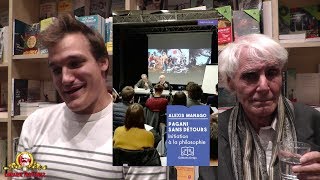 At the Tropiques bookshop
Pagani without detours
21 Sept 2019How can a book give linear form to Dominique Pagani's oral teaching, and what does this teaching say about the specificity of philosophy, of modernity, and of the question "what must I do"?
 Season 5.2
#5.9 Kafka: An Imperial Message
29 Jul 2019Is philosophical communication possible, if the message, as in Kafka's "An Imperial Message," seems never to reach its destination?
 Season 5.2
#5.6 Nature or Landscape?
2 May 2019How is the exterior, the landscape, interiorized by speech and music, and how does landscape differ from nature?
 Season 5.1
#5.1 The philosopher's Odyssey: Revolutionary thought
24 Oct 2018How does Rousseau open a sequence of revolutionary thought that leads to Lenin, and what dialectical thread runs through it?
 Season 5.1
#5.0 Presentation of the 2018-19 Workshop Season
15 Oct 2018How can we think revolutionary thought from Rousseau to Lenin without separating the study of praxis from the consideration of the psyche?
 Season 4
#4.9 Angélique (by Nerval)
14 Jun 2018How is a rigorous, quasi-scientific reading of a literary text possible if an abyss separates the exact sciences from the field of human actions?
 Season 4
#4.8 Angélique (by Nerval)
16 May 2018In what sense is Nerval's quest for the mother, far from being a personal matter, connected to the universal, and what does modernity repress in its relation to art?
 Season 4
#4.4B Objections to Dominique Pagani
4 Feb 2018Why go through Nerval and the concept of modernity to think the historical present, dominated by capital?
 Season 2
#2.5 Between crisis and war: Philosophising?
1 Aug 2017How does the modern subject divide itself, and how does literature express the unconscious before Freud theorizes it?
 Season 3
#3.3 From Ulysses to Daedalus
1 Aug 2017How can we assume the contradiction between the Greek and Christian heritages without falling back into the old counter-revolutionary thought that presents itself as new?
 Season 3
#3.6 From Ulysses to Daedalus
1 Aug 2017How does one pass from the theoretical order (what can I know?) to the practical order (what must I do?), and why is Rousseau, "Newton of morality," the decisive figure for this?
 Season 2
#2.4 Between crisis and war: Philosophising?
10 Mar 2016What is missing from the Cartesian subject in order to think the modern subject, and why do both the abstract self and the exclusive community end in destruction?
 Season 2
#2.3 Between crisis and war: Philosophising?
18 Feb 2016Why does philosophy, daughter of crisis, start from words of ordinary language, and what does modern poetry say about the historical moment named by the word "Occident"?
 Season 2
#2.2 Between crisis and war: Philosophising?
15 Feb 2016How does a sonnet by Baudelaire, La Cloche fêlée, allow us to link the problem of language and communication to the thought of our historical present, modernity?
 Season 1
#1.8 Between crisis and war: Philosophising?
28 Jan 2016What becomes of philosophy when, in place of the good, modernity posits freedom as foundation, with the negativity and possibilities of evil that this opens up?
 Season 1
#1.6 Between crisis and war: Philosophising?
10 Dec 2015What does Kant change by making the subject the legislator of knowledge, and why does this emancipation of the subject lead to the question of freedom?
 A Philosophical Alphabet
R for Reverie
1 Jan 2015What exactly does reverie mean, and what would an eleventh promenade of Rousseau's Reveries of the Solitary Walker look like?