English translation of the French transcript, made with AI and not yet proofread — click a paragraph to jump to it. Show the French original
The Douanier Rousseau painting and the three-act form 0:00 Good evening dear friends, good evening everyone.
0:30 I presume that most of you know by now that Pierre-Alain has just made a triumphant return from Cannes, hasn't he? I allowed myself to say quite a few things behind his back about his successes there. It's still the very first competition for immersive film in the history of the Cannes Festival, which is nonetheless the most prestigious in the world in this field, and he won the prize. There's every reason to... we can, you and I, be proud to be directed,
1:05 by such talents. There, I'm thinking of Pierre-Alain and his team. I would still like to point out that in the team, among others, they are all remarkable, all of them. But I'd remind those who have been following us for a long time that there are also the two children, the brother and sister of Philippe Moreau, aren't there, to whom we owe so many videos before these duties absorbed him between Paris and Lyon. There you go.
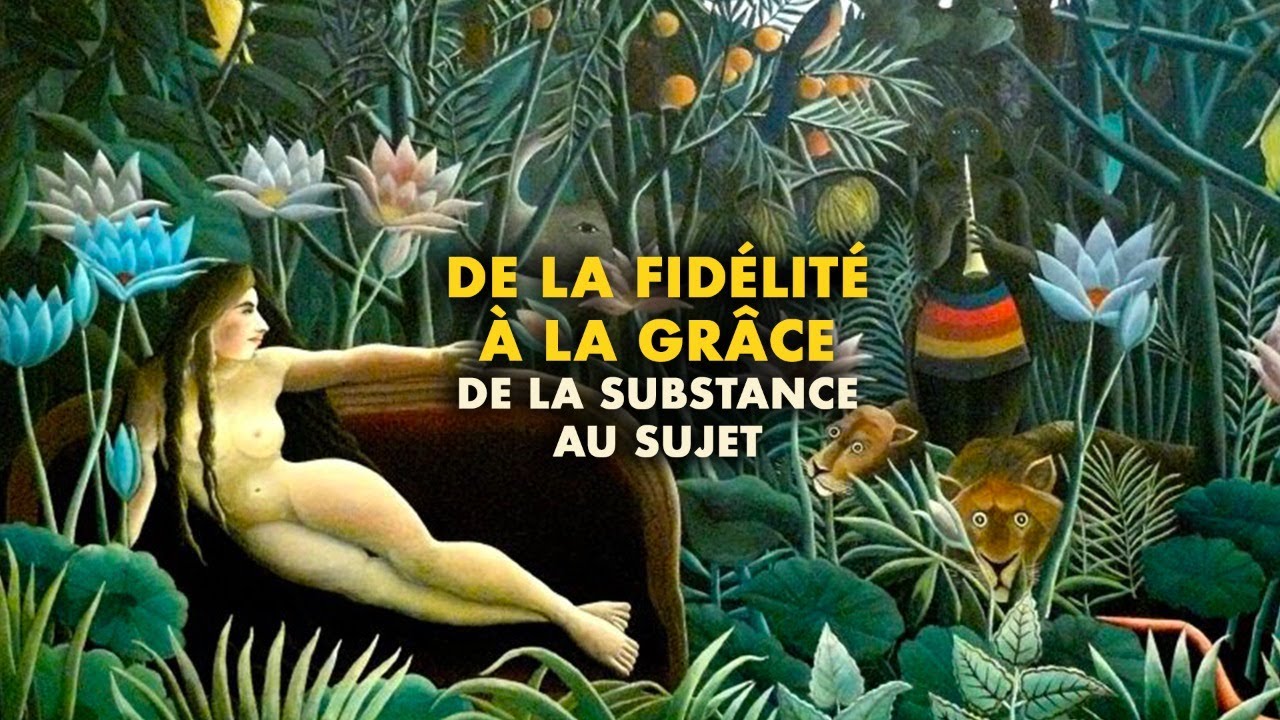
1:36 Between the Paris region and Lyon. So we meet again, as promised, to continue the quest for the Grail. This time I'm going to dig deeper, and I'll start by saying a word about the superb title card, the beautiful image Pierre-Alain just projected for you, which some connoisseurs of painting that I know here in our audience recognized as a painting by the Douanier Rousseau, the so-called naive painter.
2:19 And that he indeed was. Not a very great draughtsman, but what a painter, isn't he? And you see why I chose this painting? Because tonight we're going to talk mainly about Act II of Parsifal. Let me remind you—there, as soon as I say "let me remind you," I'm going to stray from the subject. Not at all. On the contrary. The general is immanent in the particular.
2:50 Let me remind you that, generally speaking, in Wagner's music dramas the second act is the act of action, irreversible action. The first is always an act of exposition, often long and laborious. That doesn't mean there aren't sublime passages. The third is always the act of resolution, either redemption through love or renunciation. When Wotan buries his daughter, that's a renunciation. And when Isolde keeps on dying as she is engulfed by the Irish Sea in the last seconds of Tristan, that's the most beautiful orgasm ever set to music.
First act: a ritual from which faith has fled 3:37 But here we're dealing with the second act. It's the act of mediation, the one in the middle, since there are always three. And the excerpts I played for you, the first acts, the knights' ceremonies, those rites that have lost their meaning, those hymns that have nothing to do with, I don't know, the choruses you find in a Passion, a Bach cantata, or in his motets, where there is an immediate, substantial faith.
4:07 Here, on the contrary, one has the impression that it's only the formal rite that continues, habits, ceremonial. All that's left is the formal shell of ceremony, but the heart is no longer in it, and the soul even less so. The statues are... how does Hegel put it in that passage, "the fruit that has been plucked," when he speaks just before, isn't it, of the state Rome was in—a key moment between the end of the Roman Empire and the beginning of Christianity—the statues are nothing but stones from which the soul has fled.
4:45 That's what the religion has become, the ritual of the Grail—let me remind everyone, since some are jumping on the train mid-journey, that we still have the Grail, but we no longer have the Spear. It's this dichotomy that will occupy us mainly tonight. We have the Grail, we no longer have the Spear. Second reminder: most Grail quests, starting with the very first one, the very first to utter the word Grail, the holy—that of Chrétien de Troyes, in the twelfth century.
5:26 Perceval is a quest. Perceval has the vision of the Grail in a castle he can no longer find again, and afterward, throughout the romance, he tries to find that castle once more, and this time to ask—not to be dumbstruck like an idiot, stupefied before that ceremony—but this time to ask the question that lifts the curse weighing on the world. And in all the Grail quests, the Grail is somewhat the final stage, the end of the quest—like in a board game, it's when you reach the end, there you go.
6:03 Finished, we've won. But here it's the opposite, you see, we are from the very start at the Grail castle, and the Grail no longer fulfills its function. So I'm going to move back and forth between the abstract and the concrete, because that's the only way to give flesh and blood to abstraction, and conversely, to understand a bit better the stakes contained in the intuitions and images, so as not to remain fascinated by the image alone.
6:35 To go quickly, I would say that this fundamental couple, which will be reunited at the end of the work, at the end of Act III, when Parsifal finally brings back the Spear that Klingsor had seized, while the Fisher King, who had come with that spear, of which he was the guardian along with the relics of the Grail, had come to put an end to the doings of the sorcerer and seducer—the one who no longer has testicles. Let me remind you that he castrated himself, explicitly, unable to silence within himself the assaults of libido, he laid a guilty hand upon himself, and this abominable act got him cast out of the community of warrior-priests of the Grail—and, a reminder of theology, Satan is a fallen angel.
7:28 And you find this again in the fact that Satan is called Lucifer, that is, the light-bearer, at the start—he is not originally the being of darkness, is he? So there's all that as a remnant, but here, furious at having been cast out of the community, seeking revenge—and we don't see this character, we hear about him, we're told all this, how it happened, how he took advantage of the moment when Amfortas was in the arms of Kundry, the chief seductress, and so, in that distraction, that ecstasy and resulting inattention, the magician took the opportunity to seize the Spear, turn it against his side, inflict that famous wound that never heals—and Parsifal's whole mission, who watched the ceremony at the end of Act I but did not ask the question, who stood dumbstruck—a reminder of Chrétien de Troyes, as we just saw—who stood dumbstruck before the suffering of the Fisher King, which is admirably rendered by Wagner, by his music, I mean,
8:38 the act ends in failure. Remember the old knight who acts somewhat as the historian of all this, who tells us all this, who educates the young squires, and who has the impression that Parsifal, who bursts in by killing a swan, in a place where it's forbidden to so much as touch any animal within the sacred domain of the Grail, takes him under his wing, thinking he is the one who was promised—that famous promise which says that one day will come one who is instructed by pity, by compassion, the most anti-Nietzschean value there is, according to Nietzsche, who we know practically died of pity, or at least whose reason died of pity.
9:18 who will ask the question during the ceremony—there, we're waiting—and in fact he is so stupefied by the suffering of the Fisher King, by the wound, isn't he, that he remains dumbstruck, he doesn't ask the question, and so the old knight drives him away, and right from the second act, which I'll be talking about tonight, right from the second act, we sense that he has been set upon a quest, because the second act contrasts enormously with the first—those hymns, I come back to it, that I'll be telling you about, those hearts whose faith has fled, that ponderous ritual, the time it takes for the procession to form and then leave the great hall, and then only the two of them remain, the old knight and Parsifal, who holds his hand to his chest as if he himself felt the wound, and that strange line that ends the act: "In future leave the swans in peace," says the old knight, "and go chase the geese, gosling that you are!"
At Klingsor's: the garden of sorcery and the flower-maidens 10:22 He drives him away, and so we, the audience, are left alone facing the stage, which is empty, empty, an empty time, a sanctuary deserted by the divine, you see—often, at the end of Act I, it's a failure. And in Act II, we are at Klingsor's, we are at the magician's place. Now, we can't talk about this abstractly, we need to see it—I'll show you several somewhat different stagings next time, probably on June 2nd, though that remains to be confirmed, but most likely it will be June 2nd. I take this opportunity to thank Pierre-Alain again for his availability—you can imagine there are more and more cats to whip these days—and so, we'll see sequences there where we are at Klingsor's place, so now he has the Spear, and Klingsor has a terrifying duet with Kundry, the seductress, and now we learn that the Grail's messenger, that woman in rags who came from time to time bringing balms, poultices, to relieve somewhat
11:32 the wound, without ever healing it, of the Fisher King—we learn that she is the very one who caused the wound, who seduced him, and who enabled Klingsor, taking advantage of the lovemaking into which she had drawn Amfortas, to seize the Spear and turn it against him. I'll send you, before the 2nd, entire acts for those who have time to watch—it's worth it—with different stagings, but I'll tell you right away, because it's easy to find on YouTube, you type Parsifal, Wagner, and Syberberg, isn't it,
12:11 S-Y-B-E-R-B-E-R-G, Syberberg—we've already seen excerpts, he's the one who made a real film, a filmed opera, a genuine film, with the singers dubbed, a technically quite staggering piece of work, and above all, someone who knows Wagner's work deeply and knows Germany well. Remember his film on Ludwig II, Ludwig, isn't it? So—Visconti made the film you know, Ludwig, Requiem for a Virgin King.
12:52 So, next time I'll show them to you, but you can already schedule yourselves Parsifal, Act II—often Acts I and II are grouped together, so check carefully—in the staging, I repeat, Parsifal by Syberberg, S-Y-B-E-R-B-E-R-G. So, what happens in this second act? We are in Klingsor's lair, and he is, well, he is the main character, he is alone at first, he begins by saying "Die Zeit ist da"—the time has come.
13:28 There, today, there is danger. Because the other knights are easy to seduce with the flower maidens and all that. Let me remind you, third point, that since he was cast out of the Grail community, he has settled very close by—well, very far in spirit, but close in kilometers—in what was called the desert. For a desert separates the Grail, the Grail's domain, from the rest of the world. In symbolic terms, that means that to reach the Grail one truly needs a crossing of the desert, trials and so on—of course, this is not given to everyone.
14:07 There, so—but here's the thing: out of this desert, he has transformed it—what's the opposite of a desert?—into a garden of enchantments. Not only is it no longer a desert, but it's an exuberant flora. And now you understand, I come back to it, the title card I started from, the painting, that extraordinary painting by this naive painter, isn't it? Just look at it, look, it's as if he wanted to paint the flower maidens. Do you see those flowers there, the flower maidens? Yes, in this magic garden the magician grows flowers, half flower, half woman—I mean they're supposed to be flowers below, like mermaids, a bit below they are fish, and above they have a bosom.
14:50 Well, the flower maidens are much the same, roughly speaking. And you'll see, in some stagings, I promise you, all you see is a naked woman—and he wasn't thinking of Wagner and Parsifal at all, but it corresponds so exactly that, in the correspondence I quoted to you from Wagner with Judith Gautier, his final love, when he was over sixty and she, the daughter of Théophile Gautier, was under thirty—he was writing the text of Parsifal at that time—he says, can you imagine, Parsifal enters the enchanted garden, and he puts in dashes "tropics," as an exclamation, in the plural, as if "tropic"
15:28 were an adjective—he spoke poor French. There, so that's exactly why I brought up this painting, with the sorceress playing the flute or some kind of oboe there, deep in the jungle, isn't she. So, it's said, for those interested, that the scene of the flower maidens and Klingsor's garden was inspired in Wagner by the gardens of Sorrento in Italy, south of Naples.
15:59 There is something tragic in the fact that Nietzsche and Wagner, who were already estranged from one another, had arranged to meet in Sorrento and missed each other there. There, well, anyway, let's move on. So I insist on the profuse, tropical, abundant character of Klingsor's vegetation, which so thoroughly makes one forget the desert and the trials, isn't it—so what is this garden and its flower maidens for?
16:32 Well, they seduce the Grail knights who set off to fight. Don't forget that the Grail castle is on a peak in the Pyrenees, so—and the infidels aren't far off, are they? Some people fear the great replacement, but as for us, for now, we've gone off to replace them at Jerusalem, on crusade. He fights against the infidels, and as he passes by, well, he crosses Klingsor's garden, and there they are bewitched by the flower maidens, and each time one succumbs, Klingsor makes him topple into his army of shadows, his new army of shadows—a bit like the undead, in the sense, yes, of the films you're thinking of, the horror films you're thinking of—this army of shadows through which Klingsor is preparing, one day, a general attack on the Grail domain, and his goal is not to seize the Grail, it's to extinguish it, for his wound—for he never suffers as much as when, like the Fisher King, he never suffers as much as when the Grail radiates and shines.
Decadence or war: the sermon in Le Rivage des Syrtes 17:39 So, you see, he has the Spear—so in Act I, we had the Grail without the Spear, a city withering away. No, but I'm not straying from current events. Do you realize the situation we're living through? Are we in an endless decadence, or are we, on the contrary, just a stone's throw from war? Not just war—a war unlike any we've ever seen. Don't forget Einstein said that if there's a third world war, meaning with nuclear weapons, the fourth will be fought with stones.
18:13 We will have regressed ten thousand years. So you say to me, what's this sudden shift? Listen, you know I've read you several passages from Julien Gracq speaking of Parsifal. The place where he speaks of it most, let me remind you, is in his first novel, The Castle of Argol, Au château d'Argol. But here I'm quoting you a passage that I read to you at Christmas, because it's a chapter called "Christmas," where he attends Christmas Mass in that strange city that somewhat resembles Venice, agonizing on its lagoons across from Farghestan.
18:50 There you go, the infidels on the other side, where things are stirring. You know the novel ends at the moment war breaks out. No, no, all this is very topical. And then, darn, excuse me, no, it's fine, I'll go on. He attends the Christmas Mass and this famous sermon—I'm sure some of you remember this rather unusual sermon. Christmas, the baby Jesus, the toys—ah no, but that's not it. There arose in the congregation something like a shiver of attention, and coughs here and there, stifled in the shadows.
19:32 "Let us turn back into our hearts with trembling and hope." That's the sermon of the priest who has just gone up. And he also tells us that when he's lit from below, by those little bulbs on the square so he can be seen from below, his jaw stands out. Quite something. "Let us turn back into our hearts with trembling and hope, and this comes more easily to us than to many others, on this profoundly disappointing night."
20:07 How can the night of Christmas be disappointing? "Disappointing, this night which is day, this dawn still wrapped like a veil around the uncreated light. Already, with this foreseen birth, the earth grows heavy. And yet, what it has chosen to hide within is the night of troubled counsel—yes, the night of Christmas—of troubled counsel and evil omens. And what walks before it and announces it, like dust before an army, is a sinister rumor of blood shed."
20:43 But no, he's not exaggerating. This is a commentary on what is called in the Gospel the Massacre of the Innocents. You know that Herod was told that one day a king would be born in Judea and that he would come to extend his kingdom over the earth—the prophet announcing Christ's birth. And so he ordered his henchmen to go slaughter all the firstborn, all the newborns. And there was in Jerusalem weeping and gnashing of teeth. So you see, what precedes this birth, what walks before it and announces it like dust before an army, is a sinister rumor, blood shed, and the very omens of destruction and death.
21:35 Did you think I'd forgotten current events? What carnage, isn't it! Carnage that the war party absolutely does not want to end, even though we had come to something close to peace—Zelensky was ready to sign, with Turkey, with Russia's negotiators, and Russia was ready to leave the territories it now controls under Ukraine's sovereignty. All it asked was that Ukraine not serve as a base for American nuclear missiles a stone's throw from Moscow, and not join NATO.
22:09 And of course, you remember, you all know what happened next—Boris Johnson came, that idiot, the worst head of state we've seen, and that's saying something these days, commissioned of course by the Pentagon, because America always has good intentions, to say "Come on, don't sign this treaty, you won't get a single weapon, not a single bit of aid, not a single penny, if you make peace with the Russians." It's terrible! But let me come back to the carnage! The poor kids, I'm thinking of the Ukrainians, the Russians, the tragedies on both sides, it's appalling!
22:46 Do you think that with Parsifal I was off in a daze—wait, wait, wait, wait—that in those days, "the blood shed and the very omens of destruction and death, on that very night, centuries ago, men kept watch, and anguish gripped their temples." But that's us! Those of us who are lucid, going from door to door, they went, smothering newborns barely out of their mothers' wombs, they kept watch so that the awaited event would not come to pass, to prevent the Christmas birth, isn't that so?
23:23 "So that the awaited event would not come to pass, leaving nothing to chance so that rest would not be disturbed"—rest, habits, isn't it—"so that rest would not be disturbed and the stone not be unsealed. For there are men for whom these things are always unwelcome, such as birth, he dreaded this sudden reversal, this ruinous and disturbing thing, without regard, birth, without regard, pain and impoverishment, a terrible upheaval."
Birth as upheaval and the sentinels of rest 24:07 I'm sure the most faithful among you—when I say faithful, I don't mean just those who are here every time, which already fills me with joy, but those who on top of that remember the right things. And I notice there are more and more of them in the comments. Honestly, I'm very touched. I'm sure some of you remember something, a text by an African author I once quoted, Cheikh Hamidou Kane: "The first morning of the White men in black Africa was studded with smiles, glass beads, and cannon fire. The earth, the known world, was giving birth to a new world that was made in mud and blood."
24:39 You see, the arrival of the first White men in Africa. So, let me pick up again: "For there are men for whom birth is always an unwelcome thing, a ruinous and disturbing thing, without regard, pain and impoverishment, a terrible upheaval, at the hour that has not been fixed, the plans that it disrupts, the end of rest. Sleepless nights, a whole whirlwind of chance around a tiny box, as if the very wineskin of the fable had just burst open, in which the winds had been shut up."
25:18 And it is true that birth also brings death and the omen of death. So one might say—but that's blasphemy—he's speaking ill of Christmas. No, no, look, look at the turn it takes. "But she is the meaning. The meaning is the meaning. I am speaking to you of a kind of man who is not yet dead, of the race, of the closed door, of those who hold that the earth henceforth has its fullness and its sufficiency." Those who believe history had come to an end with capitalism's victory at the close of the Cold War, isn't that so?
25:53 "That the world is full and has reached its sufficiency. I denounce to you the sentinels of eternal rest." Like Scrooge McDuck resting on his pile of gold, isn't it, like the dragon in Siegfried, remember, who spends his time saying "I sleep, I watch over the treasure." "O brothers and sisters, in this dreadful uncertainty of the night, rare are those who celebrate, from the depths of their hearts, a birth."
26:23 "They come from the depths of the Orient, and they knew nothing of what they would have asked for"—an allusion to the Magi—"what they would have asked for. They have no guide but the sign of fire that shines indifferently in the sky, the star, whether it is the blood of the grape-harvest or the blood of disasters that is about to be spilled." Magnificent text. "They bear the charge"—forgive me, I'm reading poorly—"they bear the charge of a kingdom of fabulous riches."
26:55 They bring gifts of gold, incense and myrrh. Of fabulous riches. And they feel that upon their garments, deep in this night, there is still a glow, as when one sees, faintly collapsing at the bottom of a cellar, the priceless heap of a treasure. Yet they have left, leaving everything behind, carrying from their coffer the rarest jewel. And they did not know to whom it would be given to them to offer it.
27:28 Let us now consider as a great and terrible symbol at the heart of the desert this blind pilgrimage and this offering to the pure advent. It is the royal word. It is the royal word in us which, together with them, sets out on this dark road behind this moving and mute star, in pure waiting and also deep in the depth of this night which they already hold in their hands.
28:00 I invite you to enter into their meaning and to want, blindly with them, what is to come. And so I go back, and to return to the era we are living in—the very beginning of his sermon—there is something deeply troubling, and for some of you there is a bitter mockery in the thought that this feast—he is speaking of Christmas—that this feast of fulfilled waiting and of the divine exaltation of hope should be given to us to celebrate this year on a sleepless earth.
28:45 I apologize for getting a bit personal, but I'll be turning 80 next year. There, I'll stop there. As for the personal side, I have never seen such an imminent danger of war. I don't want to sound the alarm, I'm no prophet, I'm not saying war is certain, but it has never been so likely. Because the forces of NATO are like the jaws of a pit bull, and someone has let the dog loose. You scare it, it backs off, and the jaws come back, come back.
29:16 We came close to having peace, I told you, in February 2023. It was thwarted. There were attempts, mediations, China proposed a plan. Right now there's a ridiculous conference about to be held, isn't there, which Ukraine cares about enormously, a peace conference where neither Russia nor the United States, who refuse to attend, nor China will be present. There we are, there we are.
29:47 And at the head of all this warmongering blaze is Macron. No, but listen, honestly, what happened? I'm not talking about communism—De Gaulle's France was a right-wing man, De Gaulle. Right? Can you imagine De Gaulle mobilizing alongside the Americans to finish off the Russians, alongside the neo-Nazis he helped rid France of, together with the communists—De Gaulle?
30:17 Really! No, wait, where are we headed? What is this reversal? France, which was truly loathed by the other countries of the Atlantic Alliance because De Gaulle left the seat empty in Brussels, the "thingamajig," as he called it, the Commission which decided that Nazism and communism were the same thing. Nice for the resistance fighters. The very man who chased NATO's high command out of Fontainebleau, saying, "Get out, not in my house."
30:51 If there is a nuclear war, I don't want France to be vitrified for the whim of a madman from Texas, a convulsed puritan. So I'm thinking of Bush, and so on, or a doddering old man like Biden—the Pentagon is lucky enough to have a guy who doesn't know whether to go left or right after handing back the microphone once he's managed three words of a statement. That gives ideas to those who want to pull off a dirty trick. Yes, yes, the hour is grave, the hour is grave. And so these words resonate, I don't know, with a certain topicality, I don't know.
"I denounce sleep to you": salvation in the blackest of night 31:29 He has given us this feast to celebrate this year on a sleepless, restless earth. I continue: under a sky devoured by evil dreams, and in hearts gripped and anguished as by the approach of these Signs with a capital S, these very signs whose fearsome announcement is written in the Book. He's a priest. And yet, in this scandal of our mind in which our heart has no part, I invite you to read, brothers and sisters, a hidden meaning, and to find, trembling, what we are permitted to sense of the deep mystery of the birth.
32:11 Why do I go on? Now pay attention to the lines that follow, because they help us understand what the lance is—I'm not losing my thread. It is in the darkest of winter, here we are in the negative, in the night; it is in the darkest of winter, it is in the very heart of the night that the pledge of our hope was given to us. It is midnight, midnight, and in the desert that the rose of our salvation blossomed.
32:43 We're not far from the flower-girls again. On this day which we are now given to relive, the whole of creation lay prostrate and mute. The word no longer rose up—one would think one were hearing the ceremonies of the first acts of Parsifal, from which faith has fled, the heart isn't in it, there is, but even less so, as I said, the word no longer rose up and even the sound of the voice found no more echo. In this night when the stars bowed at the lowest point of their course, it seemed that the spirit of sleep penetrated all things and that the earth, in the very heart of man, rejoiced in its own heaviness.
33:20 I can't help thinking—I'm going to tell you these lines that were written 60 years before what I'm about to tell you, which is current, you've read it, some of you have looked into it, that the American middle classes—what Clouscard calls more precisely the "middle strata," which is not quite the same thing. The middle classes are truly caught between two extremes: the immigrant worker who crosses the Mediterranean and survived, and the members of the MEDEF employers' federation in between—that's a lot of people, that's us, that's everyone. So the middle strata, in particular the libertarian liberals, isn't that so?
33:53 The middle strata, who try to cling to power through their relation to the text, are ravaged by a drug—I don't remember its name, a new drug that started out as an antidepressant—Pierre-Alain, that wasn't the name of the product, I don't remember it—the drug that is wreaking havoc in the United States, with a staggering death toll. No, wait, that's not abstract, is it? The whole of creation lay prostrate, mute, the word no longer rose up and even the sound of the voice found no more echo.
34:30 In this night the stars bowed at the lowest point of their course; it seemed that the spirit of sleep—shooting up, as they say—penetrated all things and that the earth, in the very heart of man, rejoiced in its own heaviness. It seemed, I go on, that creation itself weighed in the end with all its mass like a crushing stone on the sealed breath of its creator, and that man had lain down full length upon this stone, like one groping in the dark for the place of his sleep.
35:08 For it is sweet to man to pull the sheet over his head. There are also closed beds for the mind. Here—I'll finish on this sentence—here, on this night, I curse in you this becoming mired. I curse man wholly stitched to the things he has made. I curse his complacency and I curse his consent. I curse an earth too heavy, a hand entangled in its own works. This is exactly the ritual that no one believes in anymore, in the domain of the Grail, in Act One.
35:41 An earth too heavy, a hand entangled in its own works, a night of waiting and trembling—on this night of waiting, sorry, and trembling on this night of the world, the most gaping and most uncertain—I denounce sleep in you, and I denounce security. Ah, that's a change from those who say we've never been in such insecurity, they don't know the crime statistics from barely 50 years ago, I tell you.
The Grail as maternal substance, the spear that bleeds 36:12 All right, there we go. So I come back to the letter of Parsifal, and for those following along, let me remind you that I told you I would move back and forth between the concrete and the abstract, the Grail and the lance—we're in images, we're in myth, we're in metaphor, we're in intuition; let us raise intuition to the concept. If we agree together that the Grail—that is, the vessel that gathered the blood of Christ, as the body of Christ falls from the cross and is held up by his mother, you know, there are many magnificent paintings on this, the Avignon Pietà, all the Pietàs, aren't there?
36:54 Often the Virgin herself, you know, faints from grief, and it is at that moment that John, according to the text, says, pointing to Christ, that he must increase and I must decrease. What am I alluding to here? That the vessel has a maternal side—it is that which holds, which collects the blood that would spill out, a sacred blood that, sacrilegiously, would be lost in the sands.
37:28 "Earth, do not drink this blood!" There are some who know this. Gide, André Gide, yes, the novelist who took a trip to Africa in the jungle—you think I'm wandering off, you'll see—to the Congo, by canoe, going up the Congo River, I imagine, barely have you yawned than you're swallowing a thousand mosquitoes. Do you know what he was reading in the canoe? Bossuet's sermons, and that one in particular, where he comments on the Book of Job: "Earth, do not drink this blood"—no matter Job's blood, but earth, do not drink this blood.
38:07 An allusion, isn't it, to everything happening right now, but which is more than sacrilege, isn't it, when they operate, when they cut off a baby's arm without anesthesia, on children—earth, do not drink this blood. So, what gathers this blood, what consoles it, what carries it, is indeed the maternal element. The Grail is the substance. That's what the word means, remember? Word for word—don't go looking for a personal interpretation, not even a Pagani one.
38:41 Substance, the word—what does the word say? Not me, not him or her, what the word itself says, if the word doesn't speak, let it speak: substare, that which stands beneath, beneath the suffering, the pain, of the newborn who, coming out of the womb, suddenly encounters for the first time gravity, heaviness. Until then he was carried and gathered up by arms, by the mother's relays, the pram, whatever you like, later by lullabies. It's not—
39:12 Earth does not drink this blood. So, if the Grail is the maternal element, feminine in general and maternal in particular, the lance is the more aggressive, more pointed masculine element. Now, that's not something Wagner invented. In the original source, I told you, Chrétien de Troyes, in the twelfth century, was the first, to the point that scholars, even now, wonder where he found this word Grail, and no one agrees.
39:43 Well, if you want to get into it, there's the idea that it comes from "cratem," which would have an Arabic etymology, that it would go back to the Crusades—anyway, how do you want me to settle this? What is certain is that Chrétien de Troyes, when Perceval, in his early adventures—he hasn't yet, but he's not yet set on his quest—stumbles by chance upon the Grail castle. Right? He sees the ceremony, he sees—it's an extraordinary scene, I'll read it to you another time, we'll put it on the site, this passage—where three maidens arrive in a procession, in the great hall, where they have him dine, heading toward a chamber where a mysterious king is served—it's the Fisher King with his wound—and it says she carried a Grail, but it doesn't tell us what it is, whether it's a vessel, a stone, a dish, but it's linked to food, for that reason I say a dish, a vessel, it's certainly linked to food, since what cold rice, they served, you see, and it says that the light of the Grail was such that it seemed to have been born
40:53 from all the candles that shone in the lord's hall, the castle of the Fisher King. So once he has seen this Grail, he sees immediately after it the lance—it's a procession, there are two or three people, and maidens in general, very beautiful young women, radiant—and one of them holds the lance, the bleeding lance, that's where I wanted to get to, yes, a drop of blood filters from the point, the lance filters, a drop of blood that runs down to the sleeves, you see, the extraordinary symbolic overdetermination there is in works like this, in Perceval the Welshman, by our own Frenchman Chrétien de Troyes, one of the most beautiful poems of our nascent language, isn't it, and in Wagner's Parsifal, and all the way to Julien Gracq's Château d'Argol, since after all the variations are infinite on themes like this—you know that Chrétien de Troyes's romance is unfinished,
42:03 and that already, from the Middle Ages onward, there were countless attempts at continuation, poems from all over Europe, as far as Sweden—not to conclude, but the Grail, with the Galahads and all that, doesn't have the extraordinary, extraordinary symbolic richness that exists from the start in Chrétien de Troyes, in the quest for the Grail—you'll find it in the Folio edition, number 168, I believe, Perceval, or The Story of the Grail, do check that's right, author Chrétien de Troyes.
Passing through the negative: the spear as concept 42:34 There you go, so Wagner didn't invent the fact that the lance hurts, that it's sharp—so if the vessel is what soothes the pain, the lance is what inflicts it, and so I'll show you again—I went through it quickly the very first times we approached this cycle—but I'll show you again, now that you know it, because the perception is not at all the same, the scene where, for the last time, the Fisher King screams out his pain and even removes his bandages and shows his wound, which terrifies all the Grail knights—it's the end, it's the final minutes of the work, isn't it?
43:14 The moments where he says, go ahead, pierce me, I have sinned, I deserve it—well, anyway, at that moment the doors of the Grail Temple open and Parsifal arrives, having returned with the lance—that's the third act—with the lance, and he touches him and says that famous line every tenor has tried his hand at: "Nur eine Waffe taugt"—"Only one weapon serves: the one that made the wound." So, you see, the hand that inflicts the wound is the same one that heals it.
43:52 What are we seeing here? I think, going back to the Gracq passage I read you earlier, it's in the darkest night that our salvation appeared. One must pass through the negative, one must pass through Good Friday for there to be an Easter Sunday, one must pass through negativity for there to truly be a solution, a positivity. Positivity born of the negative is far more solid than one that is positive because it has never yet been in danger.
44:24 Isn't that so? That reminds me of a few pages by a very great Protestant, a very great poet, a fanatic, mind you, during the Wars of Religion—I don't mean it as an insult, but an excellent poet forgotten by, well, the general public—I'm thinking of Agrippa d'Aubigné. Baudelaire quoted a passage as an epigraph to Les Fleurs du Mal. Here's the passage, you'll see the connection—that one must pass through the negative to arrive at the positive.
44:58 It is said that one must pour execrable things into the well of oblivion, enclosed in darkness. In short, evil must be hidden, must not be approached. Like the neo-Spinozists—I'm not talking about Spinoza, for whom I have boundless admiration, but the neo-Spinozists of the Cold War, the Deleuzes, the Foucaults, the Onfrays—not on the same level, Deleuze is a great philosopher. One can be a great philosopher and not be politically astute, that's not the point. But anyway, I mean, all of them admire in Spinoza the fact that there is no more negativity, there is only positivity.
45:32 All right, lucky us. Let her go explain that to those living in Gaza right now. Now, it is said that one must pour execrable things into the well of oblivion, enclosed in darkness. But—it's Agrippa who continues—vice does not have knowledge for its mother. It's not because I have arrived at knowledge, at the concept, at the lance—the lance—that knowledge hurts.
46:04 Knowledge hurts, you see? The lance, that's the concept. And concept comes from a Latin root, capere, to capture. It's an aggressive word, especially in German, where concept is said Begriff. That's where "griffe" comes from, the word claw, which comes from the Germanic. Greifen, to seize, but like a bird of prey. Isn't it so? God gave Adam the privilege of naming the creatures, and we seize the Dachshund and the Saint Bernard, both of them, in the concept of "dog."
46:36 What power! No, I'm making an important detour, we're doing philosophy here. In the domain of the Grail, everything is going to rack and ruin. It's the world Julien Gracq described in the excerpts I read you. It's a world that keeps repeating rites without believing in them anymore, and that only lets the sentinels of the eternal wither away at rest. Because there is the Grail, yes, but without the lance. In Act Two, in Klingsor's realm, there is the lance, but not the Grail.
Hegel and the fall of man in Au château d'Argol 47:06 There is the lance, but only to do harm. You see? So now I'm going to emphasize the dialectical side that brings all this together. That is, it's the instrument that made the wound that can heal it. That is, it's the instrument of evil that produces the good, the negation, if you prefer. Now, you find this in Château d'Argol too, after all.
47:39 Excuse me, there we go, a visitor. Let me remind you that the hero of Château d'Argol, Albert—in a contemporary world that's a bit at war, but well, since there are cars and all, already automobiles—has invited a couple of friends to Brittany, hasn't he? And in this castle, it's solitude, isn't it? From his manor house in Brittany, which he has inherited, he brings along Hegel's Logic to work through it, doesn't he?
48:11 During those long hours. Excuse me, because I'm actually in the pages of The Opposing Shore here, aren't I? There we go. A handsome, brooding figure. Excuse me, I had prepared it and it slipped.
48:42 Ah, here it is, the room. There. So, you see, he was working, Albert, so the hero, he was working with ardor, deciphering the difficult pages of this Logic—I told you we're in philosophy, with a capital L, it's the Great Logic, where the entire Hegelian system suddenly seems to take its august and angelic flight.
49:15 Albert carried a rich curiosity toward the myths that have cradled humanity throughout its long history. He sought their intimate meaning with passion. So one morning he was quite surprised to see that Hegel, despite his declared aversion to examples, had set himself to giving an explanation of the myth of the fall of man—the scene of the moment when Adam and Eve seize the forbidden fruit.
49:46 In short, they tear the fruit from the tree of knowledge. You know that the serpent, the seducer, to push Eve into doing the irreparable—irreparable in appearance, for the devil at any rate—had told her, he is the liar, you know, he is the lie, without eyes, in Christianity. He told her rather, if you taste this fruit, eritis sicut dei, scientes bonum et malum, you will be like God, knowing good and evil.
50:23 There. The animal does not know evil. It knows pain, but it does not know moral evil, does it? But as a result, it doesn't know good either. So, here we go. So, you see, and he quotes the passage from Hegel: "If we examine more closely the history of the Fall," he said, "we find, as I have said, as soon as it brings to light the universal repercussion of knowledge on spiritual life. In its natural and instinctive form, that is, quasi-animal—if you pay attention to the end—spiritual life wears the robe of innocence, you see?"
51:03 Innocence, that is, positivity before knowing evil, pain, the negative." There's a continuity in what I'm trying to say. "Spiritual life bears the scene of innocence and trusting simplicity, but the very essence of spirit implies the absorption of this immediate condition into something higher." In French we do say a happy imbecile. "The spiritual is distinguished from the natural, and more specifically from animal life, in that it rises to knowledge of itself."
51:39 Not just consciousness. An animal has consciousness. A dog is conscious that there's a cat there it wants to chase, and a panther is conscious that there's a gazelle. And it's a good thing the gazelle isn't conscious that it's being tracked. But there is no self-consciousness, no reflection on self. So the spiritual is distinguished from the natural, more specifically from animal life, when it rises to knowledge of itself and of a being proper to it. This division must in turn vanish—negation of the negation—and be absorbed.
52:16 And spirit can once again open a victorious path toward peace. Concord is then spiritual. That is, the principle of restoration is found in thought, in what caused the wound in the first place, in knowledge, in thought and in thought alone. And here I'm following this sentence, which is almost a summary of Parsifal, from Hegel's pen. The hand that inflicts the wound—understood as knowledge, the concept—and the hand that heals.
White and red: Stabat Mater, the swan, Mallarmé 52:49 That's what I wanted to talk to you about. I told you it's the pair of the spear and the grail, but if you translate it as the grail, substance, and the whole path leading from substance to subject, there's a dimension we need to talk about, which I've touched on so far only in passing, but which needs to be developed now: what embodies substance in the world now, fundamentally? It's the maternal figure. We've seen this clearly when I spoke of the Mater Dolorosa and the countless grieving Madonnas, haven't we, in the history of painting or simply in...
53:32 in one of the most beautiful, that of Pergolesi, the Stabat Mater. You know, the Stabat Mater is... a work for orchestra and choir. But we forget that Stabat Mater are the first words of Stabat Mater Dolorosa. Dum pendebat filius? The mother stood in sorrow while the son hung.
54:02 Yes. Well, all these images recall—now we're getting to the heart of what will occupy us for the second act, a recap of the first act. We're in the domain of the Grail. Everything I told you, the ceremonies, the spear that's no longer there, the things withering away, it's told by the old knight, they're stories that never end. For connoisseurs, these are the most beautiful musical passages. You see? These are the kinds of longueurs you wouldn't want to see stop for even a second.
54:34 But the music is as if caught in glue, slow, fascinating, overwhelming, soul-rending. But as if caught in glue. And when suddenly, by contrast, this sacred history—this recollection of all these events—is interrupted by cries coming from the lake where the king goes once a day. The lake breeze is one of the balms that soothes his wound a little. You see, all these symbols. And on the lake there was a graceful swan in this domain where you're not even supposed to touch a leaf on a tree—well before the vegans, that's what they're called, well before vegetarians—which of course never stopped certain fearsome political tendencies, but that's another matter.
55:22 Be that as it may, suddenly they bring in the corpse of a swan that's just been pierced by an arrow, onto that immaculate whiteness that Bachelard, in Water and Dreams—that I recommend, a series on the elements, Air and Dreams, The Psychoanalysis of Fire, all that. And then there's, in my opinion the richest one symbolically, but that's a personal view, Water and Dreams, with a whole typology. There's stagnant water, marshes, and there's crystalline water, on the contrary.
55:55 And then there's the limpid water of the lake in which the swan's narcissism, its nakedness, is reflected. But let's not get sidetracked—precisely, an arrow, a purple blood bursting onto that whiteness, those terrible extremes of white and red—I dwell on this because we come back, we come back to our pair of the spear and the Grail.
56:26 Try to exercise your conceptual intuition a bit, if I may say so, to bring the two together. White, the Virgin Mary, the Immaculate Conception, yes or no? There, there's no red. Except that apart from the Virgin Mary and the mystery she represents, a woman who is white in the moral sense, who is virgin, and who is the object of desire of all the lecherous men that we are, isn't she?
56:59 Yes, but the trouble with all this is that as long as she remains a virgin, she's sterile. As long as that white hasn't been reddened, we have purity but not fecundity. You see, we're back to the positivity before pain and the one after. Well, there's a magnificent illustration of this in a famous sonnet by Mallarmé, whose central figure is a swan, the animal, a swan, as in Parsifal.
57:30 A swan, but what a dreadful image. Did it sleep, did it dream like a poet? When it wakes up, it's caught in the ice of winter. Its wings are trapped. I'm telling you this a bit ahead of time, because Mallarmé packs so much in, it has to be translated. So the virgin, the white, the virginal, vibrant, and beautiful today—will it tear for us, understood, well, with one drunken wingbeat, tear what? This hard lake, the ice, it's white, this forgotten hard lake haunted beneath the frost—what haunts beneath the frost?
58:09 The animal that is trapped, the transparent glacier of flights that never fled. An allusion no doubt to the literary sterility that haunts Mallarmé and modernity. Mallarmé's complete works are hardly Victor Hugo in number of volumes. So you see, sterility, fecundity—we come back to it—whether literary or childbirth in the literal sense. Everything is white in this text. So I continue.
58:39 A swan, so it's him—a swan of former times remembers that it is he, magnificent, but who without hope frees himself. Why without hope? Here's the answer in the poem: for not having sung of the region where to live, when of sterile winter shone forth the tedium. All his neck—it's a sonnet, it's soon over—all his neck will shake off, the neck is free, the swan's neck, it's the wings that are all—all his neck will shake off this white agony inflicted on the bird that denies it by space.
59:18 Mallarmé is one of the rare French authors, a great connoisseur of philosophy in general, and of Hegel in particular. All his neck will shake off this white agony inflicted on the bird that denies it by space, but not the horror of the ground where the plumage is caught. A ghost, again an image of whiteness, a ghost that this place assigns to pure brilliance, since it is white, it is confined to the violet lake.
59:49 A ghost to which this place's pure brilliance is assigned, and this is the conclusion, it grows still in the cold dream of scorn worn amid useless exile by the Swan. You see, that's white without red. I'm making you work today. I'm not just going to tell you the adventures of Perceval. They're there, but you have to see what's at stake.
The pink of Aurélia, middle term between the extremes 1:00:19 That's what it is, the Grail without the spear. The spear that bleeds, that brings the red that's missing. And here I recommend an extraordinary passage from Nerval's Aurélia. I won't talk about Nerval in general, if you'll permit me, I miss it. I hope some of you miss it too. Alright, seriously, it's full of reassurance—you'll see, in it he's in a dream, a vision, they're waking dreams, when he's in the psychiatric asylum, what he calls the overflowing of the dream into real life.
1:00:54 "Here began what I would call, for myself, the overflowing of the dream into real life." And so in this vision, which also occurs in broad daylight, the hallucinations—he is guided into a mysterious and marvelous city, where there's a society living somewhat on high mountains, which knows progress, does scientific research, but at the same time keeps patriarchal customs—it's a very strange dream. And he suddenly sees young people arriving on a terrace with a great view, young people at their studies, wearing all-white tunics.
1:01:32 You see the connection with what we were saying? But my guide tells me—I'll give Nerval the floor—that in reality they were colored, but that a caprice of the prism prevented me from seeing it. And he began, it's an extraordinary passage, with a brush, to draw on their garments, to color them, saying, here is how they really are, what you cannot see. And five minutes later, a new band of young men and young women arrives, this time both, wearing white garments, but full of pink seams.
1:02:09 And the more perceptive among you have already guessed that between the two extremes of the spear and the grail—I'll sum it all up—between the two extremes of substance, of immediacy, of origin, of maternal fixation, which one must leave behind if one wants to live at all, otherwise it's deadly—between these two extremes of substance and subject, of substance and concept, between the grail and the spear, between white and red—well, the middle term is pink.
1:02:45 We shouldn't mock sentiment too much. As the ideal middle term between the two extremes—the carnage, the red, when there's only red, the spear in Klingsor's hands, the carnage—and on the contrary the sterility worn amid useless exile, to borrow Mallarmé's phrase, by the Swan. There we are. By any chance, did I ask Pierre-Alain if there were any questions?
Saint-Dizier, the Vix krater, and grace in Saint Bernard 1:03:22 Because, I didn't tell you this, I should have started with it, but I'm a bit tired this evening—happily tired, these are tasks nothing obliges me to do, so I won't blame myself. But tomorrow I'm going to Saint-Dizier, where I've been invited to take part in the tenth anniversary of the UPSD, the Université Populaire de Saint-Dizier. They'll be screening a film that some of you may have already watched on our site and that I recommend, made by Bertrand Puy-Ségur, who so often and so kindly invites me to Saint-Dizier, and with his association the Université Populaire de Saint-Dizier, where he made a film called L'Île du Peuple—if you search on our site.
1:04:11 L'Île du Peuple, which alludes at the same time to Rousseau's tomb, which is on the Île des Peupliers. You see. I'm going tomorrow. He very kindly asked me to bring a few books—the little book I put together on Hegel and femininity, femininity and community in Hegel, and Pagani en détours, which we owe to Alexis Managot, for possible dedication requests. So I went to Delga's, I carried kilos of books, my arteries can't keep up anymore, so I'm exhausted, I'll be turning 80 next year—I've said that twice now, I'm getting a bit senile—so it's a normal fatigue, and that's why I would have preferred to start by telling you, staying in the mode of answering questions.
1:05:02 Instead I got going, didn't I, perhaps to make up for all the time you spent waiting for the continuation of the adventures of Perceval and Parsifal. So, there aren't any—Pierre-Alain, we can... not directly, not on topic, there are comments if you want to see them. Yes, yes, absolutely, absolutely. I'll look on the side. Oh yes, that's right, I have to... I always forget I have to click for the comments. So let me look at them.
1:05:34 Stavisky is always relevant, I think. The important thing is pink, the important thing is—it's good. Well, maybe the younger ones haven't heard this Gilbert Bécaud song, "L'important c'est la rose"—the important thing is the rose, it's pink—he understood it very well. Thanks to Stavisky. The conquest of the Grail always leads to Saint-Dizier. Well, we shall see.
1:06:04 Once I passed through Châtillon-sur-Seine. I don't know if you know this little town. Sorry to those who are from Châtillon, calling it a little backwater. I say that, I'm making a parenthesis, commenting on the comments, but once I was in the suburbs, instead of taking the RER as usual to go into Paris for an appointment, I went the other way to explore the suburbs a bit. That's how I ended up in Cachan, discovering the extraordinary world of the suburbs, and I found myself in Fontenay-aux-Roses, you see.
1:06:37 I didn't know it, it's fairly residential, fairly posh, as we say in French. And then it's 1pm, I'm a bit hungry, it was a Sunday, and I run into some passerby on nearly deserted streets, a Sunday, streets of suburban houses, like that. I say to him, excuse me sir, would there happen to be a restaurant open on a Sunday in this little backwater? He bristled. "It's not a backwater, sir, it's a communauté de communes." It's terrible, really, the world we live in.
1:07:07 A little backwater is hardly the end of the world. The backwater is the key to France, it's the number of little towns with a bell tower, what's wrong with that? Alright, closing this personal parenthesis, and it's because of Stavisky saying that the Grail might be in Saint-Dizier—I passed through Châtillon-sur-Seine. It's the spot where the Seine stops being navigable. That was important in antiquity. And so it's there that the Gauls got hold of the Vix vase—it's Gaulish, V-I-X, it's a small hill very close to Châtillon-sur-Seine, in Burgundy, in the north of Burgundy, where Burgundy borders Champagne, where they make the cheese, the yogurt, the Chaource, sorry.
1:07:59 And so, since the Seine stops being navigable, the merchants of the time who went to fetch, I don't know, amber, but I don't know, went to buy it with wealth brought from Greece for instance—there were extraordinary trade routes by waterway, because in the forests and so on, people talk about insecurity nowadays, that seems laughable compared to back then—the roads, you cross the forest of Fontainebleau, and already you're risking your life often.
1:08:33 So they found this vase, which is the largest bronze vase of the whole of antiquity. Yes, it's not in Greece, not in Rome, not in North Africa where there are so many Roman ruins—some of the most beautiful, no doubt, in the whole Roman Empire, particularly in Libya, for those who've heard of Leptis Magna, that extraordinary Roman city by the sea in Libya. So there, in Burgundy, in a little backwater, and this vase, you can see it at the museum in Châtillon-sur-Seine.
1:09:07 I went there, but above it there's a church—getting to what Stavisky said—a church where Saint Bernard came to work on the notion of grace, the mystery of grace, grace which can touch the hardened sinner just as well and leave aside the one who says "I keep the ten commandments, I follow the rules, I should deserve paradise"—and yet no, it's the sinner who gets salvation. It's mysterious, grace. Well, Saint Bernard's theory of grace is one of the sources Wagner used to write Parsifal.
1:09:43 So, my dear Stavisky, I'm delighted by your connections, but I mean, it's more relevant than it seems. So, the Vix krater, I see they know about it, from someone with a nice pseudonym, "controlled opposition." Frankly, I have an audience I admire. "I live two steps away," he says. Ah, I've had hypotheses, but I'm too tired to settle on just one.
1:10:16 Well then, "Rose profonde" by Dioné and Pyrus, that's nice too. Alright, let's not be crude. Masons know concrete, and in Spanish "el concreto," says Karcha, who's an old acquaintance, often extremist, isn't he, Karcha, when he talks about jazz or things like that. Yes, no, but he's cultured, I'm teasing him.
1:10:49 There, that's it, the comments? I can scroll back up, there are a lot. Ah, right, right. That surprised me too because I love the style of our audience. So, the Vix krater, that's it. "Communauté de communes, administrator vocabulary, settlers, color of concrete." Thanks, Ablussien. I admit I took it badly—still, it's not an insult—that is, isn't there a restaurant in the backwater, really? "Not a backwater, my lord, it's a commune."
Symbolism of white and red, Luther and President Schreber 1:11:20 Yes, thanks, "paper-pusher vocabulary"—we need paper-pushers, but some of them are parasites, some are indispensable, some the MEDEF would love to get rid of. Alright, "controlled opposition," what else is there? Julien Chevalier, good evening. "Would you have, like Mr. Pastoureau, a symbolic clarification on the white and red chromatics?" I admit I catch, how shall I say, a bit of schoolboy slang here—white and black keys, that I'd understand.
1:11:58 But white and red—white and red can give you endless variations. We saw earlier, these are the two extremes: not fecundity, but which can lead to carnage, red—it's the same with whiteness, which is appealing, like the Virgin, not immaculate, but terrible as long as she stays a virgin. And it's no accident that these are the two colors found in the flags—look at the list—of Japan, Poland, Switzerland, people pass by.
1:12:39 These are the colors of Saint Catherine, the martyrdom of Saint Catherine. Well, there we are, for those interested in symbolism, in the initiatic, it's always the same things. Excuse me, I seem to be a bit dismissive of what's called gnosis, but it's true it's always a bit the same trick. The same symbols coming back. Whereas with Julien Gracq, he really works them. "Oh, socialists, sodomites, only exist to take swipes at that." Ah, that's Karcha, I was sure of it. You see he's an extremist. Alright, let's calm down.
1:13:09 "If sodomites only were socialists, it would be known." And besides, what do you have against sodomites, anyway? I don't know what these value judgments are about. The Germans, in the Nazi era, were obsessed with penetration. Oh yes, listen, since you're baiting me, I'll answer. I'll answer. I've already spoken about this, about the passion for armor, the Panzerdivisionen, the fortress, and the most famous chorale of the great Protestant musical tradition.
1:13:48 of Protestant music. Bach is a titan, mind you, but it's Luther, first, who wrote a chorale titled "Ein feste Burg ist unser Gott"—"A mighty fortress is our God." It means "You will never be able to penetrate me by surprise." Whoever says that, well, somewhere, he wants it. Alright, I'm telling you this to shock you a bit. But you know, when you overdo it like that, eh? No, no, but I'm not joking.
1:14:18 You have the most striking example of this in the extraordinary document left to us by President Schreber. You're baiting me, I'm answering, right? Yes, the only analysis by Freud among the five great case histories. "Oh, it's Freud, it's more charlatan raving." Wait, it's not Freud, it's a document that exists that all specialists know, left by the honorable President Schreber, who was a well-known scholar, a doctor, as they say in Germany, and who went off the rails—a fairly serious psychotic crisis. And Freud—it's the only psychoanalysis he did this way, he says, not quite according to his usual practice, not based on words on a couch, but based on a text—he came upon his confession.
1:14:59 And in his confession, it's honorable, yes, in the sense that really, he, all his horrors, sodomy, all that, there's no question, I'm one of the most well-known men, the most honored in the place, I don't remember, I think it was in Augsburg, but I'm not sure, in Germany anyway. Suddenly, he went off on a whole thing. So, I'll tell you, his delusion is that God chose him among all creatures, it always starts like that, a crazy thing, it's always the same things, among all creatures, to save the world, but the condition for that is that he has to transform himself into a woman.
The rose in the cross of the present: religion and reason 1:15:32 But of course! And God, who takes the form of the sun, that too, he didn't invent that, even better, the sun, every ray of the sun enters him where I think you know. What do you want me to say? There, alright, I'll continue my commentary, because I feel I'm on slippery ground, it's going to be tiredness. But it's profound, isn't it, no, no. Rose, anagram of Eros, one ton, that's what Thoth says, do you know who Thoth is among the Egyptians?
1:16:03 He's the best intellectual, he's the god of scribes, isn't he? Because with his beak, you know, it's with his beak, it recalled, the reed pen, the reed cut to a point, with which one wrote on papyrus, right? The beak of the Ibis, Thoth is the god who has an Ibis face with the beak, like that. Rose, anagram of Eros, god of love, but love [amour] is 'our' [gold/light] and 'âme' for soul, that is the light of the soul.
1:16:37 That's good, isn't it? There you go. I think there are people well-versed in glossing, that's good, it could have been Nerval, that one. I'll tell you, at the same time, to calm down a bit the ardor and the temptations of delirium, once Nerval found himself in some high society gathering, and someone says to him, but what's with this individual who has no religion? Nerval answers him, you exaggerate, I have at least twelve. Alright. So, Ablussien, is the film 'The Island of the People' available online? On YouTube, is there a debate with Puy-Ségur?
1:17:07 I believe so. If not, don't hesitate to send me another message, because I'm going to see Puy-Ségur tomorrow, and I'll see what we can do, but I know it's for sale, on a DVD marketed by those who produced this film, admirably, technically too, that is by the Popular University of Saint-Dizier. There you go. Thanks Ablussien. So, I'll continue.
1:17:43 Akarcha, I like what he says, optical illusions are caught up in the demon of the unconscious, colon, rosy cross. No, no, not the Rosicrucians, but the rose that grows, the rose that rises. Yes. It's often been said that Hegel, because all the German intelligentsia, if not in Freemasonry, was in the Rosicrucians, it was fashionable. You have to know, for all these things, that at the end of the 18th century, there was a wave of what was called at the time illuminism.
1:18:13 You see, we have a text on the importance of the German illuminati who entered France through lands that were considered German, Lorraine, Chantal, it was completely... Anyway, let's leave erudition aside for now, but what is certain is that we found in Hegel, we know that Goethe, for example, was into it, but he's among the most balanced people there are. And let's not forget that the Christian religion, Catholic in particular, had been so discredited during the Enlightenment, how could you expect it to recover?
1:18:48 Blows from battering rams, people like Pierre Bayle, whom we tend to forget, the first, the most, the one who tore into all of them, then Montesquieu, then Diderot, Voltaire, I'm not even talking about Rousseau, who never commits sacrilege, but who never compromises with the Church, with the priests, if you prefer. And so it was so discredited that it doesn't disappear.
1:19:18 And here, I think of Marx's admirable text which is quoted, mutilated, only for the passage 'Religion is the opium of the people.' We forget that, in that whole passage, it's an immense homage to religion. He says that the soul's consolation for suffering, he shows there is a reason for religion's existence. And as long as we haven't solved that problem, the problem of human suffering from outside, etc., religion will be there. So when he says opium, have you ever tried to get someone off opium?
1:19:48 The alkaloids, watch out, that's not weed, that's something else. I'm not saying you should smoke weed. I nearly died of a heart attack. I smoked a lot. But it's nothing. It doesn't hook you. When you stop, it's much less of a withdrawal than tobacco. Tobacco is much more addictive. It's more dangerous, isn't it? It's the one that causes... Ah! That thickens the blood and causes at some point a clot, excuse me, that no longer passes through the heart.
1:20:20 I move the car, the car's exhaust, the engine implodes. That's what a heart attack is. It's hard to get someone off heroin, that is the concentrate of opium and morphine. Just try it. That means it's an extraordinary force. So people get attached to it out of necessity. Alienated. Isn't it? I'm doing a whole... Remember, not so long ago, a video whose title was 'Secularism, the truth of religion.'
1:20:53 But truth in the Hegelian sense, that is, its fulfillment and suppression at the same time, like the spirit in the Trinity, and the fulfillment of the split between the Father and the Son. The spirit of Calvary and the labor and patience of history. So, I recall all this to say that I insist on the fact that the established, official, Catholic Church was so discredited in the 18th century that the necessity of the sacred continuing, for the reasons I've told you, to have its reasons for existing, the real is rational.
1:21:45 That means the real has reasons, ratios. The most cultivated subjects of the time were latching onto any form of religiosity provided it wasn't the one they'd come from for centuries, namely Catholicism, hence Freemasonry, the Rosicrucians, all that to tell you that at the end of the preface to Hegel's Philosophy of Right, there's a passage where one has seemed to see an allusion that seems obvious, moreover, to the Rosicrucians.
1:22:22 I quote to you: 'To conceive reason as the rose in the cross of the present.' Thank you, Carja. 'To conceive reason a bit like the lance, it hurts, but it's what heals.' To conceive reason as the rose in the cross of the present and the mediating vision that reconciles with reality. There you go. All the same, your comments, it's when I comment on your comments that I'm most inspired, isn't it?
Satyajit Ray, Visconti, the partition of India; Kant 1:22:56 I thank you for that. 'In red and white, I will live my life.' Let loose, Carja. Make black become white and white become red. Gifts, everything. I agree. Agreed. What a program. I don't know. 'The first chess set would be made of red and white.' Ah yes, that makes sense, that's true. I'm inexcusable for not having understood the allusion, especially since I'm a fan of the greatest Indian filmmaker, Satyajit Ray.
1:23:34 Film buffs, I'm not one, I'm not knowledgeable enough, but those who are know this admirable director well, a bit like the Hindu Visconti. I say Visconti because just as Visconti expresses everything, he's a prince, from a very great family, the Visconti in Italy, but a red, communist prince. It's a bit the same with Satyajit Ray. And just as Visconti expresses the class struggle, but not through a film set in the working class like, I don't know, Germinal. No, but on the contrary, how does the class struggle manifest where everything is done to ignore it?
1:24:08 Among those who govern, in The Leopard, the count, the leopard admirably played by Burt Lancaster who has the face of someone Sicilian from birth, or else in The Damned, you know, which takes place in Germany among the ruling circles of German capitalism during the rise of Nazism. But you feel coming from underneath the Nibelung scratching from below, isn't it? Just as in The Leopard, in the middle of a dinner, where the military triumphs, having crushed, repressed the supporters of the Italian left who will ultimately triumph, the partisans called the red shirts, Garibaldi's partisans, the Leopard, a bit tired by the whole dinner, goes out into the night, like that, around 3am, and you hear a burst of gunfire, someone who's just been shot, discreetly, you see.
1:25:08 That's how Visconti expresses the class struggles in Sicily at that time. Well, you find that in Satyajit Ray, in a film, I can't recall, The Chess Players, which I recommend to you, which is funny at times, tragic too, a film set at the moment when England is swallowing India piece by piece, all that's left is the kingdom of Oudh, and it's a Muslim kingdom, which is now in Pakistan. I remind you that before India's independence, there was no separation between India and Pakistan.
1:25:43 It's the English, I'll say the Anglo-Saxons, there it was the English, isn't it? And in particular Mountbatten, the husband of the future queen, Elizabeth II, may the earth rest lightly on her as they say in Africa, even, I don't shoot at... not only ambulances, I don't shoot at... ah, what's it called? The cars that carry the dead. So, Mountbatten, when he saw he could do nothing more against India's independence and Gandhi, said, so as not to lose everything, we'll sow discord between the Muslims of the East and West and Far East, what was called at the time, but it's too recent, East Pakistan and West Pakistan.
1:26:33 West Pakistan is still called Pakistan now and the eastern one is called Bangladesh. Isn't it? Well, so as not to lose everything, they separated the opposites. Do you know what that caused in '47? Two million dead. And what are we shown pity for? Well, how many deaths were there? Do you know how many deaths there were? There were ten times fewer than in Gaza over the past few weeks.
1:27:07 There you go, every death is deplorable. Let's be serious, but still, still, you see, the carnage always comes back. Red without white. Alright, let's try to get back to the roses. When Plato takes himself for Socrates in praising his learning, so, can one fall asleep on a carpet of awakening? Tales, myths and legends are made to put children to sleep and to awaken the mind of the parents.
1:27:41 That's good, and children, while sleeping, dream. There's a very beautiful poem by Rilke on this, isn't there? On the sleeper sleeping, but dreaming. Alright, so, young Kantian, well, that's a new pseudonym, long live the negative. Well, that's nice, that. I remind you, in homage to Kant, since I'm dealing with a young Kantian, that Hegel criticized Kant a lot, but still, the three young men of Tübingen used to say that Kant is the Moses of our nation, isn't it?
1:28:16 That describes that everything started with Rousseau, according to Kant himself. So, neither with Germany, nor with France, but between the two, in Switzerland. And me, I never believe in chance, my somewhat paranoid side, I wonder about it. It's that Kant says we can know nothing of ourselves, you know, that's the continuation of the critique. Otherwise, it's never left to Kant, except in a negative sense.
1:28:46 Imagine that I've worn yellow glasses since birth, and that I can't take them off. You're convinced that yellow is a property of the wall, of the thing, of my girlfriend's dress which is in fact immaculate white, but I'll see it as yellow. It's because of my glasses, because I'm not aware of my categories, of what is a priori, even before an object strikes my sight, I already have yellow there. Let's imagine, let's admit, I say, that our perception is made that way, that it's categorized, if you will.
1:29:21 For Kant, the yellow is time and space, which force us to see everything through spatio-temporal frames, and so, what he calls seeing only the phenomenon, without ever seeing what is outside time and space. So, we can't have positive knowledge, but, I can have negative knowledge of it. If I become aware that the yellow comes from me, from my glasses, I know at least that the noumenon, I don't know what it's like, but I know it's not yellow.
1:29:53 Thanks to young kantien for giving us the occasion to make this reminder about the greatest Kantian, the greatest Kant, sorry, the one who goes so far as to say, not that we can have a positive approach, but still an approach to the noumenon. There you go. I think we'll stop there, no? So, I'll prepare the next session for you, so it will probably be next June 2nd, or upon my return from Saint-Dizier.
Announcement of the second act: Klingsor, Kundry, and Parsifal's name 1:30:28 Because of you, I don't rest, you notice, but, as I tell my young friends, I grumble, but I don't complain, so, I don't complain, I even thank you for being the occasion for me to try to continue transmitting, to externalize, isn't it? I've said it often, not being a creative person, I transmit the creations of others, isn't it? To which someone once told me, you're creative in the art of transmitting, that made me quite happy. I hope, I still hope, I'll try.
1:31:00 So, when I get back, you'll have sequences, I'll try to post a few of the complete acts, so everyone can have time to watch them by then, in the best versions that I select. I have to tell you, I don't really choose the best ones, but I choose those where there's at once what's least bad in terms of staging, that's the most fragile, the most difficult part, and as for musical interpretation, I try really hard to take what's best, but on the other hand, there also has to be, for those who don't speak German, who don't speak German, there has to be the text. So having all three isn't always easy.
1:31:38 So, I make a compromise. I've found a few that hold up and have all three. And we'll see this second act which begins with an extraordinary dialogue, it's a Corsican speaking to you here, I'm going to get scolded by my compatriots, between the pimp, well the procurer, Klingsor, and Kundry. Come on, go, go to work, because today, and I'm going to conclude with this quote from Klingsor with which the second act opens, the first one, whom we finally see appear since we've been talking about him.
1:32:09 You know that when the devil appears, he's done for. When the unconscious becomes conscious, it's over. When the lance tears through illusions, I don't know. So, at the point of the lance, I pick up my thread, he says, Klingsor, he begins by saying the time has come, what is exceptional today, why does he say 'Die Zeit ist da'?
1:32:43 The moment has finally come, because the one who comes today is not a knight like the others. And he says to Kundry, 'more dangerous today is', I'm quoting you word for word now, 'the one protected by the shield of idiocy.' So, we guess that it's the fool, the pure one who's arriving, it's Parsifal, and that it's going to be a whole different matter to seduce that one. I'm giving you the program and I'll finish. And Kundry is fully aware in her role as seductress now that she's under the spell, under the enchantment after having resisted.
1:33:15 I don't want to, he's a child, he's a kid, it's horrible to be woken up for such things. But it's really a dialogue between the pimp and the prostitute. I mean, except that the prostitute is truly under the sway of a spell. When Parsifal arrives, he'll see the flower maidens, he's amazed, but like a kid, not wanting breasts, buttocks, things, stuff, and he only asks to be possessed by him.
1:33:48 And then, he disappoints them a bit, the flower maidens, because he's not very forward, he goes from one to another, he plays around, and at a certain point, he pushes them away, because he did come, after all, on a mission, he wants to recover the lance. There's a moment where he pushes them away, for the first time since the beginning of the work, in the middle of the second act, remember, in the middle of the Tetralogy, in Siegfried, and in the middle of Siegfried, in the second act, there's the bird scene, and here, there's the flower maiden scene.
1:34:22 That, I pick up my thread again. I trust some of you to understand the connection I just mentioned. In the middle there, for the first time, we finally hear his name. We know it's Parsifal, but nobody knows it, not even him, since in the interrogation I showed you two sessions ago, at the beginning of this cycle, on the Grail, remember, when Gurnemanz, the old knight, says to him, but at least tell me your name, what does he answer?
1:34:53 I've had many, but I don't remember any of them. He's there. He hears his name spoken by Kundry. And he says, as in a monologue, 'Parsifal, thus did my mother call me in her sleep.' There you go. We'll see again, in the second act, this maternal fixation which is the greatest trap awaiting us. When one arrives almost at the end of the journey, in medieval tales, it's often the worst of trials, that's the one awaiting us.
1:35:25 At the moment when, that's it, arriving finally at the castle, there's the girl, up there, with braids falling from the first floor almost down to the ground floor. But it's at that moment that there are monsters and things. There you go. He's the devil. Let's be careful. Thank you and I'll see you next time and on June 2nd, probably. Thanks to Pierre-Alain.