English translation of the French transcript, made with AI and not yet proofread — click a paragraph to jump to it. Show the French original
Nature or landscape: arts of space and arts of time 0:01 Good evening everyone. Thank you all for braving this Tempacciu, as we say back home, or Tampaccio if you speak proper Italian. That means bad weather. And even so, I actually like it. I'm a perverse Corsican. But I like the climates of the North. And thank you for being so numerous and, for the most part, so faithful. And also, greetings to the newcomers, whose number keeps growing.
0:38 The idea of devoting this second term of our 2018-2019 season, I'm starting to talk like TV series now, to the theme nature or landscape?
1:27 It was formulated two years ago, I think. When it was... No, no, during the Nerval serial. Actually, it was last year. When we were following, when we were tracing the discreet steps, the muffled wandering of Nerval, and his endless walks on foot, in Paris, in the night of Les Halles, or in the mists and woods and ponds of the Valois. I had already broached the question, in connection with the theme, art of time, art of space.
2:02 A dichotomy that is less developed in France than it is in some Nordic countries, but which nonetheless seems to me, as journalists say, unavoidable, in the aesthetic domain. So there we are. The arts of space and the arts of time. Not complicated, the arts of space, that is painting, sculpture, architecture. I'm speaking of the major genres, you can subdivide that further. Painting could just as well include pop art in relief, never mind. The arts of space, plastic arts, as we often say in France, which, like everything that pertains to space, careful, I'm going to say this now to make it clear, in itself, it's freely posited, yes, like everything that pertains to space, is the locus of simultaneity, partes extra partes.
3:02 If the clocks are properly set, when it's noon in the living room, it isn't 4 in the morning in the attic. You see what I mean? In space, the parts are simultaneous with one another. Whereas the arts of time, music, cinema in part, particularly the auditory part, you see, that connects with music, the arts of language, of course, poetry in particular, is the art of time, which is exactly, not merely different from space, but its inverse—interesting.
3:34 That is to say, there each part chases away the other, it cannot be in two moments at once. Interesting. To hear the slightest sound, you need a certain duration. When you hear a sound, each passing instant makes the sound last, doesn't it? As the metaphysicians of the classical age said that God did not create the world with a single snap of the fingers at the origin, but sustains it at every instant of time, otherwise the world would fall like a stone. This is called, as those who know theology well know, continuous creation. Time is that order.
4:10 Victor, I'm sure you know that well. Ah yes. And there you go. So, time is that order. You see, time is something more interior, more spiritual, spiritual in the precise sense, to such a point that Hegel sometimes says that spirit is pure time, for example. You see. And that starting from Kant, I'm making this long preamble, you'll see. It's not to bore you, it's so we land back on our feet, in the landscape.
The sunset and the glass of water 4:42 Starting from Kant, thought, the history of philosophical thought, privileges the subject's relation to time. Whereas up to Kant, from Antiquity up to Kant, despite all the differences there may be between a Plato, an Aristotle, a Parmenides, a Heraclitus, a Descartes, a Spinoza, it was the relation of thought to extension, to space, that was privileged. Space, that is, philosophy, extension, the res extensa, if you want to call it that.
5:12 As opposed to the res cogitans, right? So, why am I making this preamble? Because, wanting to illustrate, in some way, this difference between space and time, I arrived at the notion of landscape, without digging too deep into it, as we will do, I hope, this term, and I had taken the example, if some of you remember, of a seascape where you see a sunset over the sea. That had inspired me, first, through lived experience—we've all seen sumptuous sunsets over the sea.
5:50 We've all seen it since there have been paid holidays. You see I'm not abandoning my revolutionary streak either. Oh yes! I say that because I once met a couple, Rudolf and Tettemont, by then they were already 80, some fifteen years ago, and he told me that in 1936, when the first paid holidays came in, you know, they had allowed themselves to go from La Courneuve, where they lived, all the way to the guinguettes of the Marne, on vacation, that is to say to Joinville.
6:22 You see? For them, that was a great journey. Can you imagine? So, yes, imagine a sumptuous sunset over the sea, when the sea is like liquid gold. I say this for—I saw there are quite a few music lovers in the room tonight, I have to be careful, I have to get it right. It's... Overbeck, you know, Nietzsche's correspondent, a friend of Nietzsche, who had encouraged Nietzsche to come see the gold of the Rhine.
6:52 Nietzsche was already starting to be angry, not with Wagner. With Wagner, it was the hatred that only a lover can have. But with the Wagnerians, there, in my opinion, he not only has some reasons, but he's often right. And with Bayreuth, let's say... And he told him, but you must come hear this orchestration, it's like liquid gold. Yes, there you go. So, you see, a sunset over the sea, it's as if it were a sheet, there, of molten gold. And if you remember well, I said, let's do an experiment. A thought experiment that we can all do.
7:23 Now, that's why I'm telling you about it. Quick and simple. You don't need to be in a lab at Orsay or elsewhere. We have the great researcher, right here. We even have women researchers. So, you take a glass, a glass, an empty glass of water. You dip it in, right where the gold is no longer liquid, you see, there, where the liquid is no longer golden, however you want to put it. You bring it back. Oh, disappointment! H2O. You see? We were in poetry, we were in illumination, you see, in the substantial.
7:56 And there, we have reality. Oh! I'm not saying... colorless, yes, I'm not saying tasteless, it's still sodium chloride after all. But, you see, but what a disappointment! What am I in the process of saying? Getting to the notion of landscape and/or nature. For now, I'm not making the distinction. Agreed? We go spend a weekend in the countryside. Ah, how beautiful nature is, ah, how beautiful the landscape is, for now. The scenery, if you like. For now, we haven't dug deep enough for this to be a relevant distinction. But, what's common to both cases is that we're looking at something.
8:28 We're looking at what? A surface. That's why I start from my example of a sunset over the sea. We never think about it. It's so simple to do as a thought experiment. So, you're inexcusable if you don't repeat it to yourselves often, even when I'm not there. There you go. You see? Oh, darn it! I was ready to go swimming in it, you see? Let's go, let's go. There's always a girlfriend who says to me, or a friend who's going to be sexist, who says to me, what if we went in? Me, I prefer to look back a bit, maybe because I'm old too.
9:02 Yes, because it will turn out that the spectacle we have—if you put a needle into the seawater, as soon as you've pushed 2mm into the surface, you're no longer in the spectacle in question. You understand what I mean? But that's serious. That means everything we say about nature, landscape and all that, it's only a surface. But what is a surface? It's nothing. I'm saying it's nothing. The proof is my needle. You see what I mean? At what point am I above the surface, below it. At the moment the point enters, these are interesting problems.
Faust: "Where shall I grasp you, infinite nature?" 9:35 These are at once problems of phenomenology and of logic. Of phenomenology because you can experiment with it whenever you want, in the phenomenon, in everyday life. And at the same time, you see, it forces us to ask ourselves, what do we call—not the landscape, the surface, the scenery. Second reference that introduces us to this notion of scenery, landscape, nature, since I say that for now, I remain in non-distinction.
10:11 A quotation taken from a period intermediate between the freedom on the barricades and a man and a woman forming a couple looking at the moon. Friedrich, the painter, made several versions of it. I'll come back to it later. Similarly, Poussin made several versions of the Shepherds of Arcadia. Some are in New York, others at the Tate Gallery in London, others here. Likewise, Friedrich made several versions of two figures.
10:42 Sometimes it's two men, two travelers, two friends, looking at the moon, like that, seen from behind. The period intermediate between the end of the 1790s and the era of the Empire's wars, that is the Consulate and the Empire. Always a Corsican causing chaos. That is, the era of Goethe. A quotation taken from his Faust. I specify this because I'm taking the opportunity to slip in a few of my little clarifications.
11:14 I hate the term 'general culture,' but let's say doing one's humanities, as they used to say in a certain era. Goethe is not a Romantic. Even if, seen from the French tradition's side, Faust is an explosion of Romanticism, compared to Molière or Racine. I mean, in Germany, he's a classic. So, there's my little clarification. And he, Goethe, hated, well, hated, was irritated by the Romantics. At the very least irritated.
11:44 He's a man who adored Greece. There are all sorts of references that aren't at all Romantic. Well. If I go on a bit more, because it's important for the clarifications, let's give an illustration of Goethe's Hellenic sobriety, so Hellenic that Nietzsche said once, and other times too—I'm quoting Nietzsche a lot tonight, we do it a lot, because we quote him so much these days that I try to balance it out a bit by talking about other things.
12:16 But here, still, it's quite fitting. He said, Goethe does not belong to the Germans, he will always be far above them. Yes, Nietzsche too, a Hellenomaniac, a Greek-obsessive. So one day, there's this anecdote, a young girl such as we rarely see, a young woman such as we no longer see, no, I'm joking, Bettina Brentano von Arnim, who left writings, a superb anthology of the German Romantics that I recommend to you, by far the best, better than the Pléiade one, both for the critical apparatus and for the choice of texts, published by Desclée de Brouwer, well, not just one W, it's an excellent edition on Bible paper, well, there you go, if it exists on Google Books, you type 'The German Romantics' and put this underneath, Armel Guerne, G-U-E-R-N-E, the best translator I know of this corpus.
13:16 So, you'll find texts by the marvelous—Goethe called her a marvel of the sea, of the sea, of sodium... So, Bettina, yes, she knew everyone, she knew Napoleon, Goethe, Hölderlin, and she wrote to her mother, she was 17, she writes to her mother, they're going to introduce her to Goethe, enough to make you faint, can you imagine what Goethe represented, the first great national author of German literature, and they introduce this young girl barely out of childhood, like that, and she recounts that, she talks to him, she tells him her subjects of interest, she gets carried away and tears come to her eyes, of course, and Goethe, to illustrate his sobriety, put his hand over her mouth and said, calm down, that's what we both need, clever Goethe, you see, well there you go, Goethe, why am I talking about him for the landscape, because in his Faust, at one point, Faust falls asleep in a sublime landscape, a Romantic landscape, a landscape no doubt taken from the Romantische Straße, if you don't know
14:26 where to go someday, rather toward the beginning of autumn, it lies between Nuremberg and Bamberg, it's a marvel, that route, anyway, the guys aren't unhappy, the region is superb, and so, Faust falls asleep and when he wakes up, he suddenly realizes the beauty of the landscape, he says, what a spectacle, but alas, alas, only a spectacle, where shall I grasp you, infinite nature—you see, again, we see this dichotomy between what is on the surface and then as soon as one wants to grasp it, if one wants to seize it, the surface disappears, I won't leave this example before recalling that 'to seize' is said in German 'begreifen,' as with 'Griff,' moreover, that's the root, it comes from there, Griff, and a concept is 'Begriff,' in philosophy, man, rotten, the concept, even existing, same definition, for man and for time, the two are said, same predicate,
15:36 the concept even as existing, not the concept in my head, not an abstraction, no, to seize is that, well, so, where shall I grasp you, infinite nature, and finally, a third and last example, I could multiply them, well, good things come in threes, as Hölderlin used to say, in a curious fragment, I'm going to tell this story once, I taught, as you know, south of the Sahara, and I had a PSEC class, I'll put it this way, because, on the poor girls, they imposed two hours of philosophy a week, secretarial baccalaureate, PSEC, shorthand, whatnot, and on top of that they were bothered with just two hours of philosophy a week, no, it was nice, I wasn't going to bother them with predicate, substance, and so on, I had a full syllabus, one asked me, sir, why do European women take the pill, I wanted to discuss whatever we could, and one day, to try to make them understand problems related a bit to our subject of surface, I said to them, listen, what do you like about your boyfriend, so of course, I was sure of the answer, you've guessed it, answer in chorus,
The flayed man, physics and geology 16:47 no, physically, what do you prefer about your boyfriend, what does she answer, everything, there, that's the stage, everything, so I say, well, since it's everything, I would just settle for removing, well almost nothing, I'll just remove the skin, all right, you see, there's no more discussion, and so, your boyfriend becomes the flayed man from the science class next door, there, you see, oh, sir, you're mean, well yes, I panic right away, the horror, well yes, well you tell me you like everything, I've removed almost nothing, for you, it's already an object of horror, that's strange, the surface, it's strange, you're laughing, you're right, because it's terrible, at the same time, there you go, you learn things, teaching over there, I tell you, nature, so, there, nature, landscape, of course, nature, physis, in Greek, hence the object of physics, etymologically, it's the science of nature, in my opinion, it's rather become the science of matter, since it truly became a science, but anyway, we'll have occasion to come back to this kind of distinction,
17:58 fundamental ones, at a time when there are even political ecologists who have never asked themselves about these differences, but anyway, let's move on, I'll tell you right away where I stand, I am a fierce opponent of everything that harms the environment, and I am an opponent of nature—we should teach the distinction in primary school, but well, we're not there yet, to explain that to, what's his name, Jadot, I'd need three hours, not to understand, actually, I should say to understand, I will never understand—so, this business of nature or landscape, nature has become the object of a science which, unlike the other, does not content itself with staying on the surface, I'd even say that physics became a science the moment it transgressed the surface, look at the distinction between geology and geography, you can guess from the second term why that's relevant to what I'm saying, geology does not content itself with the surface, it wants to know what lies vertically, I'll say in depth, the layers, the sediments, and even when it's on the surface,
19:11 we say it's a plain, geology says no, it's a mountain that has become a plain, it's a peneplain, that's what it's called, I believe, after a few million years of planing down, of erosion, whereas geography means, not knowledge of the Earth, that's geology, but drawing of the Earth, yes or no, -graphy, and you can only draw on a surface, so geography, for me it's my favorite discipline, of all disciplines, philosophy included, it's even above philosophy, well yes, for once I'm going against Hegel, for Hegel philosophy is above everything, above religion, but not above art, I put geography even above that, why?
19:54 Because in geography, you know, there's physical geography, human geography, I'm making rough distinctions, but they still hold, which means I take up my little helicopter again, which I once used to fly over the Amazon, if you remember, to distinguish what Kant calls the domain of legislation by nature, the canopy, and legislation by freedom, the Jivaro village, the Bororo village—well, but this helicopter, I take it to see everything we see, there, from the helicopter, and I see things, so Kant would say that legislation by nature suffices to know them, the erosion of mountains, the course of rivers, etc., and then suddenly, I see towns, fields, vineyards, look, the two texts I sent you, the one by Rousseau, you see, right from the third line, why does he prefer Lake Biel to Lake Geneva?
Human geography, decor, and the etymology of paese 20:52 If there is less cultivation, fewer fields, vineyards, fewer towns and houses, there is also more natural greenery, more meadows, shaded refuges, groves, more frequent contrasts, and closer variations. Allow me to read it to you, even though I have one of the best readers I know sitting right next to me here—I've trapped you, I'm bringing you in, I'm going to make you blush, I'm sorry, but I mean, we're lucky to have Grégory Protche with us, who is kind enough to be available for us tonight, having—for me, a good reader is rarer than a good actor, and a good actor is already rare, but a good reader of texts, that's so rare—let me recommend your readings, is it on Grigri International?
21:26 On YouTube? Yes, yes, with Grégory Protche, is that right? Yes, Grégory Protche, or Le Grigri. There, or Le Grigri. You'll see excellent excerpts, some of them from our friend de Negroni, whom I've quoted, among others. So, but here I'm just quoting a few lines, so allow me to do it in his place, precisely to recall that geography, geology—this is not an innocent difference.
22:02 From the surface alone, I see natural geography, and I see human geography. The traces left by man, on what at first was—I now knew for whom the scenery had been set. Does that mean nothing to anyone? That's the last sentence of a famous novel. In fact, the word 'end' appears right after that sentence. And I now knew for whom the scenery had been set. As if it weren't only speech, of which Lacan says that before it signifies something, it signifies for someone, but for scenery too—there is no scenery except for someone.
22:37 How could there be scenery if there's no one to look at it? It's not scenery. It's a mountain, there's a rock, but it's not scenery. For it to be scenery, someone has to be watching a spectacle. These are the last words of Le Rivage des Syrtes, for which Julien Gracq, in the 1950s, won the Nobel Prize, I was about to say. I don't know, I don't want to be megalomaniac either, the Goncourt Prize, even though the manuscript had been rejected by Gallimard.
23:09 I'm telling you this so as not to discourage you from writing. Gallimard had already rejected Proust before that, earlier, you see. I don't want to speak ill of Gallimard, I owe it a great deal, I owe many things to it. Besides, I'm quoted in Folio, I can't speak ill of it anymore. But, Le Rivage des Syrtes is an admirable work, isn't it? And I'm afraid it's very topical.
23:39 I say very topical, because it's been said that all of Gracq's novels are always endless waitings, Gracq's novels. Whether it's Un Balcon en Forêt, of which a beautiful film was made, whether it's Le Rivage des Syrtes or Au Château d'Argol, it's a waiting, a waiting for something that finally begins just as the book ends. And that's it, that's Gracq. It's often been said that it's the prelude to a Wagner opera that will never be performed. That's what these novels are. And I now knew for whom the scenery had been set. So you see, there, I insist on this distinction between geography and geology to tell you that through geography, I justify why I say it encompasses all the other disciplines, you have everything, you have all of history.
24:20 It's history that leaves traces in space. Earlier, I opposed time and space, now I see that time can spatialize itself. Isn't that so? The film reel unwinds, well, nowadays, it's not quite that anymore, it's digital. Well, back in the day, you know, in cinema, there was a projector behind. Still now, no? Even so. All right. Fortunately there are specialists here. I was about to tie myself in knots. Sometimes I feel like everything I once knew has become so obsolete that... Ah, quick, is that right? Yes, we have that behind, and then, you need a surface to receive the beam.
24:54 Otherwise, it's lost into infinity, we see nothing. The film is there, it's there, it runs, we don't see it. You need darkness for the light to be visible. You need an obstacle. Obscure, obstacle, object. There you go. So, to conclude this preamble. Now, you can probably guess that if I posed it as a question with an 'or' in the middle, it's in order to move from the 'or'
25:24 or 'either,' meaning 'nature,' that is, 'landscape' as an equivalent, or as an 'exclusive or,' as we say in logic. Right? Either this, or that. Your money or your life. There, that's no small matter. You can't have both at once. Or when I reach a crossroads, I go either left or right. I can't have one leg going this way and the other going that way at the same time. Except for philosophers. I say that because it's often been said that philosophy limps.
25:55 since Socrates, a limp that is both individual and collective. There, let's not stray from the point. But the philosopher always has a complicated relationship with the city he lives in, the political world he inhabits. He would like to found something, but the world never asked this Olybrius to come found it either. You see, you see. There, the relations between Socrates and the city. So, I return to my question, nature or landscape, this time insisting more on the disjunction than on the conjunction.
26:29 Why? Already, for those who have done us the kindness of watching the presentation, the announcement for this term that I made thanks to our technical crew, Philippe in particular and Hugo, who presented this term a little and which was put up on YouTube. Among other things, YouTube? I don't know how else to put it. Well, anyway.
26:59 You've seen that I'm alluding to the Italian etymology, because between Latin and us, it often passes through Italian, paysage, paese. Ask at my place in Corsica what paese means. They don't say 'the scenery,' they say 'village.' The complete opposite, isn't it, of what it means for us now. We oppose nature, landscape, to the urban world, the human world. And here paese is the village. But, but, but, di che paese?
27:29 What patch of earth are you from? Paese. Same as in Italian. Interesting that you find it again in 'peasant' (paysan). The peasant isn't someone... isn't an emanation of nature. He's the first one who made it disappear, well before industry. A field isn't a forest, isn't a marsh. It's labor. It's the fruit of labor. So, first paradox, you see, which already introduces a crack for us.
Natural language is nothing natural 28:00 And I'm going to play a little on this distance, aren't I, between nature and landscape. Even if, once again, in ordinary usage, we're perfectly entitled to use one for the other. But if we're doing philosophy, we mustn't mix things up, right? And that's why the philosopher limps, because he wants to speak precisely with... I will never insist enough, never repeat enough, that the language I'm speaking with you now, I'm not speaking language in the linguistic sense, that is, French, but Language, the form common to all human languages, which we call language (le langage).
28:39 Language, tongue, speech. Humanity, a people, a nation, a culture—I say that because there are French-speaking Chadians, it's not only the French. And speech is the individual. Everyone has a speech, an accent, a rhythm, a vocabulary, it's not... which recalls language, tongue, speech. The language common to us all, with which I address you, which linguists call natural language. We're back to our subject.
29:09 You'd think they'd done it on purpose, out of malice, calling it 'natural language.' There is nothing less natural than language. In nature, there are highly sophisticated communication systems. Watch out for bees, watch out for dolphins, there are others. It's mainly... these have been very well studied because they're among the most elaborate. We realize that bees manage to communicate to each other. First, a scout bee that comes back to the hive. Is there loot? Even though it's not in the immediate vicinity. Animals very rarely detach themselves from the here and now, from pure sensation. Is there loot?
29:40 In which direction? And at what distance? Even so! Hats off! This was studied by Von Frisch, you know, the bee specialist. They do a figure-eight dance. Like this. And the major axis, I say from memory, the major axis, check it afterward because I'll be imprecise, it's pages of equations. I'm barely exaggerating. The major axis makes an angle with the sun that changes every hour, and the bisector—sorry, the bisector of that angle indicates the direction.
30:13 Already, that's sophisticated. And the frequency with which she does this figure-eight—whether she does it Andante Amoroso or Allegro Furioso—also indicates the quantity of loot. If there's a lot, she's frantic. And if there's little, well, she performs a nice little dance like that, but ma non troppo. There you go. That has nothing to do with language.
30:45 First of all, they're talking about food. For us it's the opposite. We start talking once our stomach starts to fill up. Look at the refectory, the cafeteria. When the meal arrives—well, especially when they're monsters, I'm talking about secondary school, we've all been there, I'll allow myself to say it—there's an unbelievable racket. Suddenly the dish arrives. There's still noise, but it's the noise of plates, chewing and so on. Then there's nothing at all. For a few moments, a few minutes, it calms down because we're feeding ourselves then. It's the opposite of the bees. And then, once the stomach is..., how does it go?
31:16 'So, what do you think of that match this morning? What an idiot, wasn't it?' Yes, we start talking. Interesting. Then afterward, an aperitif before, a digestif after, a little bit. We're in the world of culture there. Let's be serious. What makes it not a language is above all—I'll go very fast, there are plenty of differences—having, innate, acquired. Bees didn't go to dance conservatories where you learn how to communicate like that. They didn't go to Repetto to buy little boots.
31:49 It's innate. Whereas if I'd been born in China and raised by bars [sic], I wouldn't speak French. Language has to be learned. We're not programmed. There's nothing biological about it. There's no French gene in us. There's nothing Chinese either, for that matter. And children of all languages learn their mother tongue at the same speed. There aren't languages that are more or less difficult. Interesting. Second difference, third, the most important one, which is a great discovery of modern—that is, structural—linguistics.
32:19 That is, I mean—not structuralist yet, mind you. That's an ideology. But I'm talking about serious things. Structural linguistics founded by Mr. de Saussure. Ferdinand. That's it, yes, thank you—I was hesitating. He's the first to have done a synchronic linguistics, as we'd say later, isn't he? He's the first to have understood that what is characteristic of all human languages, and characteristic of human language in general, is double articulation.
32:51 That's important. What does that mean? It means we all have a first level of articulation which is itself natural. It's the set of sounds that a human throat, a throat of the human species, can emit. You know that a human can't emit, say, the ultrasounds that a bat can emit, can't do sonar. Now, each of the human languages doesn't use all of this... well, the whole set of these sounds is noted by a discipline called phonetics, which is not a human science as such.
33:28 Phonology, yes, we'll get to that. You see, you see how subtle this is. Phonetics is the set of sounds humans can emit for natural reasons—physiological reasons, if you like. The phonetics of each language cuts out, among all the possibilities of the human throat, sounds that are part of that language's code and others that are excluded from it. Ask an Englishman to count to ten. You'll see, in French... 1, 2, 3, 4, 5, 6, 7—up to there, it's roughly correct.
34:01 Eight. You can't say 'eight' [the French 'huit']. There's no 'u' sound in English. You recognize he's Anglo-Saxon when he says 'huit.' But no, it's 'eight.' Yes, that's what I said. Huit. There you go. And whereas there are 'u' sounds in German—'Brüder,' for instance, I don't know, in the plural—in the Russian alphabet, which has five or six more letters than ours, there are 'shch-shch-shch-shch' sounds, I don't know how to do it well.
34:31 'Shch-shch-shch-shch'—are there any Russian speakers here? No? I wanted us to make a voiced 'shch-shch-shch.' For voiceless syllables it wouldn't be bad. There you go. So each language cuts things out like a grid—there are sounds that pass through, others that don't. So the channel is the human throat, that's common to all peoples, but the code—you see, channel/code, which information theory has clearly distinguished—the channel is natural, material anyway, look, there's air between you and me right now, otherwise you wouldn't hear the sounds of what I'm saying, and there's light which lets us see. There's always a channel, and then there's the code, if only the French language between us—but no, that's not the only thing. And so, from the moment that, with the etymology of paese, we've already moved away from nature, we need to try to see things more clearly.
Signal and sign; the finalities of language 35:41 I'll pick up the thread where I left off, from the point of view of the conceptual approach—we try to raise everyday representations to the rigor of the concept. It's not easy with, and I come back to it, natural language. You see, you see how it's anything but natural, if only through the notion of code. For instance, if it were natural, I mean, everyone would say 'lion' for lion, well, for the animal, for the signifier in question, and not—because we say 'Löwe' in German. So you might say, oh well, that's kind of similar, fine, that's languages in Europe. Yes, but in Mali, for sure, they say 'djara,' 'djara'—yes, there are footballers named that because they come from Mali, from the Mandinka area, the Mande area, if you like, the Malinke area. So when there's such total independence between the signifier and the signified, it's because we're no longer in the animal world, we're no longer in the natural world, we're no longer dealing with a signal, we're dealing with a sign. What characterizes the sign—Saussure insists a lot on this—is precisely the total independence of the signifier and the signified, the complete break. Now let me come back to the signal.
36:51 So you understand better, by contrast, in the animal world, the animal has access to signals. Smoke signals fire. We don't need culture for that. Gazelles in Africa know there's a bush fire during the dry season—there's always one that's out and about, so to speak, voluntarily or not, and then immediately they leave because they know the fire isn't far off, because there's a natural consecution in the world of causality—we come back to Kant—it's not the realm of legislation by nature that there's no smoke without fire. So smoke signals fire; the sound 'djara' signals nothing at all, it signifies 'lion' for those who have the code. You see the abyss between the signal and the sign. And it's with this natural language that I try to move from representation to concept—not me personally, but any philosopher—you understand why we drink so much philosophy [stumble over words]. You'll say to me, but then why not drop philosophical language and do like the scientists—well, they've dropped this imprecise language—we'd only have to say 'freedom,' 'democracy'...
38:02 ...and agree on that, and we'd be killing each other within a quarter of an hour, whereas in mathematics everything is well defined, the terms are defined, they're univocal, whether it's a Japanese mathematician or an American or whatever, or from whatever region—I mean, the same signs signify the same things univocally. A bijective relationship, we might almost say—it's not Thomas [garbled]—between the signifier and the signified. So why is it...
38:37 ...that we insist on staying in this language which isn't made for truth? It's true that, even for those who are naively naturalist about the origin of language—that originally men spoke because, to chase the mammoth, it was better to talk to each other, to say, 'yes, we saw it, it went that way'—well, for those who want to reduce it to that, to utilitarian things, and there's nothing more effective than language for that—well, that's what makes a soldier boy chat up a girl on a train, excuse me, there's no more military service, but it used to be a common sight on trains, it was a source of great laughter, because you'd see the guy say any old nonsense as long as the girl ended up bursting out laughing, and the whole train car—and as Stendhal said, 'make a woman laugh and you're in her bed'—that's not me talking, that's Stendhal, who was not the worst of boors. There you go, I don't know if you've tried, gentlemen, it doesn't work every time. Language isn't made only to know; it's made to seduce, it's made to threaten, it's made to prophesy—originally, you see, there are all sorts of functions well before we get to the cognitive function. So it's normal...
39:48 ...that we run into problems. I haven't lost my thread—this is going to be crucial for seeing clearly into nature-versus-landscape, precisely because of its imprecision in the scientific sense of the term. Let me explain: I took examples to show that the different functions of language all correspond to a purpose—the purpose of seduction, the purpose of condemnation, of the verdict, of exercising justice, the purpose of threat, the purpose of supplication—sometimes even both at once. Nero in Britannicus, if you want to see a sadomasochist, only Racine can show such things. I had a girlfriend who said he was certainly involved in the poison affair, perverse as he was—he was in fact somewhat implicated in the poison affair, but I'm sure he was guilty—she was a bit venomous, my girlfriend. Nero, when he saw Britannicus at night, falls madly in love, the first time—he's emancipating himself a bit from his mother. In the preface...
40:58 Racine says that he's a nascent monster, his Nero, that he's only just beginning, and that he wants to prove to his mother, to Agrippina, that he can navigate on his own—so he tells his confidant, a scoundrel ready to do anything for his master—of course, we're not in Corneille, we're among scoundrels with Racine, but who speaks so beautifully—so he tells him about the coup de foudre he had that night, the first time he sees a woman he'd captured in the night for political reasons that have nothing to do with Eros, a girl who belongs to the opposing political clan in Rome, because there's a political stake—and he saw her brought in the middle of the night, at three in the morning, brought half-naked like that, with the lictor, the weapons, all of it: 'What would you have me do? Whether it was that violence, the torches, the silence, and the fierce aspect of her proud captors, set off the timid sweetness of her eyes—however that may be, I wanted to speak to her; my voice was lost, motionless, seized with a long astonishment'—you know, at that time 'astonishment' [étonnement] carries the sense of 'thunder' [tonnerre]—'I let her pass into her apartment; I went into mine; it is there that her image...' 'I wanted to distract myself'—well, and then all at once he continues his description.
42:09 He says: 'I employed sighs' in imagining a dialogue with her—like that—'I employed sighs, and even threats'—you see what I was saying—'sometimes, but too late, I begged her for mercy.' Sado-maso in a line and a half: he employs threat and then he begs her for pity. Nero, superb, Racine. That's what language is for—it's not for knowing. I'm not trying to know her. So why does philosophy hold on—philosophy wants to know, philosophia, sophia, wisdom and knowledge. 'What can I know?'—the first great question, it's not what Kant posed for us, because precisely, I repeat, there's a teleology, an immanent finality in each of these attitudes. I'm interested when I speak—Lacan is right to say that before signifying something, every act of speech signifies for someone. The most important word in the sentence—someone—guess it, go on, you're a little...
Speaking for someone: Lacan, Rimbaud, and Kant 43:19 ...trained with me now, you know there's a little trap every time—bravo, they've been trained. The word that's least technical, least philosophical, the word 'before,' over which we slide quickly—'before'—of course, every sentence signifies, every act of speech signifies something, but also not just for someone but 'before'—that's what's incredible about what Lacan says: before signifying something, that means that from the moment I speak, I've decided to establish a speech relation with someone—that relation could be comic, threatening, judicial, whatever it might be, right? And one last example to help you understand this aspect, which is worth dwelling on a bit: you write a letter, I write a letter, we write a letter, a piece of correspondence, right, to your parents to tell them about your vacation, if you're good children, to your girlfriend whom you haven't seen for a long time, and to your boss to ask for a raise. You don't use the same vocabulary, I'm not saying...
44:30 ...that it's not the same subject, only you don't have the same style—I hope not, for your sake, when it comes to the raise—that's true—and for the girl too, you don't have the same style, nothing is the same. In other words, you're not the sole author of your letter, you have a co-author: the person you're addressing. There, I'm just chewing on Lacan here, but that's it. And Rimbaud saw this very well when he says, 'those narrow-minded intelligences'—this seventeen-year-old kid already masters the language so well that he invents new words with it, like at age twelve when he writes that letter where he says 'saperlipouille, saperlipopette'—so 'narrow-minded intelligences, by proclaiming themselves the authors of their work'—'I is another'—you see, a real word, I'm not the sole author. There, interesting: the one to whom I address myself has a determining power over what I write, at least equal to my own—he compels me to use this word rather than that one. There you go, you understand...
45:43 ...why we can't do away with philosophy now. I haven't yet given the final word, but we're almost there with the teleology I just introduced—I alluded to what we share with the sciences as philosophers: the desire to know. Let me sum up now—but you know well that the second great question by which Kant sums up the whole program of philosophy is not only 'what can I know' but 'what must I do.' So let me remind you that it differs from the first by two verbs, not only knowledge and action, knowing and doing—that's well known—but also by 'can' and 'must': what can I know, and what must I do—precisely. We're in natural language, but let's try in philosophy to make it a bit more precise, right, than in the language of doxa, of opinion—there, I'll use the first example—I'm at the corner café to find out whether Marseille beat Bastia and all that, and who was the best player—if there are some who are football fanatics, watch out, because they really know their stuff—I take the opportunity, I won't be embarrassed—but there's a book...
46:53 ...a marvelous book that's just come out, written by Grégory, called 'I Was Born the Same Year as Paris Saint-Germain'—no, it's not just about football, ladies—I'm being sexist, and there are women who are far better footballers than I am—there you go, I recommend it. We can't set aside the question 'what must I do.' Now, what makes language unscientific is precisely that it expresses purposes, and that's what interests philosophy. And Socrates reminds us that when he wanted to question the oracle, he arrived at Delphi, right, and on the pediment of the temple was inscribed 'Know thyself.'
47:38 Leave the scientists to that—that's their mission, and thank goodness for us, because that's about questioning, I don't know, the stars, atoms, whatever you like—but here, in philosophy, it's 'know thyself,' turning the question back into the questioner's own throat—which is well symbolized in mathematics by the sign of reflexivity, the arrow that curves back on itself like this, such that we can't just say A equals B, or A equals A—which isn't false either. There you go. So all that to tell you that nature and landscape—we have the right to take one for the other, but we have the duty, the duty to be a bit more precise when we're doing philosophy. My example of the glass of water with which I scoop up seawater led me to choose pictorial examples, but already, you see, I was talking about the plastic arts, the arts of space—painting is already a very particular art among the arts of space—I introduced a new determination, I was a bit long-winded, but it was necessary, and now I can move forward on more solid ground. I mean, there are other plastic arts...
Painting, an art abstract by essence 48:48 ...that aren't as abstract as abstract painting—no, no, no, every painting is abstract by essence, precisely because every painting unfolds on a surface, that is, on a space from which one dimension—depth—has been abstracted. Sculpture and architecture are more concrete in that sense, in the empirical, sensible sense, than painting. In painting I have the impression of depth, but it's a magnificent illusion called perspective. So you see, in the hierarchy of the arts, in Hegel's aesthetics, painting comes after architecture and sculpture, because there's a progressive interiorization across the genres, the artistic genres, the fine arts. I'm not going to say what I didn't say—I didn't say sculpture is worthless and painting is profound. Hegel himself, who wasn't entirely a fool, preferred a good sculptor a thousand times over to a bad painter, of course, but all else being equal, one can go further in interiorization with painting.
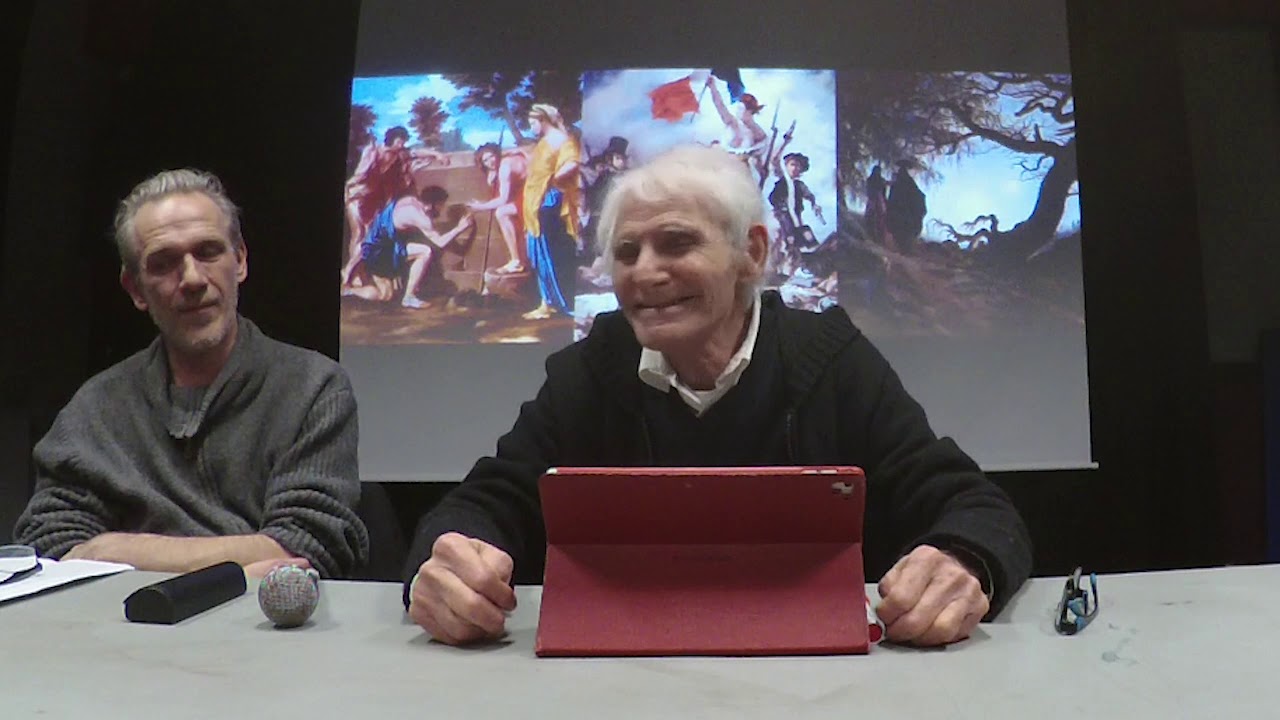
49:59 ...which, at its limit, because of the abstraction it has made of depth, stands between the arts of space and the arts of time—beyond that, we tip over into music. There, there's no dimension at all—you can't tell me how many centimeters long by wide Bach's Art of Fugue is. By contrast, you can say it lasts 12 minutes 06 in Gould's version. We're in the arts of time, it's a duration, no longer an extension, no longer res extensa. There, I wanted to insist on that, and so recall that if I chose paintings, it's because we're already at a limit—and I chose deliberately, I'll finish here, we'll move on to the text—three paintings that practically form a chronology, it's a very simple order, that is, the oldest is on the left, the most recent, relatively speaking, is on the right, and in the middle there's a transition. So, on the left, the Shepherds of Arcadia.
Poussin's The Arcadian Shepherds and the countryside 51:10 By Poussin—I'm not tired—I chose perhaps Poussin's most famous painting, Poussin being the best-known painter of what we call classicism. All these things need to be dug into, I'm skimming the surface, it should be more precise—well, classicism, French, I was about to say, but what classicism isn't French? Yes it is—Greek. All classicisms, including the French one, call themselves classical by reference to the ancients. You know that in Racine's time they say of the Greeks that we must always imitate them, we can try to reach them but never surpass them—that's how it is, it's an at-most-equal relation, an order relation, so to speak. So that's classicism—order, unity, harmony, all that—I'm not going to give a course in art history, well, there are invariants despite all the proliferation of differences among classical artists. First there's the reference to antiquity, which is tied—linked in the title, The Shepherds of Arcadia. Arcadia is a region of Greece supposed to be the paradise of shepherds, of the idealized bucolic...
52:20 ...by the trendy elite of decadent Rome—yes, I don't mean it pejoratively, in every era, like this—we don't say 'bobos,' we have the patricians, the great families, the establishment—I'll put it in Anglo-Saxon terms—yes, in Rome there were people who were fed up with Rome, there were ecologists, 'it's polluted, it's noisy, it's dirty, there are all these foreigners, I've had enough,' fine—so they had estates, they had a property—parenthesis—Aulus Gellius, Attic Nights, he wrote the Attic Nights and gives a typology of slaves—it's advice—they all had slaves—take an Illyrian slave woman, she's docile, hardworking—never take Corsican slaves, disaster, rebellious, lazy, would rather let herself die than do what you ask her to do—I hear that as laziness, perhaps their thirst for freedom—Corsicans, not bad. So the patricians of Rome had their Beverly Hills, in the region of Naples, it's Pompeii, you know that, and Herculaneum, they all had a villa there, it's at once...
53:33 ...Megève and Corsica and Croatia all at once, it's a second home, and the region of Naples has always been called Campania—that's where our word 'campagne' [countryside] comes from. There you go—the countryside, nature or landscape, you already have the answer—'campagne' comes from 'campus,' which means 'field,' that is, something worked, something already worked—nature is already suppressed, you see, I keep digging deeper. I chose a painting there that's supposed to show an excerpt of a countryside landscape, the countryside par excellence, I don't know, etymologically speaking—there's one leaning over, there's an engraving on the stele, and on the engraving, second reference to antiquity, there's an excerpt of a line of Virgil, the greatest Latin poet, isn't he, 'Et in Arcadia ego,' that is, 'you're all going on and on, and I, politely, I too, am in Arcadia'—here I am, I'm in a little earthly paradise, etc.—it's superb, you see these ancient references. Well, I don't want to oversimplify—now there may be debate as to the mystery of this inscription, look it up...
54:43 ...you'll surf the net better than me, certainly, it's fascinating. So there, you see this landscape, how incredibly ordered it is, you'd think it was a park—the left and right are slightly cropped, you see, look at the elbows and the legs, it's exactly the equivalent of what's called counterpoint in music—each elbow, there's a symmetry between the voices, VOX—here, if you look closely, you see the knees and calves of one are exactly the mirrored symmetry of the other's—the importance of the human figure at the center of the landscape, that too is classical, and here I introduce a new determination: the love of landscape for landscape's own sake being all the more beautiful—it's the case with the two texts we're going to see—both speak of a place where there's no one, a wild place—here we're not in wildness, we're in the countryside, a very orderly countryside. There you go, so it's daytime...
Friedrich: night, the wild, and modern landscape 55:54 ...there's order, there's a reference to antiquity, that is, to the world of Apollo, to daylight, to light—classicism, the light is clear, you see, there's a right angle, the Parthenon—I'll go quickly to the right, it's the opposite, it's night, mind you—one might want to distinguish them, but there's a kind of hallucinatory radiance of the moon covering everything and fascinating the two figures who have their backs turned to us—it's the greatest German Romantic painter—it's not me who says so, I'm not here to hand out prizes—he is considered the greatest German Romantic painter, Caspar David Friedrich—I know quite a few of you know him—who died mad, actually, like most German Romantics—when they're not mad, they're suicides, or both, as with Nerval, isn't he the most German of French poets, and his friend Heine, who ended up much better because he had an enormous sense of humor, not the same as Nerval's, a less suicidal humor—Heine, they say he's the most French of German poets. There you go, in any case he lived many years in Paris. Two men—a man and a woman here contemplating the moon—it's not a subject, it's not Arcadia, it's not repose, it's a nature...
57:06 ...that is already more, more wild—look at the roots, which already recall Hogarth, you know, the painter—it's striking, there you go. So I deliberately meant for the landscape in the modern sense—that's the right-hand part—I'm sure all of you are saying, 'how nice this is,' it does change things for us, it changes things from Vitry—I say that, I have nothing against Vitry, it's not because I lived there, or wherever, it doesn't matter—but still, what silence, what calm, no one there, none of those idiotic neighbors—yes, that's important. When we go on to see 'savage'—it comes from the fact that one flees ['se sauver'], and savages have fled well, when you see what's been done to them—actually, I don't understand why they flee when they see us arrive, I say that because it's important—unwritten savagery, as Hölderlin says somewhere. So this landscape, in the modern sense, which the painting on the right expresses well, is our notion, a bit...
Reading of Chateaubriand's Atala 58:16 ...when I don't specify—I've said 'we saw extraordinary landscapes during that vacation'—I'm not describing Alexanderplatz in Berlin, which I love a lot—I'd rather say Alexanderplatz has quite a few sublime landscapes—that's not the point, I'm not making a value judgment, it's the center of Berlin, but Berlin is a city that isn't very beautiful, especially compared to Paris, but which is very, very pleasant and well-ventilated, Berliner Luft. The painting on the right expresses a culture—ours—which is recent, I want to insist on that today. So there, I'll stop, since we have two texts, the older of which is Rousseau's, and Chateaubriand's follows right after—Chateaubriand is an immediate successor of Rousseau—Rousseau is the second half of the eighteenth century, you see, and it's the older of the two we're going to read. That said, I have reasons, not vicious ones, believe me, but didactic ones, for starting with Chateaubriand, if you don't mind, even though chronologically he comes right after Rousseau, isn't he—I'd like, there you go...
59:26 If you look closely at Chateaubriand's text, Atala, go down—at a certain point, after about a dozen lines, it's 'the Nile of the deserts,' you see, about halfway down the page, it's 'the Nile of the deserts,' I don't know if you can see it there, roughly there, a bit past the first half of that paragraph—and you read from there: 'But grace is always joined with magnificence in the scenes of nature: while the current in the middle sweeps toward the sea the corpses of pines and oaks, one sees, along the two lateral currents, floating islands of pistia and water-lily rising along the shores, their yellow flowers rising like little pavilions; green serpents, blue herons, pink flamingos, young crocodiles embark as passengers on these vessels of flowers'—thank you, sorry, I apologize for my voiceover coming to disturb the words of the one they called the Enchanter, Chateaubriand. You're beginning to understand why 'the enchanter,' incantare—what a symphony, that man.
1:00:38 So you saw the number of colors he just named there—no, repeat that sentence, it's extraordinary: 'green serpents, blue herons, pink flamingos, young crocodiles embark as passengers on these vessels of flowers, and the colony, unfurling its golden sails to the wind, goes to land and fall asleep in some secluded coves of the river'—thank you, thank you very much, that's good, thank you. So wait, we're not done, let's skip to the last paragraph, so the following page, the last paragraph, which begins roughly in the middle, there, you see, roughly in the middle, often near the beginning of a line, there, all this to illustrate the theme of color once more, let's go: 'Often lost from tree to tree, these vines cross river arms over which they throw bridges of flowers. From the midst of these thickets the magnolia raises'—sorry—'its motionless cone crowned with its broad white roses; it dominates the whole forest and has no other rival than the palm tree, which lightly sways its fans of greenery beside it. A multitude of animals placed in its retreats by the hand of the Creator...'
1:01:48 '...spread enchantment and life there. At the far end of the avenues one glimpses bears, drunk on grapes, staggering on the branches of the elms; caribou bathe in a lake; black squirrels play in the thickness of the foliage; mockingbirds, Virginia doves the size of a sparrow, descend onto lawns reddened by strawberries; green parrots with yellow heads, crimson woodpeckers, fire-colored cardinals climb circling to the tops of the cypresses; hummingbirds glitter on the jasmine of the Floridas, and bird-catching snakes hiss suspended from the dome of the woods, swaying there like vines'—thank you very much. If only I had that voice, a good baritone, bass a bit—I know music better, and well, good tempo, that's what's needed. The demonstration is made, you understand why he's called the Enchanter—you realize, though, on every side, you saw there's nothing, nothing bearing on a human dwelling in there—there are bears wandering about, there are parrots, there's whatever you like...
The virgin land and the "initial solution" 1:02:58 ...there are cataracts of flowers falling into the Mississippi, there's no human presence—if there were, they'd have to deal with me—the Indians, you can go looking for them, apart from a few drunken idiots on reservations—you see, the Americans are more intelligent than the Germans, I say that because they're a bit more thuggish Germans—it's not me, it's my German wife who made me understand that, I'm like Columbo, I listen to my wife—that, I listened to, so, we've stayed on very good terms—but still she was right, because she knows jazz well, so she knows America, she knows Germany. I said to myself, look closely, everything that's American WASP—not the Latinos, not the Blacks, not the Indians—WASP, they're Germans, it's true, Eisenhower, Kissinger, Bush—even the English are Germans, the Scandinavians, the Vikings—no, but listen, I'm not making this up, Catherine, you're a historian, aren't you, Catherine, the peopling of England, not originally—originally they were wiped out—it's the Danes mostly, more than the Swedes, that's it, but yes.
1:04:08 it's the very origin of the Germanic peoples, there you go, look at the furniture, she's right, look at the end of Apocalypse [Now], whatever, Kubrick, 2001: A Space Odyssey, you know, like the little old man dying in his bed, look at the furniture, I know plenty like that in Germany, that kind of furniture, it's a bit modern but not too much, you see, it's German, I love Germany, you know, I'm joking a bit here, well, I love Germany so much that I prefer there to be two of them, like Mauriac said, forget it, because you get lynched for that today, it's a settlement, well, I fathered my son, that's a German trick, excuse me, yes yes, thank you, bravo bravo bravo, the final solution, the Germans, what is it, it's a historical notion, in the Third Reich they used to say now we must move on to the final solution
1:05:18 you see what it's about, how foolish the Germans were, the Americans smarter, they did the initial solution, liquidate them first, discuss afterward, no but at a time when we're about to do the same thing in Venezuela, I mean, well at least I'm putting it on record, after having organized 300,000 coups, Ricardo who comes to us from Chile, what he thinks of it, I'm sure we're not entirely in disagreement about that, bastard, that means in English, no that's right, the tape where Nixon, we have it live, when he talks about Allende, that bastard, he's not dead yet, I'm not shunning Americans, no, I love Clifford Brown, great trumpeter, and yes I love Charlie Parker, not only him, I love Steinbeck, Wells of course, I hold it against Atlanticism, there aren't only Americans in Atlanticism believe me, you just have to see who governs us, come on, let's come back down to earth
1:06:28 in the present, the initial solution, we liquidate the Indians and then we go home thanks to Hollywood, I love Hollywood even with this turpitude and these lies, so all the same, the legend, we arrived, there was a virgin land, ah well yes, we're talking about Chateaubriand, a magnificent writer, you know he's a confirmed reactionary, of course, his name is François-Alphonse-René de Chateaubriand, he's Breton, he has plenty of reasons to be counter-revolutionary, we forgive him, well when you write like that, look at Hans von Bülow, I don't know if anyone said something, who was he, huh?
1:07:12 he's Cosima's husband, the husband of Cosima, the future Mrs. Wagner, except that Wagner was a little musician who came out of the plebs who only had to make one gesture for all the women to fall into his arms, that's not me saying it, it's a great music historian who said that, when he was little he had a lantern jaw, anyway, and the only problem is he took other men's wives cheaply, he grabbed both the money and the husband's wife, yes, and Hans von Bülow is one of his most famous cuckolds, perhaps the most famous, he was a tremendous conductor, he was the Karajan of his time, a charismatic conductor, one of the first great conductors in the modern sense, charismatic, who sends crowds into a trance, you see, well why am I talking about this, because when I say we can forgive everything, because Hans von Bülow conducts Tristan, you'd have to be a masochist, he conducts it, it lasts 5 hours, the poor old man, 5 hours of the torrid passion his rival felt for his wife, including at the moment of consummation in act 2, which ends in a veritable — I'm the one saying it — coitus interruptus, all the musicologists know it, well, so Hans von Bülow, after a rehearsal, the dress rehearsal, says to his orchestra: to the man who wrote this, we must forgive everything
Phèdre: the circle of the city 1:08:23 do the same, well, what will become of Bülow, I don't know, as you like, Chateaubriand was a big fool but I mean he does it on purpose, romanticism has just emerged, we're fed up with the city, with order, I keep going from one thesis to the other, well actually to the opposite thesis, it's to stay within it, because you see red better against green than red against blue, or green against blue, sorry, so I come back to Racine for example to make clear what the opposite is, romanticism, that is to say us, because we're still in it, that's what I insist on, I'll come back to this continuation later, but yes, take Phèdre, since we spent a whole year working on that text, no, take Phèdre, everyone who has crossed the circle of the city dies in the play, but that's how it is, the Greeks escape, so do we, what do we do on vacation, we go to a deserted beach in Corsica, we try to make sure it's deserted, it costs a bit more, or else you have to walk or have a boat, land in inaccessible spots
1:09:33 by car, there you go, that's all we're looking for, but me like you, me like them, I don't know if you're coming for the first time, I'm not there yet, in the countryside I'll show you a place where there's no one, and I'll curse paid vacations, and as communist as I am at heart, at heart, but at the same time I come to terms with it, I say since paid vacations we're a few million wanting the beach to ourselves, what do you expect, we organize ourselves, it's not a big deal, we put out trash cans, the beach, come on come on, and there you go, there are people, we chat, a little beach shack there, we can have a coffee, that's not bad either, all right, let's move on, I'm trying to show what, that when in Phèdre there's a circle, I'd like you to picture it in your head, at the center of the circle, the hearth, at the center of Athens, of the city, there's Theseus, at the center of Versailles there's Louis XIV, it's the same for Racine, I'm bringing out a structure, an isomorphism between Athens and Versailles here, well Racine's Athens of course, and Versailles, at the center there's Theseus
1:10:43 except, you see, as you know, at the beginning of the play he's not there, oh dear, and you know that when the cat's away the mice will play, the mice being these poor heroes who will think he's not there, we can do whatever we want, watch out, and then his son, that fool Hippolytus, I'm doing this on purpose a bit out of jealousy because all the female readers love him, yes, the handsome Hippolytus, you know, the one who's a bit shy with women, he's clever, it's Nerval who says the beginner in love plays his part well, Hippolytus, the first time he's really touched by a woman it's little Aricia, you know Aricia is the only woman in Athens about whom Theseus, who is nonetheless the political boss, said no man must go near her, no child, nothing, she's the last offspring of the family I exterminated down to the last one to get power in Athens, so no question of the line coming back, that's political, Theseus is a hero, not a romantic, he's a hero who freed Greece from the Cretan yoke by killing the Minotaur
1:11:53 he's a hero and he gave asylum to, to whom, to whom did he allow to come die on Athenian territory, to the most unfortunate of the Greeks, come on, yes, thank you, to Oedipus, bravo, Oedipus, he had committed the most monstrous crime, so he's condemned to the worst punishment there could be in Greece, what, torture? No no, there's worse in Greece, it's being condemned not to stay in the city but to wander between cities, hence the expression banished, hence the word banlieue (suburb), yes, if you read not Oedipus Rex, which some of you have read, but Oedipus at Colonus, which almost no one reads anymore, the book is a marvel, it's the sequel, that's where you see the admirable death of Theseus, I see, well I have, of Theseus now, the death of Oedipus, it's not with Theseus who welcomes him, a gentleman, without whom I could put an end to Theseus, and so the only woman
1:13:03 there are only transgressions, Hippolytus would never have been allowed to come within a kilometer of Aricia while his father was there, and I showed you arithmetically, I don't say mathematically, everyone says mathematics to mean uncertain things, no, arithmetically, that's serious, namely that from the very first speech, from the first lines, Hippolytus, to explain why he's leaving, as if one could break the unity of place, will die before departing: 'For more than six months, far from my father, I know not the fate of a head so dear to me, I do not even know what places might hide him.' And when his confidant makes him understand, come on, hey, I'm your servant, I've run all over the Mediterranean, I worried before you did, I'm a faithful companion of your father, I haven't found him, so who knows if he even wants you to look for him, he's a ladies' man your father, he says all that, he doesn't say it like me but he says it: 'who knows, who knows if the king your father wishes that his absence remain a mystery, and if, while we tremble for his days with you, and hide some new love affair, this hero merely awaits that a deceived mistress...' 'Dear Theramenes, stop, and respect Theseus,' the son suddenly interrupts, no question of talking about the father's love affairs
1:14:13 what else, he doesn't like love, he doesn't like women, and then we learn at the end of the scene that in fact he's leaving because he's in love for the first time, he's afraid, he leaves, and yes, 'I fear, I will admit it, this young Aricia, remnant of a fatal bloodline conjured against us,' he gets there at the end after the other one, like a good psychoanalyst, has defeated all his stated reasons for leaving, he ends up naming little Aricia, a little wretch by the way, we'll see that later, sorry for this sexist language but we understand each other, and that's how Racine described her, and had his reasons, the poor girl, 'remnant of a fatal bloodline conjured against us,' political motive, he takes a big strapping fellow like him, a vigorous young man who's afraid of a girl who's walled up, confined to house arrest, well anyway the other one tells him, Theseus, open your eyes while trying to close them, a true psychoanalyst, 'your father's ban gives her charm in your eyes, and his hatred, irritating a rebellious flame, lends new grace to his enemy, why then do you fear so chaste a love,' he says, wishing his young master
1:15:23 to be a man, I mean, sometimes in life you have to get to work, so 'if it has some sweetness, dare you not try it, do we fear straying in the footsteps of Hercules,' Hercules was a great lover, 'will you always trust a fierce scruple, dear Theramenes, I am leaving and going to seek my father,' you see, there's not even a confession, bam, he interrupts and leaves, now 'for more than six months' — I said arithmetically — we learn three acts later, when he finally makes his confession to Aricia, when he has the courage, you see, 'before you stands a pitiable prince,' when he paints this narcissistic portrait of himself, 'my bow, my javelin, my arrows all irk me, I no longer recall Neptune's lessons, my idle steeds have forgotten my voice,' sorry, I don't remember, 'my bow, my javelin,' I don't recall Neptune anymore, 'my idle steeds have forgotten my voice,' 'no doubt the tale of so wild a love will make you blush at my own handiwork as you listen,' look how he describes himself, 'what a strange captive for so fair a bond'
1:16:33 'but the offering was dearer in your eyes, remember that I speak to you a foreign language, that of love, and do not reject vows poorly expressed which, without you, Hippolytus would never have formed,' this word, I didn't tell you at the beginning, I kept it for the end, 'for more than six months, ashamed, desperate, carrying everywhere the dart that tears me, against you, against myself, vainly I strive' — six months since the father left, six months that I've been in love with you, listen, that's not diabolical, that, I tell you poetry is more exact than mathematics, I don't say it just like that, I say the only difference between mathematics and poetry is that poetry is an exact science, a joke, that's the world of the city among the Greeks, we escape, you see, I'm resuming my film now, we don't go looking for a deserted beach, no, we escape from nature into the city, the city is the elsewhere of nature, as some modern urban planners say, in the painting on the right it's the reverse, and moreover at night when everyone is asleep, romanticism
Fantasy in discourses on nature 1:17:43 that's it, you can feel where I'm going, I'm going to say there's a fantasmatic side behind ecology, some ecologists, I remind you I'm pre-qualified for anything that destroys the collective environment and therefore the private one, since man is a zoon politikon and the private is situated within a collective, so, that's not what this is about, I'm speaking, I don't know about it myself, I don't know, the warming, all that, I'm not a scientist and I don't know any scientist omniscient enough to be — you are what, physicists, that's good, and you, chemistry, you are what, ecologist means the guy is a chemist, physicist, geologist, astrophysicist, humbug, Bachelard already said in the 1950s that chemistry no longer exists, a physicist no longer exists, a surface physicist, I don't know, specialized in what, you there, Erwan, whom you should contact for memberships, sorry, optics, there you go, you can spend your whole life on it, you agree, there you go
1:18:53 yes well there you go, I've known people who were on a team of potential Nobel laureates at the CNRS, they'd been working for 20 years not on the liquid on top, you know, immiscible liquids, on the liquid on top, nor the one on the bottom, but on the phenomena occurring between the two, between oil and water, you see, in a glass, but ecology is the environment, and the environment includes everything, remember my helicopter story, physical geography, human geography, they're sociologists, psychologists, demographers, what else, that's it, I'm criticizing — I'm not criticizing the praiseworthy action of those who, like Hercules and Theseus, rid us of the monsters that prevent man from inhabiting this earth in order to transform this earth and this planet as we say today, the word bothers me, the planet, the word interests me, the planet will be here when we're all dead, don't worry about it, it's not going to die, it wiped out the dinosaurs without batting an eye, and even later, at the time of the Siberian volcanoes, for those of you who know a bit about it like me, meaning very little, 95% of species
1:20:06 of that era disappeared because of the volcanic emissions, but still, you see, we're all descendants of those who survived, will there be hope? No, I've come to fight so that the admirable snow leopard, you know that superb animal, perhaps one of the most beautiful of feline coats, look it up on Google, snow leopard, you'll think of me, image, leave the — image, and it seems it's coming back a little, some efforts, so I've come to fight so that it survives, man must be the shepherd of nature and not its enemy, so I fight against certain discourses, there, I reassure you, I don't fight against actions but against discourses, with all their sophistry and the shifts they make, especially the fantasmatic ones, so if we strip away from ecology everything that belongs to the realm of fantasy, I repeat the example Freud gives which is striking, I'm always surprised that in anti-ecology discussions the symbolic field is never addressed, which is perhaps the most important thing for understanding discourses about nature, well, to understand nature itself you have to ask physicists, so Freud takes the example
1:21:17 of that patient who had told him, doctor, I had a relapse, I had an attack of palpitations, I had a relapse in a dream, but when I woke up the palpitations hadn't calmed down, what did you dream about, I was plowing my field, I don't know, in bright sunlight, I remember it was hot, and suddenly I was seized by an attack of palpitations, I must say, you astonish me, you're plowing the mother under the father's eye, we don't see that side of it, you mustn't touch the mother, Gaia, you know, you hear her, mama, mama Gaia etc., symbolically it makes sense, the earth is nurturing, we don't feed on rocks, and there's more ammonia in the universe than greenery, believe me, statistically there certainly exist living beings in other galaxies, but I mean it's not the rule apparently, and statistically it must exist, for now we only know our own, we know nothing more about it, I quite agree, Gaia is a fantasy, all that, mother earth, look at Cybele, the goddess representing the earth in Roman mythology
1:22:27 which is a transformation of Greek mythology, she has 20 nipples, that's because she's always depicted nursing the universe, humanity, there you go, and as for the beautiful ocean on which Venus's shell floats, Botticelli's painting, you all know it, are there some among you who know the nature of the ocean in Greek mythology, it's not sodium chloride, here's what I'm going to say, you know, she floats on the semen of Uranus, I'm not joking, you find it in Hesiod, you read everything, we know roughly the most mythology through Ovid too, in Latin, namely in Ovid it's the Metamorphoses, it exists in paperback, there's a kind of compilation, Greek mythology, but in Hesiod especially, to be archaic, so at the origin there's Uranus, the sky, the father who spends his time violating the earth, the sky violates the earth so much that she's had enough, the earth, of giving birth for nothing
1:23:37 of being violated, and so one day she asks — what's his name, the blacksmith god — Hephaestus, Vulcan, for a pair of shears, and she cuts him — it's in mythology — the seed spurts out and makes a new titan, Oceanus, the ocean, and it's on this ocean that the goddess of Eros floats, well yes, isn't it, Cypris coming to land like that on the island of — go on, I just told you in Greek — Cyprus, thank you, the island of Venus, you see there's such a fantasmatic part in our relationship, now that we've seen it's a surface onto which — I spoke of cinema earlier, of the screen that holds the projection — well the outer world, which Kant was so right to call the phenomenon, is not reality, especially when we see it as we do, on the surface, we're not scientists, it's not reality, it's the screen onto which we project, we project as subject, whereas we believe we're dealing with objects, what's actually at stake there is the world of the subject, there, that's where I wanted to get to, you see
The night in which all cows are black 1:24:47 it took a lot of time to get to what Hegel — the night, look at the painting on the right, the night in which all cows are black — Hegel is mocking a bit the romantics who said that the absolute, in the absolute, I'm thinking of Schelling, if I'm not mistaken, the romantics' favorite philosopher, subtle and profound, I'm not caricaturing, the weak point is that his absolute, one can't say any precise determination about it, a bit like nirvana, you know, in Hindu spirituality, it's not a religion, it's a profound spirituality, we're never told what nirvana is, when the Buddha was asked, when his bhikkhus, that is the monks in Sanskrit, asked him what nirvana is like, one is neither lying down nor standing, there's neither right nor left, neither up nor down, one can only speak of it negatively, you see, there's no positive determination, one can't say, like lead which melts, I think at 500 degrees, there you go, one can't say, like water, it boils at 100 degrees, there's no property, there's no determination, property, Eigenschaft, it's the same word for property in the legal, economic sense
1:25:57 and in chemistry it's the same word in German, you know, the man without qualities, Musil's famous novel, the German title is 'Mensch ohne Eigenschaft,' without quality, that means without property, it's part of honey's qualities to be sweet for example, there's none of that in the absolute, and so there's no determination at all, and so Hegel said ironically, to pass off the absolute as the night in which all cows are black is the naivety of emptiness in knowledge, in French we'd say the night in which all cats are grey, it comes down to about the same thing, you know there was an SS division called Nacht und Nebel, night and fog, no, I'm serious, I'm not saying that day is more left-wing than night, I don't want to say nonsense, but I mean there's a certain way of using the nocturnal, admirable here, and which can be terrifying elsewhere, isn't that so, Nacht und Nebel, move along, nothing to see, I'm telling you I arrived on virgin land with the rifle in my right hand, the Bible in my left
1:27:07 and with bison, the first savage who touches one, a good Indian is a dead Indian, there, initial solution, I close my long parenthesis, well, I'd like you now to read me the beginning of the Rousseau, yes, so, the colors, very quickly, the colors, you know your questions you can ask them live afterward since we're going to stream it online shortly, isn't that right Philippe, but for now I'd like us to start the beginning of the fifth walk, I started with Chateaubriand to create the contrast with Rousseau, there's never any color in Rousseau, and in this passage there's no color, you'll see there's nothing, everything he sees before him he's going to annihilate and doze off and close his eyelids, it's the total opposite of Chateaubriand who only ever gives us things to see, Chateaubriand takes us to the heart of the landscape, he says there, the Mississippi, there, it's exactly the reverse, there's only one time where there are two colors in Rousseau, and it's almost as a provocation
Rousseau: no colors, sounds 1:28:18 against Voltaire who likes to describe, in Le Mondain, the carpets, the interiors, what does Rousseau go looking for in the forest, you'd have to be mad to go into the forest, of the scenery, in the Letter to Malesherbes: 'the gold of the broom and the purple of the heather struck me with a luxury that touched my heart.' That's the only time we see well-defined colors in Rousseau. Let's go on. 'The shores of Lake Biel are wilder and more romantic than those of Lake Geneva, because the rocks and woods there border the water more closely. But they are no less pleasant.'
1:28:49 'If there is less cultivation of fields and vineyards, fewer towns and houses, there is also more natural greenery, more meadows, shaded retreats, groves, more frequent contrasts and closer irregularities. As there are no wide roads convenient for carriages along these happy shores, the region is little frequented by travelers. But it is of interest to solitary contemplatives who love to lose themselves at leisure in the charms of nature and to gather themselves in a silence disturbed by no sound but the cry of eagles, the intermittent song of a few birds, and the rushing of torrents falling from the mountain.'
1:29:23 Thank you. A pause. The last sentence. I told you there's no color, there's not much to see, it's generalities, retreats, shaded spots. He says, you see, it could almost be anywhere, whereas he's in a very specific place. But on the other hand, there are sounds. Let's repeat the last sentence, 'in a silence.' 'But it is of interest to solitary contemplatives who love to lose themselves at leisure in the charms of nature and to gather themselves in a silence disturbed by no sound but the cry of eagles, the intermittent song of a few birds, and the rushing of torrents falling from the mountain.'
1:29:58 That is, of the three, these are sounds, that is, things one can perceive with closed eyes, and perhaps even perceive all the better for closing one's eyes. It's happened to all of us at the beach, to listen to the murmur of the sea, closing your eyes, you've swum so much, you're allowed to rest. When you listen to a shell like that, when the murmur swells, you close your eyes to hear it better. Something sound shares with taste. And yes, cooking and music, there's a relationship.
1:30:31 I'm talking about cooking, I'm not talking about food. We don't just wolf down food like a dog on the ground. No, cooking is the pleasure in the act of feeding oneself. It's still different, isn't it? Now, when it's good, they close their eyes. Ah, tell me, I don't know how you do it, who's there, but yes, go ahead. 'This beautiful, almost round basin encloses in its midst two small islands. One inhabited and cultivated, about half a league around, the other smaller, deserted and uncultivated, and which will end up being destroyed by the earth constantly removed from it to repair the damage that waves and storms cause to the larger one.'
The first "romantic" and the almost round basin 1:31:11 'Thus the substance of the weak is always employed for the benefit of the powerful.' Well, of course, I'll stop there. You find the great political Rousseau there right away. He's in the middle of a scene where there's no one. And bang, right away, a political metaphor. The master and the slave are already there. Well, let me sum up everything we've read since the beginning. 'The shores of Lake Biel are wilder and more romantic than those of Lake Geneva.' Now, listen, this is important, even solemn, it's the first time the word 'romantic' appears in our literature.
1:31:42 In the 1760s, then. And at the time, it's not at all the sense I'm trying to give it now, based on reflection on modernity, when the term appears it's very technical, very precise. It designates the English manner of making gardens. English-style, if you will, therefore wilder, as opposed to French-style gardens, with right angles and yews trimmed into perfect spheres, balls or cones, as they say. There, so it's quite precise. Wilder and romantic go together.
1:32:14 You see, that confirms it, let's take stock of everything we've seen. The text is clearer now, it's dense. I say that because we tend to slide over such a fluid language. So, after insisting there are fewer vineyards, less cultivation, etc., but more shelter, greenery, etc., he says 'this beautiful basin of an almost round shape.' Did you hear that? It was articulated so well. This beautiful basin — there's Lake Neuchâtel, which is a bit elongated, then at the end of Lake Neuchâtel, like a dot over an i, there's Lake Biel, which is smaller, which is the dot, if you like.
1:32:49 A big round dot. And yes, yes, it's true there's an island. I'm trying to show that landscape is a fantasy construction. It's not a photograph either, it's not a news report. 'Literature which serves the universal reporting,' says Mallarmé. Already. There really is an island, the Île Saint-Pierre, we'll get to talk about it, but anyway. But first, it's no longer an island. It's very close to the shore and not in the center. And that's why there's 'this beautiful basin of an almost round shape.'
1:33:21 The imagination cannot help but push the island toward the center. Right? It's the infant speaking unconsciously here, putting himself back into the maternal womb. It's extraordinary. It's not only him, you're interpreting, you say you don't like interpretation. No, no. The more we read the text, the more obvious it becomes. But for now I'm telling you dogmatically, I allow you not to be convinced, because saying it's not true — but in any case you can be certain of it, certainty not being the same as truth. 'This beautiful basin of an almost round shape shelters in...'
1:33:53 shelters in... I don't remember anymore. 'Encloses in its midst two small...' 'Encloses in its midst,' you see. He wants it to be right in the middle. He recenters there. We're far from Chateaubriand. Chateaubriand was everywhere. Yes? Ah no, you're not rereading the same paragraph, you're continuing. I'm going on. Sorry. So don't be surprised, I'm not going to read exactly in the... yes, it's old French, so we're modernizing it.
The boat, delicious reverie, and the bath 1:34:24 'The exercise I had taken in the morning, and the good humor inseparable from it, made the rest at dinner very agreeable to me. But when it went on too long and the fine weather invited me out, I could not wait, and while still at the table I would slip away and throw myself alone into a boat which I rowed to the middle of the lake when the water was calm.' I'll interrupt again. So that's not enough, I'm on an island, I'm at the water's edge, that's not enough. I get into a boat, even closer to the water, you see? And it's not over, go on, you'll see the progression.
1:34:55 You'll see. 'And there, stretching out full length in the boat, my eyes turned toward the sky, I let myself drift and float slowly at the water's will, sometimes for several hours, plunged in a thousand confused but delightful reveries which, without having any well-defined or constant object, were nonetheless to my taste a hundred times preferable to all I had found sweetest among what are called the pleasures of life.' Thank you. Well, that's enormous. 'A thousand confused and delightful reveries which, without having any determinate object' — one couldn't be more precise than this imprecision.
1:35:27 He puts it very well. First, his eyes are turned toward the sky. We have the total opposite of Chateaubriand, who spends his time showing us all sorts of differentiated things, bears, monkeys, sparrows, herons, blue, yellow, green, pink, fluorescent. For him there's no one, no savage. But here he set the scene a bit at the start, there's no cultivation, there's all that, it's wild. But here he's turned toward the sky. There's nothing left to see.
1:35:59 On the other hand, he's plunged into a confused but delightful reverie. So, watch closely, this word will come back in the text. But before it comes back, let's note that it's an oral, buccal metaphor, in the literal sense of 'delicious,' it's what one eats. I'll talk about infants. Go ahead. 'Often warned by the setting sun that it was time to return, I found myself so far from the island that I was forced to work with all my strength to get there before nightfall. At other times, instead of straying out into open water, I liked to hug the verdant shores of the island, whose limpid waters and cool shade often tempted me to bathe.'
1:36:35 Good heavens. I told you the boat wasn't enough, he still had to plunge into the water. But that wasn't done at the time. Don't ask me the brand of his swimsuit. But there was no swimwear industry. Water was feared, it was congestion of the lungs, it was illness, it was... oh dear, a bronchitis that could carry you off. That means he bathed naked. Direct contact. Yes.
1:37:05 I'm telling you there's a progression from reality toward fantasy. There's a fantasmatic logic to the basic text. 'When the agitated lake did not allow me to sail, I spent my afternoon roaming the island, botanizing here and there, sitting sometimes in the most cheerful and solitary nooks to dream there at my ease, sometimes on the terraces and hillocks, to take in with my eyes the superb and delightful view of the lake and its shores, crowned on one side by nearby mountains, and on the other widening into rich and fertile plains over which the eye stretched as far as the bluish, more distant mountains that bounded them.'
1:37:40 There. Sorry, my interruptions are annoying for you, and for Grégory, and for me too, but on the left, the nearby mountains, and on the right, the bluish mountains that bound them. In other words, he manages to circumscribe, in the literal sense, to inscribe within a circle. I inscribe myself at the center of a circle. Circumscribere. You see? Already, the rest of the world, everything beyond these mountains, he doesn't want to know about it. That's why I like this spot. It's closed off from the rest of the universe, first of all.
1:38:12 And — where is it? Thank you. Yes, 'sitting sometimes in solitary nooks,' and 'nooks' means somewhat enclosed, sheltered places, sometimes, on the contrary, on hillocks up high. You see? There's a dialectic here of hiding and exposing. I have no more, you'll see what follows. 'When evening approached, I would come down from the heights of the island.' I'll stop there again. When evening comes, that's when anxiety sets in.
"The agitation of the water fixing my senses" 1:38:44 We see the night, like flowers that close up, that's darkness. No more question of staying exposed. We'll see an admirable text by Edgar Allan Poe that develops this theme. For the man who has death in his heart, he fears distance like the plague. Distance is the spectacle one sees of a landscape seen from a height. Think of Monsieur Seguin's goat, who is a little anxious when she sees everything from above, when she sees her little house and her enclosure below. The end is near. And now, when evening approached, go ahead, you'll see now.
1:39:16 I would come down from the heights of the island and I would gladly go sit at the edge of the lake, on the shore, in some hidden shelters. There, the sound of the waves and the movement of the water, fixing my senses and driving out of my soul every other agitation, plunged it into a delightful reverie. Second time. Delightful. Where night often surprised me without my having noticed it. The ebb and flow of that water, its continuous sound but swelling at intervals, striking my ear and my eyes without relief, made up for the internal movement that reverie extinguished in me, and was enough to make me feel my existence with pleasure, without taking the trouble to think.
1:39:51 From time to time a few faint and brief reflections arose on the instability of the things of this world, of which the surface of the waters offered the image. But soon these light impressions faded away in the uniformity of the continuous movement that rocked me, and which, without any active participation of my soul, did not fail to attach me to the point that, called by the hour and by the agreed signal, I could not tear myself away from there without effort. Well, when I told you that I don't boast about anything, still, we've moved on to full confessions, even unwittingly.
1:40:21 When evening approached, I would come down from the heights of the island. So, let's look at this more closely. And I would gladly go sit down — I don't even stay standing. At the edge of the shore, in some hidden shelters. So, we've already seen that the whole region is a shelter with respect to the rest of the world. You see, it's shelters within shelters, like a mise en abyme. There, the sound of the waves. There's nothing left to see, we're not in Chateaubriand here. But what is there to hear? The sound of the waves.
1:40:51 Driving out of my soul every other — no. That's it. There, the sound of the waves. The movement of the water fixing my senses. Ah yes, the movement of the water, sorry, fixing my senses. Wait, but that's a paradox. Normally it's our senses that fix things. I fix my gaze on Samuel. Good evening Samuel. Or on the clock, to see the time I have left. It's our senses that fix the world. And here, no. It's he who is fixed by things.
1:41:21 It's extraordinary. It's an inversion. He is, as you'd say today, glued in place by the ebb and flow of the water. Stop moving, I hypnotize. You see? Fixing my senses and driving out of my soul every other agitation, meaning other than that of the senses. You see how he becomes animalized, there's no more thought. There's nothing but senses left. That, dogs — my dog has it even better than me, senses on alert, right, in a landscape. Driving out every other agitation, plunged my soul into a delightful reverie.
1:41:55 Second time. Where night, the giver of wonder, often surprised me without my having noticed it. Loss of the sense of time, the night, the sounds, and nothing to see — I tell you we're in the prenatal world. To the point that, called by the hour — ah yes, sometimes a short and faint reflection arose, and there we come back a bit to active life, I reflect, I think, it's written — on the instability of the things of this world, you know, like the old Stoic sages, of which the surface of the waters offered me the image — yes, a rather banal comparison.
1:42:34 But soon these light impressions themselves faded away, as if even that were already too much, the surface of the waters. Into what? Into the uniformity of the continuous movement that rocked me. There you have it, Rousseau doesn't think what I'm saying, but he does better than think it, he says it. I'll never repeat it often enough, he expresses a structure, he brings it up to the surface of the text. It's remarkable. There, we'll stop there for today. Thank you very much, Grégory.
1:43:04 Thank you very much. We have 10 minutes for questions, but really, you'll have much more time by asking them online, right? By asking on Facebook — but I'd be delighted, we have 10 minutes, let's not waste them if you have an immediate question. It's a very general question that isn't tied to nature or landscape, it was just about the two questions — philosophy which is distinguished from the sciences and why, what can I know, why does that distinguish it from the natural sciences?
Question from the audience: philosophy and the sciences 1:43:42 Why? Why is it a question we don't share with the natural sciences? Yes, yes, yes. Ah, I thought you meant... yes, yes. Philosophy has a complicity with the sciences. Those who are in their next-to-last year and who tell themselves, when I'm going to be... and who are very good in humanities, like a good grade in composition, in essay-writing, tell themselves in their final year, I'll be able to do literature but much more deeply in philosophy. Wrong. In philosophy, there is precisely a complicity with mathematics more than with literature in certain respects. It's that we don't just want to speak, we want to speak in order to say true things.
1:44:12 That may be an excessive ambition. That's what the skeptic says, for example. And it's the illusion some give themselves of being a bit too immediately in the truth. Those are the dogmatists. The two enemy brothers, neither of whom is a philosopher. Since both of them dispense with the essential thing, which is inquiry. The dogmatist because he believes he knows, he has no need to inquire. The skeptic because he says there's nothing to inquire into, truth doesn't exist. It's convenient because in both cases one doesn't inquire. Come on, let's be serious, the philosopher works. He too would like to arrive at what is called the universal and the necessary in Kant.
1:44:45 For example, propositions that are valid always and everywhere, and not merely true in Paris but false in Montauban, true on Monday, false on Tuesday. That, roughly speaking. Only not on the same objects as the natural sciences. He doesn't seek to know how such-and-such a flower reproduces, etc., whether it's sexed or not. He doesn't want to know how long it takes for the light of a star to reach us and why it takes so long, etc. I mean, that has to be left to the sciences whose specialty it is, which have these phenomena as their objects.
1:45:21 It turns, as I said earlier, the questioning back toward the self. That's the madness of philosophy, hence the limping I was talking about earlier. It's never very satisfying. Not only wanting to use natural language alone in order to arrive at truth. We've seen that it wasn't originally made for that. It tries to raise it up to truth. That's no small matter. But above all, it strives to arrive at the universal and the necessary on objects that are not part of scientific questioning.
1:45:54 There, I'm really answering your question. That is to say, the axis of all the sciences — I'm simplifying, it's more nuanced than that, but roughly speaking — it's still the true and the false that matters in matters of science. It's not good and evil, that's not the object of science. I always repeat it, a scientist can ask himself the question of good and evil, of course, as a man, at every moment, but not as a scientist. I mean, it's not his studies in chemistry or botany that make him able to know what is good for the city, what is good for my family, what is good for myself.
1:46:26 Or evil. At that level, sometimes the ignorant man knows more. I'm thinking of the man in the street, in Abidjan, truly the African who is illiterate, who hasn't even gone to school. There are still many of them on the continent of orality. With this saying you often find in the streets of Abidjan: death is nothing, it's man who is only afraid. It's beautiful, isn't it? Death is nothing, it's man who is only afraid. There you have all the research of Stoicism summed up in a phrase of striking simplicity.
1:46:56 Wisdom. It's not knowledge, it's wisdom. That is to say, let it go, don't worry about nothing. And when someone has died, we don't say may God keep his soul, we say may the earth lie light upon him. So, that's one way of answering your question — good and evil give philosophy an object of its own. That's what Kant says, having to answer the question: what must I do? Sometimes it's morality, sometimes law, politics. Above all, the problem, as Aristotle said, is that mathematics unites men, politics divides them.
1:47:28 Can we end on that? And you? Thank you for your question. Thank you very much.