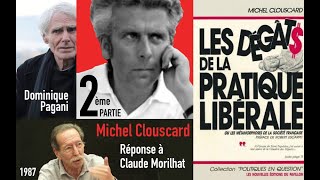
Dominique Pagani mainly discusses Bourdieu by setting him against Michel Clouscard. He notes that Bourdieu got rid of his Béarn accent in khâgne, which Clouscard did not do, and he attributes to him a strategy of entryism12. He discusses his notions of field, habitus, illusio and symbolic violence. To him, they are not decisive when set against class struggle, and the multiplication of fields illustrates the fragmentation of the human sciences. They compartmentalize reality, like relative autonomy in Althusser3. In La Distinction, Bourdieu describes the processes of distinction remarkably well, but without criticizing them, as a positivist scholar4. Dominique Pagani grants him operative concepts and a demand for rigor, while holding that numerical data do not replace conceptual development. He also points to the anti-intellectualist and resentful side of his empirical approach5. He links Bourdieu to Lordon on libido and illusio, and applies the notion of habitus to musical evolution. Finally, he considers L'Ontologie politique de Martin Heidegger one of the best texts on Heidegger's Nazism.
Summary produced automatically from 18 of the passages below, to be reviewed; the numbers link to the moment in the session.
Who is this?
Pierre Bourdieu (UK:, US: ; French:; Gascon: Pèir Bordièu; 1 August 1930 – 23 January 2002) was a French sociologist and public intellectual. Bourdieu's contributions to the sociology of education, the theory of sociology, and sociology of aesthetics have achieved wide influence in several related academic fields (e.g. anthropology, media and cultural studies, education, popular culture, and the arts). During his academic career he was primarily associated with the School for Advanced Studies in the Social Sciences in Paris and the Collège de France. […]
.jpg)
 Season 12 · 28 Feb 2024Clouscard by you - Answers to your questions