English translation of the French transcript, made with AI and not yet proofread — click a paragraph to jump to it. Show the French original
The second act, the middle act 3:07 We are finally online. Thank you very much for your patience. I'm sorry for this long delay. We both simultaneously had transport problems. I won't waste your time with my litany of apologies; not so long ago we were, so to speak, face to face via the internet, but we remain, as announced in the analysis — one shouldn't be pretentious, though sometimes yes — let's say in the apprehension of the second act of Parsifal. And if some are surprised that I'm lingering on this, it's because we are not doing history of music, nor even history of opera, nor Wagnerism, far from it — we are doing philosophy.
4:08 And I think it's hard to suspect the philosophical yield one can draw from this second act. Well, I say that for now in a rather external and abstract way, but you'll see we'll quickly come to agree. So, I had recalled last time — I don't want to recall recollections — that a second act in Wagner is always the middle act.
4:39 We always have to come back to the act. It's always the middle act, and each of these acts lasts roughly an hour and a bit — I mean, often 1h30. So already, when the act begins, the longest act, the first one, as is often the case, the act of exposition is fairly long in Wagner, when it isn't preceded by a prologue. That's the case, for example, in Twilight of the Gods, for those who remember the magnificent prologue of the Norns.
5:19 And here, then, it's been almost two hours — but at least an hour and a half, more than an hour and a half, sorry — since the work began. Yes, we're close to two hours and we still don't know what the main hero is called. We, the audience, know it — it's the title — but the characters, starting with himself, don't know it. I tell you this because I started from a return to the notion of the middle, which you know I hold to quite independently of any musical work, be it Wagner's.
6:02 The middle, the medium, mediation, the medullary bone, as we say for marrow, which is at the center of the bone — it is also often the most protected act. I had pointed out — protected from the two extremes, the beginning and the end, quite simply, in an almost geometric sense, even though we're dealing with duration and not space. I had also pointed out that this is often called the act of the flower maidens, because from talking about them so much, we're finally going to see them.
Flower-maidens, birds and President Schreber 6:40 And the girls… This moment of the flower maidens in the middle of Parsifal is not without analogy, symbolically speaking — I know some of you are following and deserve credit — with the second act, the middle of the second act of Siegfried, isn't that so? That is, with the bird scene.
7:11 The young girls, the birds, birdbrain, parakeet, hen — excuse me, I'm alluding to expressions that exist in the language, where it's customary to give bird names to the fair sex. And each time implying — sometimes, you see, 'birdbrain' says it well — that there's a chickpea in there, so to speak: there's malice. That's how the masculine prejudices about women can be summed up — she's capable of malice, but not of intelligence. Let's not dwell on such shifting and uncertain ground.
8:00 But what is certain, for example — I'm staying within the symbolic order — let's take it from Freud's five great case histories. I remind you that the five great analyses were a work apart in Freud, because instead of alluding to a slip, a parapraxis, to analyze it, here for once these are long-term analyses followed through to the end. The five great analyses are famous; they have become almost classics of the novelistic genre.
8:35 I'm thinking of Little Hans, Infantile Neurosis — Little Hans, the Rat Man, the Wolf Man — what a bestiary — and the unspeakable President Schreber. No, it's me adding 'unspeakable.' The extraordinary case of President Schreber — I lost my thread; I was in the middle of substantiating the analogy young girl/bird, young woman/bird.
9:07 Now, President Schreber's case is, in every respect, an exceptional analysis, since, contrary to his usual practice, Freud did not have a subject in front of him on a couch or elsewhere — no matter — actually speaking, because it's always the analysis of speech, an analysis — but here it concerns an exceptional situation: Freud makes clear from the start, with all the reservations of someone reading, that this is an analysis made from a written document. Freud never met President Schreber.
9:42 So this President Schreber was an honorable Herr Doktor, as one would say in Germany or in the German-speaking world, right? Someone highly honored, well known in his circle, in his town — I don't quite remember his specialty, but no matter, he was a doctor, a scholar. And for a long time entirely normal, and then suddenly he fell into delirium. With him, it's really not neurosis, it's psychotic — with hallucinations, everything you like. Those familiar with psychiatric clinical practice, not just psychoanalytic, will understand me.
10:15 And so here, very quickly, is the object of his delusion. I remind you that until his illness declared itself — his affliction, his suffering, his symptoms, however you want to put it — this man was entirely normal and had a full social life. So suddenly, one day, he decides that God has chosen him — up to this point it's banal, psychiatric hospitals are full of people who have problems with God or with the Pope spying on them, often through their neighbors, in short.
10:53 So God has chosen him — this is very precise — to save humanity, since this too is fairly frequent in mental illness, bordering on megalomania, you see, an inflation of the self. Except that the condition under which he must accomplish his mission to save humanity — the honorable president, who was about fifty at the time — is that he transform himself into a woman. And serve God, even in female form, to be penetrated and to save the world. So, he must turn into a woman. Forgive these details, but I'm sorry — it's a rather extraordinary document, well known of course to those familiar with the clinical literature.
11:42 God has a solar side, and each of his rays enters him where you can imagine — I'm sorry. And of course he becomes the object of mockery from those around him. And those around him are birds in his garden who speak like young girls. It's incredible, isn't it. So, back to my story about the middle — we are in the middle of Parsifal, we've had to wait for the middle of this long work for Parsifal to finally discover his name.
The witch's cauldron and the fool who knows nothing 12:24 It's so important. I'm starting from the middle in order to speak afterward, progressively, about what comes downstream, and retroactively about what came upstream. It's so important, and you'll see how the music marks it admirably — there's suddenly a suspense, because this second act — Nietzsche, not without reason, because he is pertinent when he talks about music, he's never more pertinent than when he's in bad faith, he's pertinent about himself too.
12:59 He had described this second act of Parsifal as a witch's cauldron — a striking contrast with the first act, all in length, with this society that keeps withering away, soldier-monks who spend their time carrying on a ritual in a formalistic manner. The heart and soul are no longer in it — I repeat what I said last time, and we shall see, I announce it in advance.
13:30 This will be the first video excerpt: we'll see a brief reminder of the last seconds of the first act, that is, the end of the unveiling of the Grail, the great ceremony at the Grail castle. We see the soldier-monks, with slow, heavy steps, leaving the immense hall inside a temple of heavy, violent, convulsive architecture, like Piranesi's.
14:03 [Julien] Gracq, to speak of this passage. And it's very well observed. And there remains practically only the old knight, the old knight who is catechizing the young men, and who thought he had found — in the one who had appeared on stage killing the sacred bird, killing the sign of the Grail, isn't that so — by splattering the immaculate whiteness of the sign of the Grail with blood.
14:33 He saw right away, in questioning him — I remind you, I'm doing — that he was dealing with an idiot, a fool, as they said at the time, an innocent, and above all someone who knows nothing. Remember the extraordinary interrogation at the beginning of the first act. 'How could you commit such an act?' 'I don't know.' 'How did you find the way?' 'I don't know.' 'Who is your father?' 'I don't know.' And to the question, then, 'What is your name?' the answer was, 'I have had many, but I don't remember any of them.'
15:11 So you see the importance of seeing this name surface through Kundry, who pronounces his name just as he was about to leave the stage, just as he was trying to rid himself of the flower maidens surrounding him in their libidinal frenzy, hoping he would be a bit more forward than this innocent young man. He flits from one to the other, but without being much more consequential about it.
15:49 And yet they told him — we'll see this shortly, I'm moving quickly, we'll see it in the slowness of the tempo at that moment — that they are placed in the garden by the master, by Klingsor, by the magician, to seduce the knights of the Grail, and that if a man resists their assault, they wither and fade. 'I die at the end of the day, and the rose has lived what roses live: the space of a morning.'
16:23 I recall all this — I started from the middle, from the center of the work, the utterance of Parsifal's name. And the rest, I prefer to say after the first excerpt we're going to watch, which, again, is not yet in the second act, but is the last minutes of the first.
16:55 In the great hall, then, the knights leave, heavy and ponderous. The old knight remains alone with Parsifal, quite disappointed to see that he witnessed the ceremony, the unbearable suffering of King Amfortas, the Grail king, whose sin was to have succumbed to Kundry's charm. No one in the Grail community knows, of course, that it is the same person, the same woman, who is both this wild creature we see in the first act among the bushes, isn't that so, like a woman who spends her time trying to relieve the wound without ever being able to close it, but at least bringing balms and remedies from the four corners of the earth.
17:51 The world is vaster than the planet, since she says, when she brings the balm in the first act before collapsing into the dead leaves and bushes, saying 'ask no more, I am weary' — 'Fragt nicht weiter, ich bin müde.' She says, 'If this balm doesn't work, Arabia no longer holds any perfumes that could help him.' You see, they don't know it's the same woman who does this when she is more or less in her right mind, and who instead becomes the seductress in the service of evil, isn't that so — in every sense, in every spelling — when she is put under spell, according to certain diabolical rituals, by Klingsor. So the knight is very disappointed; he saw this boy appear, he sees clearly in his foolish demeanor something resembling what the promise announced.
18:54 So let's take the promise — we haven't talked much about the music, but there are themes that recur more than others throughout Parsifal. I'll still give you the harmonies of the promise, to put it in your ear, because you'll hear it in almost all the excerpts. I repeat, it's still quite far off.
19:36 You told me — are you instructed through compassion? I ask this of you, and you have not answered. Know how to await the one whom I have chosen. The theme of the promise — we hear it in the orchestra, we hear it as though the promise had not been kept.
20:08 The boy not only hasn't asked the question that would have lifted the curse ravaging the world, but on top of that, I mean, he's dazed, he brings his hand to his chest. When the knight asks 'Do you understand what you have seen?' we feel that he senses Amfortas's suffering without being able to say more about it. So the other one chases him off rather forcefully, with that somewhat enigmatic phrase I quoted last time, which you're about to see live now.
Projection of the end of the first act 20:38 After all, you're nothing but a fool; in future, leave the swans alone and go chase after the geese you are. In Syberberg's staging — to which we'll be somewhat unfaithful later, since there are other stagings — here then are the last minutes of the first act of Parsifal, the failure, as is often the case with the end of a first act in Wagner. Let's go.
21:45 Singing.
25:40 Well, listen, that speaks for itself. So that ended, as it happens, with the last words — that sort of vague being, an angel no doubt on the heights of the dome, who utters, in case we were left desperate by a poor innocent chased off so brutally by Gurnemanz — 'Well, patience,' we hear the promise, I'll play it again, in the original key of the aria.
26:33 And then another theme we heard — I won't be able to do it later, but I'll do it now — these are the most recurrent ones, so let me give you a little guide, a very brief little sound guide, very brief. But the one that comes back most often is the Grail theme, isn't it?
27:03 Second act. There we go — we'll soon find them again, but in this second act we'll have to reckon with many themes we haven't heard much of in the first act, which all, in contrast to those, are rather diatonic, as we say in music — ample, broad, with wide intervals, solemn. But no, we immediately see the demonic side, with the sudden appearance of chromaticisms.
Change of staging, Barenboim and Wagner's antisemitism 27:48 But we'll have every opportunity to see that in this second period. So, this second period — perhaps it's time to begin it, because I prefer commenting on what you've seen and heard rather than talking about it from the outside and teaching you to swim without putting you in the water. There we go. So, we change staging — a very interesting staging here. Don't hold it against me too much.
28:20 Sometimes the staging is… the acting is… I won't say ridiculous, but well, these are real singers — apart from Syberberg, who does absolute filmmaker's work — but otherwise the others are real singers. It's not easy, you know, to sing and especially to act such roles, is it? Chéreau, in his staging of the Ring, had people sing lying flat on their stomachs — not easy on the lungs.
28:56 But anyway, I tried to find what was least bad among the various stagings, without forgetting a few real successes here and there. I'm not talking about Syberberg, who does something exceptional. One may not agree with his conceptions, with his fantastical bent, but in any case, it's never mediocre. So here, we also change conductors. This is Daniel Barenboim.
29:33 I say this because I listened this morning to a concert he gave in Tokyo — a great conductor of Argentine origin, Jewish, who has done a great deal to try to reconcile Israel with Wagner. You know that for a long time Wagner was banned in Israel — understandably — because of his virulent antisemitism, which was born, by the way, in Paris. The whole German bourgeoisie was antisemitic, but Wagner became even more virulent than average when the Jew Meyerbeer, who was calling the shots at the time in what we'd now call show business in the world of opera, saw this talkative young man coming — as Schumann called Wagner — with enormous demands.
30:25 He rather blocked his path, and Wagner always felt he had missed his worldly career, in the economic, financial sense, that comes from succeeding at the Grand Opéra, that is, in Paris at the time. You know that nowadays it's located on the Boulevard des Italiens, and that's where the name comes from, isn't it? People didn't say 'we're going to the Opéra,' they said 'we're going to the Italiens,' because most of the time it was Bellini, Verdi, Rossini, and so on.
The chromatic prelude and Kundry's awakening 30:55 So, Wagner became antisemitic out of spite, out of pique — I know this very well, by the way. I'll come back to this file later. So we're going to… So you yourselves will be able to measure the contrast with what we've just heard. So we move from that starched, solemn, mystical side, with generally extremely slow tempos, and suddenly — the acceleration, the witch's cauldron.
31:30 I'm not showing it to you because we don't have time to watch the whole opera — it lasts nearly 4 hours — but I skipped two-thirds of the prelude; each act begins with an instrumental prelude. This is a performance very well conducted by Nagano, but you'll immediately see the frenzied agitation — we're truly among the wicked here, it's like being in hell, isn't it? And this prelude has often been compared to Schoenberg's early works — you see, on the level of music history, this fits into an acceleration of the path that will later lead, via Debussy and so on.
32:13 And the Russians, toward contemporary music. So, let's go for this hubbub, this witch's cauldron with its chromatic intervals — pay attention — and we'll first see Klingsor alone, who, by burning I don't know what magic herbs, will awaken Kundry — Kundry who is still in… This will remind you of what we saw about the death drive outside of Wagner, isn't that so — the extinguishing of all drives.
32:45 Kundry, who is always plunged in deep sleep and who longs only to sleep and die - well, there he's woken her up, off to work, because there is, and this we suddenly learn right from the first bars, and it reassures us after the failure on which we were left at the end of the first act. We know that Parsifal has set out. He didn't content himself with mute compassion for Amfortas's suffering. He decided to take the risk of going to recover the spear so that at last substance and subject might be reunited.
33:27 We'll come back to it, the Grail and the spear. So, let's go for the last bars of the instrumental prelude first, and the sudden appearance of Klingsor.
34:54 Leopoldanononononononononononononononononononononononononononononononononononononononononononononononononononononononononononononononononononononononononononononononononononononononononononononononononononononononononononononononononononononononononononononononononononononononononononononononononononononononononononononononononononononononononononononononononononononononononononononononononononononononononononononononononononononononononononon
38:01 "Zack, where have you been roaming again? Fie! There, among that pack of knights - how badly you keep yourself, does it not suit you better with me? Their master, did you not capture him for me, the pure guardian of the Grail? What is it chasing you here again?"
Expressionism and the pimp's dialogue 39:35 You see, where are the beautiful airs, the beautiful arias, the beautiful arias, the vocalises, of Italian opera - I'm not even talking about Mozartian opera - here it's hiccups, groans, sobs, borborygmi. You saw the incredible audacity of the harmony and the orchestration. That's where we see - and it's contemporary, a little before, but well, it's the 1880s, Parsifal's premiere takes place in '82. One can always recall that it's the...
40:33 The first work conceived by Wagner, musically and scenically, for Bayreuth, which had just been built. At that time, romanticism had already taken a hit for a long time, but on the other hand it's the beginning of the wave of what we'll call expressionism, and in France we like to say "German expressionism" as if there were another kind - there isn't much of another kind.
41:07 There. There are a few, somewhat Scandinavian ones. But it's more expressionist than romantic. The scene we're about to see, because for the moment she's in an altered state, that's the least one can say, I'm speaking euphemistically - you've seen the words that keep recurring. It's sleep and die.
41:43 "Tief Schlaf," "deep sleep" if you prefer, "a profound sleep." The dialogue is about to begin - there's no question of her sleeping, since the enemy is coming, that's what Klingsor informs her of. And there are a few lines here I ask you to pay particular attention to. First, he's going to tease her cruelly when she seems to refuse to go to work, to do her work of seduction.
42:19 I told you this is really a dialogue between... the pimp and his stable, if I may say so - you see, she is by far the most important of the flower maidens. And he makes her understand she must go to work, but first he says that, as it happens, he sees everything in his magic mirror. It's a kind of wheel, a rather specific one.
42:53 I won't discuss the staging. It's not unwatchable, that's already something. But in his mirror, where he sees everything that happens, he sees that she went prowling around the knights, which we saw in the first act. So he lets nothing at that level slip by. "Ah, you go prowling around them." So she says timidly, "But at least there, I am useful." That's what we said earlier, the balms and poultices she brings from time to time to relieve, somewhat, the wound that never closes. But he says, "Yes, that's it, you go help them tend the wound you yourself inflicted on them." He twists the knife in the wound.
43:37 And suddenly he turns serious and says this line I ask you to pay attention to - and there he's speaking less to her than to himself, though she hears it of course, when he says - I was trying to translate simultaneously - "Den Gefährlichsten," but far more dangerous, of course, than all these knights who succumb rather easily to the charm of the flower maidens, far more dangerous today is the one protected by the shield of innocence. And that's when the tension starts to rise, because she says, "No, I don't want to, the boy, I don't want to."
44:12 So of course, a challenge to power: "But how? I am your master." Oh really, and with what power? An allusion to the fact - let's not forget - that Klingsor castrated himself voluntarily, right? So it's a terrible irony, a violence, a suffering, a terrible violence. The subject itself is expressionist, if you like, the drama itself was expressionist. I'm thinking of Lulu, you see, by Berg, later - there are passages where you'd think you were hearing Berg, or of course, of course, Strauss, his most expressionist works, I'm thinking of Salome.
44:55 And since we're talking about Salome, you noticed that when he wakes her he gives her all sorts of titles. "Rose of hell," "Ur-Teufelin" - "Teufel" is the devil, "Teufelin" is the she-devil, how to say it word for word - "she-devil" of the origins, right? "Ur" - "she-devil" from the beginnings of the world, and he says, "You were this, you were that," "You were Herodias." And I'll tell you about Salome, but wait, who is this? In the Bible, Salome is the daughter of Herodias.
45:34 Herodias is the favorite of King Herod, the one who ordered the massacre of the innocents. And a prophecy had told him that his reign would be challenged by the appearance of a new king who would reign over the world - supposedly this is Jesus, of course - and so, as a preventive measure, he ordered his henchmen to go and murder all the newborns in the households of Jerusalem.
46:05 There was much weeping and gnashing of teeth in Jerusalem, as the text says. So there you have it, you see the bloody context already, which reminds us somewhat of this music. Now, the daughter, the very young daughter of Herodias - Herodias is the king's favorite - and her daughter, I lived in Africa, you know, I imagine her Fulani dances, no doubt her dances from the edges of the desert. Her daughter has...
46:36 performed a dance at Herod's court, and Herod was so captivated by this dance that he made her, you know, the fatal promise, the one Zeus had made to the mother of Dionysus, right, to give her whatever she wanted if she danced it again. And what does the girl ask for? I want the head of John the Baptist. You see, at the bottom of debauchery and vice and sin, I'm putting myself in the biblical logic, of course, the depravity that can reign in the worst of courts demands the head of the saint and prophet who is somewhere out in the desert.
47:22 One understands her a little - I'm not being sacrilegious - but every day she hears the imprecations of John the Baptist, who curses, right, these people living in debauchery, in filth, and in abominations. And you see, that's the accusation "you were Herodias" - it means we see that Kundry is a character who transcends the centuries.
47:52 We'll learn, during the great seduction scene of Parsifal by Kundry - which hasn't begun yet, far from it, since for the moment she refuses - we'll learn that she became this compulsive seductress ever since, precisely, at the time of Herodias, she witnessed Christ's ordeal on the cross and laughed as he passed by.
48:22 And he, at that moment, turned around. It's since he turned around, and since she saw his gaze, that she's been seized by convulsive laughter. I can't reproduce it for you because it's a kind of chromatic slide that will come back often. It's not that there's a sneer, but it's compulsive, if you like. That's what she'll explain later when Parsifal - but I won't say too much about what follows.
Klingsor's lament and the reading of Château d'Argol 48:52 For now, the tone rises. "Oh really, you're my master? With what power?" And there he answers her, boasting one last time: you know well that I am the only one over whom you have no power. She can't seduce him, right? He is nothing but impotent. And that's when she says, "Oh really, you'd be chaste?" And there we witness nothing less than the devil's lament, right, which tells us very clearly that the drama of his life is this desire, this desire, this desire, this desire - it's the libido he has tried, without success, ever to extinguish, to open himself up, right?
49:38 And it's ever since that he holds a grudge against the Grail, against the community of the Grail, because the light of the Grail is the very expression of this desire. Which reminds me of a passage, right, that I read to you by Julien Gracq - it's time to reread part of it - in Château d'Argol, not in The Opposing Shore, a chapter called "The Room," for those who want to refer to the novel, where Albert, the solar hero, blond, a great intellectual, suddenly wakes up in his manor where he has invited this strange couple of friends, Herminien and the disturbing Heide.
50:30 He wakes up and notices he is alone and that they have disappeared. So he wonders where they've gone. He goes to Herminien's room, and there everything in this room seems arranged in such a way as to show it was deserted only moments before, well, not long ago. There is an arrangement that converges in this room toward an engraving near Herminien's bed, and this engraving relates to the sufferings of King Amfortas - so you see, we're not straying off topic, quite the opposite - and you'll see the connection between suffering, the wound in general, and the light emanating from the Grail.
51:20 First, I'll skip over the description of the engraving - it makes one think of Dürer's engravings, he says so himself, right? So, he looks at his library, there. "The most captivating achievements of human art bent on fixing the expressions of a face ravaged by a violent and abnormal passion - this one combined them to an extraordinary degree and made this unique collection a treasure almost beyond price."
51:59 "However, as he set the engravings down again on the high oak table to wipe his sweat-drenched brow, his attention was then drawn for the first time to another engraving of tiny dimensions. It lay on a shelf at the very head of Herminien's bed, and its slightly rippled edges seemed to preserve the traces of very recent handling, and like the very warmth of the attentive fingers that had, moments before, grasped it and then set it down, as in the act of a perpetual and ecstatic contemplation."
52:40 "It showed a craftsmanship remarkably different in every respect from that of the works Albert had examined until then, and in particular by the incredible minuteness of the details the artist had lavished upon it, which seemed to bear the very mark of the unfathomable love he had conceived for his work, which was closely akin, in style, to some of the most hermetic works."
53:11 It depicted the sufferings of King Amfortas. So the scene that will follow - we'll see that at the very end of the work, at the moment when Parsifal, having recovered the spear, returns to the Grail castle, at the moment when Amfortas can bear it no longer and asks all the knights to plunge their swords and weapons into his wound, let's finish it once and for all. In any case, he no longer wants to perform the service, because as soon as the Grail shines, his suffering becomes overwhelming. That's when the door opens, the great door opens, Parsifal arrives with the spear, with the old knight, and with Kundry - a great trio.
53:50 And of course, it's the famous "Nur eine Waffe taugt" - "only one weapon can heal your wound, the one that made it" - the famous spear. So it depicted, the engraving, the sufferings of King Amfortas, at the very center of a temple of gigantic proportions, of a heavy, violent, and convulsive architecture like that of Piranesi's works - one need only recall the admirable series of Piranesi's prisons - and whose vaults and walls, in their thickness, everywhere seemed to attest to an almost unbelievable feat of genius. The mere slant of their smooth surface made perhaps never more prodigious the vertical descent of a dense, gleaming ray of sunlight into the depths of that abyss - so, in this insane setting, Parsifal touched the fallen king's side with the mystic spear.
54:51 At last the wound closes, right? The fallen king's side, and the faces of the knights, buried in their long robes, lit up at the very threshold of the miracle with a supernatural exaltation. Kundry's delicious confusion, at last relieved. The grave joy of Gurnemanz, the old knight who instructs the young one - the artist had known how to paint them with naivety and truth. Certainly it was a marvelous and singular work, profound and singular - when Gracq repeats himself, something is happening - and no one could have contested its convincing and sovereign perfection, and yet such a judgment, whatever unreserved approval it implied of the artist's technical and spiritual resources, and of the troubling, rich harmony with which it was here distributed - the word being italicized - could not, in the presence of this entirely meaningful work, render explicit in any way the trouble that awoke in the viewer's soul and seemed to be reborn every second from an ungovernable contradiction. So what is it about?
56:20 And this contradiction was, in final analysis, reducible to the hierarchy - again an italicized term - in every respect unusual, which the composition of the scene ended up imposing on the viewer. It was visible - you see the characters, the hierarchy one can establish among them - the main one, Parsifal, who touches with his spear, who forms, as he's about to say, a link between himself, the savior, and the sinner, and the wound, Kundry and Gurnemanz.
56:54 So it was visible that in this pathetic pair, Parsifal-Amfortas, which the sharp flashes of the sun designated as the heart of the whole composition and to which the flashes of the spear formed, as it were, a link far beyond the miracle - it seemed what? That the figure of the divine savior, who should radiate and shine over the whole scene - the figure of the divine savior grew pale before what? Before the secret wound, from which he had forever drawn his charm and his ardor.
57:39 For Parsifal, as we'll learn afterward, took years to find his way back to the Grail castle. He devoted his whole life and youth to trying to heal this wound. And now, beside it, he pales, as if it were the center, the true center of the scene. "And, overstepping a sacrilegious equivalence, as in the delirium of an infamous inspiration" - a witch's cauldron - "it was clear that the artist, whose unequaled hand could not have betrayed him" - so it's not through clumsiness.
58:11 "had drawn from Amfortas's very blood, which stained the flagstones with its heavy pools, the glowing matter streaming into the Grail." It's the wound that lights up the Grail. One can't go further. Sacrilegious and blasphemous. "And that it was from his very wound that there sprang, from all sides, the rays of an unquenchable fire."
58:41 We're supposed to be right at that point. "And whose ardor parched the throat like an inextinguishable thirst. And it was also clear that the naive and faithful knight, at the end of his long quest, in the dust that dulled his armor, attesting to the painful and uncertain vicissitudes" - I'll come back to that time, which she did not speak of - "of finding his way there did not hope to have finally found the power to close the august revolutions of the Holy Blood, of the sacred blood, unfolding in their fierce mystery within a universe situated forever beyond his reach, but only to consecrate to it the testimony of a life that must forever bear its mark of chance."
59:36 "With a cruel and provocative gratuitousness. And to the humiliation of him who had wandered amid sufferings across the world only to forever revive the brilliance of the incomparable wound" - and not - I repeat, "and to the humiliation of him who had wandered amid sufferings across the world only to forever revive the brilliance of the incomparable wound, and to bring the admission of his henceforth perpetual dependence, it was possible to understand that the artist, for his own glorification, had obscurely wished to suggest that the quality of savior, redemption, redeemer, savior, was never" - it's never obtained, understood, through merit.
1:00:26 "Was never obtained, but always given" - so it's of the order of grace, right? "And could in no case be measured by merit, but only by the permanence of its inexhaustible effects. For, enclosed in one of the corners of the engraving, in an iron ring hanging on the wall," he - the artist, the engraver - had himself signed his work with the bitter motto" - so, an inscription.
1:01:01 This motto - these are the final words of the third act of Parsifal, Wagner's ultimate words - they aren't in his stagings. "For, enclosed in one of the corners of the engraving, in an iron ring hanging on the wall, he had himself signed his work with the bitter motto which seems forever to close" - and never to close - "but nothing other than itself, the cycle of the Grail:" and these are the last words sung by an admirable chorus that closes the work, "Redemption to the redeemer."
Wounds mirroring each other and the blood on the snow 1:01:34 As if now the savior himself had to be saved. There you have it. One must try to follow, because there is such an abundance of symbolic riches in mythology in general, and in Parsifal in particular. Wagner spent more than 60 years forging a character like Kundry. It took many superimposed women to forge the character of Kundry. There's already Herodias, right? And in 2000 years there have been others. So one must pay attention to the wounds, in the plural, because look at the way the wounds - and therefore the bloods - telescope and contaminate one another.
1:02:28 There is, of course... the wound, first and foremost. The wound made to Christ's side by the spear of the Roman soldier Longinus, I believe, and it's the blood from this wound that was gathered in the Grail, making it a sacred relic. Well, that is the matrix wound, so to speak. And then there is Klingsor's wound, from his self-castration. We're not going to compare them, of course - we go from one extreme to the other, from the extreme of loftiness to the extreme of baseness, forgive the figure.
1:03:10 If I wanted to joke - but does one have the heart to joke in the face of such atrocities - one could say that Klingsor had resolved to say "tomorrow I take off the bottom half." No, but I do hold to this dichotomy of low and high. And then there is the wound of the Fisher King, made by the spear at the moment when he was in Kundry's arms. And it's not over yet. But yes, I know some of you are saying, "and the swan, and the blood on the whiteness of the swan."
1:03:45 Here, let me recall that Wagner doesn't invent everything - well, he invents the manner, the staging, whatever you like, the music above all - but this particular element... the red on the white, to which the arrow he shot at the swan returns, reminds us of a passage from his principal source of inspiration alongside Wolfram von Eschenbach, the German troubadour - the German troubadour, to put it quickly.
1:04:18 In Germany, they say the Minnesänger, the love singer, who wrote a Parzival — I think you've shown it, but I'm not sure if I still have it, I think I did — anyway, a Parzival that contains quite a few fantastic elements that Wagner took up, and of course, he was the one who first started, wasn't he, these stories of the quest for the Grail, without our ever knowing where he found either the word or the idea.
1:04:51 for this quest, Chrétien de Troyes, at the court of Philip of Champagne. Now, what do we find in Chrétien de Troyes's Perceval the Welshman? I'm not losing sight of our swan. On a winter morning, Perceval continues his adventures, he is wandering, he despairs of ever finding again that mysterious castle that had risen on the edge of the forest and in which he had witnessed the showing of the Grail without knowing which king it served.
1:05:34 The procession carrying the Grail went into a mysterious chamber where moans and weeping could be heard. In short, he has been looking for this castle for a long time without success. And there, his adventures bring him, without his knowing it, very close to the camp of King Arthur, who is camping nearby. A winter camp, if I may say so, not far off, but Perceval hasn't noticed. He is busy, as usual, carrying out massacres of white birds. Yes indeed! And he shoots down in flight what he calls a merlette, a blackbird.
1:06:14 And the animal falls, wounded by Perceval's bolt. It falls into the snow. Perceval rushes to seize his prey, but the bird has only been slightly hit. It has already flown off again. And Perceval contemplates for a long time, at the spot where the bird had briefly remained, three drops of blood on the snow, from the blackbird's wound.
1:06:48 He stays there for hours and hours, fascinated by these drops of blood on the snow. At times the text vaguely suggests that it partly reminded him of the face of his beloved. For not so long ago, he found love with Blanchefleur, with whom he spent an entire night, body against body, as Chrétien de Troyes puts it. After rescuing her from dire straits, poor girl, and restoring her to her rights as Châtelaine.
1:07:26 So, because it reminded him of the red on white cheeks. You know that at the time, the absolutely beautiful woman was white — that is, she did not work outdoors. To work meant to be in the countryside, and in the countryside a woman quickly became dark-skinned, as they said back then. So you see where the story of the swan comes in, don't you? Wagner is a swan, in good Nordic fashion. Let me open a parenthesis: I've been struck, since my return from Niger — it's been several years now, but still, since these long stays abroad — by the transformations in France, and in particular in the Paris region.
Swans and Valkyries, projection of the dialogue 1:08:14 The first thing that struck me was the number of swans you now see, for instance, on the Seine. I saw it recently at Courbevoie, not far from La Défense, squadrons of swans that until then you only saw in Andersen's tales, in Scandinavia — I don't know if there are any in Iceland, actually, I'd be surprised if there weren't — it was the realm of ravens back then, and of course in Russia.
1:08:44 And I do recall — yes, women, birds, but I'm coming back to it, it's not me, it's the symbolic order that catches up with us every time. You have to be — if you don't want to be superfused — you have to be obedient to the logic of the signifier. Now, a Germanic mythological tradition tells us that the Valkyries, those young women, daughters of Wotan by the earth, Erda, whose mission is to ride through the skies carrying the bodies of warriors they have gathered from the battlefield — not just any warriors, but those who died valiantly in combat, to form an elite army for Valhalla, which the German Olympus badly needs in order to fight against the underground rumblings of the Nibelung, of the world proletariat — that these Valkyries are the origin of swans.
1:09:46 Yes indeed, swans. And sometimes they play at being the Rhinemaidens, they frolic in the waters of the Rhine, and to do so they take off their feathers and lay them down like garments on the bank. I close the parenthesis. Why do you think I'm adding to this or interpreting it, hmm? Reality is not fiction — the reality of the symbolic order, of course. So there, I wanted to recall all this before we watch the incredible dialogue, with its violence and its crescendo, until Kundry, completely subdued, disappears to go to work, as he himself puts it, an's Werk.
1:10:41 "At work" — you see, it's violent — and "hot" as an adverb, how did it go again? And meanwhile, on his magic mirror, and for our benefit too, since it informs us, Klingsor sees coming the one who is supposed to come and put an end to all his sorceries — that is, he sees the child arriving, the one he called earlier, with a lovely phrase, "the laughing, singing child." That's my last, my final comment before we go back to the film, so to speak, in the figurative sense of all this, the sound and light.
1:11:27 It has been noted that the negative characters, the villains — here Klingsor — have odd moments of tenderness. And right now, he is visibly touched by the boy's youth and his innocent side. And later, though you'll see this live before you, when he finally sees him appear on the battlements of his diabolical fortress, which he has built in the desert and transformed into a garden of enchantments, when he sees him appear, bloody sword in hand, for he has just slaughtered all those living dead, all those shadow soldiers who are the former Knights of the Grail who had succumbed to the seduction of the flower maidens — and so Klingsor had made a phantom army. He has mutilated them all, cut them down. The text is cruel, to the point that when they arrive among the maidens, the maidens are frightened to see him coming, for they say to him, "You have mutilated, you have murdered our lovers." As Parsifal will answer — but you'll see it — "They barred the road that leads to you."
1:12:50 So right away we see the pair, as I was saying earlier, practically that of the pimp and the one who is bewitched into being a prostitute. Let's go.
1:13:20 Ha, ha! There, after the chaste knight. No, no, him. Yes, yes, to forbid the wretch you have brought into evil.
1:14:19 ...shields him with the shield of purity. ...at last I have him! ...what do you want, since you must? ...you cannot hold me!
1:14:51 People — your master, by what power? People — my only power — nothing can prevail against it. People — are you mad? People — how can you say that, you offspring of woman? ...terrible distress, so that the devil himself laughs at it, ...the very one who laughs in the holy rank.
1:17:44 A new charm wants, wants to win you over. Ah, whoever defied it, let him be freed of it — try it with the boy who is near.
1:18:53 So, you guardians, so, come, heroes, up, enemies there! Ha, how, out of foolish minds, bewitched to protect their own fair one's beauty!
Proust, Faust and the verb to remain 1:21:02 But you see, we've left behind the stillness of the first act. Musically, truly, the contrast is all the more striking when you're at a concert, of course. So there, on this strange near-homage, you see, how the roses bloom on his cheeks as he gazes at the solitary man's garden. That's what Klingsor says of Parsifal, covered in the blood of his own henchmen.
1:21:45 So at that moment he sinks down, he disappears from the set, his magic tower sinks away and only the garden of enchantments remains. Here again I must ask you for a bit of a spirit of transversality, but it's obvious — no, actually it's not obvious, so it needs to be said. In any case, he has proof of it, the title for which Proust finally won the Goncourt Prize, didn't he?
1:22:21 That is, the second part of In Search of Lost Time, titled Within a Budding Grove, was of course inspired by the scene of the flower maidens, which we're now going to see unfold, isn't that so? I have a friend who wrote her master's thesis, in fact, on a rather interesting parallel — so interesting that I borrowed from it; I should have put it in quotation marks, actually, that's why I'm interrupting myself to say so, but I wanted to say, you see, the title chosen for this cycle of fidelity to...
1:23:11 On fidelity to grace. It should be recalled that Perceval, throughout all his early years, was raised far from the world, in intimate closeness with a mother who was more than attentive, who trembled at only one thing after the death of her husband on crusade, or in battle — it depends on the version. And before dying, her husband had spoken the name Parsifal. That is how I would like to call him.
1:23:50 This is perhaps the moment to point it out. But let me return to my story of Perceval's origins. When I speak of fidelity, it's because he had every reason to develop what is called in the psychological field a maternal fixation, if you will — unable to break away, as it were, since he never left his mother's apron strings. You see, there's a side to him that stayed, that remained fixed.
1:24:24 I deliberately choose a word that has varied and rather pejorative connotations in French, but on purpose, because it's a verb of state. And we shall see that right afterward, the very first word that comes after "Parsifal," the first time we hear it, Kundry says "weile," which means "stay," don't go away. I'm making quite a few connections, but I'm not flitting about aimlessly. Once again, it is the signifier that carries me along.
1:24:58 The first one — well, this isn't an interpretation, it's ratified, so to speak, in Proustian exegesis, in Within a Budding Grove. That title owes much to the scene of the flower-girls. It's the cult that Proust, like a good part of his generation, devoted to Wagner. A cult that began with Baudelaire, and before them all, with Nerval, which is a bit less well known.
1:25:35 And then there's this connection too — the fact that Wagner, who wrote the text, uses the verb "weilen" to mean to remain, to stay. You know, verbs of state — we learned this in grammar, there are action verbs and state verbs: to be, to appear, to seem, to become, to remain, to stay. I never reviewed it, but I learned it with the African schoolteachers when I was in fifth grade, and each time we made a spelling mistake, they made the whole class repeat them in chorus.
1:26:11 Believe me, one is less inclined to speak ill of learning by heart when one sees... I think I could never have memorized texts without that training. There. I can't help but pay tribute now and then to what happens south of the Sahara. Yes, the connection here is with Goethe. And not just any work — Faust — and not just any passage, but the very thing that governs the whole work: the deal with the devil.
1:26:44 The devil — we always know what he wants, there's no mystery, what he wants is the sinner's soul, and in the deal we guess that's what he's after. But what is the only counterpart Faust demands, for which, if he obtains it, he is ready to give his soul to the devil? It would be the hypothesis in which the devil made him feel a happiness, a pleasure, a bliss such that he could say to the instant — the instant being what is fleeting, never a point in space, but a disappearance in time —
1:27:19 And the "now," says Hegel in a striking passage at the beginning of the Phenomenology, in sense-certainty, is precisely this: to already no longer be, the moment it is. So, to say to the instant — such a bliss that Faust would be entitled to say to the instant — "Verweile doch, du bist so schön." Stay a while, you are so beautiful. And one last connection, forgive me, this is my third geographical hand, owing to my many travels — but the many towns you see with this suffix in the north and east of France, in Normandy, you see — Abbeville, I don't know, Trouville, Mallarmeville, etc. These are in fact — it's a region conquered by the Germanic, Viking people — it's "Weiler," the place where one settled, where one stayed.
1:28:16 There. Well, perhaps now we can finally go ogle the girls. No, sorry, no, no, I haven't been drinking. That was a remark of Clouscard's when we replay this scene. Well, thank you, Pagl, he can count himself lucky, ogling the girls. Right, there. So, let's go to the garden of the flower maidens.
Projection of the flower-maidens scene 1:33:48 [unintelligible transcription noise]
1:38:54 ...you called me namelessly.
1:40:52 "Do you too ask these flowers to heal?"
1:41:29 ...your homeland. ...that you might notice, I only stayed here a while; from far away I came, where I saw much.
Kundry's lullaby and remarks from the audience 1:43:33 The [sic] a moment ago — it's really almost unbelievable, we're witnessing what is called in the analytic field — what Kundry develops there starting from "Ich sah das Kind," I saw the child at his mother's breast, over this kind of...
1:44:09 The musical backdrop, from the moment she says that, is an immense, slow, mesmerizing lullaby. Except that... the most faithful one is the one whose memory reaches furthest back, if you look closely. The one least contaminated by the forgetting of fidelity is forgetting itself.
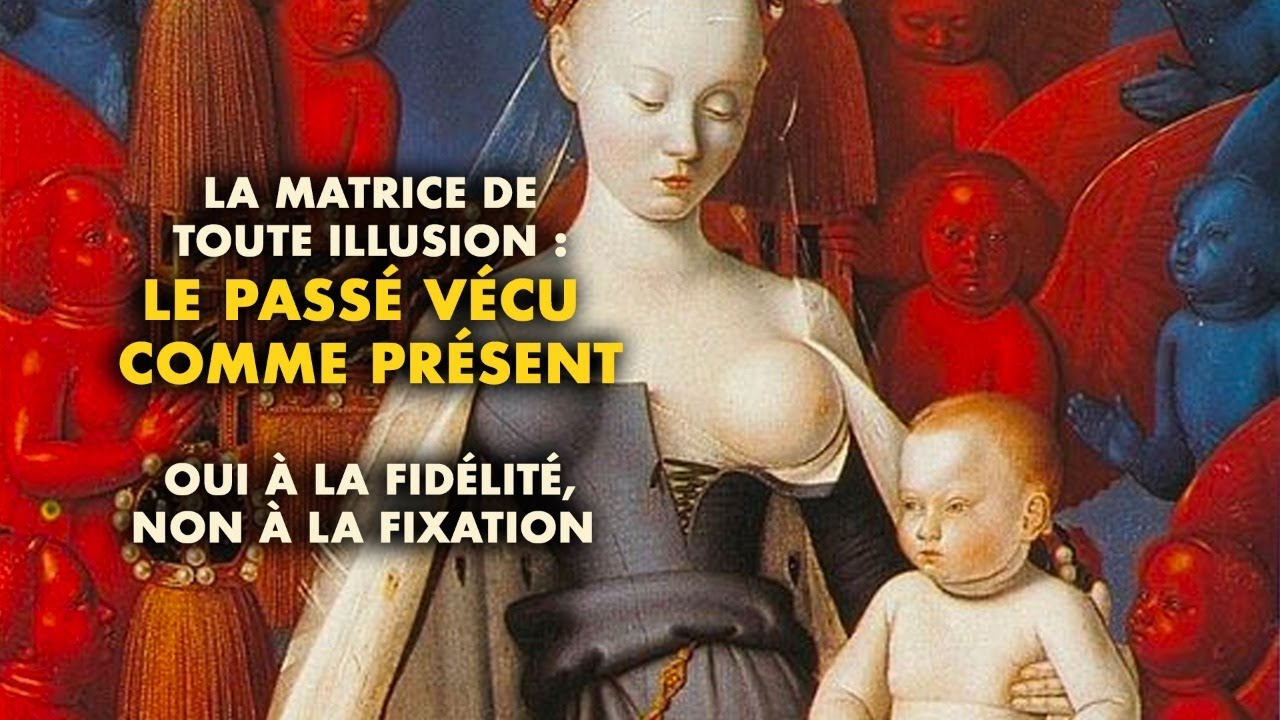
1:44:42 How can one go further back than the moments she speaks of, the moments when he is newborn, when he babbles at his mother's breast? You understand now why, finally, as the poster image for this session, I thank Pierre-Alain for managing to frame the textual part in such a way that we can still see the Virgin in her entirety with the child.
1:45:18 We're not very far off, are we? And I'll say no more — you'll see, in a different staging shortly, the same scene with Kundry, which will make us think back to this painting. So there — I'll take the opportunity, briefly, to mention some comments I noticed during the excerpt. First, I've learned, and I thank our friend Frédéric Cordier for it. I cannot recommend enough to those listening that they follow his videos on YouTube.
1:46:00 If they want something to change from everything that's overwhelming us, mostly for the worse — in short, amid nullity, mediocrity, reaction, all of that combined — well, in any case, and I also really like his delivery, they will gain a lot from following Frédéric Cordier's videos.
1:46:31 So he tells me there's this painting at the Musée d'Orsay — well, it's been a while since I've been there, but I've gone often. I don't recall this painter at first, my apologies — Georges-Antoine Rochegrosse, if I understood correctly. And clearly, I intend to go take a look, precisely because it corresponds perfectly, generally speaking, to the period.
1:47:03 And among the Nordic painters we see — look at what's called the school in England, the Pre-Raphaelites, you see? It's not very far from Parsifal in spirit — Wagner's Parsifal, I mean, not Perceval the Welshman. So, an odd question from Frédéric Cordier, a technical question, so to speak — he says that in the Boulez '70 recording — Boulez made a very notable interpretation of Parsifal at Bayreuth —
1:47:41 I'm first going to turn to Frédéric's question and comment a little on Boulez's relationship to Wagner. The libretto, in Boulez's 1970 edition. The libretto, because at that time there were no CDs yet, or it was barely starting, and in any case thanks to the LP record, which is much bigger, we used to have superb librettos, you know, in three languages, in English, in German, in French, at least those three, sometimes in Italian, texts either of Bach's cantatas, or of operas by Mozart, by Wagner, by the Italians of course.
1:48:17 So, in the Boulez 1970 edition, the libretto on the audio CD was, by a printing error, printed upside down. Well, go on, check if you have it, or tell me if that's the case. So, calling all enthusiasts, I no longer have it here, but I don't remember ever having noticed that the libretto of my Boulez recording — which I had for a long time — was printed upside down. So tell me if it's just my own copy. There you go, thanks for the humor, Frédéric.
1:48:54 It only happens to me, as they say. Let me open a parenthesis, but this makes me think of Clouscard, who at the restaurant would sometimes look at the tables around us and see how people were served the same dish as the one he had ordered. He'd say, I don't know if it's a form of my paranoia, but I'm always the one served worst. He would order, say, a steak with fries, and a neighboring table would get a superb steak dripping with meat juice and overflowing with fries. And he would have three fries fighting each other pathetically on a piece of overcooked meat. There you go. I close the parenthesis.
1:49:41 So there's Pierre-Luc Sexe, to stay in tune with our second act, who says "Is this the painting of the knight of flowers?" That's what I understood, I mean, which is indeed very fitting for the knight Parsifal walking among the flower maidens. There you go. Frédéric confirms it, by the way. Also, I saw earlier — wait, something — I believe it's Geoffrey Gio who put me onto a ballet author. I don't know the name, I'm delighted, I'll go check, because he says that the flower-maidens scene reminds him of this American's works.
1:50:36 I don't know if the choreographers and composers — I know he made musicals, but because those are the years when he flourished, as we used to say — are somewhat the pinnacle of the great school of contemporary American choreography. It might be time for us to move on to the acts. Ah yes, the most important thing is the commentary on what we just heard. Kundry understood very well that this innocent one, who ended up rejecting the flower maidens before she called out to him, at the moment when he was about to leave the enclosure and resume his mission to recover the spear, if he doesn't linger with her, it's because…
The guilt of having killed one's mother 1:51:28 It's because he's not a ladies' man, as they say. He's not mature enough for that yet, he's still too innocent, still fixated on the mother, so instead of showing off her figure and her breasts to him, and so on, she does everything to make that maternophilic fiber vibrate in him — eternophilic, if I may put it that way.
1:52:03 And for that, she goes so far as — again, I don't know if you see how enormous this is. I've always told myself that Nietzsche, Wagner, Rilke, Dostoevsky, who are roughly contemporaries of one another, give or take a few years, a bit earlier, a bit later — Nietzsche is noticeably younger than Wagner, etc. — but still, what they have in common is that all of them brushed up against access to Freudian discourse, and no doubt it's a good thing they never actually encountered it, because I know some who would have ended up even worse than Nietzsche, faced with the explosion of truth shattering their certainties.
1:52:55 So, it's incredible that she quite literally traces out the primal scene in every sense. On one hand, she evokes the weeks, the months, the eternity spent between the newborn and his mother, "Von Waffenfern, von Männerkampf und Wüten" — I don't need to say it beforehand because it's an admirable passage — far from the clashes of wars and the hatreds, not of men.
1:53:39 She lays him down on a bed of moss in the heart of the forest, far from any chance of contact with knighthood. She doesn't want to lose this last token that remains to her of her husband, whom she lost in battle. And of course, you know the importance of the forbidden fruit: the first time Parsifal happens to see, at a bend in the woods, a band of knights suddenly go by, it will be like a thunderbolt for him, his decision to leave, abandoning his mother in a swoon, whom he will later learn died of grief after he left her.
1:54:25 So, you know, symbols are always an abyss. It's not a matter of interpreting them, quite the opposite. It's not about moving from the signifier to the signified, it's about extending the chain of the signifier. It's not entirely false that at our birth, we are ready to kill our mothers. First of all, at the time Wagner wrote this, there was not yet the discovery — the importance, perhaps, for the surgeon and the obstetrician — of washing their hands with soap. I won't insult those listening to us by recalling the appalling mortality rate of women dying in childbirth at that time.
1:55:07 It's not that old. I'm talking about a time when there was already electricity, steam, industry, and so on. But in any case, the general childbirth which is very painful, mater dolorosa. It's precisely the moment when the son comes out, leaves, quits the mother, which is the most painful. You see, we can take it literally. That's what I call signifiers in abyss — it's not me who decides it, and I'm not interpreting anything. I'm noting that it's on the same signifying chain.
1:55:46 For what does Kundry not do, what does she not say, to increase in the young man the guilt of having in fact been the murderer of his mother? And this, this sends us back again, this repetition, to the first act where the old knight — what had he not said and not done, to make Parsifal feel guilty for having made an attempt, not only on life in general, on the animals, it being strictly forbidden to hunt them in the domain of the Grail, but in particular on the swan, Er war uns hold, which literally means 'it was dear to us,' we loved it well.
1:56:31 You see? He looks at it, and do you remember those details, look at the glassy eyes, the feathers matted with blood — there's really a sadistic side to it, you see? Forcing guilt onto someone who doesn't need much of it, isn't there? And in the version by Perceval, the Welshman, a worthy man he meets during his adventures in a chapel speaks of his kinship, reveals that he is his uncle, and well, let's pass over the detail, ends up telling him that his state of being wild, somewhat foolish and mad, and above all not having asked the question when he saw the Grail, whom it serves, that all of this comes from the fact that he was negative, bound up by guilt.
1:57:27 He may have left his mother behind him. In Chrétien de Troyes it is said very clearly that at the moment of leaving, he turns around for an instant, sees her fall to the ground in a swoon, and gives his horse a flick of the rein and flees. So there you have it, yes, this guilt dug deeper and deeper, and this guilt-inducing especially, isn't it, both by Gurnemanz in the first act and here by Kundry, who is going to finish tearing down our hero's defenses. That's the piece we're going to hear now.
1:58:15 The last defenses of our hero, so softened in every way by the sorrow he feels at having killed his mother, that she need only take him in her arms to console him for such great grief — well, the rest Pierre-Alain is going to send us. It's working.
1:59:22 Herzeleide ... died.
2:01:42 What else did I perhaps forget... of what was I still ever mindful? Only dull folly lives in me.
Two primal scenes and two reversals 2:06:07 I'm not exaggerating when I spoke of a primal scene in abyss. Not only is there a primal scene, there are two. The first, Ich sah das Kind, 'I saw the newborn child' on its bed of moss — we saw it, didn't we, with the mother's kisses. That's a coddling. And then, here, it goes even further, it's the primal scene in the strictly analytic sense, that is, the vision of the parental coitus.
2:06:44 She says outright, 'I saw how Gamuret, the father, was inflamed before the ardent Herzeleide.' Really, it was in the text, it's hardly believable.
2:08:00 Sorry, there was a network outage — really, this evening, between the transport problems and the network outages. I'm sorry about that. So, I presume you heard what I was in the middle of saying, which is that she is quite literally reconstructing the parental couple, how Gamuret, I quote, 'was inflamed before the ardent Herzeleide,' the mother.
2:08:32 There's enough there to shake you up. That said, there are two great reversals that both occur in the second act. As always with Wagner, it's the act of action, the second one, where a threshold of irreversibility is crossed. On one hand we've heard his name, and I tell you right away that we're going to see another version. This density of reversals in that act is so important.
2:09:04 We're going to watch the same scene again but in another version, that of Syberberg, Marie-Anne Boucagie. He pushes her away, but because of the kiss — and I'm thinking again of Gracq's text — that it's the wound; we do say it well, the language is terrible, in surgery, or when you're treating a scar, the lips of a wound. But I don't want to get ahead of an absolutely incredible exhibition of the wound that we'll see in Syberberg's staging, a bit further on.
Yes to fidelity, no to fixation 2:09:53 So we're going to move past the scene, but first — and this is really the main subject tonight, because for some the text may seem enigmatic — yes to fidelity, no to fixation. You see that in the case of Parsifal, it's more than fidelity, it's a fidelity so fixed on the maternal reference, and thus on the reference to a dead woman, that there can be no happy ending. To unveil the truth of what's happening to him is to remind him that what he believes to be present and alive is in fact a corpse.
2:10:37 And here, I'm sure some of you remember. I'm not too displeased when I try to fulfill my contract, when it seems to me that I'm beginning to fulfill my contract despite my detours — or rather thanks to the detour — because I'm thinking of the cycle I did on Nerval's Angélique. That novella about which I say that, for once, Nerval — if anyone was ever more than Perceval le Gallois, and more than Parsifal, and that's saying a lot — fixed on the mother, because Nerval, after all, died of it, didn't he?
2:11:20 Let me recall this mysterious sonnet, of incomparable beauty, in Les Chimères, called Artémis. "The thirteenth returns, it is still the first; and it is still the only one — or is it the only moment; for are you queen, O you, the first or the last? Are you king, you, the only one or the last one? Love him who loved you from the cradle to the grave; the one I alone loved still loves me tenderly. She is death — or the dead one — oh delight, oh torment."
2:12:02 We need to understand this trauma. I'll show you afterward, because if it were just about doing psychology on Nerval or Wagner — why not? But that would be a confusion I don't lend myself to. Because that psychological field treats individuals as if it were accidents. The poor things, they were just born a little simple-minded and fixated on their mother's apron strings. No. What interests me is how this concerns you, and me.
2:12:34 What I mean is that it's the modernity to which we belong, and to which I return in a recurring way. You see that I'm bringing together here my most recurrent themes, thanks to Parsifal, the work — what am I alluding to? I'm alluding to the fact that in our approach to the text of Angélique, I had shown that what makes the originality of this novella, which long remained on the margins as far as the public, the readership, the reception, as they say, of Nerval's so-called major works is concerned…
2:13:18 I had even said that in Nerval's case, "major work," "minor work" doesn't mean anything, does it? Because it never had the prestige of Sylvie. Look at how Proust talks about Sylvie, doesn't he? How, in his notebook, Proust tries to go further than Gérard. He himself acknowledges the importance of this exploration of memory. Now, since we're talking about maternal fixation, the narrator of the Recherche — well, his maternal fixation, the palinode, there's no other word, the tragic comedy of his mother receiving company downstairs, while he, meanwhile, is supposed to be asleep up there like a child, and his despair at seeing that, because there's company, she doesn't come to give him the goodnight kiss without which he cannot fall asleep.
2:14:14 Listen, we've just left behind a troubling kiss. Before I read you the equivalent passage in Proust, I hold onto all this to illustrate this fixation which fidelity must not go as far as — which is what Nerval succeeds in achieving in Angélique. But before I read it to you, I'll extend this allusion I just made to the fact that it interests me on a collective level.
2:14:44 It's modernity in general that has affected every generation since the origin of man — the relation to the mother, whether of the son or of the daughter for that matter, let's not be formalists, no silly symmetry — is privileged and fundamental. The mother-goddess in her convolutions, the oldest mythologies, all this has been studied a great deal. And I'll come back, apropos Parsifal, to the ancient mythologies, to explain why it takes him so long to find the way to the Grail.
2:15:17 I told you earlier, but it's not the third act we're commenting on tonight. So I return to this modernity, and the same friend who had written her thesis on this parallel between the narrator's trajectory in the Recherche, which goes from fidelity to grace — that is, from what I'm about to read you in a moment, the drama of his bedtime where his mother doesn't come to give him the last kiss, to the end of the Recherche, where there are German airships — so he flies over the square of…
2:15:51 The Place de la Concorde at the time of the war of 1914. And she showed very well that musically — since Proust of course makes many musical references, Wagner not being the least among them — musically, the two periods, that of his childhood with its maternal fixation, and that in which he becomes aware of the role of history and of temporal thickness in Time Regained, are also what takes us from what Proust calls the white sonata — Vinteuil's sonata — I quote — "to the red septet." I wanted to respect this thread within the symbolic order, which never ceases, you see, to blossom.
Reading of the bedtime drama in Proust 2:16:42 They're called flowers, I was about to say, right in front of us, weren't they? And it's not over. So listen, I'll only read you a very short extract, because this whole bedtime story runs to 25 pages. My mother is receiving company — I'm showing my bourgeois world — in their country house at Combray, which is now called Illiers; it's Illiers, the village where Proust's house was, in the Beauce, near Chartres. It's now Illiers of worldwide renown thanks to the novelist — the village entrance sign reads Illiers-Combray.
2:17:23 So wait, let me not mix up Julien Gracq — there we go — and other Pléiade volumes. So yes, it's been fifteen pages of him trying tricks, calling the maid to tell her: I absolutely must… I have a very important message for Mama, would you please give her this letter? All of this, of course, is the ruses of a desperate child.
2:18:03 So there it is, he confides in her. "The anguish I had just felt, I thought Swann would have found quite laughable." His mother is receiving Swann that evening. I mean, we'll hear about him later in Swann's Way — Un amour de Swann — and he's Gilberte's father, who is the narrator's first love. "The anguish I had just felt, I thought Swann would have found quite laughable if he had read my letter and guessed its purpose."
2:18:33 "Yet on the contrary, as I learned later, a similar anguish was the torment of long years of his life, and no one perhaps could have understood me as well as he could." For him, this anguish of feeling the person one loves in a place of pleasure where one is not, where one cannot join them. It's Nerval who has a magnificent phrase, as usual, when he speaks of being "banished from merriment" — the one banished from every celebration, the banished from merriment. Where one cannot join her — it's love that made him know this anguish, a love to which she is in some way predestined, as if there were a maternal matrix underlying the future loves of maturity.
2:19:22 "She is in some way predestined to it, by which she will be monopolized, specialized — but when, as with me, it entered into us before it had yet made its appearance in our life" — because here he's a child, before love had made an appearance in our life — "it floats while waiting, this vague and free anguish, without fixed attachment, in the service one day of one feeling, the next day of another, sometimes of filial tenderness or of friendship for a comrade" — and the joy with which I served my first apprenticeship when Françoise came back to tell me my letter would be delivered.
2:20:01 So there he is, relieved. "Swann too had known this deceptive joy." Yes, I'm talking to you about illusion tonight. "This deceptive joy which a few friends, a few relatives of the woman we love, give us when, arriving at the hotel or the theater where she is, for some ball, masquerade, or opening night where he's going to find her, this friend spots us wandering outside, desperately waiting for some chance to communicate with her. He recognizes us, greets us familiarly, asks what we're doing there, and as we invent some urgent thing we have to say to his relative or friend, he assures us that nothing could be simpler, brings us into the vestibule, and promises to send her to us within five minutes" — that we love, as at that moment I loved Françoise, the well-meaning intermediary who has just made bearable, human, and almost propitious the inconceivable, infernal party — well, well, Klingsor, Parsifal, the infernal party — her parents calmly receiving friends on the floor below, isn't that right?
2:21:16 "Infernal, within which we believe that hostile, perverse, and delightful whirlwinds — there are our flower-maidens — carry far away from us, making her laugh at us, the woman we love, if we're to judge by him." Well, I'll skip ahead, and I come straight to his disappointment. "My mother did not come." And out of consideration for my self-respect, committed as it was to the fable that the Recherche was supposedly asking me to report its result to her — so that it wouldn't be contradicted — she has Françoise tell me these words.
2:21:48 "There is no answer" — words which since then I have so often heard concierges of palace hotels, footmen, and gambling-house attendants report to some poor girls who are astonished: "What? He said nothing? But that's impossible! You did give him my letter, though! Very well, I'll wait a little longer!" You see how long the pain of bedtime lasts. And now the friends are leaving. He'll finally be able to find his mother again. "I heard my parents' footsteps" — look how this becomes dramatic — "as they accompanied Swann out."
2:22:27 And when the doorbell had let me know that he had just left. I went to the window. Mama was asking my father whether he had found the langoustine good, and whether Monsieur Swann had had some more coffee and pistachio ice cream. "I thought it was rather middling," said my mother. "I think next time we should try another flavour." "I can't tell you how much I find Swann is changing," said my great-aunt. "He's an old man." My great-aunt was so used to always seeing in Swann the same young man that she was astonished to find him suddenly less young than the age she continued to give him.
2:23:05 Well, I'll skip ahead, I'll skip ahead, and at last he sees his mother arriving. Soon I heard him going up, closing his window. I went silently into the corridor, in my pyjamas of course. My heart was beating so hard that I had trouble moving forward. But at least it was no longer beating with anxiety, but with dread and joy. I saw in the stairwell the light cast by Mama's candle. No electric current yet in the country house. Then I saw her herself, I rushed forward.
2:23:43 In the first second, she looked at me with astonishment, not understanding what had happened. Then her face took on an expression of anger. She didn't say a single word to me, and indeed, for far less than that, I would go without being spoken to for several days. If Mama had said a word to me, that would have been to admit that I could be spoken to again, and moreover that might have seemed even more terrible to me still, as a sign that, given the gravity of the punishment being prepared, silence, the falling-out, would have been childish.
2:24:17 A word, that would have been the calm with which one answers a servant when one has just decided to dismiss him. The kiss one gives a son one is sending off to enlist, when one would have refused it if one had, if one were to be content with having been angry with him for two days. But she heard my father coming up from the dressing room where they had gone to undress, and to avoid the scene he would make, because for the father it's...
2:24:47 Childish nonsense between nervous people, between mother and son. "But she heard my father coming up from the dressing room where he had gone to undress, and to avoid the scene he would make, she said to me in a voice broken by anger, 'Run off! Run off, so at least your father won't have seen you like this, waiting like a madman!' I kept saying to her, come say goodnight to me, terrified to see that the reflection of my father's candle was already rising on the wall, but immediately, using his approach as a means of blackmail and hoping that Mama, to avoid my father finding me still there, if she kept refusing, would tell me 'go back to your room, I'll come.' It was too late. My father was standing in front of us.
2:25:42 Without meaning to, I murmured these words that no one heard: I am lost. It was not so. My father constantly refused me permissions that would have been granted under the broader pacts allowed by my mother and my grandmother, because he did not care about principles and there was no law of nations with him. For some entirely contingent reason, or even for no reason, he would cancel at the last moment a walk so habitual, so hallowed, that he could not deprive me of it without perjury.
2:26:22 Or else, as he had also done that evening, well before the ritual hour, he would say to me, "Come on, go up to bed, no explanations!" But also because he had no principles, in my grandmother's sense, he was not, strictly speaking, inflexible. He looked at me for a moment with an astonished and annoyed air. It's suspenseful, isn't it? Then, as soon as Mama explained to him in a few embarrassed words what had happened, he said to her, "Well then, go with him, since you don't feel like sleeping anyway. Stay a while in his room. As for me, I don't need anything."
2:27:03 "Yes, my dear," my mother answered timidly. "Whether or not I feel like sleeping doesn't change anything. We mustn't get this child used to it." "But it's not a matter of getting him used to anything," said my father, shrugging his shoulders. "You can see the boy is upset. He looks miserable. Come now, we're not executioners. You'll make him ill, and a fine thing that will be. Since there are two beds in his room, tell Françoise to make up the big bed, and sleep in his room tonight, next to him."
2:27:33 Well then, good night, as for me, I'm not as nervous as you, I'm off to bed. This is an avatar of grace. It's like something unforeseeable. The father ought to have let his anger loose, but this is grace. And here, you'll see why I go all the way to the end. There's a passage that's crucial for our subject tonight. "One could not thank my father. He would have been irritated by what he called sentimentality. I remained without daring to make a move. He was still standing before us." All right, he describes it.
2:28:06 So, many years have gone by, look, suddenly the step back and the conclusion. The wall of the staircase up which I watched the reflection of his candle rise no longer exists, has not for a long time. In me too many things have been destroyed which I believed were bound to last forever, and new things have been built up, giving rise to new sorrows and new joys that I could not have foreseen then, just as the old ones have become hard for me to understand.
2:28:37 It has also been a very long time since my father has been able to say to Mama, "Go with the boy." "The possibility of such hours will never be reborn for me." Listen carefully now, the past and the present—but only recently, he was beginning to grow old, you know he forced himself to write the Search in order to fight against death, dying practically as he wrote.
2:29:09 But only recently have I begun once more to perceive very clearly, if I listen closely, the sobs I had the strength to hold back in front of my father, and which broke out only when I found myself alone with Mama. In reality, they never ceased. And it is only because life is quieter now, around me, that I hear them again.
2:29:42 Like those convent bells so well covered by the noise of the city during the day that one would think they had stopped, but which start ringing again in the silence of the evening. When I speak of maternal fixation, that's where I am, isn't it? And well, I told you there was a historical dimension—I'm going to ask what time it is, because the subject is so overdetermined, as they say, that I've lost track.
Rousseau's fifth walk, the modern beginning of maternal temptation 2:30:12 Sorry? Yes, but I'll say this—that means saying we started late. We started two and a half hours ago. All right, then I'll close on this crucial point. It's the collective side, I come back to it. No, I'm not doing cut-rate collectivism, this is serious. This pregnancy of the maternal temptation, one can date its beginning in modernity, one can situate it exactly.
2:30:44 It is nothing less—and I am doing intertextuality, if I may say so—than what is found in the incredible text of the fifth walk of Rousseau, in his testament, the Reveries of the Solitary Walker. "The shores of the Lake of Bienne are wilder and more romantic than those of the Lake of Geneva. If there are fewer fields and vineyards there, there are more woods." Well anyway, he begins by situating the Lake of Bienne geographically, which is a bit less well known than Lake Geneva.
2:31:22 But how does he situate it? Look how the imaginary overflows into what geography ought to be about reality, doesn't it? It's true the Lake of Bienne is wilder, and so farther away, isn't it, from the modern world, from current events and noise. And people go there less than to the other. And then he speaks of hills and mountains bordering it, as if it were, on its own, cut off from the rest of the world.
2:31:53 So I was going to say like a maternal womb, but I'll refrain so you don't think I'm doing interpretation. The text is coming. And he says "this beautiful basin of an almost round shape." Look at the "almost." One must know how to analyze a signifier. Good heavens! This beautiful basin. Look at the connotations of the word "basin" all of a sudden. "Of an almost round shape" contains in its middle two small islands. They are not in the middle. I went there at seventeen. Stop!
2:32:28 I saw a herd of deer in the woods that cover... There's a small village at the start of the Lake of Bienne called Erlach, the first German-speaking settlement when we get there. That only exists in Rousseau, that combining of French Enlightenment and German romantic night. The night into which the reverie is soon going to plunge. So you see, the islands are quite close by, to the point that nowadays there's actually a dyke connecting them to the village, but Rousseau can't help imagining them in the middle, far from everything, isn't it a bit like what I said earlier, that the middle of a three-act opera, whether it's Siegfried or Parsifal, in the middle, is the most protected place.
2:33:22 We come back to the maternal, against the avatars stirring at the beginning and the end. And so, let's go now to outright fusion with the mother, because this is only the beginning. "When evening approached," says Rousseau—because up to now he's spent the day botanizing, that's not... he's active, he moves, he goes from one plant to another. "When evening approached, I would come down from the heights of the island"—the top, so from above—"and I would gladly go sit at the edge of the lake, on the shore, in some hidden retreat." Retreat, protection.
2:34:08 There, the sound of the waves and the movement of the water. And the lullaby, the immense lullaby by which Kundry manages to disarm Parsifal's defenses. We see it with the waves of the lake. "There, the sound of the waves and the movement of the water, fixing my senses..." Usually it's the senses that fix the setting. But what an inversion! What a passive infant! And here, it's the world that fixes him. It's the weight of the lake.
2:34:38 The rhythm, the music of the lake, "fixing my senses," that is, stopping my eyes from looking left and right, making me totally passive, "fixing my senses and driving from my soul any other agitation." You heard that it's about the senses, I'm almost a little animal. "It plunged my soul into a delicious reverie." Delicious is a term with a connotation of oral, buccal pleasure. I can't help it!
2:35:12 Plunged into a delicious reverie "in which night often surprised me without my having noticed it." That was needed to reconstitute the state not of the infant but of the fetus in the maternal womb—"in which night often surprised me without my having noticed it." "The ebb and flow of this water, its continuous sound, swelling at intervals"—what a musician—"striking my ear and my eyes, supplying for the internal movements"—I'm thinking of the heartbeat, of breathing—"the internal movements which reverie extinguished in me." When you're born, you start to breathe. "Supplying for the internal movements which reverie extinguished in me."
2:36:00 "It was enough to make me feel my existence with pleasure, without taking the trouble to think." Sometimes there arose—I'll end on a verb that can only stem from the maternal field—"sometimes there arose some faint reflections"—there, he becomes a bit active, he suddenly thinks—"on the instability of the things of this world, of which the surface of the waters offered me the image"—a banal comparison—"but soon these light impressions themselves faded away"—now pay attention—"in the uniformity of the continuous movement which rocked me."
2:36:46 And here we are at the lullaby. There is a birth, and what a birth, what a masterpiece! One would never believe it's the same man who wrote highs and lows, a bit labored in the Discourse on the Sciences and the Arts, which is magnificent, eloquent, a bit stilted, clumsy, which hasn't aged a century. I went and looked at the subtlety of Voltaire's letters. Except that here, he surpasses Voltaire and everyone else because he heralds the sentence that never ends and that will go on into Chateaubriand, into Flaubert, and into Proust. This sentence is marked by maternal deprivation.
2:37:25 There, I'd like you to leave with this thread in mind, thanking you for having been so numerous. Pierre-Alain seems to be telling me that there's, how should I put it, an unusual gathering around both YouTube and Twitter. Thank you. I thank you for it. You can't imagine how grateful I am. See you soon.