English translation of the French transcript, made with AI and not yet proofread — click a paragraph to jump to it. Show the French original
Two themes for the season: revolutionary thought and landscape 0:00 Hello Dominique, so you're starting a new year of the workshop, it begins on October 19th. This year, what are you going to talk to us about?
0:30 Before I say what I'm going to talk about, I'll mention a change in the form of my presentation. Up to now, I've dealt with one subject throughout the year in the monthly talk cycle, which corresponds roughly to a school year — we always start in the autumn, and this time we'll start on October 19th, and it runs roughly until the end of June, that's how it usually goes.
1:04 And each year I had a theme. The first year it was Between Crisis and War, philosophy; then it was From Repetition to Liberation; then we had the sequential reading of Nerval's short story Angélique, from Les Filles du feu. The novelty this time is that there will be two themes over the course of this year, one theme per term. So I'll deal with a first theme during the first term. Then, following the first term, there will be a month devoted to discussion of what was said about that first theme.
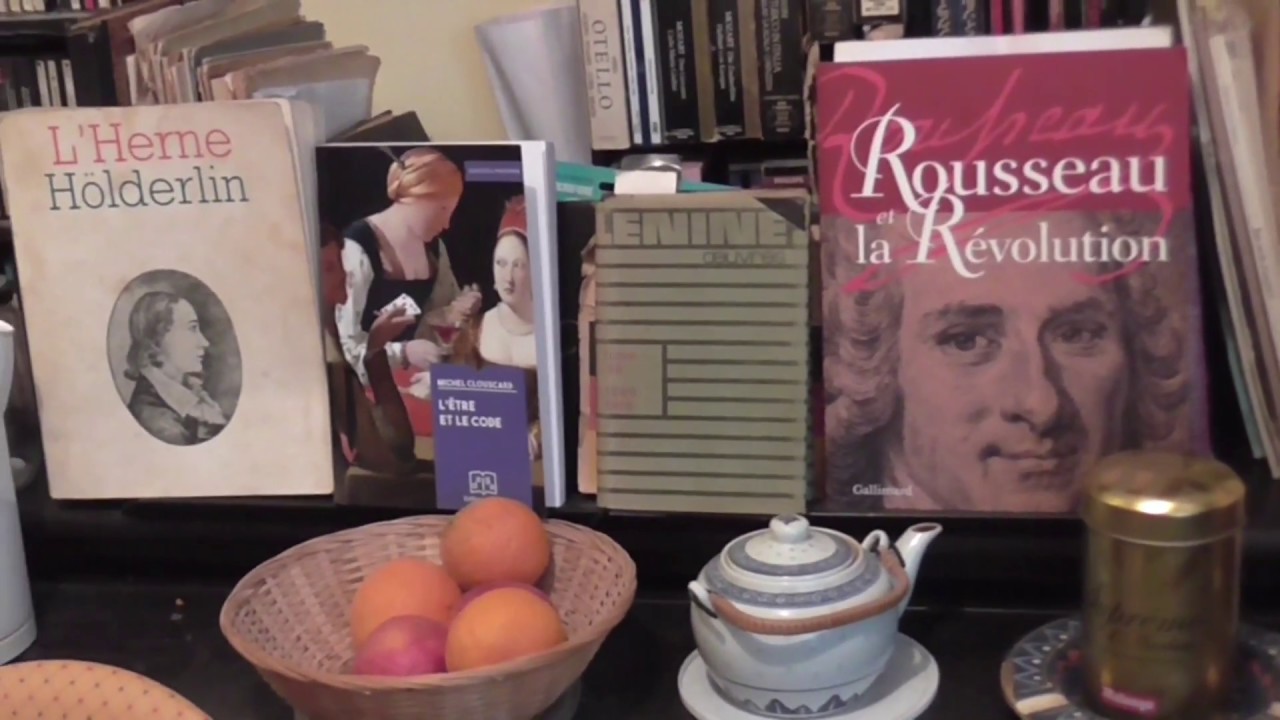
1:43 Then the second term begins, and likewise it will end — that makes two terms of three months, so six months, plus the two months of discussion, that makes eight months. Sorry for these rather abstract considerations, but now let me get to the content. For the first term, the theme I'll be taking, the exact title, is Revolutionary Thought, in a temporal sequence running very precisely from Rousseau to Lenin, via the following stages: starting from Rousseau, then Kant, Hegel, Marx and Lenin.
2:29 I don't want, for now, to justify this division too much — arbitrary like all divisions, arbitrary but not without reason, but in any case these are deliberate reasons, not counting all those that aren't and that are unconscious. And once we've finished this term on revolutionary thought from Rousseau to Lenin, we'll have a session, a whole session, two hours of discussion on what was said.
3:10 I'll take this opportunity to specify, if dear Julien will let me, that although we'll have this two-hour discussion session — where the audience can of course speak about what was said during the preceding term — we'll keep our usual practice of leaving half an hour for the audience to ask questions at each of the monthly talks I give, are we agreed?
3:47 So that comes in addition to the half hour of discussion at the end of our monthly sessions. The second theme, which we'll deal with from spring to early summer, will be the question: nature or landscape? There you go. So, I presume your question is mainly about the most immediate one, that is, the one that will be inaugurated on October 19th.
Rousseau, Clouscard, Lenin: praxis and psyche 4:23 Which has as its theme revolutionary thought from Rousseau to Lenin. I don't want to give away the subject before the talks themselves, but still — since the audience will be watching this video, so I'm addressing them too — let me say in summary, not the reasons for this choice, which I'm keeping for the talk itself, nor for the division, but I want to forestall, for once, a negative reaction some might have toward my choice, or rather a positive reaction, one that might lead to disappointment given the way I'm going to treat the subject.
5:15 Let me explain. It's all very well to spend a year on an author who isn't even a political author, a dreamer, a minor sub-romantic or romantic, as one prefers, as was long believed, who on top of it comes to talk to us about dreaming — I mean, whereas it's good to go back to revolutionary thought, to the Social Contract. Yes, except that, firstly, Rousseau did write the Reveries of the Solitary Walker, as far as I know, and — I say this as a preamble, and it's the second time I say 'once is not a habit,' so twice is not habits, it's a bit emphasized — in my view, it's the revolutions that may have been disappointing; I leave aside whether that's the fault of the revolutionaries, or whether their failure should be attributed to the fierce struggle waged against them — both are true.
6:15 One of the main internal causes of the difficulties that revolutions have encountered — to put it euphemistically — is the fact of not having, of not having thought to restore a revolutionary gesture that Rousseau was the first, and as far as I know the last to date, which is why I'm starting again with him, namely — and here we'll find an eminently Clouscardian point — to link in an indissociable way the study of praxis and the taking into account of the psyche.
7:03 That the greatest revolutionary of the Age of Enlightenment should also be the one who wrote Julie, or the New Heloise, whose main subject is nevertheless an amorous passion of the order of Eros, and the Reveries of the Solitary Walker, where the final epithet 'solitary' seems to run counter to the one who wrote the Social Contract — well, of course we'll see that not only is there no contradiction, but that it's even very coherent — this gesture has never been renewed except, significantly, by Michel Clouscard, who is, as far as I know, the only Marxist since Marx to have written, on the one hand, I mean, the study of a precapitalist historical ensemble — that's the title of L'Être et le code — and, on the other hand, a treatise on mad love.
8:05 So I risk disappointing those who believe I'm going to talk about Rousseau to Lenin only to talk about productive forces and relations of production, which I do fully intend to do, because I think it isn't done enough, but on condition, precisely, that they be related to the psyche. And so that no one thinks I'm shutting myself up in Rousseau as a pretext for this intimate connection — the phrase fits — between praxis and psyche, I can also refer to Lenin.
8:46 So here I'm taking the two extremities of my historical sequence. For Lenin — and this isn't very often publicized, even among Marxist-Leninists, incidentally — said 'dreaming is necessary.' Rousseau isn't the only one to have written Reveries of the Solitary Walker. 'Dreaming is necessary,' I continue quoting Lenin, 'provided the dreamer sees his dream through to the end.' End of quote. So that's the preamble I wanted to make.
A sequence treated in a loop around Hegel 9:16 Second point: I'm not going to start with Rousseau and then move on to Kant, because Kant himself speaks, regarding his philosophical initiative, of a Copernican revolution. So he has a say in this sequence of revolutionary thought. Hegel, then Hegel, then Marx, then Lenin — we'd never get there. It would take, I don't know how much time, an enormous amount of time for each element of this crucial sequence.
9:54 And so there's no question of treating it in a linear way. Instead I'm going to treat it as a loop, that is, I could just as well talk about Lenin from the very start, even if we're going to begin with Rousseau. But precisely, I'll keep recalling here everything we should have meditated on in Rousseau when working through Kant, Hegel, Marx and Lenin as well. So, I'm going to work in a way that I believe is familiar to quite a few of my listeners, which is both linear and circular.
10:31 Which of course brings us back to the image of the spiral, but let's leave the formalism aside. It's just to show that this isn't contradictory. It's quite clear that I'm not going to treat each of these authors in the manner of some kind of history of revolutionary thought. That's not the genre in which I'm going to present this sequence.
11:03 Once again, I want to stay within philosophy and not, with all the respect I have for that discipline, which is a different one, the history of ideas. We're not doing the history of ideas, even the history of philosophy itself, which is a very noble discipline, agreed? And if need be I'll recall some elements that may belong to the history of philosophy, but the important point is to treat this sequence as a Rousseau-Lenin block, stirring it constantly as a totality.
11:36 Which makes me think — and this is the third element I'm introducing — is... Let me start from there. I'll point out that there is... let's get a bit abstract again. I have... how many references? Rousseau, Kant, Marx, Hegel... sorry. Rousseau, Kant, Hegel, Marx, Lenin.
12:07 That makes five. And I mentioned two terms. So it doesn't divide evenly. How are we going to do it? I'll dwell a bit longer on the central element. I'll group Rousseau and Kant together on one side — that's for the initial sequence — and Marx and Lenin for the final sequence. And we can see clearly that there's one in the middle, which is Hegel, who mediates between the two. The mediation between Rousseau and Kant on one side and Marx and Lenin afterward is Hegel.
12:42 Why? Not because I favor him, any more than Plato or, even less, Marx for that matter, but because I have a special thought for our listeners who are properly philosophers, agrégation candidates, and since Hegel is on the philosophy agrégation syllabus this year, I'll dwell on him a bit more — not on Hegelian thought as such, they don't especially need me for that, they have excellent professors I'm sure, plenty of sources — but on the place Hegel occupies in this sequence of revolutionary thought.
13:29 Because there's also something reactionary in Hegel, as in everyone, it's not all black or all white. But there, I'm going to insist precisely on the irrefragably revolutionary part of Hegel. So that's roughly, to answer your question, what I intend to develop. And I'll end on this: Marx, in the famous 1859 preface to A Contribution to the Critique of Political Economy, says that the revolution which will do away with the bourgeois mode of production will be — and I quote — 'the end of the prehistory of human society.'
End of history or end of prehistory: Hegel and Marx 14:17 I say this because some people are a bit impatient — I understand that, starting with myself, it's true. But still, for such high stakes, one understands that it takes time, especially since in the same text Marx says, another famous passage, that a social formation never disappears, a mode of production never disappears before it has exhausted all the possibilities it contains in potential. That recalls — wasn't there a famous title written about Hegel — the patience of the concept.
14:51 So, the end of the prehistory of humanity, according to Marx — in other words, what for Hegel was the end of history, absolute knowledge, is for Marx nothing other than the end of prehistory. It's a fundamental disagreement, but one to which I hold firm, I who so often, unlike Althusser, have fought against the counter-revolutionary decoupling that's been made between Marx and Hegel. We'll see that Lenin, for his part, recouples them, saying that one understands nothing of Marx, and especially not the first section of Capital.
15:23 I quote Lenin in the Philosophical Notebooks on dialectics: if one hasn't read the whole — I'm quoting Hegel's Logic — so I reread them myself, but there are disagreements. Marx is not Hegel. There are fundamentally different things. I'll come back to this, I say it in passing, to whet the appetite of those interested in the question, and it does them credit — there's the fact that the great turning point which leads from consciousness to absolute knowledge in Hegel is when consciousness becomes aware that its content is the spirit of a people.
15:58 It's when there's a historical figure that serves as its content. Now, the notion of a people is still too abstract — rightly so from Marx's point of view, who moves, for his part, from the people to the social class. The people being a notion that's still too generic — this is a problem I'm introducing myself — and social class allowing us to move from genus to species, that is, the highest level a piece of knowledge can attain. Species, in Greek, 'eidos,' which is the same word as 'idea.'
16:29 I recall this in passing, noting that Hegel himself recalls it in the preface to the Phenomenology. And that we're quite wrong, therefore, to look down on the notion of species when we say there's nothing good in its kind. It's a crucial term. It's the maximal degree of precision that can be reached at the level of a logic of natural language, the species, between the excessive abstraction of the genus and the somewhat derisory or contingent side that the particular can represent.
17:02 So there you have it. So, as a middle term, species — and my model here is Marx — by moving from the spirit of a people, from a notion of a people in Hegel, or from a spiritual figure à la Hegel's Geist — like, say, the Greek city or the phrase 'empire of abstract right' for Rome — to social class, does away with what is still excessively abstract in Hegelian thought.
17:32 So I won't develop this further, since that would be anticipating the course. On the other hand, let me note here a little quip of Clouscard's about the classless society, since the prehistory of humanity ends for Marx at the moment the classless society begins, since he does say that the capitalist mode of production is the last figure in the historical progression of modes of production, the last historical figure.
Classless society, Clouscard, and Nietzsche's superman 18:11 So, to be rigorous, one should say 'prehistoric.' We were at Clouscard's quip when he was asked, 'yes, but what will become—' I say, 'yes, questions like that do come up' — 'what will become of love in a classless society?' Or 'what will be the status of art?' I don't know. I do like Plato: as soon as it's about art, I talk about eros, I think of the Symposium; as soon as it's about eros, I talk about the beautiful. It's an impersonal game, we've been doing nothing else for 2000 years. So, more than 2000 years.
18:43 Clouscard would answer, 'the classless society is the equivalent of an ancient omen'— we're so determined by class society that our thinking is incapable of thinking what will arise in a classless society. And here, and this will be the end, I think, of my answer to your question, I can't help thinking of Nietzsche — who would have thought it — I who often decry, not so much poor Nietzsche himself as the neo-Nietzscheans, those who proliferated during the Cold War.
19:18 And in particular, those who figured in the vast counter-revolutionary philosophical offensive that developed from the late 1960s onward, with Deleuze, Foucault, Derrida — those who influenced, I think, Althusser too, and who thought of Nietzsche — well, Nietzsche, from the text itself, and not one rigged behind his back to be used only against Marxism — Nietzsche who wrote, in Zarathustra, that famous passage, when he speaks of the overman: 'What is the ape to man? A laughingstock or a painful embarrassment.'
20:04 It's as if man saw a bit of his past and were ashamed of it, at a time when the revelations of Darwinism were being discussed. And, likewise, by implication, what should man be to the overman? 'A laughingstock or a painful embarrassment.' Man should appear, once we reach the overman, according to Nietzsche, in the same way an ape appears in relation to man. Why did I make this allusion? In the wake of what I said about the classless society — we can't even reach the thought of it.
20:41 Well, precisely, to defy this opposition — when Nietzsche says 'an object of shame,' why shame? I think I've given enough anti-ecologist speeches — not anti-environment, far from it, but anti-ecology — that no one should suspect me of leaning toward naturalism or fashionable antispeciesism.
Reading of Rimbaud's "Mouvement" 21:11 But still, here, I'm taking the ape's defense. Why should the ape be an object of shame? And here I contradict Nietzsche — I'll stop on this — with a text by Rimbaud that I've quoted in the course of my workshops for a completely different purpose. It's in the famous Illuminations piece called Mouvement, which is very short, one of the most beautiful hymns to modernity, in the most technological sense one can imagine.
21:45 'They are the conquerors of the world seeking personal chemical fortune; sport and comfort travel with them. They bring the education of races, classes, and animals aboard this vessel.' This clearly refers to Noah's Ark. 'Rest and dizziness in the diluvian light, in the terrible evening of study.' In short, a kind of hymn to humanity saved, saved from catastrophe, from the flood, by this ark which is science. It recalls the Rimbaud who says elsewhere, at the end of A Season in Hell, 'one must be absolutely modern, keep pace gained.'
22:17 But — and here, to further heighten the derision and the prehistory of humanity to which we must remain faithful — I'll finish Mouvement, and I quote Rimbaud, who ends this Illumination with this small remark: 'For the most surprising atmospheric accidents, a couple of youths isolate themselves on the ark' — in the language, there unwinds the hydroelectric power-station barrage, hyper-technological.
22:47 'Is it ancient savagery that we forgive?' There's where I understand Nietzsche too — 'is it ancient savagery that we forgive?' — question mark — 'and sings and takes its stand.' So, I'll try to hold together everything that can reconcile the hypermodernity for which I campaign, like Rimbaud, and ancient savagery. Thank you, Dominique. So, see you Friday, October 19th, to find out more, at the Centre Goscinny, rue Goscinny, in Paris, 7pm.
23:21 Thank you.