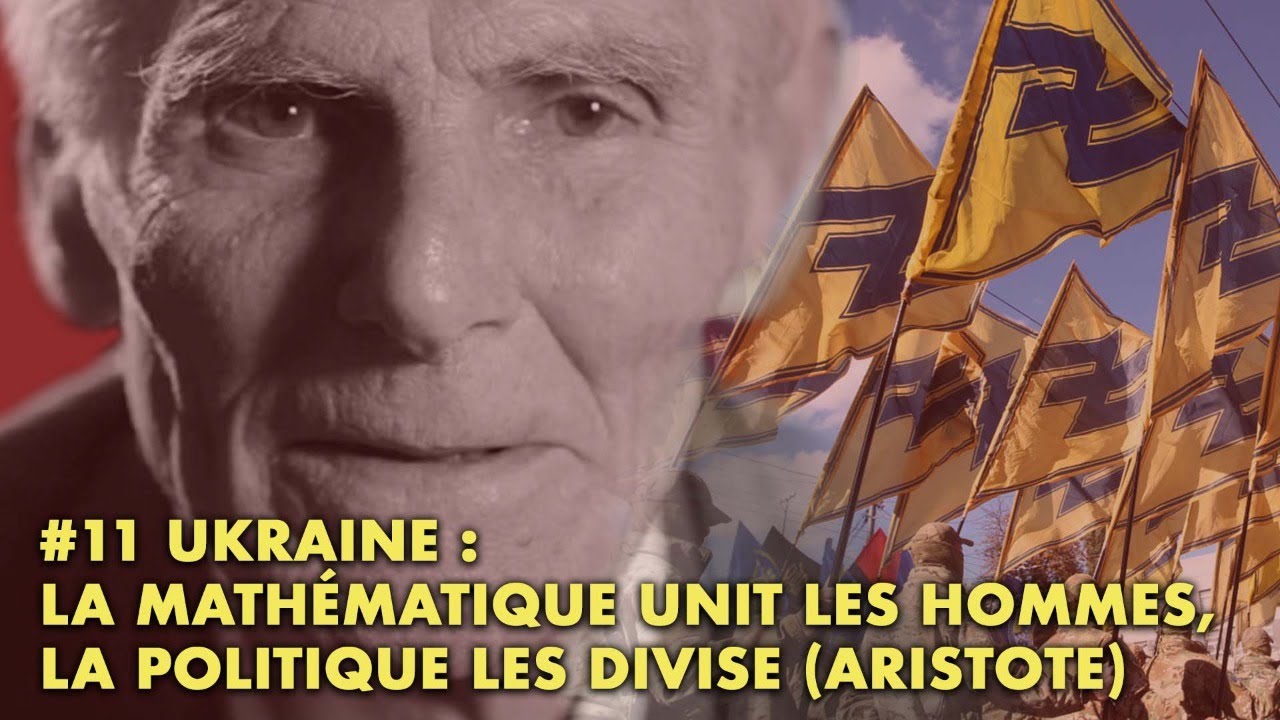
English translation of the French transcript, made with AI and not yet proofread — click a paragraph to jump to it. Show the French original
Return after an interruption: speaking of the war 0:00 Hello, glad to be back with you, very glad indeed. I offer my apologies on behalf of the whole team, for several causes independent of one another. The first being mainly technical, that is, in our image and sound capture equipment, there was maintenance to be done, which revealed that the equipment actually works very well.
0:43 But it was necessary, and besides, we had some minor health problems, unfortunately, nothing serious this time, but which affected first one of us then the other. So there it is. And all that meant we had to upset our schedule a bit, and above all our appointments, push back our appointments. I won't keep making you waste time.
1:13 I'll still take the opportunity, yes, to confirm to you that this time again, current events demand it, I'm going to talk about the situation. You can guess it will be about the war, to sum it up as elliptically as possible.
1:45 There you go. But I am neither a specialist in the course of operations, nor ever the... You know that... A famous phrase by... I believe it's Valéry or Churchill, well I don't remember anymore, but a phrase in any case that everyone can agree on, is that the first casualty of any war is truth.
2:15 There you go. It seems we've forgotten that enormously these days, because truth, everyone is bathed in truth in our media. In the same truth. I have never seen that, in over 75 years. I have never seen... I lived through the Algerian, Indochina, Korean wars, I was small, sort of... The Gulf wars, the first, the second, the invasion of Iraq, Libya. I never... People were arguing during the Algerian war, there were people for, people against.
2:46 I have never seen so little debate in the media, I believe. As soon as you go down among the population, it's different. But... You'll think I'm obsessed. But the same phrase comes back to me, and you can guess it. It's because, alas, it's in the context in which I introduced it to you: the death drives are advancing in silence. What frightens me, what... Because we're not out of the woods, you know, in terms of supreme peril.
3:20 We're not out of the woods. I'm certain of nothing. I'm even less of a prophet. We're not out of the woods. Just today I learned that now NATO is proposing to supply the Ukrainians on the coast, there, Odessa, with missiles allowing them to sink ships that are offshore. So, adding fuel to the fire continues. The cannon fodder is Ukrainian. Wonderful, isn't it? Wonderful, I mean. There are no NATO soldiers, no public opinion to manage, the boys, right?
3:55 It's not like in Afghanistan or Iraq, they don't come back in coffins. Vietnam, let's not even talk about it. For now, for now. But once the cannon fodder is no longer available, what will we do? Right? The death drives are advancing in silence. I'm using this phrase to tell you that the goal tonight is to give voice to this appalling silence. To what we're never told about. So little that it's not even worth talking about.
Anti-Atlanticist, not anti-American 4:25 The proof is that we don't talk about it. There you go. But today I'm not giving a general overview of the geopolitical situation. No. Today I'm responding more specifically to letters I received personally, from friends, real friends, right? who reproach me, sometimes in vehement terms even, without ever questioning our friendship, at least it didn't seem so to me, who reproach me for my unconditional alignment with the Kremlin, my Putin-philia, my Americanophobia, I mean, there you go.
5:14 So that's what I'd like to respond to today, through this lens of answers to my friends. I won't name them, first out of courtesy toward them, because, I mean, first, they express the most widespread idea currently, in the media, so there's no point in giving proper names, but there can be small nuances in each person's letters, but they all come back a bit to the same thing, which is, let's go, let's begin: I am blinded by my hatred of America.
5:50 I must be nearing 500 videos of around two hours each, on average. That's quite a lot of airtime. I don't know what you're supposed to call it now. Out of those 500, it happens very often that I address the question of my relationship to the politics of the United States and America, necessarily, given the place it occupies on the world chessboard. And every time, if you listen closely, I refer you back to it.
6:20 So there, no need to put words in my mouth. There's blatant evidence in my videos. Every time, I say, I don't do anti-Americanism, I don't bash Americans. That's actually how I usually phrase it, in a somewhat more familiar way, if I may. And I add every time, I repeat, since it goes unheard, I insist on repeating it anyway. I give voice to silence. Because everything happens as though, despite my precautions, it falls back into silence.
6:51 it wasn't heard. So I repeat what I say every time, that anti-Americanism is first and foremost a right-wing tradition. I'm not part of it. The American is the Englishman, only more vulgar, more thuggish, more ill-mannered, more uncultured, more prejudiced. Right? No, no, I worship Kubrick, Chaplin, Clifford Brown, Charlie Parker, George Gershwin, Faulkner, who has conservative sides, who is a magnificent writer, perhaps one of the most beautiful hymns ever written to what was called at a certain time, approvingly, negritude, it's surely in The Sound and the Fury that we find it, regarding the slaves.
7:44 African-Americans, as the politically correct say, whereas Africans say the Whites, they're not entirely stupid, they don't say the Euro-Caucasians or whatever. So, every time, I say, anti-Americanism is a right-wing theme, what I do is anti-Atlanticism, and Atlanticism can, and often does, have nothing American about it.
8:14 The most Atlanticist are the Poles, the Balts, the Ukrainians. Here at home, it's Sarkozy, Hollande, I say that so you see there's no favoritism, the nuances between left and right explode, don't they? This left and this right, right? It's been ages since this left stopped being left. I say that to distance myself from those who say left and right don't mean anything anymore. No, it's not because the left has been abandoned that it no longer means anything.
8:44 It has simply been temporarily deserted. Yes, there you go, I mean, you can be Atlanticist and Nigerien, New Zealander, I mean, it's not exclusive to America. Of course, the United States is the flagship, but that's the American executive. And likewise the Americas, the Vietnamese, and what political consciousness! My God, it's been a long time since we've seen political consciousness like that at the level of an executive.
9:15 Just as the government, the authorities of North Vietnam, as it was called at the time, when Vietnam was not yet reunified and was buckling under the greatest quantity of bombs ever dropped in human history, since more bombs were dropped on the Indochinese peninsula, especially if you total Vietnam, Laos, Cambodia, etc., than on all the battlefields of the Second World War, look it up, don't take my word for it, never take anyone's word for it, that's measurable, so it's easy to agree on, right? There is science only of the measurable.
9:48 Buckling under the bombs, it never missed an occasion to say it held nothing against the great American people, but that it held it against the criminal policy of the Pentagon and the executive of the government of the United States of America, which, it's true, has a rather terrifying continuity since the founding fathers, you know, the great democrats, the Washingtons, the Jeffersons, all slaveholders. Yes. Well, but I don't lump in with that, again, the millions of Americans who protested against it.
Media unanimism and Aristotle's phrase 10:24 If we celebrate May Day, it's because of a riot by American workers, a bloody riot in the 1880s. And I pay tribute to that America. And we'll see shortly that I—to show that I'm not a stooge of Putin's—I'll show that the criticism I make of the appalling unanimity of our media, which I repeat I'm seeing to this degree for the first time.
10:58 I have never seen French media society to this degree. Before, there were TV panels, people tore each other apart over the Algerian war, Vietnam, I don't know. "Be quiet, Elkabbach!" No, no, no, now everyone agrees. It's a kind of sentimentalist mush that is the opposite of information. You must inform first, and then, fine, there's nothing wrong with feeling sorry afterward. When the game is worth the candle, when they aren't fake victims—God knows unfortunately in a war there are victims, and one victim is already one too many.
11:41 So it's not about whitewashing anything, but I'll come back to that shortly because there's a whole mechanism at work here. No, but I simply want to insist here on the fact that tonight I'm responding to my friends. First, because they're friends I care about, I'm even grateful to them for many proofs of friendship they've given me, human, psychic, material proofs, I mean, these are more than tested friendships, and if despite that they rain their scourge down on my head, their scourge—political discussion, of course—it's clear proof that the phrase I put as the epigraph of our live session tonight, Aristotle's beautiful phrase, hasn't aged a bit, has it?
12:41 Mathematics unites men, rationality in general, the universal. Mathematics unites men, politics divides them. The greatest minds, the most beautiful cultures have never been immune to ideological blindness. No doubt this must hold for me too, in some exaggeration of this or diminishment of that. I don't claim to be an exception to the rule, but I recall that it is a rule, that one shouldn't be alarmed and play at outraged virtue when catching a great mind, someone cultivated, red-handed in ideological horror.
NATO's war against Russia 13:28 So, I'll take up these reproaches made against me, I've already developed one, that I would be anti-American. I'm not anti-American, I'm anti-Atlanticist. The government of the United States of America has for a long time, and never as much as right now in a very long while, even under the fascist-leaning Trump, it wasn't as far right as it is now. But it's smarter, more presentable.
14:01 That's what's terrifying. The American executive is hyper-Atlanticist. And as soon as things start to be sorted out, as soon as humanitarian corridors are agreed upon between Russians and Ukrainians, immediately America intervenes to make peace fail, to push the Ukrainians—it's cannon fodder. Expressions like that, cannon fodder, right, that will come up again tonight.
14:36 Yes, the people, the Ukrainian populations, alas for them, are cannon fodder, whether with their consent or against it—that's a separate problem, one we'll have to address once the Ukrainians are free, which is far from the case. For now, we'd have to consult Ukrainians to find out who is cannon fodder willingly and who is against their will. I say once they're free, because—second example I'll take from current events, on which there's silence, this silence that kills, this silence where the death drives run wild—you can kill, silence, murder is committed, you know.
15:21 It's a variation on Freud's phrase, that the death drives advance in silence—silence, murder is committed—which proves that this formula is quite fertile, one of the deepest in psychoanalysis. It concerns humanitarian corridors. Extremely difficult discussions between the aggressor—that's Russia, it is the aggressor—of the current fighting, it's the one that started the war by crossing the Ukrainian border with its armies.
15:53 And the Ukrainian executive—extremely difficult negotiations are being held, it must be acknowledged, some find that irritating, some... And there, at least there's been progress with humanitarian corridors, but it doesn't work because those wretched Russians are shooting, right, at the humanitarian convoys, right? Well, when we say that, we stay silent about the fact that now that tongues are starting to loosen, that the Russians have freed tens of thousands of inhabitants of Mariupol in buses they chartered, and that they can finally speak freely without there being Nazis—real Nazis, with the insignia, I'm not talking about Nazi-leaning or fascist-leaning ideas, there are quite a few of those these days, so I'm talking about Nazis who openly claim the label.
16:42 in the greatest historical [gruel/carnage]—that's Stalingrad, right—who fire, leaving dozens, hundreds of corpses on the highways that allow people to get out of Mariupol or elsewhere, but especially Mariupol, where it's a festival of [delegates?]. Now that some of them have been freed, who say it, it's never reported, is it? We'll see all that. You're not shown it, you're not told it.
17:12 I am frightened by the news, by the unanimity of the news, again, at over 75 years of age, I have never seen it to this degree. We need to wake up. It's a nightmare. We need to wake up. Not to reassure ourselves, as often happens when we wake up from a nightmare, we're relieved, we think we're falling off a cliff, we wake up in our bed, and suddenly we're happy. No, no, no.
17:42 No, to worry even more, once awake. Because the danger of war—of real war, this time. What do I call real war here? Russia-Ukraine, no. That's the one masking the other. It's the war NATO is waging on Russia. "But what are you on about? That's the paranoia of the pro-Putin crowd. But no one was threatening Russia at all, what got into it, going to attack a sovereign country that had done nothing to it?" Really?
18:12 "No one did anything." Those who say that are even further right than the American president. Yes indeed! Since he himself admitted it in a speech a week ago, that for months and months—it's actually been months and years—but he, for months, never stopped over-arming Ukraine at the very moment Russia was asking and begging for a written, signed agreement that would let it breathe, tend to its economic development, and not sacrifice most of its revenue as it did throughout the Cold War to build up a defense equal to the most formidable armada of all time.
18:52 That of anti-communism originally and that of NATO now. There you go. It's been admitted. Don't fight rearguard battles and try to deny it. Right? There have been nuclear missiles stationed for some years in Romania and Poland. Right under the Russians' noses.
19:22 Right? That is, missiles that can reach their target in Russia within 10 minutes. And the day those same missiles are in Ukraine, it will take just 2 minutes. And since every minute counts here, I'm not just speculating. Right? And the hypersonic missile that was sent 20 km from the Polish border—it thought itself safe, right? And that was truly an entirely military target.
19:52 We learn, of course, that we weren't told, but it can't be hidden when a missile strikes and causes over 100 deaths. That it was a center for delivering highly sophisticated weaponry, and secondly, for training by Americans, Canadians, and British, among others. Well, at least those, in any case, have been officially declared. There may be others from NATO too, right? But mostly Americans, Canadians, and British who were training, there, on Ukrainian soil, initiation into the weapons they had just supplied, and then into combat, combat, right?
20:31 And not with softies, you know, these are people who fought street battles in Iraq, in Fallujah, and that produces a very different death toll from what's happening in Ukraine, which is already, alas, deplorable. I'll come back to it, I'll show you shortly, I'm going to move on to texts where I'd like my friends to understand that I'm in line with these texts, extremely nuanced, that I'm not saying everything is black and white, I'm not saying Russia is right and America is wrong. This isn't the schoolyard—when adults behave like it's the schoolyard, it produces millions of deaths, because these aren't kids here.
Makine, Count West and racism toward the East 21:11 No, no, no, I'll show you. I might start with the text of someone who, unless one suspects him of being a dreadful totalitarian Russophile—he's a Franco-Russian, I mean, who fled Russia to live in France. I'm not going to look for Kremlin-linked sources, right, Muscovite ones, to speak like the little Nazis of Mariupol, Kyiv, and Kharkiv.
21:48 I'm thinking of Andreï Makine, yes, the novelist, the writer, who has hundreds of thousands of readers, many women too. But I'll ask Pierre-Alain simply—well there, you see, an interview done with him by Alexandre Devecchio, and they titled it "Spitting on Russia won't help the Ukrainians."
22:19 We'll come back to that, we'll see that the current Russophobia borders on racism, but we'll see that this has a history, the Russian, there, who is the East of the East, before reading Makine's text, since I'm talking about the East of the East, and since I want this to remain a seminar in philosophy, and in literature sometimes, but literature when it helps us better understand a philosophical problem, to pay attention to precise statements, and what's more precise than a poetic, literary, pictorial, musical statement, whatever it may be.
23:00 I'm alluding to what I was talking about, the Russian, the barbarian who is the East of the East, to his symmetrical counterpart, yes, I'm doing that, the West of the West, the hyper-Occidental—but yes, some have already guessed who I'm talking about, I'm talking about the owner of the castle in Kafka, yes, Kafka's testament, The Castle, the owner, we never talk about him, we never see him, of course, already, we never see the judge in The Trial, how could we expect to see the last incarnation, right, of power that eludes us, of this silence, we can no longer mortar over the bloody and deadly, right, of the supreme reality, the owner of the castle, I said we never talk about him, he's mentioned in just a quarter of a line in the whole novel, at the beginning, to say, this castle belongs to the Count, West, the Count, literally, West, in German, West, W, that's the richest
24:11 and the strongest, and even west of the United States, to California and Silicon Valley, where they gather among themselves—the opposite of what Germany was, for a Frenchman of the past, before the Industrial Revolution, they used to say "querelle d'allemand" [German squabble], they were hicks, people who ate black bread, the Germans, compared to the rich kingdom of France. But that's how the Germans in turn viewed the Poles, whom they called "Polak," and the Poles, that's how they treated the Russians, historically, and the Ukrainians, everyone who is over there in the East.
24:56 I had given a talk a few weeks ago, more than a month ago now, where I had already addressed the problem — we were already starting to talk about Ukraine, it was just before the operations, the fighting, began. I had brought up the very origin of the name, the toponym, Ukraine, and I had recalled that it means limit, border, a region of transit, between one thing and another.
25:34 Well, since I'm talking about East-West and East, they're telling you now — they don't tell you much. It's not when they tell you that the refugees are safer in Lviv, as it's now called, Lvov, the former Lemberg. In pre-war Poland — this reminds me of a Jewish story that Lacan quotes so often, showing just how deep a certain humor is, especially that one from Central and Eastern Europe, where a Jew says to his friend, on the road, whom he runs into, and says to him: why are you walking from Warsaw toward Lemberg, to make me believe you're going to Warsaw, when it's really to Lemberg that you're going?
26:30 I'll close that parenthesis. Yes, Lviv, in the far west of Ukraine, is traditionally the most Nazi-leaning area. Go on, let's make the amalgam — the flowered blouses, the braids, you know, like Ukraine's former prime minister, Tymoshenko, who got caught red-handed with her fingers in the jam of embezzlement, who was fully backed by Westerners, with her outfit, the braids and the flowered blouses. I actually find those flowered blouses very pretty.
27:02 But there's a certain folklore I'm wary of, just as I'm wary, in Bavaria, of the feather in the hat and the lederhosen, the leather shorts, even though I'd be delighted to take part in a wedding, a celebration, among those who traditionally wear those outfits and among whom there are very fine people — I know some, believe me, far more than the average Frenchman. This is to recall, or to push back against, an imagery that claims Nazism arose out of old Prussian militarism, from northern Germany.
27:42 No — well, yes, it exists. The Prussian militarist milieu is very conservative. But a conservative is not a reactionary. A reactionary is much more dangerous. It's someone — a conservative who has become afraid and wants revenge. But the great strongholds of Nazism are in the south. The south — that's Munich, Nuremberg, Vienna, Hitler the Austrian. Yes indeed! And good old southerners, the feather in the hat and the yodeling, the yodeling, the Tyrolean songs. I'm not saying that when I sing a Tyrolean song, I'm a Nazi.
28:12 I'm moved to tears when I listen to Mozart's Magic Flute, the Austrian. All right? And in the Magic Flute, Mozart manages, marvelously, to win over the paupers of paradise, I mean, those who no doubt had the cheapest seats in the theater in Vienna, those from Vienna's outer districts, the popular audience, to whom he sends, through Papageno, the non-mystical hero, the popular hero, the one who does not seek fulfillment through water and fire — that's Tamino, the prince.
28:46 No, no, Papageno, the one who says that what he'd like is a glass of beer, a slice of ham, and now and then a little woman — Papageno. Of course, a variation on the German word Papagei, meaning parrot, in the language common to Germany and Austria, because he's a chatterbox, Papageno. Like me, yes, I'm a chatterbox. I've actually been called Papageno once.
29:18 There are yodels, aren't there? Yes — I'm not making an amalgam, but I am saying that's where you find the most Nazis, in western Ukraine. There are people appalled by that Nazism in western Ukraine, who are no less western, nor any less Ukrainian, but they are not in the majority. And we're not told how much they've been captured, banned, tortured.
29:48 Zelensky has banned eleven parties in his country. Yes, this great model of democracy — he's going to get the Nobel Peace Prize. It's coming apart at the seams. We know what the Nobel Prize is worth. It was given to Kissinger, after all, the one who advised the American government while the millions of tons of bombs I was telling you about were pouring down on the Indochinese peninsula. Isn't that right? Today, we're discovering the war crimes — the Russians, the phosphorus bombs, the napalm bombs.
Reading Makine: Ukrainian friends and induced amnesia 30:19 Napalm made children's eyes melt down their faces. Well, I don't like being voyeuristic and playing into that. So there. I wanted to make this parenthesis about East-West to recall that there is a racism toward the East. The further east you go, the more pronounced that racism is. So look — Alexandre Devecchio, a brief introduction, lets Andreï Makine speak, who says: to stop this war, I turn away, I look at the screen, one must understand the antecedents that made it possible, in an interview of great intellectual stature — that's the introduction to the interview, which is very rare in this period, ah well, I'm not the only one to think so, whereas comments often go in the same direction, often, with purely epistemic caution.
31:18 The Franco-Russian academician, winner of the 1995 Goncourt Prize, laments seeing Ukraine turned into a cauldron of war. He denies being pro-Kremlin and regrets a Manichean view of the conflict that prevents any debate. That's a relief to me, because sometimes my friends act as if I were an extremist for talking the way I do. Well, Makine really is — for those who have read him, even just three pages of Makine, you can see there's no one less extremist, but it's admirable how he writes.
31:48 So, question from Figaro Vox: as a writer of Russian origin, what does this war inspire in you? For me, it was unthinkable. I have in mind the faces of my Ukrainian friends in Moscow, whom I saw above all as friends, not as Ukrainians. This distinction is recent, this opposition, this Russian-Ukrainian divide — but yes, don't listen to what they tell you, that it was swept under the rug — not at all. Specialists in Russian literature, the Russian novel, often the sprawling Russian novel — Dostoevsky, Tolstoy, Turgenev's First Love — keep saying, and the one I'm coming to, that the most Russian of them all is Gogol.
32:37 I have no idea, I'm not Russian, I'm telling you what Russians often say. And just as they say the most Russian of Russian composers falls somewhere between Mussorgsky and Tchaikovsky, for almost opposite reasons — it's an interesting dichotomy, this Russian one — it's Gogol. Gogol is Ukrainian by origin. The greatest Soviet pianist, and one of the greatest pianists of the contemporary world, now deceased of course, is Sviatoslav Richter, from Odessa.
33:11 Well, I won't multiply examples — this is for the ignorant, to spell it out for them, or for those who knew it but let power inject them with amnesia. I'll have to come back to this kind of thing. I did a whole series of talks on this, remember — memory, anamnesis, amnesia. I traced it back to Mnemosyne, the deity in Greek mythology said to be the origin of memory and of words and language.
33:45 We'll have to come back and dig into this. How can one let oneself slide into amnesia through the intermediary of the other? I'm not talking about the amnesia for which you go see a specialist, I mean a psychiatrist or a trauma doctor, I don't know. No, no, the one induced by the other. Let me remind you that I had pointed out the fine title of an excellent essay from the 1950s by the sociologist Maurice Halbwachs, 'The Social Frameworks of Memory.'
34:19 Not the biological frameworks — those exist too — but the social frameworks. What makes it so that we retain something, because it's constantly repeated by the press, by others, at the café, etc.? And the death drives progress in silence. And events that we knew, that we saw, but over which a huge collective silence hangs, such that in the end it's as if they had never existed. I feel as though I'm talking about prehistory when I listen to Makine, or when he talks about prehistory when he says, 'I have in mind the faces of my Ukrainian friends in Moscow, whom I saw above all as friends, not as Ukrainians.'
34:54 The face of their children, of their grandchildren, who are in that cauldron of war. I feel sorry for the Ukrainians dying under the bombs. You'll tell me, yes, but that's exactly what they're being reproached for — that they only saw Russians when they were Ukrainians. It's as if you said: he's not French, he's a Picard. He's not French, he's an Auvergnat. He's not French, he's a Breton. He's not French, he's a Corsican. He's not French, he's Alsatian. What an inability to synthesize unity and diversity, when that's the ABC of anthropology.
35:29 Good grief. The face of their children, of their grandchildren, who are in that cauldron of war. I feel sorry for the Ukrainians dying under the bombs, just as I do for the young Russian soldiers engaged in this fratricidal war. The fate of the suffering people matters more to me than that of the elites. As Paul Valéry said, war is men who don't know each other slaughtering one another for the benefit of men who do know each other and do not slaughter one another.
The "pro-Putin" label and the memory of Yeltsin 36:01 I'm going to ask Pierre-Alain to continue with this text. Here we go. Part of the press calls you a pro-Putin writer. You see why I'm reading this to you? Because that's what the excellent friends I hold dear, and to whom I owe much, accuse me of. For shared memories, especially — and hopefully future ones. Part of the press — that sounds contradictory with future memories, but after all, a writer like Julien Green said somewhere, in The Visionary, I believe—
36:37 —that beautiful line that has stayed with me since adolescence, which I quoted from memory — sorry, imagination, is the memory of what is going to happen. Part of the press calls you a pro-Putin writer. Are you? Answer: it's an AFP journalist who slapped that label on me about twenty years ago. It was just after Boris Yeltsin left office. The shame of history that we're stuck with, Renormus — the shame. Him and members of his family, their credit cards circulating on the French Riviera, in the Yeltsin casinos.
37:14 The drunk — you should see Clinton roaring with laughter at the Kremlin next to the other one, staggering beside him. The Americans had a field day at that time. At that time there were even people from the World Bank — yes, Americans from the World Bank and the IMF — occupying half the Kremlin's executive branch. You see, you've already forgotten that. It's not that old, you know? This supreme humiliation into which Russia had sunk so low. I had explained to her that Yeltsin, in a permanent state of drunkenness with responsibility for the nuclear button, represented a real danger.
37:47 It's still not a criminal statement to point out that this puppet — and when I say puppet, I don't mean clown, it's worse than that — I remind you that this puppet is the only head of state in the 20th century who, with tanks, in the heart of Moscow, had his forces fire on a parliament that was not in revolt, that was not armed, where there were deputies who simply did not approve of the illegal dissolution of the Soviet Union.
38:24 But let's leave the legal formalism aside for now. It's a historical point, as they say. There will be other occasions, I suppose, to come back to it. But look it up. In any case, what's certain is that he fired on that parliament and that there were nearly 200 dead, 200 dead elected representatives of the people, unarmed, not even protesters but people inside the parliament. A massacre. Yes. And in the West, he was already presented to us, just as Zelensky is presented now, as a hero of freedom, standing on his tank, having foiled a coup.
39:01 I explained to her... Well, as Makine puts it so well, if in addition to that, not only is he a drunk, but he's also dangerous, criminal and a murderer, they still entrusted him with responsibility for the [nuclear] suitcase. I had explained to the journalist in question that Yeltsin, in a permanent state of drunkenness, with responsibility for the nuclear button, represented a real danger, and that I hoped Russia could become somewhat more rational and pragmatic in the future than it had been under Yeltsin.
39:33 But the journalist ran the headline, 'Makine defends Putin's pragmatism.' Since it was an AFP dispatch, it was picked up everywhere. Halbwachs's social frameworks of memory — memory is not a report of what actually happened. It's serious, it's serious. And when I was inducted into the Academy, a major weekly, whose name I'll charitably withhold, in turn ran the headline, 'Makine, a Putinist at the Academy.'
40:11 That's where we stand. But if Makine also feels the need to come back to this, not to justify himself — he may not be guilty of anything at all, heaven forbid he should have to justify himself — to say that in one of the greatest nuclear powers on the planet, it is dangerous to entrust the decision over nuclear fire to a drunken head of state who has serious precedents of collective murder using the state's forces.
40:48 Heaven forbid one should have to justify criticizing that. This Yeltsin, who is once again ground zero of post-Soviet Russia, when Putin began to emerge — he comes out of that same team originally, he comes from an obscure background, a mix of the KGB, perhaps even association with petty Russian criminals in his youth.
Defending Russia without being a Putinist 41:19 I am not a Putinist. I said I wasn't buying into Americanism, I was calling out Atlanticism. Second point of clarification, where they say I'm a Putinist. However many videos — I repeat every time I try to explain the point of view of Russian diplomacy, I clarify each time that if I were living in Russia today, if I were a resident of Russia, and if Russia weren't surrounded by nuclear missiles, and if — that's a lot of ifs — it's not at all obvious, which is what I add each time, that I would vote for Putin, which clearly means I would vote neither for Putin nor for his party.
42:03 That's not enough! You have to be in one camp or the other. But this is serious! It means, and this is why I'm reading Makine, this is the most worrying point about the current situation, because this is what makes war risk becoming, at some point, inevitable. I don't want to sound overly assertive here, I'm saying it cautiously. I'll come back later to our commentators in the media who say, 'Biden, the United States and Europe are being too soft!'
42:40 —against Putin. But yes, you heard right. You heard correctly. It's that we're not going all the way to nuclear fire. When they refused to impose a 'no-fly zone,' as they say — I think of the German 'Zone' — to bar Russian planes from Ukrainian airspace, which would be a casus belli of the highest order and would trigger nuclear fire, suddenly the government gets accused of cowardice by our editorialists on the national channels.
43:12 I'm thinking here of France 24. I won't name the journalists. They're well known, it's always the same ones. Who almost never give any actual information. It's feelings, states of mind, psychology. Oh, Putin is a bit paranoid — when you have the most formidable armada surrounding you and advancing in four successive waves from NATO's borders, from Germany, which have been pushed practically to the vicinity of Minsk, of Belarus first, then of Russia.
43:56 And they say, well, Putin has strange ideas, with nuclear missiles aimed at him. Oh no, no. You know that was the argument. You see how far the shamelessness goes. I'm choosing my words carefully, even though it's barbarity or shamelessness in the media. But no, it's not against Russia that those missiles are in Poland. It's against Iran. I swear that's what they said.
44:26 For... right? The Americans, who have all the bases they want in the Middle East, right? All the United Arab Emirates, Saudi Arabia, and there you go... The French, who have one in Abu Dhabi, right? The Russians have one base, well, one and a half, in Syria. The Americans have 700 around the world. And they need to go to Poland to send a missile against Iran.
44:58 You see, we've reached the sorry level of so-called Western propaganda. You know that's a word I dislike? Atlanticist. Where is 'the West' on a round earth? Geographically, historically, that's a different matter. So there you go: 'Makine defends Putin's pragmatism.' Let me get back to Putin. Well, yes, that was the point in bringing it up. If he has had popular success, and if the approval ratings he enjoys — that's not my party.
45:31 I won't vote for him if I were in Russia. I repeat — I'm sure some have already forgotten that by the time I say this. It's only been five minutes since I said it. If he has this popularity, it's first of all because of that appalling situation Russia had fallen into, being plundered — like few Third World countries, one might say — have been, from outside, particularly by the World Bank. Well, it's because — oh, he didn't get rid of the billionaires.
46:09 Ah yes — we don't say 'billionaires' in Russia, we say 'oligarchs.' In Texas, in California, we say billionaires. When it's the former ones, oligarchs. Interesting, isn't it? Pay attention to the semantics. So, he didn't get rid of the oligarchs, the mafia. He said, 'Do your business. Keep going. Enrich yourselves,' to paraphrase a famous French politician, I'm thinking of Guizot.
46:41 But he specified: 'But the money stays in Russia.' Just one example: under Yeltsin, there were loans totaling roughly 100 billion dollars, which is enormous, that flowed from Western countries, mainly the United States and the World Bank, into Russia. From Yeltsin's Russia. I remember the Western press saying, 'The West is holding Russia up, financing Russia.' Yes, 100 billion.
47:12 In the reverse direction, because, mind you, those 100 billion were not invested in Zaire, excuse me, in the Democratic Republic of Congo, or in Uganda, but in a country with nuclear engineers, computer scientists, excellent engineers in every branch of industry — so in the reverse direction, it bore fruit, it generated economic activity, such that in the reverse direction, but fleeing Russia, the money that had accumulated thanks to those 100 billion in loans coming from the West, but which had been produced by the sweat and intelligence, the physical and mental sweat, of Russians, fled immediately once it was monetized, heading to tax havens, having grown to 700 billion dollars.
48:10 Look it up, this happened under Yeltsin, look it up. I say plundered, and I mean it seriously. And so, if he has this popularity, it's because he said, enrich yourselves, run your schemes, your rackets, I know you, but the money has to stay in Russia. I repeat, today we learn that Russia has decided that if you want to buy its gas now, you have to pay in rubles. Good grief. Ah, he's cunning, the bastard.
48:42 Well, but I maintain that I won't vote for him — I think there are better options in Russia. In fact, let me take this opportunity to say, I would vote for the Russian Communist Party, I don't want to be mysterious about it, which currently stands at around 25% of the Russian electorate, which is enormous compared to where it stood, firstly. And you're constantly told about the main opposition figure, Navalny, who accounts for maybe 0.8% of the Russian electorate, and who on top of that is being prosecuted even in France for embezzlement, and who spoke of Chechens as insects to be crushed underfoot.
"I have too often seen pity go astray" 49:17 There you have the people, you see, for whom your kindness, your generosity is being exploited. Because you're like me, you don't like to see someone imprisoned, you don't like shooting at ambulances, and even less at coffins. And you're quite right about that. But as Saint-Exupéry says—I'm citing here an anti-communist and anti-Gaullist author, but that doesn't matter, that's not what makes it significant. What's important is the first sentence of his testament, Citadelle.
49:47 Yes, this will surprise my friends, my comrades, that I'm quoting this author, who begins with—this was to illustrate what I was saying when I said that people exploit your kindness and your compassion. First sentence, the opening shot of this admirable text that is Citadelle: "For I have too often seen pity go astray." What could be more exploitable than a feeling? I told you we'd stay in philosophy today, what Hegel calls the mush of feeling, when he speaks of a certain exploitation by the romantic notion that to reach the absolute, it's better to have a nose for it, so to speak, than to line up arguments.
50:32 Yes indeed, yes indeed, no but it's serious, what we've been trained into, this mush of feeling. I'm not saying you shouldn't have any. Everyone who knows me knows perfectly well that I don't spit on feeling, far from it. But beware of sentimentalism, beware of feeling when it excuses us from doing what I'm trying to do tonight, giving speech back to silence. Death drives sharpen their blade in silence.
51:02 Makine, a Putinist at the Academy, that says a lot about the world of lies, says Makine, in which we live. So, to wrap up—his interview is very long, I refer you to it, the link to this interview will remain on our YouTube video—he's asked to condemn the Russian intervention. "My opposition to this war, to all wars, must not become a sort of mantra, a certificate of good citizenship for intellectuals starved for publicity"—everyone knows, it's not just BHL, but those, plural, whom he's alluding to, who all seek the blessing of moralizing doxa and sentimentalism.
51:57 By endlessly repeating the obvious, you propose absolutely nothing. It's horrible, these corpses, I quite agree, who would deny that the corpses of war are horrible? That doesn't excuse us from knowing the chain of causes that produced these corpses, and it's not over, I'm afraid, since as soon as things try to settle down, the Pentagon—that is, also Poland, the most extremist of the Atlanticist countries, the Baltic states, and of course Zelensky first and foremost—pour oil on the fire again.
52:35 You can denounce Vladimir Putin's decision, spit on Russia, but that will solve nothing, it won't help the Ukrainians. There. That's the text of an honest man, if I may say so. He's neither a political scientist nor a geopolitics specialist, but he's someone who knows Russia better than you or I, better than the average Frenchman and myself—I don't know, who knows it well, for those who know his work, his childhood spent in the magic of a certain Siberia, and who has a love for the West and for France in particular.
53:18 No, he's not the only one, it's very common in Russia. A little parenthesis—I recall that in the communist era, let's say the 50s, the late 50s, I was in France, that's it. A friend who was coming back from... a friend who worked in publishing, a friend of my parents, who told us there was a cultural exchange exhibition between France and the Soviet Union at the time, there were a few of them, and there were books by French authors at France's booth at this exhibition, this cultural event.
53:57 And he told us that the Soviets would come and steal the French books, the novels, Maupassant, Balzac, and they'd come and return them before the end of the day. So there you go, I haven't quoted a specialist in defense issues, which we haven't touched on, nor in geopolitical matters. And now I'm going to turn to someone who knows about defense issues, better than all of us.
Larry Johnson: an air of despair in Washington 54:28 A former CIA man who hasn't turned his coat. A CIA man who went independent, as often happens in the United States, who became a consultant. And who has become, who has become a very widely read columnist in the United States. I believe he's very well known in America, Larry Johnson. But I know, there's nothing more damning to say about the Euro-Atlanticists than that people think I'm pro-American, whereas I find there's an intelligentsia in America much less Atlanticist, often, well in the majority, but often, than the near-totality of our Europeans.
55:19 So this is an interview of Larry Johnson by Mike Whitney. Everyone who knows the North American world well knows this isn't conspiracy stuff pulled from a blurry photo. No, these are people who are widely listened to. And I'm telling you he was also responsible for defense matters at the CIA. Look at his Wikipedia entry and you'll learn even more about him.
55:52 There's an air of desperation in Washington right now. On top of trying to ban everything Russian—including, you know, in Italy they even banned a Russian music concert. In France, a Chekhov play was cancelled. Chekhov! If there's one author who was ever so slightly Russian—if that—it's certainly the admirable and unforgettable Chekhov, isn't it?
56:32 There's an air of desperation in Washington. On top of trying to ban everything Russian, the Biden administration is trying to intimidate China, India, and Saudi Arabia. I'm telling you that's what worries me most. I'll come back to it since no one is listening to me. I'm forced to repeat it. I know I'm wearing you out repeating myself. I apologize to the other friends, those who do remember what I say, because it must bore them. I repeat that what scares me most here is the silence. Silence about what?
57:03 About the fact that there's a consensus that no longer tolerates the slightest dissent. Why don't we talk about this unprecedented anomaly in our political history? It's not exactly trivial. Especially since it extends across the whole West. But in France it's even more unusual. France, a country of grumblers, discontented people, come on. So, I get to it. They're furious that neither China, nor India, nor their most loyal allies, Saudi Arabia.
57:34 Take away the United States, Saudi Arabia as well as Israel for that matter, to make everyone agree, would collapse within a week. We could count 150 million Arab population. When you see missiles from those poor Yemenis managing to strike Saudi territory, you can imagine, despite the Patriot missiles that have been deployed there by the West or by pro-Western forces, you can well imagine I'm sure of what I'm saying.
58:07 I don't see any... So, as for China—I'll make another parenthesis, but it would be too long. I need to remember to bring it up another time. I trust Pierre-Alain. The China-Russia file. I'll just say this briefly. I belong to the generation that saw the great schism between Moscow and Beijing, which went as far as bloody confrontation. Look it up. On the Ussuri, a river that separated, that formed the border at the time between the Soviet Union and China.
58:39 That's the era when Deng Xiaoping traveled to China—to Texas—put on a cowboy hat and came back and invaded Vietnam, which was emerging from the two most exhausting wars a modern country had ever known, against the two greatest imperialists of the time, the French and then the American. It didn't last long. No one knows the number of dead the Chinese suffered at that time against the best and most battle-hardened infantry in the world. But they never tried it again. I mention this in passing to some of our pro-Chinese friends from that era, who never recanted and who sometimes fall in with the pro-Chinese of today, among whom I count myself.
59:18 Anyway, I mean, as with Putin, I defend China against those who attack it. That doesn't mean I wouldn't be denouncing this or that particular point of Chinese policy if I were there. But it seems to me a thousand times less dangerous, both for its own population and internationally, than the policy of the so-called West. For now I'm speaking without backing it up, but I'll support it now. So, China, which was anti-Soviet, but to the point of having relations with apartheid South Africa, with Pinochet's Chile, everywhere resistance movements could be fought, where guerrillas funded by the Chinese, with the CIA's blessing, could compete—in Latin American countries for example—with old guerrillas that were there and were pro-Soviet-Castroist.
1:00:09 But yes, yes, yes, don't forget that the first massacres carried out by the pro-Chinese Khmer Rouge in Cambodia were against Vietnamese. Even Le Monde ran headlines at the time saying the Mekong was swarming with floating Vietnamese corpses. That was even before the great genocide took place and before Phnom Penh was emptied by the Khmers whom I call "green," since already the city had to be emptied to go to the countryside. They'd done their schooling in Paris and not in Moscow. I mention all this in passing. I mention it because there's silence about all this, and I'll come back to it, I'll come back to it.
1:00:43 But anyway, if I had to give voice to all the silence you've been covered with, I'd go on far too long for just one session. Let's come back to this time. But that India—India, which is led by a more or less fascist-leaning figure, which has an Indian nationalism, exactly, and a Hinduist one at the religious level, just as fanatical as that of the Pakistani Islamists opposite—Islamists—and which has leaned toward American diplomacy because throughout the Cold War they were non-aligned, as India always has been, neither pro-Soviet nor pro-American.
1:01:31 But, for example, they had extraordinary relations with the Soviet Union and it was from the Soviet Union that they bought their weapons. Look it up, every geopolitical specialist knows this. That's no longer the case; now they were pro-American. And here's India refusing to condemn Russia. Neither Saudi Arabia, again, I repeat, this country where people are beheaded in public, where women don't have the right to drive—which is, of all things, the armed wing, the most powerful army in terms of equipment.
1:02:08 I don't know what it wanted, but what we haven't seen in action yet, except perhaps in Yemen. You see what that gives you, the death drive resting in silence for the rest. There's silence now about Yemen. Not so long ago, a few months, a few weeks ago, the UN kept repeating that it was the greatest humanitarian catastrophe in the world today. We don't hear about it anymore. And that's something else besides Ukraine, which is already grim enough. One corpse can't hide another, but a fortiori, two corpses can't hide two thousand.
Sanctions, the dollar and media regression 1:02:43 I don't see any of these countries falling in line, say the columnists. America is struggling, and now we get to the heart of my message. It's a unanimism, this Russophobia, this anger against me and against those who hold, like Makine, a very nuanced discourse, like this man who nonetheless worked for the CIA.
1:03:13 This anger, whenever there's the slightest deviation from what must be said and broadcast today, in wartime when the first casualty is truth, is proof that the West is weakening. They can't even manage to mobilize the allies they were sure of anymore. The United Arab Emirates themselves—yes, Dubai, Doha, all that—refused to condemn. There's no need to vote for it, since the Russian veto already suffices to annul the Atlanticist condemnation proposal, so it's easy to be content with abstaining.
1:03:57 Well, that's not enough, you see. Look. On top of trying to ban everything Russian, the Biden administration is trying to intimidate China, India, and Saudi Arabia. I don't see any of these countries falling in line. It's not working anymore. I believe the Biden team made a fatal mistake trying to demonize everything and all Russians. On the contrary, this is uniting the Russian people behind Putin, and he's ready to engage in a long struggle. You see, they show you the small fraction of Russians—some, I admire them—because when I see them getting into the paddy wagon, as we say in France, I'm not someone who shoots at coffins or at ambulances.
1:04:40 But anyway, I mean, just their look compared to the peasant women liberated from the Donbass by the Russian army right now, which reveals to us the extent to which it was the Ukrainian Nazis shooting at them every time they tried to enter the humanitarian corridors—that is, to stop being the human shields preventing the Russians from cleaning out the worst of the worst, the Azov battalion concentrated in Mariupol. In fact I believe, as I speak, there can't be much left of it.
1:05:11 We must hope so anyway. So, you see, these exports are essential to... Oh, sorry, excuse me, I'm struck by the miscalculation in thinking that economic sanctions against Russia would bring it to its knees. The opposite is true. Russia is self-sufficient and does not depend on imports, not even for wheat. Everyone who was 20 years old 40-50 years ago remembers how, every year, because of catastrophic harvests, the Soviet Union had to buy wheat mainly from the United States and other countries, from Australia.
1:05:50 And now, today, it's a wheat exporter. Thanks to the sanctions, which have only strengthened the Russian economy, which relies a bit too heavily on these raw materials for export—if they hold back wheat, potash, gas, oil, palladium, nickel, and other key minerals from the West, the European and American economies will be devastated. And this attempt to constrain Russia with sanctions has now made it very likely that the dollar's role—now we're moving from the economic to the financial, and even monetary.
1:06:29 That's quite a progression, isn't it. And this attempt to constrain Russia with sanctions has now made it very likely that the dollar's role—this is an American speaking—as an international reserve currency will end up in the dustbin of history. The machine translation is rather poor. It will only appear in the dustbins of history from now on. So, in conclusion of this interview, Putin's main objective is to protect Russia from foreign threats and to carry out a divorce with the West.
1:07:04 Russia has the physical resources to be an independent sovereign power and is in the process of realizing this vision. Or else we're told the opposite, that they're stuck there, that they've retreated, that it's an army whose logistics are wrecked, that's exhausted, where the soldiers are rebelling. It's frightening, the media gulag the West is locking itself into because of its decline.
1:07:38 Everyone remembers, in Kubrick's admirable film, 2001: A Space Odyssey, how the robot, as it's dying—since it's being deconstructed, taken apart, neuron by neuron so to speak, connection by connection—regresses. A regression is always infantile, and it ends up singing songs. That's it, that's exactly it, the media frenzy about Ukraine right now, it's that kind of regression.
1:08:10 The material is too rich, too heavy, too abundant. I've tried to give back a part, a small part, too small, I apologize to my listeners and my viewers, I apologize to my followers—a small part, too small, of this silence in which the most sinister deeds are accomplished behind our backs, because most people feel pity for Ukraine's fate or curse Russia with excellent sentiments that I respect.
1:08:50 What I hold against them is that they stay only at the level of feeling, where everything is a bit blurry, you can't see clearly, in everything that's merely sentimental—that someone was suffering and that they wanted to help. That's clear. It's not that which is unclear. It's who's the good guy and the bad guy, good and evil in all this, as people keep insisting on rehashing. But since the material is too long, I'd like to move on now to the comments, because since I was deprived—I was deprived of your words, your remarks, and your comments—I'll take this opportunity to reconnect with you through your comments.
The 2014 France 2 report and the Godwin point 1:09:38 I hope you missed me too, one never knows. There, I know that's true for a few of you who were kind enough to write to me. So, Pierre-Alain, do you have advice on who we should start with? Because Pierre-Alain knows. Dominique, do you also want to—you know, there's a video you wanted to show, do you want to show it? Ah, yes indeed, you see, I was afraid of being too long, but I'll show a video that's very short.
1:10:08 But yes, yes, let's show the video, Pierre-Alain, and we'll comment afterward. But first, today's news: what future for Ukraine? A new government is expected soon. While bankruptcy threatens—we'll see the country—some fear an implosion. Russia denounces a power grab by Europe. Tonight's report from Kyiv and Brussels with our special correspondents on site. But first, then, let's head to Ukraine tonight, still in the headlines. The questions are numerous. There's the economic unknown, as I said, we'll come back to it, but also the political unknown, because for now no one knows who's really running the country.
1:10:43 As proof, these astonishing images of ultra-nationalist militiamen—you'll see—who have taken over Kyiv's city hall as if it were their own. Exclusive footage by Frank Genauzeau on site with Giona Messina. On the top floor of city hall, here's the man sitting in the mayor of Kyiv's chair. A masked far-right activist wanted, he says, by the police. "We're not stealing anything, we're not damaging anything, we're just protecting the building. Don't be afraid, we won't attack you, and above all, don't hesitate to ask questions."
1:11:18 And he's clearly very much at ease in this new environment. "Look, there's a direct line to the presidency, it says so on it. Hello, Mr. President? Oh no, that's right, there's no more president." These men belong to Right Sector, a far-right movement in the front line of the protest. They don't run the city, but they've made city hall their new headquarters. One floor down, the entrance to their office is very explicit, with numerous swastikas.
1:11:51 These movements are said not to be in the majority, but they're very organized and the protest has given them influence. All these far-right movements were on the front line during the demonstrations. Now it's often they who provide security in the streets of Kyiv, and they enjoy real popularity among the population. "I don't know if we would have won without them. They should get seats in Parliament. They're very good, they need to be represented." Of course, they're only one facet of the revolution, say their detractors.
1:12:21 Certainly not the most reassuring one. As if in echo to these images, Russia is raising its tone tonight. This is the first official reaction since the fall of President Yanukovych, and this time the West is directly pointed at. Excerpt just now from Prime Minister Dmitry Medvedev's statement. Listen. "We are ready to talk with our Ukrainian partners. The problem is knowing with whom. If these guys wandering around Kyiv with black masks and Kalashnikovs are the government, then it's sure it will be hard to work with them."
1:12:54 You see, this isn't Radio Moscow, it's not TV Leningrad—excuse me, I can't say Saint Petersburg, except in a historical sense. No. This is France 2. You see? This is from 2014. At the time, you could still say that there was a worrying return of Nazis in the executive.
1:13:29 So now, even that is denied. "Stop it with your stories about Ukrainian Nazis. That only concerns 2%." That's what I was written. What an admission—unnoticed. They didn't notice the admission. If they're only 2%, let's grant that, in the case of an electoral consultation, how is it that they hold 40% in Parliament? How is it that they hold key positions? How is it that the battle of Mariupol, about which we've practically been told nothing, except that the city was being savagely bombed by the Russians, and that the hostages were alive, and that the inhabitants, 400,000 inhabitants, were hostages?
1:14:06 I saw this morning that there were only 100,000 left. So that's 300,000 that the Russians managed to evacuate despite the opposition of the Ukrainians. Today, I even saw that the Russians deported people to Russia. Isn't that so? Yet if you look at the agreement that was reached, but they don't tell you about that, it's an official agreement between the Ukrainians, the Ukrainians of the government of Ukraine, and the Russians, isn't it? They even say that civilians had the choice between those who wanted to go to zones controlled by the Ukrainian executive and those who wanted to be either in the Russian-speaking Eastern provinces, now autonomous in any case from Ukraine, of Lugansk and Donetsk, or outright in Russia.
1:14:56 They had the choice. We're told they were deported, but they're playing with words like that. What an insult to those who were really deported. Those ones never came back. There you go. This case, it's very important, what we're seeing here. Here again, I'll come back to philosophy. You've noticed that for a few years now, not that long ago, not a great many years, people mock as soon as Nazism or a suspicion of Nazism is brought into the conversation.
1:15:34 People say, there it is, the Godwin point, you've heard of that. It even gets laughs at dinner parties. I find it extraordinary, and extraordinarily worrying, that this irony about the Godwin point, about talking about Nazism too quickly, arises precisely at the moment when Nazism is making an unprecedented comeback, unprecedented since the whole postwar period, in every country in Europe, where the only political forces on the rise—just look at the elections in every European country from Spain to Scandinavia, through Austria and France—the only forces on the rise are the environmentalists and the far right.
1:16:14 Don't you believe it? Just measure it. That's why I made a point of showing that clip. We'll move on now to comments if we get to it, and we'll have other texts, since these aren't the only ones to comment on. So I'm being given Mathis here. Good evening Mathis. What should we make of the so-called ideological explanations of the Putinian psyche in its aspirations, namely Berdyaev, Solovyov, or Ivan Ilyin?
Berdyaev, Solovyov, Ilyin and the existence of Ukraine 1:16:44 They shape his thinking about the Russian nation and about Westerners. I don't want to be too quick about it, Mathis—not toward you, I wouldn't allow myself that—but I mean about this kind of question. I mean, we're not going to discover today that Putin has never said he was a man of the left, still less that he was a communist. The day before entering the war in Ukraine, the day before the order he gave to cross Ukraine's borders and unleash the war we're living through now in terms of unfortunately military combat, the day before he gave a very important speech in which he gave a summary of history since the Russian revolution—not only that, but especially the Russian revolution—and in which he cursed the very thing people claim he wants to restore, the Soviet Union. It's exactly the opposite: he said that the ill from which Russia currently suffers is largely due to Bolshevik management, I quote,
1:17:54 the term he uses, Lenin's party, which had the fault of granting too much importance and too much autonomy and independence to the various nations present within the Russian state—the Kazakhs, the Ukrainians, the Belarusians, etc. There, look up that speech. We're not going to discover now—I'm answering Mathis's question more precisely—that Berdyaev, Solovyov, and Ivan Ilyin, and a good part of Solzhenitsyn's work, notorious antisemite, there's another great hero of freedom, isn't he, who said about Pinochet, all those Pinochets—he didn't hesitate—we'd need to invent more of them, as if that were the only example of Western criminality in the world. Solzhenitsyn, all these people belong together—it's not me making an amalgam, that's how they're called in Russia, the specialists, I'm not one, of Russian literature and ideological currents in Russia, I'm not talking about politics, I'm coming back to what you're raising, currents of spiritual, ideological thought, what's called the Slavophile, pan-Russian current.
1:19:04 Dostoevsky is part of it, that is, those who denounce too great an attraction to the West among Russians. Some believe this only began with the communists, which is nonsense, it's quite the opposite, and who want to re-anchor or re-found, isn't it, Russian identity in what is—I don't know what that means myself—properly Russian, just as little as what is properly Corsican or properly French, let it be said in passing. You see, if we doubt what is properly Poitevin on such a small scale as Poitou, when it comes to saying what is properly Russian, I'd like to see that. And Putin recently gave a speech where I noted he said he was proud to lead a state that includes Russians, Belarusians, Chechens, Ukrainians, Kazakhs, Chukchis, Evenks, and so on, and Yakuts—the region no doubt richest in gold and diamonds in the world, Yakutia, in the far east
1:20:16 of Siberia, not far from Alaska. So there, that's why I say, yes, no doubt, but what bearing does this have on his thinking? I might as well ask what bearing on the West the thought of Schopenhauer and Nietzsche has—it's roughly the same, you know, it's not that far off, an irrationalist current, often spiritualist, in any case very opposed to progressivism, to rationalism, and even more so of course to communism. That's all I can say. We're not going to discover—that's why I want to be a bit brisk about this—that Putin is not a communist, but I mean, it's not the ideology of the American Midwest either, which means a Black man has little chance of survival if he makes a rash movement during an identity check in a car in Saint Louis or Atlanta. So, Daniel Arias, good evening Daniel, glad to have you back, sorry, I use the informal 'tu' but these are friends I've never met, yet they are friends.
1:21:26 Ukraine owes its existence to the revolution of 1905 and that of 1917, then consolidated by the Soviet Union. It's only from the Soviet Union onward that Ukraine became a nation-state, so to speak; before that, Ukraine did not exist—the name existed, but again, not to designate a geographic identity, but the opposite, to designate transition, border, limit—Ukraine means all that, from one identity to another. There, thanks for reminding us, Daniel, we'll meet again soon I'm sure. I'll jump to Sébastien—I see his name, sorry, Guillaume, I'll get back to you right away, I'm delighted to speak with the musician that you are, but it's been a while since I've been in touch with Sébastien, so I'll take the chance. Another silence right now: we see dozens of videos proliferating showing appalling scenes of humiliation. I didn't want—thank you Sébastien—I don't know if you can see what he's alluding to, I believe some of you have seen it, it's terrifying, I was tempted
Public humiliations in Ukraine 1:22:37 to allude to it, of course I didn't want to show it, it's unbearable. I'll give the floor back to Sébastien since he brings it up—punishments inflicted by Ukrainians, shaved heads, those bearing Nazi insignia, here today as I speak, against those accused, for instance, of not having been eager enough to take up arms against the Russians, while most of those very people flee at the last moment and take shelter. I'm telling you, another silence right now: we see dozens of videos proliferating showing appalling scenes of humiliation, not just physical harm—Ukrainians are tied to posts, yes, Ukrainians, not Russian soldiers taken prisoner, which would already be strange treatment of prisoners—no, Ukrainians are tied to posts, to trees, right now, sometimes several at once, sometimes with children. I saw one where a father was whipped along with his child—savagely whipped along with his 10-year-old child whom he held against his sides
1:23:48 and who was crying. Sometimes I didn't want to talk about it so as not to indulge in voyeurism, in case people think I'm exaggerating—no, I'm understating rather than overstating, if you look closely, and I thank Sébastien that his youthful indignation broke through this wall of silence in which I had wrongly, no doubt, entrenched myself. Ukrainians are tied to posts, sometimes several, sometimes with children, sometimes with their trousers pulled down—yes, in the street—sometimes subjected to acts of violence, sometimes also with their faces covered in a green dye, zelyonka, which takes weeks to remove and can cause blindness. Roma people have also been targeted. So, Raphaël Glucksmann blocked me on Twitter when I shared images of these horrible acts with him, even though I'm nobody on that network, absolutely no danger to him. Here again, thank you for joining me in denouncing the worst of all this: the silence, their silence, the silence of those who govern us, Glucksmann included. About Glucksmann,
1:25:00 there would be so much to say. I'll content myself with this one point, on which there is total silence, that's why I'm raising it—he has, as everyone knows, very close ties with Georgia, even personal ties, but I don't meddle in those things. Glucksmann was very close to the former head of state who was expelled from Georgia for embezzlement, who took refuge in Odessa—Saakashvili, of course, everyone knows who I'm talking about, I presume. Why do I mention it, as I mentioned Yeltsin earlier bombing his own deputies—he did the same thing with his opposition, he killed 45 people on the forecourt, on the steps of his parliament. It really is a habit among post-communists, isn't it?
1:25:52 Yes, these are people presented to you as heroes of freedom, Georgians, Ukrainians, yes, the people, certainly a vast majority of decent people, even among those who voted—there were many decent people and excellent family men, we mustn't lump them together. Raphaël Glucksmann blocked me on Twitter simply when I shared images of these horrible acts with him, even though I'm nobody on that network, absolutely no danger to him—again, the silence. Thank you Sébastien, find out about these abominations, there's no other word. Some suffered this violence, this humiliation, physical violence, psychological and moral humiliation, in the presence of their children, tied up like them, taped with several turns of tape rolls to trees in the dead of winter, and savagely painted with the substance Sébastien was talking about, it's
The Winter War: dialecticizing pacifism 1:27:07 sometimes the pretext for tying them up is to maintain order, yes, because for instance they caught a Roma man who had stolen a bag of potatoes from a grocery store, no doubt out of hunger. So I'll continue, I see the messages are piling up, I'll have to have Guillaume forwarded to me again, whom I skipped over, but let me answer Mathieu, Mathieu Nercess whom I greet here, whom I'm always delighted to read—well, whom I'm always delighted to read, as I often do on his Facebook page. 'I can't help drawing a parallel between the current war and the USSR's war against Finland in [19]40.' Well, that pleases me to see that some people aren't entirely amnesiac. A strictly philosophical, even logical, parenthesis, since the Finnish case is raised: it means nothing to be for war or for peace—oh yes, I may seem to be overstating it here, you guess that I'm rather pacifist like you,
1:28:17 certainly like most of you, but it means nothing, because at the same moment the same individual, Pierre or Paul, can be pacifist in one conflict and bellicose in another—be for war. I'll give an example, and it's precisely Finland: when there was the Spanish Civil War, one of the most atrocious the contemporary world has known, isn't it, and the Western governments refused to intervene, isn't it, while Nazi Germany, isn't it, was overarming Franco, and it was with German planes—it's not that, the Spanish revolutionaries were crushed—the West, including Léon Blum in Paris under the Popular Front, refused to intervene, out of love of peace. There, you'd be called pacifist. Well, that's still better than being for war, you'd say—except that at the same time, those Westerners who refused to intervene in the name of pacifism in the Spanish Civil War, and thus let Franco triumph thanks to German weapons,
1:29:28 in particular Italian but especially German, on the other hand did everything to trigger war against Finland, at the very same moment when Finland was fighting against the Soviet Union—which the far right in Finland had called for at that time, isn't it—since already the Westerners wanted to exploit the proximity to the Bolshevik country. So I repeat and I'll continue: I've just shown that these concepts, pacifism, need to be dialecticized—as long as there's no content, we're stuck in formalism. There's the philosophical takeaway of what I wanted to bring in. 'I can't help drawing a parallel between the current war and the USSR's war against Finland in 1940. There too, long negotiations had failed and an extreme threat weighed on Leningrad. There too, Western Europe had supplied weapons and fully supported Finland, the French contingent in particular being commanded by the unforgettable'
1:30:38 'Marshal Weygand'—he had avenues named after him—'had supplied weapons and fully supported Finland, even though they were themselves supposed to be at war since September 1939. This was the only preventive war the USSR waged. It ended with a peace treaty; the victorious USSR carried out no occupation, did not stay in Finland, nor demanded war reparations, at a time when it would have badly needed them.' Thank you Mathieu, thank you very much, we'll meet again very soon in the hours and days to come. I'm also watching the clock, I don't want to overdo it—oh yes, it's already 10:18 pm—I'll perhaps still take Guillaume's question, whom I sacrificed shamelessly and am delighted to get back to. Guillaume, we should see each other soon, sorry for this personal message, we should get in touch by phone, there, I'd be delighted, I keep no hours, old people sleep little, so don't hesitate to call me.
Right and left still exist 1:31:48 'For technical reasons that can't wait,' and positively: 'aren't right and left categories inherent to the bourgeois capitalist superstructure, making them obsolete now that the liberal synthesis and libertarian social-democracy have been established?' No, Guillaume, I disagree on this point. Right and left, that exists—it's not because the left was embodied by a Vichyist like Mitterrand, who didn't even hold his party card at the PS—that's where I answer your question—because I could say, you know, we shouldn't be surprised, the non-communist left, the anti-communist left, that of the PS, we shouldn't be surprised that it's so far to the right. I remind you all the same that during the workers' riots they fired live bullets at workers—I'm not even talking about the only fatal shooting in May '68, during more than two months of supposedly apocalyptic demonstrations—I remind you what Clouscard used to say, isn't it?
1:32:56 'They club the sons of the bourgeoisie, but they shoot the workers.' The only person killed by gunfire was a worker at Sochaux, at the Peugeot factories in Sochaux, shot dead. So I come back to those workers' riots, much more serious ones, which took place right at the beginning of the postwar period in Marseille, under the reign of the socialist Jules Moch, who had troops fire on the CGT dockworkers at the port of Marseille, several of whom were killed—against whom?
1:33:33 Against workers who refused to load American weapons that were transiting through Marseille to go and support the repression of the Vietnamese struggles for independence from Việt Minh and from our comrade Hồ Chí Minh, for independence in Vietnam, right around when I was born in '45, a bit later, '47. So that's why I say the left of Jaurès, the socialist party of Jaurès, is quite another thing from that of Mitterrand, who didn't even hold his card, who wasn't of that traditional left, who didn't even hold his card at the PS, even that corrupted PS I've just referred to—Jules Moch. As soon as the Cold War began, the PS immediately sided with the right, with the far right. I remind you it's the Socialist Party, French socialists, when they ran the SFIO—that stood for the French Section of the Workers' International—Guy Mollet, who supplied nuclear weapons, nuclear technology, to Israel for example, perhaps rightly or wrongly, I won't even decide, but I note it.
1:34:43 I mean, these aren't centrists and moderates, and I mean even that left—Mitterrand didn't hold his card at the PS, he came from the right, and before the war, everyone knows, there are photographs, read Pierre Péan's book, all the documents are there, very well documented—he was in the royalist far right, and he took part in demonstrations shouting 'foreigners get out.' Yes, the very man who would later found what became Harlem Désir's movement. That's the left in question, if it's to be condemned, well of course you'll find me agreeing, Guillaume, but we don't throw the baby out with the bathwater—progressivism, pacifism, humanism, everything that's being torn to shreds, probably the three values most torn to shreds by, note this, the only two forces currently rising, the far right and environmentalism. It's not uncommon to hear, in deep ecology circles, that man and the animal that most spoils being, the universe, being in the Heideggerian sense, isn't it, oh dear, that it's the species that shouldn't exist—I've heard it from young people, poor things, who were sincere,
1:35:53 who said that every time they put their cell phone on the table they were threatened with leukemia—but it's terrible, well anyway. Yes, there is a right and there is a left, these aren't just categories—or rather, I mean, they were never really operative, of course they're crude, aren't they, but I mean there are themes on which we can find common ground, because if we abolish the right, we abolish the far right—that's a serious thing I'm saying. I spend my time, to reassure you, saying that those who presented themselves—that's where the dice are loaded, and there I grant you the point—it's true that it's not enough to stick to the face value of words, it's not enough to say 'I'm on the left' the way Mitterrand did, with trembling, 'for me, being a man of the left'—he'd put his hand on his chest and blink his eyes ten times. I seem to be relentless against Mitterrand, but still, I mean, every time he blinked he was lying, and he blinked several times a second—except once, he told the truth, just before the campaign he ran for the presidency began, when he said we could take three million votes from the French Communist Party.
1:37:04 Some left that is! A real left is one that takes votes from the right and shifts them to the left—here it's the opposite, we haven't recovered from that since, because a left needs a communist party, but look, it's shrunk, there isn't one left now, the debate now runs between the Macron right and the far right. Well, if only it were just in France—I'm often asked about this question of right and left, that's why I lingered on it a bit. I thank Guillaume for raising it, because it's not simple, I understand people push back on me, but how many times have I said that those who called themselves to the left of the PC in '68, that is the 'gauchistes'—for someone on the far right, everything that's on the left and 'gauchiste,' that's very fashionable right now, this confusion, obviously when you think of Mitterrand's left it's easy to make the amalgam, but still, the gauchistes, almost all of whom
1:38:14 ended up landing with Mitterrand afterward, by the way, but I'm talking about '68, that is the union, in the mathematical sense, so as to leave nobody out, in chronological historical order—the oldest anarchists, the Trotskyists, the Maoists—the Maoists of that era, nothing to do with China today, that's not the same, where 14-year-old kids, the Red Guards, denounced Mao's companions who had made the Long March and defeated the Japanese, as dreadful revisionists—that's the terminology, at the end of the day, I'm not making it up, it was in the Daily Flag in Beijing. No, I still have a bone to pick, because there are Badious who have never disowned their adherence to the Maoism of that era—I specify, the one that backed the Khmer Rouge, the greatest genocide alongside Rwanda in the postwar period—in both cases we were very far from Russia, from the Soviet Union—on the contrary, there was nothing more anti-Soviet than the Khmer Rouge, believe me, at the time of that China.
1:39:25 Fortunately your generation sees the joining together of the two rather than the split that Kissinger and Nixon had managed to bring about between the two great capitals of the international communist movement. I'll come back and finish, for now, with Guillaume's question: those who called themselves to the left of the left in '68, the gauchistes, Trotskyists, anarchists, Maoists, turned out to be—I'm thinking of Jospin, exactly typical, who ends up saying years later, when he becomes Mitterrand's prime minister, 'my program is not socialist,' meaning it isn't even socialist—and that presented itself, was displayed, as being more to the left than the PC, isn't it, agreed? Well, I say that those who presented themselves to the left of the PC were in fact to the right of De Gaulle. So we mustn't drop these terms, because De Gaulle never called himself a man of the left—he knew what right and left were, he held conservative positions on many points, he was faithful
1:40:35 to the Atlantic alliance, but not to the integrated command—it's not for the Americans to decide whether we go to war. The hour is grave, believe me, that's the most important thing in my talk this evening: we are not out of the woods. Except the difference from De Gaulle's era is that now, if the Americans decide it, we are under nuclear fire, France is vitrified in a few seconds, because automatically, if the United States, if the flagship, decides we're at war, no ship will be able to escape—or perhaps the United States alone will get away, protected by the ocean's waters, but certainly not us, who are just a stone's throw from Kyiv and Moscow—overland distances, sorry for the paradox. So there, I can't take all the questions tonight, I'm asking Pierre-Alain to plan a Q&A session, since we're resuming our pace presumably as soon as next weekend, or in any case, if Pierre-Alain can't, I can't presume to know his schedule,
1:41:45 which is very busy, quite independently of me, and I take the chance to thank him for it in passing—I ask him to plan, in the coming days, as soon as possible, a session entirely devoted to questions, starting with tonight's. So there, I'm sorry for those who will feel frustrated, but I'm delighted to have found you all again, I'm sorry to frustrate you, I'm frustrated to leave you too, but well, I think of those whose partner, I can hear it already, is saying 'come on, enough of this old rambler, maybe it's time to come and eat'—and she's right, well, bon appétit and have a very good evening—not just 10 minutes—and there, I'm sorry, moving on. Thank you.