Nature and landscape
4 videos, newest first.
What Dominique Pagani says
Dominique Pagani distinguishes nature from landscape. He reserves the word nature for what the human hand has not touched. He calls landscape the compromise between what nature gives and what humans have shaped, and draws for this on the history of the words campagne and paese1. He takes up Hegel's formula that nature copies art. He dates the invention of natural beauty to the end of the eighteenth century: the Industrial Revolution then pushes back a nature that stops being threatening, whereas Madame de Sévigné still fled the sight of mountains2. Between Poussin's ordered nature and Friedrich's night, he places the French Revolution1. For him, even raw nature is never looked at immediately, and the rigorous concept is that of matter3. Starting from Rousseau's Emile, he links the beauty of landscape to freedom and property: the Romantic alienates in nature a freedom of which the relations of production deprive him3. With regard to Wagner's Ring, he notes that the beauty of landscape and erotic beauty can exchange their functions4.
- 1#5.4 Introduction / Nature ou Paysage ?25 Jan 2019
- 2Education : le Beau s'apprend-il ?20 Jul 2018
- 3Saint Jean30 Jun 2019
- 49 #13 Comment des sciences de l'histoire peuvent-elles être réelles?29 Jan 2021
Introduction produced automatically from the 4 sessions on this theme, to be reviewed; the numbers link to the sessions.
The 4 videos
 Season 9.2
9 #13 How can sciences of history be real?
29 Jan 2021How can sciences of history have a rigor with nothing to envy in the hard sciences, and what does Wagner's Das Rheingold show on this subject?
 Season 5.2
#5.8 Nature or Landscape?
30 Jun 2019What distinguishes nature from landscape, and how does the beauty of landscape relate to freedom and property?
 Season 5.2
#5.4 Introduction / Nature or Landscape?
25 Jan 2019Are nature and landscape interchangeable terms?
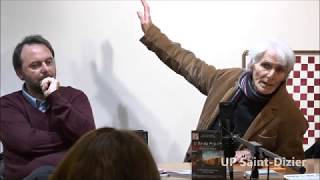 Saint-Dizier Popular University
Education: can the Beautiful be learned?
20 Jul 2018Is beauty a matter of individual taste, or can it be learned through an education that brings us into contact with works of art?