Love
8 videos, newest first.
What Dominique Pagani says
Dominique Pagani approaches love as something both natural and historical. The content of amorous desire comes from nature, but also from a history that places it in the symbolic field. To show this, he draws on Clouscard's Traité de l'amour fou, the myth of Tristan, La Rochefoucauld and Racine's Phèdre1. With Pascal, he asks whether we love someone or only qualities, and he points out that qualities also have a history, as with Swann and Odette2. In Rousseau he sees a new form of couple, carried by the middle strata, which rejects pleasure as a class privilege. Clarens and the festival after work are its image3. The couple in Rimbaud's "Mouvement" allows him to link the erotic to a fault, with Vigny and Hesiod, and to argue that this "ancient" love presupposes millennia of history4. In Proust, he reads love as a victory over death through music5, and then as the search for someone behind the body: in Plato, love is not "platonic"6.
- 1D comme Désir17 Dec 2014
- 2Q comme Qualité31 Dec 2014
- 3W comme Wolmar6 Jan 2015
- 4NOTRE ANCIENNE SAUVAGERIE ? - Lecture à vif d'une illumination d'Arthur Rimbaud13 Jun 2025
- 5SCHUBERT - LES CAPTIVES DIVINES • Pagani Parle Musique3 Aug 2022
- 6De Platon à Proust - Lectures à vifs6 Jul 2026
Introduction produced automatically from the 8 sessions on this theme, to be reviewed; the numbers link to the sessions.
The 8 videos
 Readings on the spot
From Plato to Proust - Readings on the Spot
6 Jul 2026What does amorous desire seek through the body and the gaze: someone or something?
 Readings on the spot
OUR FORMER SAVAGERY? - An impromptu reading of an Illumination by Arthur Rimbaud
13 Jun 2025What does the question "Est-ce ancienne sauvagerie qu'on pardonne ?" mean in Rimbaud's "Mouvement," posed before a young couple in the midst of a hymn to industrial modernity?
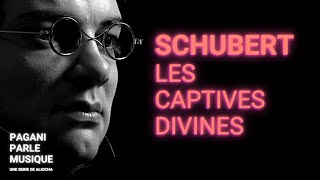 Pagani Parle Musique
SCHUBERT - THE DIVINE CAPTIVES • Pagani Parle Musique
3 Aug 2022How does music enter into time only to leave it, bringing back the past to the point of touching a kind of eternity?
 Season 5.1
#5.0 Presentation of the 2018-19 Workshop Season
15 Oct 2018How can we think revolutionary thought from Rousseau to Lenin without separating the study of praxis from the consideration of the psyche?
 A Philosophical Alphabet
W for Wolmar
6 Jan 2015Who is Wolmar in Julie, or the New Heloise, and thereby who is Julie?
 A Philosophical Alphabet
Q for Quality
31 Dec 2014What does a quality say, and what are we talking about when we qualify a thing?
 A Philosophical Alphabet
I for Island
23 Dec 2014What does the figure of the island mean, from Robinson to the île des Peupliers, where Rousseau's tomb is located at Ermenonville?
 A Philosophical Alphabet
D for Desire
17 Dec 2014What is the place of desire in philosophy and in today's society?