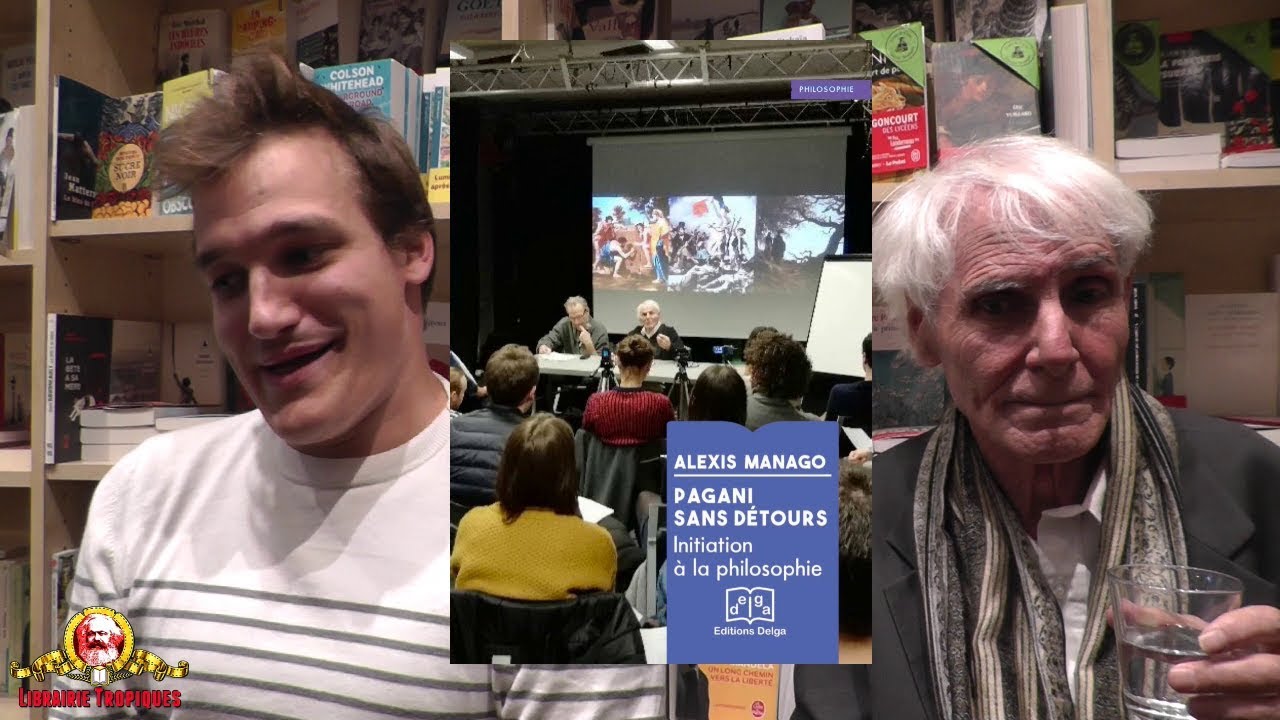
English translation of the French transcript, made with AI and not yet proofread — click a paragraph to jump to it. Show the French original
Seeking a beginning: from axioms to Hegel 1:30 And so it's better to let him speak about that. I'll say a bit about the intention I had with this book and what I tried to do, and what in fact appealed to me about Dominique. So actually I thought about it a little and I said to myself there were two things — first, in fact I have more of an engineering background, so I'm more naturally a mathematician, and as a mathematician, when I started getting interested in philosophy and in politics in general, I was always looking a bit for the first principles of a philosophical system. So, you know, you can find Descartes will tell you that the first principle is the universal self, it's pure consciousness, we start from there, we start from the Stoic — I think therefore I am — we start from there, and then we think about the outside world; the empiricists will tell you that the first principles are the sensible world around you; Spinoza, we start from God, etc. And so, following this philosophical training, I quickly arrived at Hegel, and Hegel tells you that
2:42 in reality, how should I put it, he tells you that truth is the totality, and so whatever point you take within the great system of truth, in any case it will always be something abstract, something insufficient, and so there isn't really a first principle, there's no good starting point — it will always be, it will always be insufficient. But so, as a mathematician, that leaves me a bit unsatisfied — you wanted axioms — yes, that's exactly it, I'm looking for the first axioms. So, well, after that I continued my training, I read a lot, I read Lucien Goldmann in particular, I kept getting interested in Hegel — it's very stimulating and very enriching to see that the methodology for approaching philosophical truth is not the same as the mathematical method. And there, that's where I discover François — that's where I discovered Dominique, in fact thanks to the videos on Hegel that were made here in the garden, that's it — and through the Hegelpals, yes exactly.
3:52 That's right, the Hegelpals, that's how I discovered Dominique, yes, with her, with Reban, that's it — and by the way, ah, François Negroni is here but doesn't dare come up, doesn't dare, too bad, I'll go on. And so, following Dominique's teaching, I find content that I find extremely rigorous and that starts from the beginning — that is, we start from the first question, which is: what is philosophy? And we try to properly delineate philosophy, we try to properly specify it in relation to other modes of thought. I find that's a good way to start, a fine way to begin. And that allowed me to properly set out what philosophical inquiry was, because I find — well, I find that today philosophy is enormously confused with, I don't know, theology or even spirituality. There's also, I'm thinking of Michel Onfray for example, a philosopher who fights, who is somewhat engaged in battles of opinion — you can't really tell
5:02 what the fact that he's a philosopher actually contributes to the matter. And so, from that point of view, I found that the content, at least, of Dominique's teaching brought something very structured, something very rigorous. But the gamble of the book is that, in my opinion, there is added value in making sure this teaching is delivered in a somewhat more linear form — that is, not the spiral form you know from Dominique, which he uses very well orally, but with something structured, one can perfectly well convey the content of Dominique's thought and teaching. So that was one of the gambles of the book, and that's what I tried to do, I'd say — well, what I really thought hard about was the plan of the book. Afterwards, well, it's work, but somewhat more, let's say, brute and mechanical work; but what I really thought about, what I tried to bring, is a very structured plan. And so, I think we arrive at a result that's not too bad. And what else did I like about Dominique — well, I'll talk a bit more, for those who don't know him
6:12 don't stop, yeah, yeah, that's it — what else did I like about Dominique — no, but because, yeah, because the people who are going to hear you speak will immediately see — well, afterwards they'll say what they didn't like, but yeah, yeah, that's it — they might see a pedagogical approach, you have some very beautiful images, but what I'm saying is what someone who had started training himself philosophically found very interesting and innovative. Because often you describe yourself as an African griot, giving the impression that you're just transmitting things, but I don't think so — that is, Dominique Pagani appealed to me in my philosophical training because I found things I didn't find elsewhere. That's what I'm trying to say. So on one hand there's this rigorous content, there's the fact of trying to start from the beginning, and on the other hand there's something — more polemical perhaps, maybe a bit less present in the book — which is denouncing a certain naturalism in the ecologist discourses we hear nowadays. And that's true, it's really been the dominant discourse, really the dominant discourse, I find it's shared across the whole political spectrum. And that appealed to me a lot, I said to myself, this is the first time I've heard this — that is, I hear someone criticizing
Against the naturalism of ecological discourse 7:22 the concept of the consumer society, for example, someone who draws distinctions between nature and matter, who draws distinctions between nature and environment, who defends universalism, humanism — whereas humanism has actually rather been under attack for the past 40-50 years by people like Michel Foucault, or, when it is defended, it's completely debased as a word — that is, it means the opposite of what one hears; it's humanist to bomb Libya. I read a book called Antispéciste by Aymeric Caron, which is actually a very good book, I think, because it's radical, and there's a chapter called 'Antispeciesism is a new humanism' — yes, for those who wouldn't know, antispeciesism is a kind of antiracism directed toward animals, that is, it says that claiming the animal is inferior to man is racism, is speciesism. And so Aymeric Caron doesn't want that, he says no, no, the animal is equal to man — before I interrupt you, but the main cause of death in the world, and always has been, is malaria — yes, exactly, malaria, sorry, I'm speaking from an African milieu — it's someone who didn't spare me
8:33 but I'm well fed, I'm white, I take Nivaquine, so I don't die — but it does wreak havoc, of course, south of the Sahara, transmitted by a mosquito, guaranteed organic as you know, and indeed it would be racist to exterminate that poor mosquito — exactly, that's where we end up — and so there's a chapter, I say that because I'm a mosquito, there's a chapter in this book called 'Antispeciesism is a new humanism' — you see, for Aymeric Caron, being antispeciesist is being humanist. I naively thought humanism meant placing man as a value above God and above nature — for Aymeric Caron it's the opposite, I don't quite understand — and, well, I found that on all these points Dominique allowed for things to be well structured and to denounce — I think you'd agree with me that not everything the ecologists say is completely stupid, there's a whole bunch of things one can certainly share — but to denounce a certain — I don't understand what you just said
9:43 that we're in favor of animal suffering — is that we've completely misread things, I presume you hate animal suffering just as much — yes, yes, it's a bit that critique — denouncing a certain naturalism within certain ecologist discourses, that's more it. And so, yes, those are the two points I wanted to emphasize as an introduction — the two things I find new in Dominique's teaching, and the two things I tried to put into the book that seemed important to me, that I enjoyed developing and that seemed important to develop. And so, is that everything now?
From oral transmission in spirals to linear writing 10:25 Yes, that's everything, that was my eulogy — I thought it would go on longer — no, but there are other things, that's what struck me — that's fine, that's how it is. Before giving the floor to the audience, I'll allow myself to ask the first question, if you don't mind — how did you go about it? That's my essential question, because it's been six years that I've been doing what we call the 'ateliers entre nous' monthly — talks, lectures, call it what you want — I keep repeating to anyone who'll listen that I'm not a structuralist, that's fine, as if — you want, but in any case, regarding transmission, I'll already make a small qualification about what you just said, which is that I'm not being coy when I say I'm not a creative type, I merely transmit — I'm not being coy, it's really, really sincere. So maybe I'm creative in the art of transmitting, fine, but otherwise I see what real creative people are like, and I don't think I'm one of them, because I had the good fortune to receive, and I tried to transmit, at least in part. So, yes, my question is: how did you go about it, because it's not a rhetorical question, I'd really like to know, because I'm astonished to find
11:35 in your book almost the entirety of the essence of my teaching, if I may say so. Because there's — how many pages are there? There are 200 pages, roughly — a few hundred pages — that synthesize six years of monthly lectures, each sanctioned by a video averaging two hours in length. So, of course, I presume he had to eliminate — when I repeat the same thing thirty times — well, I think he did well, he did very well to insist on the difference between the constraints of orality and the constraints of writing, because I think the great problem this book had to overcome — solved, even, in a way that surprises even me positively — is precisely the difference of genres. It's true that the only thing that's mine in this book is the title, which allows me to propose
12:45 'Pagani sans détour' [Pagani without detours], because in my oral teaching all I do is take detours — but that's because, by the third year, there are newcomers, and I can't very well tell them 'you should have caught the train while it was moving, too bad for you, you had to be there at the start' — so I go back a bit. He had to eliminate all these repetitions, which means he must have gone through all those videos — that's enormous, that's why I said, how did you do it, because it's not — it's real work, but still, first question: what gave you the most trouble, as ungrateful work, if I may say so? No, it's true that watching the videos took a long time, but actually, in reality, I focused mainly on the first two years of the teaching — the first two years, because I told myself that made a good outline for telling people, when we talk about the book, about the plan. So the plan is: what is philosophy — first part; second part, philosophy of knowledge; third part, philosophy of values, let's say moral philosophy, where we look at a specific issue, which is modernity. And that, in fact,
13:55 corresponded to the first two years of the workshop, in fact I concentrated on that. Those videos I listened to four or five times, and afterward, well, the other videos I did listen to as well, I listen to them often, but that was more about filling in gaps, because to arrive at something structured and coherent, gaps had to be filled, things had to be linked — and that's also why it's clearer — so, did we cover everything, did we even — well, let me pick this up, that's well observed, it's important to clarify for readers the genesis, the gestation of this work. Indeed there is a break in the book between the more linear part, if I may say so, which comes after the introduction, where — as you say — we dwell on what the specificity of this discipline is — I don't say a science, I weigh my words, it's not the opinion of the corner café either, it's neither one nor the other, it's a discipline, philosophy — what is its specificity
Specifying the philosophical field 15:05 in relation, of course, to the discourses with which it could be confused. Nobody's going to ask you the difference between philosophy and soil mechanics — that's just to recall, sorry, that's my teacher side, excuse me, I always find a way to fit something in — but it's to recall that when one looks for, when one establishes, specificities, it's implicitly between things that can be confused, not between a hazelnut and a book, you see, we're not going to bother looking for the difference — but between an African elephant and an Asian elephant, for instance — I show this very well in the work — you don't know the difference between an African elephant and an Asian elephant? You know — yes, it's not obvious — the Asian elephant is domestic, the African elephant is wild — you astonish me, I can die in peace — yes, the head has two humps, the ears are smaller — well, once you know — that's my archaeo-colonial side, it's a friend who told me that, my archaeo-colonial side that gets interested in animals apparently, it's my Kipling-of-the-Empire side, well — so philosophy, one can confuse it with the poles that frame it, but you see
16:15 there's religion on one side, there's science on the other — I mean, those are opposite poles — but you see, there's also literature and poetry. So how do you assign it its own domain? Look, I'll dwell a bit on this aspect because I find this beginning of the specification of the properly philosophical field particularly well done — look at someone like Durkheim, in what we've seen — I don't know what you think, Victor — for me it's his best work — The Rules of Sociological Method, it's a great first, especially the first quantified study, well anyway in The Rules of Sociological Method, I mean it's more condensed, few pages. In it he spends a huge amount of time saying: good grief, for sociology to exist it needs to carve out a place for itself; to carve out a place, one has to realize the place is already taken by other disciplines — so I'll take two extremes, like biology on one side, which would explain everything — very topical, cognitive sciences, you see, neurosciences — between biology on one side and history on the other, say, to take another extreme —
17:25 sociology needs to push both of them aside in order to establish itself, to find a proper object — that's what keeps coming back — and indeed a science is only truly and seriously a science once it has a proper object. The set of animals gives zoology its proper object, the set of plants gives botany its own. I advise — there are quite a few philosophy teachers starting to teach, aren't there — and I advise them, for the first essays, to give this topic: 'Plants are the object of botany' — the subject, like that — 'animals are the object of zoology,' etc. Two or three like that, and then: what is the object of mathematics? That's a good start, especially with seniors like that — the science-track seniors who say 'don't bother us, the philosophy teacher, we've got a coefficient' or something — harder: what is the object of ecology? That one's mean right away — well, we won't go that far. So, finding the specificity, that's it — it's, on the one hand, finding an object that is properly its own — well, there it's not a discipline, but strictly speaking if it's a science, which is not the case with philosophy —
Empiricism, rationalism, determinism 18:35 to formulate the laws that determine that object — well, that's it. So, this is very good, and after this introduction, I refer you — I think it's good that it apparently took time to answer this question of the specificity of the philosophical field — then begin the different positions of philosophy. I'm telling you the plan of the book, it makes reading a bit easier — and by the way the plan is very well announced, very clearly, not only in the table of contents but in the introduction. The first point of view is everyone's first point of view — it's what you had as a kid — what's true, what's the criterion — it's what I see, what I touch, in short it's sense certainty, to speak like Hegel, the immediate world — well, Descartes too, he starts there, Spinoza too — Spinoza calls it knowledge of the first kind. You know, people make you believe that philosophers fight, argue with each other — Kant insists a bit too much on that — science, everyone agrees, whereas philosophy is the queen of battlefields — well still, I mean, I note for example that all philosophers from Plato until now have a tripartite division of philosophy
19:45 which always starts with the sensible — the bottom of the cave — then afterward dianoia, you know, mathematics, discursive knowledge, and then beyond that — well, this starts to get a bit complicated — intuition, Spinoza, knowledge of the third kind, reason in Kant, which comes to synthesize sensibility and understanding — you see, so there is indeed a common corpus. Alexis spoke earlier about, compared to my oral teaching, a greater linearity in its written form, and this is the part where that's most visible, this progression. We start with empiricism — and since it's a dialectical progression, I presume he won't contradict me — the antithesis is of course rationalism. Empiricism starts with facts — what he calls facts — with things, if you prefer — let's talk about Foucault, just to please you — yes, I'm delighted — with things, whereas rationalism starts with words — the mathematician starts with statements — it's exactly the opposite, isn't it
20:55 with ratios, with logoi, as one would say in Greek, that is, statements — you have to say something first, afterward we'll see whether it contradicts or not — but I mean, you still have to say something, because in order to know whether there's a contradiction, when there's been no statement to begin with — that doesn't speak, does it — the bottle doesn't either — animals, let's leave them aside or we'll start quarreling — but anyway, it communicates but it doesn't speak, take bees, dolphins — it doesn't speak, they never say the sun rises, they don't make metaphors, animals — they're paid, they only deal with food, that's how it is, they communicate like that to say where the food is, fine — that's not language, metaphor is — that's not our subject, I'll move on. So you see: empiricism, we move past the antithesis, rationalism — with empiricism we have the real, but we can't say anything true about it, to sum up the great progression of all philosophies — we can't say anything true about it because as soon as we say something about it
22:05 it's already false — you know, the Greeks were good at that: we say Socrates is young, by the time we've said it he's already older, it's already false — they liked that, the Greeks. With rationalism, it's the other way around: we finally have a truth — if A equals B, B equals A, perfect, now we're happy, we're sure that will hold always, everywhere, on Monday, on Tuesday, in Montauban, in Phnom Penh — but we no longer know if we're talking about the real. There we had reality without truth, now we have truth without reality — that's a problem — either we have things, or we have words — things about which we can say nothing certain, and words about which we never know what they're talking about. A great mathematician, one of the greatest of that century — I meant the twentieth century — Bertrand Russell, you know, one of those at the origin of set theory, said that mathematics is a discourse in which one never knows what one is talking about, nor whether what one says is true — and for those who might misread this, let me say right away it's an immense tribute to mathematics. So we're at an impasse — well, no! Third moment: determinism, that's right, that's the progression, determinism, where
23:15 we manage to draw a parallel, as Spinoza would say, between the chain of reasons in rationalism — the chain, say, of theorems in a mathematics textbook, for example, starting from first notions with, as a principle, the principle of identity or non-contradiction — and the chain of facts in physical reality, for example — there would be a parallel, that is, there would be as much rigor in the chaining of facts, cause and effect, as in the theoretical link between a primitive proposition and a derived one. And well, there — the program is finished, that's why I insist, the book could have ended there, if you like. And well, no — bang — the book begins — yes, indeed, in philosophy, if you like, the philosophical part of the book begins, because with determinism we've won everything, in fact — we've arrived at Newton, roughly, historically, one little phrase like that: bodies attract each other in proportion to their mass and inversely to the square of their distance — that's right, guys — I have scientists here and I'm wary, I watch my step — man, this little earthworm
The crisis of determinism and the two meanings of "must" 24:25 come out of nothingness, man manages to account for every motion in the universe, with a few relativistic exceptions at certain speeds — it's extraordinary. Except, well, if we stop at determinism, philosophy might as well shut up shop — and here he brings out very well the crisis, the first crisis that begins there — why? Because if everything is determined, what's the use of asking myself the question 'what ought I to do?' I couldn't do it anyway, since I would be determined to do this, I wouldn't have the choice to do otherwise, you see. That's why Kant, still, has this merit, is right to say that freedom is a postulate of practical reason. And I find that Alexis brings this out very well, because he doesn't say it abstractly like I just did with this Kantian statement — he quotes this phrase from Kant at the end, after having made the problem well understood that this occupied him with — because if the question were only 'what can I know' and not 'what ought I to do,' philosophy would belong at the CNRS — mathematics, astronomy seek to know, botany too, what do you want me to say, that's not specific to philosophy, you see — it's better to have started there — what is proper to philosophy?
25:34 it's the question 'what ought I to do' — the one he called earlier, how did you put it, values, action, morality — call it whatever you want, in the past we said philosophy of knowledge, philosophy of action, why not, in Kant it's theoretical philosophy, practical philosophy — that would be the leap, when Marx says philosophers have only interpreted the world, we want to change it — we find that same dichotomy again, you see, it's quite fruitful. Except, what is specifically philosophical is to pose the question 'what ought I to do' in such a way that the answer comes in the mode of knowledge and not of opinion — that's the whole difficulty. So we didn't waste time with the question 'what can I know' — we need to take a detour through the sciences first, it wasn't time wasted — that's why Plato had inscribed at the entrance to his school that none may enter here who is not a geometer — that doesn't mean we're going to do geometry, we're going to do philosophy, but it's a prerequisite, because one must first see how to overcome the little smart aleck at the corner café, who thinks there's no criterion of beauty anyway, as many notions of beauty as there are guys, as many opinions, you see, relativism, capitalism
26:44 well, I made a slip there, sorry — it's the same thing — everyone in their own bubble, each isolated producer, you know, Robinson-crusoe-type fictions as Marx called them, ignoring the neighbor, each trying to sell his own wares. And then there are the sophists — that's it — I can teach you, if you pay me well, I can teach you how to persuade a crowd of any statement whatsoever as being true — I mean, we don't care whether it's true or false, that's between us. That's the shady lawyer, the crooked lawyer, we say in French — I don't mean literally crooked — the one who will say anything to get his client acquitted; after all, he's paid for that, even if his client is guilty, we don't care about the truth. Well, no — the philosopher wants to answer the question — let me sum up — 'what ought I to do' with knowledge, and so, since it's the question 'what ought I to do' that is fundamental, pay close attention, because he didn't miss it — I won't go back over it, but perhaps I underestimated — but the fact that he concentrated his discussion on this passage, which I ask you to pay close attention to, at the point called
27:54 'Reason,' in the chapter — I think that's it — just before moving on to the analysis of language, in the Socratic question, at a certain point he takes up Kant's question 'what ought I to do,' which I just said is proper to philosophy — sorry to repeat myself — we answer it in the mode of knowledge, but what does he analyze in it? The verb 'ought.' It's not just 'what can I' or 'what ought I to do' that's laborious, as with Kant, you see — still, that clears things up — 'what can I know,' 'what ought I to do' — there are two verbs that differentiate these two questions, not just one — it's not merely knowledge, knowing, and doing, action — 'what can I' and 'what ought I.' So why — why am I splitting hairs here — because when you say 'I must eat to live' and when you say 'I must stop at the red light,' you'll agree that's not at all the same kind of 'must,' you see that clearly — no need for a philosophy teacher for that — yes, to point it out, because in everyday language it's conflated, it's the same word, and there we're trapped — we need a Socrates who says no, capture — capture the difference, you see — the big difference is that
29:04 'I must eat to live' is a misuse of 'must' — I act as if I set myself the duty to eat in order to live, as if it depended on me — I have no choice, I cannot live without eating, that's it, I'm a living being, so I should honestly say 'I can't live without eating,' it's not a matter of duty. Whereas the red light, I can run it — especially in France at two in the morning, excuse me — one shouldn't do it, but there, there's no rebellious cop around — it's when there's a choice, you see — I'm coming back to freedom, no, I seem to be rambling like this — it's when there's the choice to do the opposite — I can run the light — that suddenly the problem of 'what ought I to do' arises — that's very good to recall in the work — and I say this because some may be disoriented by the progression of the book at a certain point — you agree, because it follows on — the fault is mine — there's a linear progression during my first two years, he repeated that well earlier, and suddenly we move to: what is our modernity? What do we call our modernity, we moderns, what does that mean? You agree that there's a
The hiatus of modernity; determination and liberation 30:14 that must have posed problems, I ask you again — yes, that is to say, in fact, yes, so that's, that's the crux between the second and third parts — that is, indeed, in the first two parts there's something rather linear, indeed the issue that's a bit — yes — modernity isn't brought in necessarily, but the conclusion of the second part is to say: ultimately, in order to ask the question of what one ought to do, one shouldn't — first of all it's no use posing it just like that in one's head, 'what am I going to do, what will I do later' — we're going to first try to look at what has already been done throughout human history. So there, indeed, there is something a bit contingent, but we start the third part by saying: among all the things humans have done throughout human history, we're going to try to analyze something particular, namely the texts that were written at the beginning of modernity, that is, the 19th century, right after the French Revolution and the English Industrial Revolution — in that period. And so, indeed, this third part isn't brought in necessarily, it isn't exhaustive, let's say, it doesn't claim to be exhaustive, but it analyzes a particular case, which is modernity, which is still quite interesting I find, since we're in it, that's not
31:24 I stopped myself, Alexis, because this hiatus will be felt, I think, everywhere — yes, Dominique, sorry, just a word, you know my objections, I feel it coming out, a dirty trick, I can feel it in your look — couldn't we, using exactly the same reasoning, the same progression, completely invert the proposition and say philosophy is 'what can I do' and 'what ought I to know in order to do it'? It's possible, but it can't at all follow the same logic, it seems to me — oh, no, no, because when I analyze the difference between the two senses of 'ought,' I clearly see that one of them is misused — we don't often reflect on the fact that freedom is implied in the second sense, which is the only correct one — that's all that needs recalling here, that it's a postulate of practical reason in Kantian terms, that is, again, I mean, if everything is — I'm not deciding, that's what needs to be seen — I don't have the answer, well, it's not — it's not a personal game — I believe the philosopher perhaps doesn't have, no doubt doesn't have, the answer — philosophy doesn't have the answer as to whether we're determined or not. Marx said it's not in the answers
32:35 that there are mystifications, but in the way of posing the questions — I'm not sure this isn't itself a mystifying and mystified question, or rather I'm convinced there is mystification in this kind of question — are we determined or are we free? I think we can only speak of freedom — which Sartre analyzes rather well, I can say something good about Sartre from time to time — when he says that we are determined but that we can set in motion a process of liberation starting from the determinations and situations — to use a Sartrean term — in which we are implicated, for example. You see, with liberation, the concept of liberation is already a synthesis of determination and freedom — hence the very fine title of Sartre's The Roads to Freedom — if there's a road, it's because at the start we're not so free as all that. So, setting this parenthesis aside, I come back to the concept of modernity that apparently introduces a hiatus in the work — I'll concentrate on this main difficulty of the work. Alexis has just alluded to the
The Greeks, the sphinx, and humanism 33:46 empirical aspect, without any pejorative connotation, of this modernity — he said, between the English Industrial Revolution, the French political revolution — yes, both happen within a stone's throw of each other at the end of the 18th century — so that's it, but I think we need to get used to considering it in logical terms, not merely chronological ones. When Hegel says modernity begins with Christianity, for example, in relation to antiquity, in relation to the Greek world, that is, with the demand for infinity, as opposed to the right angle of the Parthenon — the Greeks hated infinitude, indeterminacy, didn't they, they liked things to be well defined
34:34 they preferred the peras to the apeiron, if you know a bit about the pre-Socratics — it's not to show off that I use Greek words, I'm not Heidegger — it's because you find peras in 'périphérique' [ring road], in 'périmètre' [perimeter], which is an outline — well, there: this side, I'm in Paris; beyond, on the other side, I'm in the suburbs — that's how it is, clear and neat, that's Greek, isn't it. And then there's the apeiron, that which has no outline — that, the Greeks didn't like — well, rather intelligent people. It's said that the Greeks 'escape' — it's the opposite of ecology — the Greeks escape from nature into the city, into the human community — that's why the notion of humanism is always somehow linked to the Greek world. Careful, don't make me say what I haven't said — racist — there were good men well before the Greeks, and I would say Greece would not amount to much — it's not Heidegger's Greece I'm talking about — it's not a radical break from the Orient, is it, from all those myths — no, no, on the contrary, I'm placing Greece back in its context. There would never have been Greece, there would never have been Astarte — yes, who's that — it's Venus, no less — yes, it's
35:44 another name for Venus, there would never have been Aphrodite, it's the same thing — all that, without Astarte, which is Ishtar, a Babylonian goddess — but yes, that's right — and then the flood mentioned in the myth of Deucalion, of Thebes, that's the flood of Gilgamesh — right, exactly — don't make me say what wasn't said, but what is specific to the Greek world, where they insist the most, how it appears — is that man, man arises precisely when nature recedes. There are still gods with animal heads among the Egyptians, aren't there — Anubis with a jackal's head, magnificent, Horus with a falcon's head, etc. — and then there's the reverse, there are animals with human heads, the Sphinx — yes — and the Greeks, the statue, there's nothing animal left, you see — so there's a link between humanism and the Greek world
36:54 because Hegel saw it, and he says that Oedipus's answer to the Sphinx — you know that before the catastrophes befall him, Oedipus is all of us — Oedipus, according to Freud — so I still have to listen a bit — it's each one of us, each of us — Oedipus cannot enter Thebes, can he, where his destiny is going to play out, because the Sphinx guards the entrance to Thebes and devours all those who fail to solve the riddles it poses — a sphinx is someone who poses riddles, isn't it — and it had asked — don't you remember the question to Oedipus — 'what walks on four legs in the morning' — I can die in peace, yes — what is the animal that walks on four legs in the morning, on two legs at noon, on three legs in the evening — and Oedipus answers, it's man — that's really bad news for the Sphinx, because up until then no one had answered its questions, so it devoured the questioner — but there, when someone answers its question, it's the Sphinx that gets killed, just like that. So there, the answer is man, because the baby crawls on four legs, then the mature man walks on his two feet, and then when he's old, well, I don't know, that will happen to me soon, I'll walk on three legs, or I'll lean on Alexis, like Oedipus
38:05 leans on his daughter Ismene throughout Oedipus at Colonus — it's not only a magnificent work, and so, you see, we look at everything through Antigone's eyes, since he has gouged out his own eyes — there, the answer is man. And Hegel said, there's a symptom there — the answer to all the riddles that Antiquity posed to itself, for Egypt is the world, is the world of the riddle — it's magnificent what he says about Egypt: there is nothing more mysterious that confronts us with such strangeness as Egyptian art — but precisely the answer to the riddle is man. So there, I come back to it: when Hegel says modernity is Christianity, but that begins vaguely at the time of what are called the Gospels — going quickly — which were written a century after what is supposed to be the life of Christ — but Hegel says it takes 2000 years of patience for the storming of the Bastille to start bringing Christianity into reality. And well, yes, but yes, the fact that we no longer have to abase ourselves before God
From Christianity to the double revolution of the late eighteenth century 39:15 isn't it, and that the creature only abases itself before the creator, never before another creature — that's the emancipation of humanity. And that, Christianity puts an end to slavery, which was the pillar, in Marxist terms, as a productive force of antiquity — you see, there's a logic to all this. So when we talk about modernity, we have to see it as I just did, in logical terms — it can begin, I don't know, if you like, in the Middle Ages, and Clouscard worked a great deal on this question — Clouscard died without being able to complete one of his dreams, which was to do his study on the feudal world, which he condensed in a very fine publication, Traité de l'amour fou [Treatise on Mad Love], which was a commentary on the myth of Tristan and Iseult, for example — but this only really enters into the facts starting from the period Alexis marked out when he says our modernity, ours, we who live in a city, in the industrial world — it begins between the English Industrial Revolution and the French political revolution, these two great fractures, as happens every 15 or 20 centuries
40:26 and which defines our modernity. So there, why do I try to lift the hiatus that may appear in the book as a reflection of the hiatus in my teaching — how I moved from the empirical linearity — empiricism, rationalism, determinism, freedom — and then, bang, we move on to modernity — because this modern world had to happen. End of the 18th century, that's the age of Mozart, of Don Giovanni, of The Magic Flute — that's no accident, you know, of Beethoven's Ninth — it's a kind of hymn to the emancipation of humanity freeing itself, that's quite something, you see — Beethoven was born in 1770, Hegel was born in 1770, Hölderlin was born in 1770, and my fellow countryman Napoleon in 1769 — yes — no, none of that is accidental, it's all within a stone's throw of each other. Why do I mention Napoleon?
The cunning of reason and the meaning of history 41:16 To illustrate the concept, since it's in the chapter 'Reason,' at this turning point that Hegel calls the cunning of reason — a concept that may seem enigmatic — afterward I'll hand over the floor, but I wanted to finish my remarks on this concept. The cunning of reason in Hegel is the fact that — it's a way of recalling, against all those who take Hegel for an idealist where reason is all-powerful and simply accomplishes itself in history, quite the contrary — yes, reason is truth in Hegel, but truth is weak, because, as we saw earlier, it lacks reality. It's true that man ought to be free, but that's not actual — look around you at the world. So, truth having no reality, it needs something that already exists — that's where materialism comes in — needs something that already exists in order to make its way through. So there's a small ambitious and rapacious Corsican, Napoleon, at just the right moment, and reason is going to use him — who's there to create the modern state
42:27 look at our legislation, not only French but European, the importance of the Civil Code, everything that was created at that time, the grandes écoles, I don't know — the simple fact that a soldier of the Grande Armée had what's called a marshal's baton in his knapsack, meaning that from the Grande Armée on, any private could hope to become a general — hence Hugo's beautiful verses, isn't it, 'those generals who were twenty-four years old,' and your laughter at Kléber, you see it in Les Châtiments — that was unthinkable before, one had to be born a noble to be an officer, even if incapable of leading the smallest battle — there's even a snowball battle, laugh if you like — Napoleon's first great victory is a strategy to win a snowball fight at the school of Brienne, when he was 15 — I never speak at random, I have my paranoid side. So, it's important to see that: the cunning of reason uses someone who is there, who has particular goals to fulfill, using reality in its crudeness, what's called the prose of history, the prose of the world
43:38 to make reason advance by one step, and once that's done, Napoleon — he's taken and dumped on Saint Helena, finished, next. Yes, so it's in that sense that one must understand here what modernity means. I'm going to say this to settle a debate, and I'll end on this — that the great debates of the structuralist era, which we knew well, of anti-totalitarian thought — watch out, I'm a radical master, I myself am anti-totalitarian — I've never understood why there was such hatred of totality in politics, because when we say 'we're all here at the table,' that means no one is missing, doesn't it?
44:24 It seems to me — no? So if we're all in power, if the totality holds power, that's the most democratic regime possible — I've never understood why that suddenly became pejorative. So I put it to you, it's a very simple point that's never made: if totality holds power, that would be good news. I've never seen that — I've seen a race presuming to be the chosen race and speaking in the name of humanity while liquidating others — that, yes, that happens; a single party can happen too, can't it, a single line of thought, a single currency, a single Brussels — but I've never seen the totality in power, that would be known — that would mean you, him, everyone, we're all in power — well, Grégory, we've really pulled it off then, haven't we? So, you see, anti-totalitarian thought — I seem to be laughing about it, but it's because it's a curious story — and I'll finish on this notion, immanent to anti-totalitarian thought — at the time, people used to say history has no meaning, giving history a meaning is already totalitarian, that's saying you're heading toward a single thing
45:35 yes, you've heard that back then — oh, do you agree — no, I say that because there are young people sometimes who — you, they believe — and that has been replaced by the duty of memory — yes, yes, that's right, yes — that's not at all giving a meaning — yes, yes, that's just — it's incomprehensible — it's the duty of memory, that's it, that's the moment when, instead of giving tools of memory, we say the duty of memory — yes, exactly. Now, look closely, I'm speaking about freedom and its progression through history — that's it, my son — when Hegel says the Orientals knew that only one was free — he's talking about historical Orientals, I've said a thousand times that there are nuclear engineers in Iraq who are far more modern than I am, I'm not talking about geographical Orientals, I'm talking about the Emperor of China, or the King of Kings in Persia, or whatever you like — so the Orientals knew that only one is free; the Greeks knew — he says knew, imperfect tense, 'surent,' past historic — the Greek miracle knew that a few are free — 20% citizens, 80% slaves roughly in Athens — knew, but it's progress — there are women, because among, sorry, and among the remaining 80%
46:46 there are women too, so right away you can see you're not Corsican since you're contradicting me, well of course I wanted to finish and hand the floor to the audience, but still I should point out that in Plato's Symposium, which is not exactly a marginal text — I'm not doing conspiracy theory, I'm not pulling out a blurry photo from some obscure file — in Plato's Symposium there's a progression, the beautiful, each speaker gives his theory of love, we're agreed on that, the doctor's speech is cute, fine, and then afterward there's Socrates who's going to give, you'd think, the last word — well no, what does Socrates do? He says, I'm obliged to tell you what the stranger from Mantinea told me — it's a woman who gets the last word, there, let me give credit where it's due — you're speaking well, there — the stranger's name is Diotima, isn't it, whom Hölderlin will of course draw on. So when Hegel says the Orientals knew that one alone is free, the Greeks knew that some are free, the moderns, in the sense I meant earlier, know that all are free
47:56 in potentiality, you understand — he gives history a meaning, and that meaning is freedom. If you're now going to tell me that this is totalitarian freedom, I'll leave you with the anti-totalitarians, I've got nothing more to say to you. There, I'll hand over the floor. Just one more thing though — you've understood that all this is an immense thanks to Alexis's work on my part, let's applaud him. So, question — I finished the book last weekend — it's true the title is excellent, for instance it's striking how in one weekend I relived hours and hours of viewing, we find all those little things again, it's quite pleasant. Now I'm going to play devil's advocate: the book starts with the philosophy of knowledge, then in modernity there's a good chunk on Hegel, the book ends with the notion
Class struggle, freedom and equality 49:06 of the unconscious, Clouscard's unconscious, and the conclusion answers the question 'what must I do' by saying we must go, taking what is already there, toward more freedom. Now I'm going to apply the concept of the unconscious of the unconscious to the book itself: there's no chapter on class struggle, and the conclusion 'more freedom' abstracts away from the necessary negation in the process of liberation, which is properly class struggle. So my question is: when's volume 2, to talk about class struggle?
49:37 In my opinion he's a Marxist — I'll complete the question, even though I haven't read the book, but I know Dominique's corpus well — so what about the relationship between equality and freedom, because that's another form of... it's true Bourgeois has left, I would have liked him to hear the answer — yes, yes, exactly, but he'll be back, as you know, Bernard Bourgeois was here this afternoon, we talked at length, in passing — I'll cut that out, but a small aside — we confirmed the principle of his popular education lecture, a severe critique of the Frankfurt School. So, equality, freedom — which is another way of asking the same question as Léo, I think — I'll pick up again what I just said, thanks essentially to your question, the truth...
50:30 sorry — to affirm freedom is first to affirm truth. In what I just said, the truth of human society must be freedom. So we start with equal freedom — that's the sequence, it's not by chance, of the triad, agreed? Now if I tell you I give you freedom as a principle, but the implementation of the principle — you can always count on that, right, or else I make you believe that freedom is that of liberalism. You know, it's the fig leaf — a phrase Alexis picks up right at the right moment in the book — the fig leaf that hides, so to speak, the shameful parts of capitalism. Oh yes, that does sound nice, liberalism. I worked for the Hachette group, not to hide anything from you, I worked on school textbooks — you know, Hachette is called the octopus in the publishing world, capitalism without a conscience. I did well to work for them because I saw the other side, the hell behind the scenes, and I learned things you don't always learn in your work as a teacher. And when I said the word 'capitalism,' the executives would tell me, 'we don't like that word here.'
51:40 At least it was frank. So, I affirm freedom, but look at school — I'll take the case of one who arrives, a survivor of the Mediterranean, a child of immigrants who escaped the sharks, the drownings, whatever you like, on his father's third crossing — because we never talk about that — some cross, get turned back, get sent home and come back for the umpteenth time, at the border for years, as you know I taught quite a bit south of the Sahara. That's also a question I ask ecologists: how is it that in these countries, where there's no industry, people want to stay there? Curious, isn't it? Well, if you want the answer, it's not so curious — go spend a dry season in Mali, you'll understand very quickly — 'shame on him who thinks ill of Mali,' as a Malian told me with great humor. So if at school this kid who arrives, who doesn't speak French, who by outside chance might come across a volunteer who gives evening classes like that, to teach literacy to adults, immigrants, etc.
52:54 he's not on the same footing as the one who has dad's books at home, for whom a private tutor will be paid if he has any difficulty. To know all that — what does it mean? It means, I'm answering your question — if we don't link freedom and equality, freedom remains what Hegel calls an in-itself. The in-itself is the most important thing, isn't it? Sure, if there were no acorn there would never be an oak, everything starts from the acorn — but go take a nap in the shade of an acorn, that's not serious. The truth has to enter reality — that's equality. So all those who separate the two are hypocrites, are enemies. Freedom is a middle term — but of course it's a middle term, it's THE middle term, and as a middle term it becomes a bit abstract — no, it's precisely the middle term, it's the decisive moment of dialectical philosophy, people often think the opposite. It's not 'my thought is sublime, I'll use crude language to communicate it to you, but it will never live up to what I wanted to tell you because words are a bit crude, but not like my ideas' — we've all thought that at some point — 'I'll arrive tomorrow at 7:15 by the train from...' you see, I'm using the telegram as a means — the middle is what's in the middle
54:05 but no, it's language that determines me — actually you see, I think it's me using it, and it's it using us — for millennia, that's not... there, no need to be... you see, that's Freud, and you see right away that at the root of our unconscious there are statements that aren't conscious but that determine our consciousness, you see, for example. There, I've answered your question a bit, but I never doubted you had the answer — moreover we have somewhat the same answer. So as for the fact that apparently this question, if I understood correctly — because once I didn't check — isn't explicitly addressed — will you answer or not?
The philosopher's scruple before writing 54:46 yes, yes, well, I'm not the one answering these questions now, it's him, of course, to Léo, to Léo, right — so actually, well, quite simply, my answer is that the book had to be finished, and well, Dominique in his workshops never finishes, actually, one workshop follows another, so — it's my Penelope side, that's it — and so the conclusion is actually really unpublished material, something I hadn't found in the videos, something that at one point I asked Dominique — I told him, indeed, as always you talk about the question 'what must I do' but you never actually get there because each time there are intermediaries to get there, so there's the intermediary of 'what can I know,' which is important, that's the philosophy-of-knowledge part, and there's a new intermediary which is exploring the problem of 'what must I do' but in terms of looking outward at what men have already done — but so we never arrive at a question that matters most to us, which is 'what do I do, me, now, here' — and so I asked him the question just as I've just asked it, and I only had the conclusion to do it, so indeed that's when — it's in the conclusion that indeed I think there's... I talk a bit about Marx, a bit about Lenin, and I say... I say well, the political question is paramount, that's it
55:56 yes, well, that's it, but look, I had roughly 5 pages to speak, I'm not going to give you all of class struggle — the question is very good, the question is perfectly justified — yes, yes, absolutely — the answer proves just how good a question it is — yes, absolutely — he gave a technical answer, I'll add an answer — this happens rarely to me — a moral one, I won't play the Corsican anymore — out of scruple, as a philosopher I can't act as if I had the last word. Class struggle is an answer — yes, I agree — Marxism presupposes 'the poverty of philosophy' — yes, that would have been limiting — to borrow a famous title of Marx's, which I'm not contradicting, agreed — but I don't have the right, toward those I'm passing this on to, to act as though I had the answer. So it's a scruple — that's what... it's a scruple that means I don't write — well, and in passing, I'm giving myself the nice role here because I also have pathologies, otherwise I'd write — but I mean, because there are some who say, 'yes, it's like Socrates,' that's kind, but really... well...
56:52 it's a good cover — it's above all a weakness, but there is partly that reason: writing commits you much more than speech does. Here I'm talking, seducing you, playing the clever one — it's like we do in class with students, I used to say, excuse the expression, you have to be a bit of a whore with a class, otherwise you don't get through — well yes, they're... they're tough kids, careful now — no, but they're very disciplined — yes, yes, no but you write on the board and bam, the bull — I was comparing the class to a bull earlier, it's a bullfight, you pull the horns into your back while you're writing on the board there — no but I love teaching, it's one of the finest professions, but still, you have to...
57:30 you mustn't be entirely Socratic, you have to be a bit sophistic too — and here's another example, not from the Greeks but from the Bible — Athens and Jerusalem, it's Moses and Aaron, you see, that's an interesting pair — some of you may know, I'm sure Camille knows, good evening Camille — it's an opera by whom? Schoenberg — it seemed unmissable, no? Yes, Schoenberg, yes, yes — the Jew Schoenberg made a masterpiece, a superb opera called Moses and Aaron — what's the pitch, as they say now?
58:05 it's quickly summarized, otherwise I wouldn't talk about it — but yes, it's that Moses is the one who sees God, he's the absolute, he has the truth but doesn't know how to speak it to men — you know, as soon as he comes back down toward the golden calf, they don't listen to him, they say, oh, damn, your eternal-one business — for us it's about money, right? No joke — he's in reality — and Aaron is his older brother who says, but you don't know how to talk to them, let me handle it, what? I promise I won't betray the cause, but let me, I know how to talk to them — we'll talk to the ladies, we'll talk to the guys, right, if it's to women — well, you don't catch flies with vinegar, you see?
58:43 So that's it — I have a scruple when I write that I don't have when I speak — the pen is made of lead because then it will remain, it will be transmitted, and I won't be there to justify, to defend — it's serious, what I say — spoken words fly away, written ones remain — though thanks to — I'm speaking to those who kindly follow my workshops, and to people like Alexis, which is wonderful — now, with the internet, I can speak and it leaves traces, it's not like before, before it left nothing. There, now everything will be held against me, won't it?
59:17 with wiretaps, the NSA etc., and the GAFA companies — well, there, I think I'm answering your question — you see, he gave a technical answer, I want to give a moral one — I don't feel I have the right to assert myself — I said during the workshop, I think you were there, I'm not sure, because a lot of people work, they can't be at every workshop — I had said that if I had to make a choice among all the discourses that serve as references, it's Marxism that seems to me the most comprehensive, that is, the one that comprehends all the others, the reverse not being true, agreed?
59:52 by adhering to Marxist discourse, that's where I lose the least — I find all of Plato, Aristotle, Kant, Descartes again — I find that in Marx plus something that isn't in all that. There, am I clear? But I don't feel I have the right to take it as a starting point, agreed? And so I can't say at the end, 'be Marxist, otherwise you've understood nothing of my book,' because once again I'd die with a doubt about it — and all the better, you see? That's my destiny as a philosopher, I've tried to give an honest answer, maybe not a satisfying one — over to you then — so, other questions — you're all so moved, intimidated, I thought there'd be a flood of questions, no? Really not — go on, the third thing in Kant is 'what am I permitted to hope for?'
Kant, hope, and the logic of the subject 1:00:41 Patrick Lasalle: 'what am I permitted to hope for' — is that it? Yes — and what is it? I never talk about it — ah, well precisely, that's a very interesting non-said — no, it's not a non-said — is it the 'what must I do'? Funny, it's the first question I told you — I told you it's a — well I'll say, pedagogically it's less important because once one has well grasped the problems of the first one, I'll answer you — I've made myself young again there — no but it is important, certainly — no other questions?
1:01:12 I'm very sure-where-from — but sorry, before I give you the floor — it's a bit frustrating, the answer — yes, we can feel that — yes, but I'll flatter — there's a little issue there — no but I don't care, because Kant is one of our great points of discourse — I'll flatter his anti-Kantian side, well anyway — when Kant says one of his most famous phrases, 'I have found it necessary to deny knowledge in order to make room for faith' — you know that the thing-in-itself is unknowable in Kant, so knowledge cannot know everything, that's the end of philosophical dogmatism — Descartes, Spinoza and Leibniz are dogmatists, not in the ordinary sense, that would be an insult — no, in the sense that each of them, regarding knowledge, has a principle and a method with no assignable limit. When Descartes says: 'those long chains of reasoning, all simple and easy, which geometers customarily use to reach their most difficult demonstrations, gave me occasion to imagine that all things which can fall within human knowledge follow one another in the same way'
1:02:22 it's extraordinary, there's no assignable limit — if you look closely, if my staircase step, if there's no gap in the staircase, in the ladder, there's no limit — it's magnificent, it's heroic. Kant somewhat ruined that side of things, because that's exactly what cognitive science tries to do, believing that what worked in mathematics, in physics, in chemistry, in biology, will also work for relations between men, and worse still between men and women, or between women — to reach the vile — no, no, I'm joking. Now Aristotle said a capital sentence about this: he said mathematics unites men, politics divides them — you see, already they're not the same rules. I'm dwelling on this a bit to answer the question because I'm anticipating what will be the subject of my talks for the coming year, which begins on the 11th of October next, with the first workshop of the new term, isn't that so?
1:03:15 and which I've called 'the logic of the subject' — sounds a bit abstract, what can you do. Our contemporary culture — and here I get more topical — and like any philosophy that tries to cauterize a wound of the present historical moment, otherwise it's not worth a minute's trouble — well, our present, the wound of our present historical moment, in the ideological domain, I mean, makes us torn between two seemingly antithetical things: an invasive neo-positivism, which I illustrated earlier with cognitive science, the neurosciences etc., in short a scientism as it was well called in the 19th century — which for me is the complete opposite of science, real scientists are very careful not to be scientistic, they're much more cautious — and on the other side a kind of irrationalism, a mush of feeling — you know, now it's emotion that reigns in the media, agreed? So since you're aware of it — go rewatch, re-view Children of Paradise, you know, when he comes on stage, Pierre Brasseur, I mean Frédérick Lemaître, I don't know, when he comes on stage because he's heard
1:04:25 the authors who are hacks say, 'you can't play my character with a bit more emotion,' and he comes on stage saying, 'yeah, that's it, that's it, always emotion, always emotion' — and yes, that's it, now between positivism, isn't it, and, well, everything that comes out of Heidegger, to go fast, the Grund, you know, in Heidegger it's the Grund, ground in English, the ground, the ground that has no ground, the abyss, right, Abgrund — Nacht und Nebel, Alexis mentions it in a note in the book, look closely, there was an SS division called Nacht und Nebel that carried out massacres in Russia, in the Soviet Union, at the time — night and fog, move along, nothing to see, nothing clear and distinct, nothing Greek here, curious, isn't it, all the same, you see how that hangs together, how it all hangs together. So there, between those two there's no bridge. I try, by proposing a logic of the subject, to say there isn't only logic
1:05:36 you can't reduce everything to a logic of objects — astronomy is a logic of celestial bodies, they're objects, a bottle will never contradict me when I say 'you're making a bottle,' no, we never even think of such simple things, you don't need an engineering degree to understand that — an object will never say 'you can call me a tree, look, I'm a tree' — an oak will never put up a sign saying 'oak' — ah, wait, you know there are very scientific books, yes, 'trees talk,' I know, they feel things, they communicate, there's novelty, science has progressed, they communicate with the book's author but not with you and me, among themselves — well, that's for the initiated, like those who say, 'mushrooms too' — it's like those who told me, 'but you understand nothing about the blues, you're white, you can't understand anything about the blues' — a white guy tells me that, let me point out we're not even talking about knowing the blues, why, were you initiated? He was as white as me, they gave you some stuff, they did something to you, he looked rather sheepish about it — yes, yes, that's irrationalism. So there, I try to say there can be a logic of the subject
1:06:46 that is, what is properly subject — it's a difficult notion, isn't it — what is not object, which posits itself through a double negation — I'm forced to speak for free here, because if you want to know more, come to my workshops, you'll get the rest — watch the videos if you don't have time — and buy the book, oh yes, buy the book — how you remind me, when I worked for — buy it, that's exactly it — logic of the subject means showing this. For me there have been two great advances in the logic of the subject, chronologically, it's Marx and Freud, right, chronologically of course, two advances since Descartes — no, no, no, no, of the logic of the subject, careful, I mean at work, because as Alexis said very well earlier, what's not yet valid in Descartes is everything, but Descartes was the necessary threshold to cross to get there — but I mean caught in the act, not as a program, that is, in my dreams, in a reading, in a slip of the tongue, I can see a logic of myself as subject, that is, not a physical, chemical, biological causality — we don't need philosophers for that — the fact that I'm hungry, that's not
1:07:56 that's not a logic of the subject — the fact that I'm hungry, I'm an object all the same — whereas the fact that I insist on eating at a certain time, with chopsticks or with a fork or with the three fingers of the right hand as is the case for those who invented couscous, that is not, not, not, not biological. There, I'm answering very quickly — so with the question 'what am I permitted to hope for,' Kant had reduced — it's not obscurantism at all, I say that because the three young men, Hegel, Schelling and Hölderlin, when they were still theology students at the Stift in Tübingen, were rightly furious to see that Kant, still alive — I said earlier he wasn't dead — and already the clergy was trying to recuperate Kantian discourse to say, yes, philosophy is useless since the essential, the thing-in-itself, the true ultimate reality, cannot be known, so in the end you shouldn't waste your time, just read the Bible — and then say, well, read the Bible, that's good to say, I recommend it, no, no, listen to my sermon — which isn't quite the same thing, because as you know, outside the church there is no salvation
Video as the middle term of transmission 1:09:06 there, I've partly answered — so there's still one question — earlier — yes, I told you — no, that's not true, I have a question about the middle term precisely, and topical, that is, for Alexis, is that it? Yes, yes — so the fact of always, how to say, having the obligation to summarize something very much montagnol, oral and strong, how to say, and so notably on the question that I find often present as an undertone but never restructured, allowing possibly the music that appears very, very often in Dominique's talks, there — and while I mean addressed a bit more to Dominique, the question would be — you say you have a kind of difficulty writing — feminism, sorry, technological advances, so the middle term in my sense, well, part actually of the middle term having brought about video as a major new relational medium, what change between
1:10:17 these two ways of presenting a discourse — does that bring about... well, we can't... what change in the way of presenting or receiving a discourse does that bring about... in the content of your discourse. Besides, for example, for Alexis, having, as you said, watched so much and having done... I couldn't have done that 50 years ago. That is, having a video, listening to it again, listening to it again 5, 6 times.
1:10:47 Yes, sometimes I listen to it again myself. It's a question that concerns me a lot. What does that change? No, because that... I haven't said it up to now. The answer is: the medium. So there's no change of content. For me, that has changed nothing at the level of content. Except that it's only now that I mediatize the content, that I publish it, that I transmit it, because I'm sure there's a transmission taking place. Instead of resigning myself to saying, I'm going to die soon, I don't write, too bad.
1:11:18 Too bad for me. So, that's an interesting question of yours. Of course. What matters is that there be transmissibility. But do you think it changes something? We have access to the videos of a thinker whose writings we can also read elsewhere. Take, for example... A good dialectician is... let me correct what I just said. Normally a change in the medium should, by feedback, induce a change in the content, agreed?
1:11:48 Well, maybe the change is the one I pointed out earlier when I answered Léo, when I said... I have a scruple that remains valid in my oral teaching, even when it's transcribed via the internet. I have a scruple. I can't go beyond it. It's Merleau-Ponty who says that admirably in that book I can't recommend enough. It's quite short, In Praise of Philosophy. It's a lecture that had been commissioned from him at the Collège de France. He was to come and give a eulogy for Bergson. Well, they were commemorating... sorry, Bergson.
1:12:18 I say this for those who don't know — Bergson, who was Jewish, of course, by origin and religion, had a philosophical trajectory that led him to want to convert to Catholicism in his last period. At the last moment he gave it up because it was under Pétain, that is, under a regime that wanted, by making Bergson convert, to restore official honors to him, to make him the philosopher of the French State — you see, of the Vichy state.
1:12:48 And magnificently, Bergson, even though his whole trajectory was leading him to convert to Catholicism, gave up a diamond. He said, because I don't want to dissociate myself from those who will tomorrow be persecuted. Lévi-Strauss... sorry, what's his name... Merleau-Ponty concludes: one does not satisfy men with approximation, with imposture.
1:13:23 That's exactly what I'm taking up. Even though the logic of his thought was leading him to convert — politics intervened. One does not satisfy men with approximation, with imposture. If I'm not sure, I'm not going to act as if I were sure. Between us, of course, I will militate for a world where class struggle is behind the unconscious of all unconsciousnesses, of course. But since I'm not sure of it, I can't prove it in the detail of what happens to this person or that one, etc. I can't tell her that if she prefers this film to that one, it's because of class struggle.
"Or death": reading recommendations and conclusion 1:13:54 Or as long as I can't do that, I'll say I refrain from doing it. Otherwise it would be what Hegel calls, you won't contradict me, an abstract universal in the pejorative sense. It would be a slogan. There. Out of respect, both for class struggle and for my interlocutor, I refrain from doing it. There, I think I've answered both questions. Another question. I'd like to ask you a small question to wrap all this up. Could you comment on this kind of current Freudian repression, because you know that the motto of the first French Republic was liberty, equality, fraternity, or death?
1:14:29 And so there was a suppression of the alternative. That is, there was this idea, and it connects a bit with what Léo was saying and also what Dominique Mazoui says, about precisely this idea that there are three inseparable aspects, liberty, equality, fraternity, and if we don't do it, on the other side, it's death. So we keep this idea of an alternative. The Cubans kept it — the Cubans kept it, indeed, but not the French. So, there, I'll let you comment on this... Well, I won't waste time searching, but I have a text by Hegel that I thought I had at hand.
1:15:00 Letter to Zellmann, 1807. Hegel says to his correspondent, he writes to him, he tells him, he's talking about the French Revolution. I'm not straying from the subject. And he says: thanks to the bath of the French Revolution, the French Revolution didn't only rid the French of a heap of injustices that had been lying around for centuries. The pendulum had to be reset, roughly speaking. It couldn't go on any longer, things were ripe.
1:15:30 There. But that's not all the Revolution is, he says. And he adds — and here it connects with what you're saying — there's also the fact that people freed themselves from the fear of death. People went to face the guns. They weren't afraid of repression. I'm thinking of a certain current situation — yellow. They freed themselves from the fear of death. And it's because of this transgression of an abyssal, transgenerational fear that the French Revolution was incomparable to all other revolutions, and that it will never cease to be contagious for the whole planet.
1:16:08 So that gives me, in answer to the question, the occasion to recall that. It's scandalous that this has been forgotten, indeed. It's no accident. They didn't know the revolutionaries — no need to have. We say liberty, equality, fraternity, or death. And I, who almost published Sankara's memoirs, because I was working for a publishing house at the time and I almost had the final proof approved, and then he was assassinated right when I was about to come and give the go-ahead for printing — Sankara, at the time, I remember when I was on assignment at a hotel in Ouagadougou, the slogan was: 'Freedom or death, we shall overcome.'
1:16:45 There, that's a small reminder. A tribute to Sankara. Yes? A question. So, let's take this question, we'll maybe take one or two more, but I should point out, since you're not informed, that we need to be finished, including the book signing, by 9:15 pm, so we don't have much time left. There. Go ahead. A small question for the philosophy teacher, then, for the pedagogue. After being introduced to philosophy thanks to the book by Alexis, I wanted to ask you if you had reading recommendations, or if you'd already put together a reading path, because when you're like me, looking to deepen your knowledge of philosophy, or rather to get initiated more than to deepen it, but now to deepen it, and you're outside the university system, not socially surrounded by people with a philosophical culture, with a great interest in philosophy, you don't quite know where to start, there are so many works, so many authors — sure, you can draw on the authors cited, but for example if it's Hegel, he wrote an enormous number of books, where to start, what a mess, where to start, that's it.
1:17:49 It's a bit discouraging. Can we benefit from the experience of a teacher and pedagogue like you to define a bit of a reading path? I'm serious. I spend my time answering this question. So I say, it's very simple. Because the answer is right there. You start with the book. For everything up to, let's say up to Kant at least, Bréhier's book is now available in paperback and I recommend it because, from a pedagogical point of view, given its clarity, its respect precisely for chronological logic, including of philosophical problems — that is, we can only understand the evolution, the history of philosophy by understanding that it's a succession of problems that people posed to themselves, others gave answers, contradicted each other, and so on.
1:18:39 On philosophy — it's presenting a philosophy as a history. There. And, well, there are others, but that one, I reviewed it recently, on the whole part that is nonetheless essential, going from Bacon to Kant, the 17th century, and since there was quite a bit of discussion, of debate, I realized it was an essential moment that today is totally unknown, since practically it's not taught at all, or taught any which way, and above all not within this historical continuity. So, that's one of the pieces of advice I give — bookseller's advice.
1:19:10 It's Émile Bréhier, B-R-E-H-I-E-R. Well, according to the latest news, it used to be three thick volumes but they've been combined into one that's 1000 pages, but it's a paperback edition so it's an affordable price. I learned that today. I need to check again because sometimes I'll find out tonight that it's out of print, but there it is, that's part of it. No, but the book. It's not the book, etc. But I mean, there are works like that if... But you... But I'll take the opportunity to do a little bit not of my own advertising but that of my colleagues and especially my fellow booksellers too, at least those who have real...
1:19:46 real... real expertise in the humanities as they say now. Yes, you have to go to booksellers, buy books, books, and then listen to the advice of good professionals. You have a good professional teacher of philosophy. Then, for the bibliography, he's still going to give you... He pretends not to, but of course he has plenty of advice to give you. Yes, I promise, if you're a bit... We have a website, I don't know if you're aware of it, sorry, I'm asking you. We have a website, dominiquepagani.net, made by my listeners, which I'm delighted about.
1:20:19 It's happened several times that I've been asked for references. Hugo asked me whether there weren't some essential ones, that we should make a list. I promise I'll try to take care of that this year. There we go. Thank you. To be continued. Thank you, Dominique. If there are no other questions—there are certainly many—but in any case for this evening, we're going to have to wrap it up now and then move on to the book-signing part. For those who want to buy the book, if not yet, I'll reopen the till.
1:20:50 Otherwise, I'll hand over to Alexis and maybe to Dominique for a conclusion, and then we'll move on to the part where you'll leave your indelible mark on coins that will become collector's items. How to conclude? No, just to say that I'm happy with the thanks. I thank Dominique very much, who contributed a great deal, the Delga publishing house, the Tropiques bookshop—so I was saying earlier that it's thanks to the Tropiques bookshop that I got to know Dominique.
1:21:25 There's also Romain, who is a bit the third man of the book, who helped me a lot in writing it, and there we are, that's not bad. And I'm happy. I'm happy to be here. Absolutely. I'm glad that Alexis also recalls the role of our comrade Romain, who remains in our association and who I believe will even become treasurer, and who had co-planned this work with Alexis and who afterwards, for both family and professional reasons, wasn't able to devote to it the time that Alexis managed to carve out from his own family and professional obligations.
1:22:00 There we are. So I greet Romain here. Well, thank you, bravo. We're stopping the recording now. You'll be able to keep asking questions. Thank you.