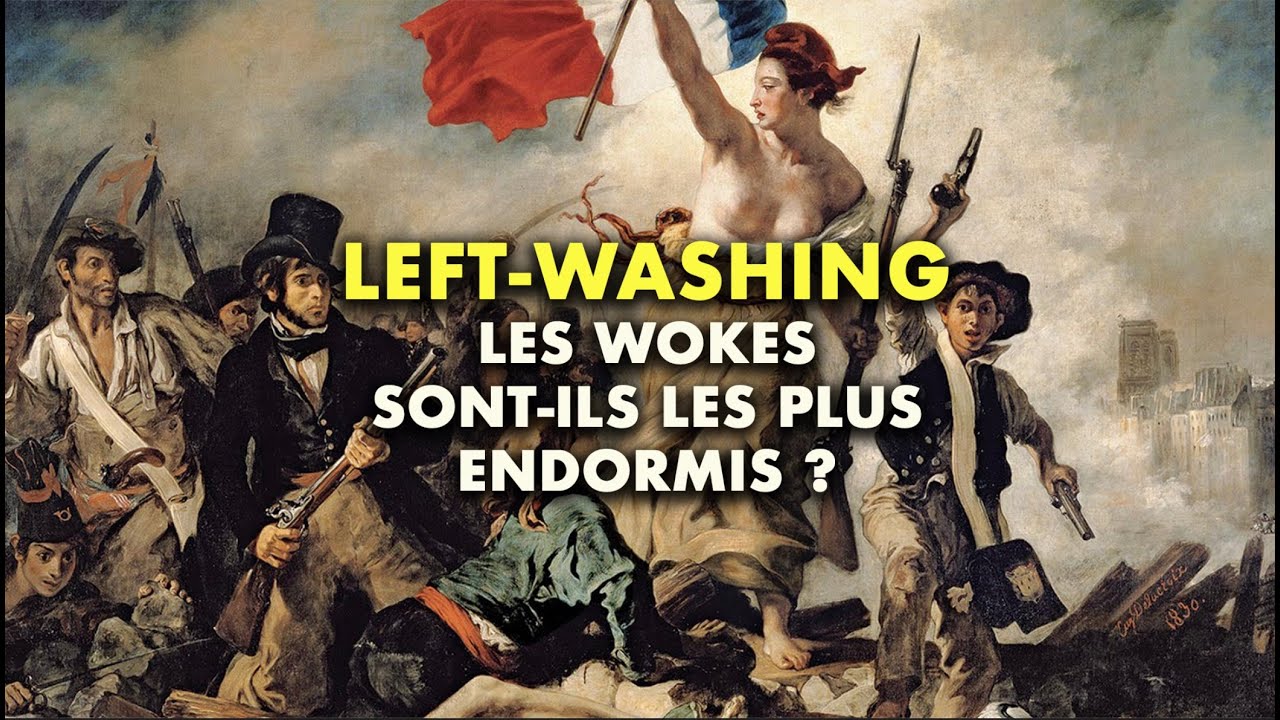
English translation of the French transcript, made with AI and not yet proofread — click a paragraph to jump to it. Show the French original
Opening excerpts 0:00 So we had women who asked us to create a space, a non-mixed group, so they could march today against sexist and sexual violence with more peace of mind. Also, a few days after launching sign-ups on our social media, we had a wave of reactions from sexists and fascists, with men signing up under the names Adolf Hitler, Guy Georges. It was shameful to propose a non-mixed zone in a march against sexist and sexual violence.
0:32 That left is damn right-wing. In any case, it's to the right of De Gaulle, who never claimed to be on the left. That is, it's more Atlanticist than De Gaulle, more pro-Brussels. What rage drives it to absolutely proclaim itself as left, of the left! That was already the case in '68, it was even inaugurated in '68, this forgery, because that's what it is. How many Marxists are there? The most widespread category now is anti-capitalism.
1:02 It's very hard to rank struggles, because I think the priorities for me won't be the same. I who am white, for example, for people who are not, I'm not trans, in short, we have to work with all struggles at the same time. This left, in order to pass itself off as left, has spent more than two generations doing left-washing, the right delights in doing left-bashing, that's all you hear now. When we talk about degrowth, for example, I mean, MEDEF rubs its hands, even though it might be some precarious worker saying that who's fallen into the trap.
1:33 They're really behind, those who believe capitalism is exacerbated productivism. It's been a long time since it's been on an investment strike, the only strike I condemn, frankly. On the other hand, that's where it's at, it's just not possible.
2:03 Feminist, not that kind. As if all sovereignty were right-wing, even far-right, whereas the great act of the French Revolution begins precisely with popular sovereignty. The blue-white-red was almost associated as an emblem of Marine Le Pen. It's outrageous. This flag that made every reactionary in Europe tremble since the French Revolution, for her father and for the French far right, the blue-white-red flag was a horror, it was the white flag with fleurs-de-lis that they wanted.
The left has disappeared as an organized force 2:39 The gyratory acceleration of the whirlwind—it's almost a pleonasm, isn't it? Of the whirlwind of current affairs, geopolitical, domestic politics, the rapid approach of the presidential deadline which doesn't help matters when it comes to the clarity of everyone's positions. The fact that properly political debate has almost become inaudible, since it's submerged by societal considerations coming straight from American campuses, with their outrageous excesses.
3:18 All right, I'll keep it simple. I'm past 75, after three quarters of a century—forgive me for talking about myself, it won't last long—this is the first time I see looming an election that will pit face to face, let's be clear, the right and the far right. Well yes, some are surprised to see that I'm not counting the left, and it's not that I'm not counting it, it's that it no longer exists. I mean, as an organization capable of making MEDEF tremble on one side, the institutions that govern us on the other.
3:56 It's been a good while since France has been run by people who sit within a very slight, barely perceptible oscillation between center-left, Hollande, and center-right—and I still put all that in quotation marks. For example, the center-right, which we've seen since the end of the war under labels like 'various moderates,' 'unaffiliated,' 'no opinion,' 'various moderates,' 'various right,' was a way—which didn't fool many people at the time—of masking the fact that they had collaborated during the war, or at least that they hadn't given up opposing those who, to the victors of the last world conflict, that is, sticking to France, on the right, the Gaullists,
5:06 on the left, the communists. Yes, but the two had one thing in common—because they fought each other, but they had one thing in common, compared to those I just mentioned, the various right, various left, unaffiliated, without a label—they had one thing in common: on the right the Gaullists, as on the left the communists, both got in the way of the Atlanticist takeover of Europe, and of France in particular, which was by far the greatest continental military power in Western Europe at that time.
5:41 We need to be clear sometimes, in grave moments, given what's happening at the border between Poland and Belarus, in the South China Sea, around Ukraine—given that while I'm speaking, and for ages already, weeks, months, more than two years, unprecedented equipment, thousands of soldiers, armored vehicles, heavy artillery, are landing directly from the United States into the ports of the Baltic states, to encircle Russia, well before the few small recent detonators, you see, but it's accelerating.
6:27 And meanwhile, what are we talking about? Dominant lesbians and dominated lesbians—I'm being crude with this contrast, but I mean, I say that because the last demonstration with a self-proclaimed feminist label—you see all the semantic precautions I'm taking, because the majority of women on the planet wouldn't recognize themselves for a moment in those who were marching—there was a demonstration whose main recognizable element was a movement called 'Nous Toutes,' as far as I know, which is a local offshoot of MeToo.
7:13 All that comes from the same very socially confined milieu, and then there were attacks against these feminists—not from far-right commandos, which one must never forget to condemn, but that wasn't the case here—but from more radical feminists, who accused the 'Nous Toutes' movement of including men in the march, and what's even a bit more serious, Islamists—I'm not talking about Muslims, who are the main victims, our Muslim brothers, of Islamist fundamentalism, no, fundamentalists, to be clear, movements financed by the Muslim Brotherhood, but endorsed by the European Commission, by Brussels—yes, all that, none of that is good.
Mitterrand, Vichy, and the leftists of '68 8:09 But here, I don't want the trees to hide the forest. The stakes, I'll tell you right away, I'm not going to go after this societal left—I've been doing that for years, precisely to show that I have no ill will in doing it, since it's not the left. Mitterrand is Vichy—it's not me saying that, it's not even someone among my usual references, it's someone I criticize, most of the time, and against whom I even made, I don't know, a video where I took apart a bit, 'debunked' as they say, one of his own videos—I'm thinking of Michel Foucault, one of his French Doctors, a paragon of the ideological counter-revolution that took shape starting in the 70s.
8:57 and who all have in common, despite their differences, which I don't overlook, between Derrida, Foucault, Deleuze, etc., having in common references like Nietzsche, like a Spinoza completely—isn't it—transformed for the needs of the Cold War, a Spinoza who's reduced to freedom, which is outrageous, when the last great part of the Ethics is precisely titled 'Of Human Freedom.' But they're counting on ignorance, aren't they, which national education induces more and more systematically.
9:34 In classes—Michel Foucault had said about Mitterrand, for once I'm quoting him, quoting him, mind you, approvingly, and not to distance myself from him. He had noticed this, Foucault—everyone knows the photo, Mitterrand, beaming, being received and presented to Marshal Pétain. And it's around 'Tonton,' as he was called, you see, making it sound more like family.
10:07 There was kindly old grandpa Pétain, and then there's Uncle Mitterrand. We're all family here, it—it smells musty. Stuffy. And all that got passed on—not to the left, but to those who positioned themselves in '68 to the left of the left, those we called the 'gauchistes,' to be very precise, and in chronological order—I said I didn't have time in the introduction to go into detail—but I'm not a man of the right, so I don't call everything on the left 'gauchiste,' quite the contrary.
10:40 The gauchistes, historically, those of '68, who most of the time had as their adversary the CGT and the Communist Party, let's be clear about that, and not the real right—they all rallied to the worst of the right. Not to De Gaulle, who was a man of the right and never hid it, never claimed to be on the left, but to Mitterrand, a man of Vichy, who came from Vichy, and who was precisely, in his early labels, 'various left,' 'various moderates,' you know, before he became—before he was general secretary of the new Socialist Party, starting in the early 70s, that is, general secretary of a party he had never even held a membership card for—you couldn't make it up, these are extraordinary things that happened.
11:32 But since young ears—we take care not to remind them, it's not that they don't know it, it's that no one ever told them, we're careful not to—that's today's youth. So, I criticize this false left enough, this left which for me is to the right of De Gaulle—who is a man of the right. It's a serious thing I'm saying, when you're to the right of the right, you're already in—I don't know if it's the far right, but it's already the extreme right. We're on that borderline, aren't we?
12:03 Now, that's the point of my talk, and it will be the subject of the video you're about to watch: this left is so pathetic in its discourse, especially in its latest outbursts—it's logorrhea, once again, coming from American university campuses, almost all identity-based claims—that the right delights in it, the old right, which is making a formidable comeback, it won't hold back.
12:40 What's it going to do? As I said, this left, to pass itself off as left, has spent more than two generations doing left-washing, the right delights in doing left-bashing, that's all you hear now. And it's so easy to knock down this left, this left in however many quotation marks you like. But that's why I wanted to do an introduction before the video. So that the trees don't hide the forest. The forest is this new right.
13:10 That's the danger. Isn't it? Those who have learned nothing and forgotten nothing, as was said of those who emigrated during the French Revolution, to England or elsewhere, or to Austria or Germany—those who learned nothing still haven't understood, but who got scared at a certain point—the communists, social security, pay-as-you-go pensions. Capital's right had to make concessions. It has never forgiven that and it's coming back in force.
13:41 It's not since there's nothing left to oppose it. Yes, I'm not far from saying that since there are no more communist parties, there is no more left. Find it for me, the left. I'd love that. I mean a left that makes MEDEF and those who govern us tremble. Because there are people sincerely on the left, effective, interesting, relevant, and who are tiny fringe groups. I don't say that with contempt. Even the Bolshevik party started out as a tiny fringe group. Everything has a beginning.
14:11 But still, the situation is serious. The right against the far right. Abroad, not just in France—these aren't the only forces rising in Europe. I don't mean abroad in the world, because there are places where things are going somewhat better. But in Europe, and that's what concerns us, the only forces rising with every election, constantly, are the far right and the Greens. I'm not conflating things, I'm talking about political ecology, not the legitimate concern for the environment.
14:47 I'm not the last to worry about its degradation. There you go. I wanted to be very clear. We're going to hit on the false left during the video you're about to watch. But it's precisely by showing how much it is right-wing, and how much its themes are almost word for word those of the oldest right there is—even though it claims to be up to date and trendy—that I wanted to give this introduction, because the result speaks for itself.
Minorities that asked for nothing 15:23 We must avoid ending up with nothing but that. It's a nightmare, the right against the far right. Have a good evening, enjoy the viewing, and don't forget this introduction when it comes to the details of what you're about to see and hear. Thank you. So, a question from Estavisky, whom I greet in passing, and I'm very glad to find a great connoisseur of Clouscard's thought. Here's his question. So-called progressivism.
15:54 You see it's in quotation marks, pushed in an increasingly caricatural way. Let me go back. I deliberately pointed out the quotation marks to make clear this isn't a critique of progressivism. It's quite the opposite, isn't it? So-called progressivism, pushed in an increasingly caricatural way by self-proclaimed representatives of minorities who never asked for this. When I see a representative of CRAN, which has happened to me, or minorities of the same kind, hyper-identitarian and playing right into the hands of ontological domination, which I often mention a word or two about, and you can be sure I'll come back to it this time.
16:40 I often tell them: why do you speak in the name of Africans, where were you elected, are you an ambassador of Africa? Africa is a bit large for you to put it in your pocket, come on. I mean, I know a lot of Africans, and believe me, I knew some even before you were born, if I may say so—it happens, alas for me—who don't think like you at all, who even think the opposite, and who wouldn't feel represented at all by your discourse, and God knows they have things to say to what's dominant among us.
17:14 There you go, so, so much for the quotation marks. So-called progressivism, pushed in an increasingly caricatural way by self-proclaimed representatives of minorities who never asked for this—it's worth remembering that these minorities, women in general, as they say, 'Afro-Americans'—I guarantee you that Africans themselves, sub-Saharan Africans, say 'the whites,' they don't say 'Euro-Caucasian Americans.' You see, they don't get their wires crossed, they don't fall into the ridiculousness of inclusive spoken or written language.
17:50 So, these minorities who never asked for any of this—I repeat—women in general, I often cite the Malian woman, the Sahelian woman in general, that is, the one who does, as you've often heard me say, the water-fetching chore, the wood-fetching chore which she then has to heat the water with, then the pestle all day long—that one doesn't quite have the same problems as MeToo, you see what I mean. So these women are silenced when we're made to believe that the minorities Estavisky mentions speak in the name, isn't it, of these enormous generalities that are 'women,' 'Africans,' 'racialized people,' as they say now, which is an incredible reversal.
18:43 So I'll pick up and continue: so-called progressivism, pushed in an increasingly caricatural way by self-proclaimed representatives of minorities who never asked for any of this, deliberately and knowingly relies, like all perverse discourse, on irreproachable moral values. I know Estavisky well enough, even beyond the text, so to speak, to guarantee you this isn't moralizing. When he speaks of 'perverse,' it's not to inject moralizing, it's on the contrary to denounce the moralism of those he's pointing to here.
Every difference except class 19:22 Respect for human beings in all their dimensions—of color, they say 'race' without complexes, of sex, sexual orientation, religion, physical condition, etc. In short, every difference except social class. When—I'll pause before starting the second sentence, you see—when there was still production at Billancourt, back when it wasn't yet a leisure and culture space, as they say now, culture mediated by sponsors, since we've gone back to that.
20:06 When there was a strike, you know, back then, people used to say: when Billancourt sneezes, France catches a cold. It was a real force. And when the strike had a favorable outcome, led to a positive advance for the workers, Abdallah, Moussa, Jean-Michel and other Poles in the mines, for example—there were many Poles in the mines in the north and the east—I mean, they benefited from the same advantages.
20:39 Isn't that so? And that's exactly what's unbearable for the dominant circles, whether it's the big banks or the discourses that go in the direction the big banks want. I'll give you an example: when we talk about degrowth, for instance, I mean, MEDEF rubs its hands, even though it might be some precarious worker saying that, having fallen into the trap, seriously thinking that it's the poor old man who overconsumes and that we're all wallowing in consumption.
21:16 But MEDEF rubs its hands—degrowth means millions of workers it can put out of work, that's all MEDEF wants, degrowth. Those who believe capitalism is exacerbated productivism are really behind the times. It's been on an investment strike for a long time now, the only strike I truly condemn, frankly, and it prefers—instead of productive investment—it prefers to invest in speculation, in financial investment rather than properly economic investment.
21:49 You see. But let's not get ahead of the main debate. I'll pick up on the excellent distinction Estavisky draws here between the oppositions. I repeat his phrase: of color—they say 'race' without complexes—of sex, sexual orientation, religion, physical condition, etc., on one side, and on the other side, differences of class, or class difference.
22:19 which I'd remind, for those who find this obscure and abstract when it's actually the ABC of the concrete—there are, if you like, thousands of social classes, and that seems complicated, but they all boil down to two, and Clouscard perfectly identified them: those who consume more than they produce, and those who produce more than they consume. Today's struggle, through all the masks it wears—of color, of 'racialized,' of sex, of gender, etc.—
22:56 in fact, there's always one of the two behind it. And of course, at the media level, it's of course the one about those who consume more than they produce that we hear almost exclusively on TV panels and other media. When a genuine contradictory debate—here's the second sentence—through lack of vigilance from an official media outlet, sometimes provoked, when a genuine contradictory debate occurs through lack of vigilance from an official media outlet, the cleverest ones say that class struggle goes without saying and that the struggle of sexes and races doesn't prevent it.
The liberal libertarians and the abandoned flag 23:34 How often we hear that. But yes, you're right, there are social problems, but then, it's not contradictory to talk about women's issues and male domination, for instance, alongside social classes. So the cleverest ones say that class struggle goes without saying, of course, we're all on the left, aren't we, and that the struggle of sexes and races doesn't prevent it, and that it all goes together, even if we never seem to move from one to the other in the dominant discourse. It's curious, isn't it.
24:05 If it all goes together, why then—on TV panels, nine times out of ten—listen, listen to Zemmour facing his interlocutors. He, like his interlocutors, only talks about societal issues, practically never social ones, practically never class struggle. Zemmour would take good care not to. Can we not say, on the contrary, with Michel Clouscard, that the libertarian liberals like the Goupils, Cohn-Bendit, Bégaudeau, Autain, Obono—note here that these are all names that place themselves, that proclaim themselves, to speak like Estavisky, on the left.
24:42 Isn't it? Funny kind of left. A Greek tragedy, the state things have come to. No need to add more. Obono, Diallo, the celebrities of showbiz, the so-called left-wing unions, the so-called left-wing parties, the France Inter columnists who appear as left-wing in a media outlet run by economic liberals, etc., have seized upon socialist themes, in the historical sense of the word 'socialist,' in order to carry out what Michel Clouscard, were he still among us today, might call left-washing.
25:13 And even large-scale left-washing. It's not when. When the left finds itself so pathetic, it opens a boulevard for the right. I'll give an example for those of you who are a bit caught off guard here by Stavisky's excellent remark. And here, for once, you see, I'm not being sectarian, I'll give Mélenchon a good mark. Before Mélenchon appeared in the arena of what's now called eco-socialism or La France Insoumise, the blue-white-red flag had almost become associated with an emblem of Marine Le Pen.
26:00 It's outrageous that this flag, which made every reactionary in Europe tremble since the French Revolution... I wasn't born under Vercingetorix, but I still remember, and this is recent history in historical terms after all, that for her father and for the French far right, the blue-white-red flag was a horror; the white flag with fleur-de-lys was the emblem of the French far right. That's Tixier-Vignancour and Jean-Marie Le Pen, isn't it?
26:36 And one of their last dishonorable last stands was their stance on French Algeria, as he used to proclaim. I'll remind you that this blue-white-red flag—Marine Le Pen only had to bend down to pick it up out of the trash can where the left that Stavisky denounces had thrown it. I'm thinking here in particular of the Trotskyists, I'd almost say the Trotsky-bores, out of respect for certain Trotskyists who are worth more than others.
27:13 I'm thinking in particular of Bensaïd, which will be a bit heavy-handed, but still, who never wanted to hear talk of sovereignty on the pretext that any sovereignty would be right-wing or even far-right. Whereas the great act of the French Revolution begins first with popular sovereignty, which is the main subject of The Social Contract, if you know how to read Rousseau—and not between the lines.
27:43 The sovereign, he says, the sovereign is the one who expresses the general will. There you go. Let me go back to the text. I was alluding to this boulevard offered to the worst there is, in political reaction, that is, in the right and the far right, to the point that many say, well, I leave them the responsibility, but I'm not far from thinking they're not far from the truth, when they say that in France in particular, but in Europe in general, the debate is increasingly happening between the right and the far right.
28:21 The left seems to have disappeared. And how did this extreme right—lumping the two together—manage to give itself such a boulevard? Because it dates back to a certain use of the legend of '68, you see, there's the reality, which was the advances made by the workers, the '68 of the CGT, and then there's the legend, the '68 of Cohn-Bendit and others, of what it swept away politically, that is, the liquidation of everything that stood in NATO's way.
28:56 Yes, I'm not saying the United States on purpose—NATO. On the right, Gaullism; on the left, communism; both begin to decline. Afterward, the societal '68—this '68 didn't begin, I'm referring to Renault earlier, no—it began with stories about dormitories, boys and girls, in the university residence halls. That matters.
29:27 On an individual, personal level, I could have mobilized for things like that, of course. But that this should be put at the center of what is perhaps the greatest social event in our history, and in any case in the whole postwar period broadly speaking, that's a bit much, isn't it? Mitterrand, Jospin, Hollande—the privatization record was set under Jospin and Bérégovoy, Mitterrand's prime ministers.
Societal progress versus social progress 30:00 And to the point that the nuances between Sarkozy, Hollande, I mean Macron, become imperceptible at that level. Isn't that so? So, how could a 25-year-old with altruistic moral values be in favor of the oppression of Black people, of homosexuals? You don't need to be a hysteric from American LGBT campuses to be rightly scandalized and to find it monstrous that mass imprisonment of homosexuals has been practiced, for example, in Egypt.
30:45 for example. So, but no, there's a burglary, you see, of all these general humanist values—here, without quotation marks—for the benefit of, as we'll see, an ontology reduced down to pure identity. How could a 25-year-old with altruistic moral values be in favor of the oppression of Black people, of homosexuals? Well, I'll tell you, that's not the point, so I'll add it.
31:18 Who is in favor of pollution? Who wants a more polluted world? Who wants more unbreathable air? Who would want to swallow more fine particles? Find me one... So, causes like that, consensual ones, hide something. When you have no one in front of you, it's easy, isn't it, to claim unassailable values. How could a 25-year-old with altruistic moral values be in favor of the oppression of Black people, of homosexuals, of any minority, and of women?
31:49 Because it's indeed in these terms that the media, politicians, the left—in quotation marks, thanks Stavisky—and, curiously, the multinationals as well, explain to us where progress lies in our modern Western world. There would be only societal progress, which is supposed to console us for the fact that social progress isn't just stalled, but is even being subjected to a powerful regression.
32:22 We should remember that in his speech last night, Macron once again toughened the conditions for unemployment benefits. But that, the unemployed—among the unemployed there are men, there are women, there are gays, there are straights—but who cares. Who cares. That's too many people. Better to have small minorities fighting each other, gays against straights, when they're united, for instance, as unemployed people, or as job seekers, or as overexploited employees.
33:03 So greenwashing consists in passing off opportunistic, absolutely non-ecological commercial practices as ecological. I recently learned, to illustrate Stavisky's point, I recently learned that there's a coffee brand that can call itself ecological, you see, and organic, because the road leading to the coffee plantation from the main paved road, the path itself, isn't tarred, and it's about fifteen kilometers long. So, you see, that wrecks the joints of the workers who walk it, and it isolates them from the rest of the world, but it's organic.
33:43 Because tar is petroleum, and petroleum is dirty. It's polluting. Let me remind you there's a disease that has almost completely disappeared here, tetanus, because you're all vaccinated, thankfully, in today's generations and for quite a while now, for more than two generations. And the main vector of tetanus came from soil, not from tar, from soil—many gardeners, for example, fell victim to tetanus from a simple scratch by rose thorns, especially in soil where there was horse manure in the fertilizer.
Dividing the collective worker 34:31 Ah yes, none of that is industrial, but all of it is deadly. Mortally lethal. Left-washing consists in being able to pass yourself off as being on the left, when in fact you're supporting, consciously for those who profit from it or unconsciously for those who believe in it, systems aimed at deeply dividing the collective worker. I won't harp on. Is it really still necessary to illustrate here what Stavisky is saying, unless one is truly the worst kind of deaf person who refuses to hear anything, dividing men and women, the young and the old, the forty-somethings?
35:14 Yes, yes, I've seen that—that people in their forties, apparently, were taking jobs away from young people? Or that we, the old, the retirees, were too well paid and weren't leaving enough to raise wages? We hear all that, don't we? Or even dividing the person who's truly at the minimum, on minimum wage, but lucky enough to have a job, so he's pitted against the person who has no job. What a shame!
35:44 While those who stash their billions in tax havens, sums that could pay for French pensions ten times over, while those people, no one bothers with them, except in words, now and then. Words fly away. So, men against women, the young against the old, gays against straights, Black people against white people, Indians against...
36:17 I'm thinking of East Africa, Indians against Black people. Let me remind you that Gandhi was a racist against Black people. Yes, I know. There's a sort of mushy-headed left, always a bit surprised. Or in Southeast Asian countries, in more tragically recent news, Buddhists against Muslims, and it never ends.
36:49 Capital twiddles its thumbs meanwhile and loves this kind of opposition, you see, which doesn't cost it a cent. Saying 'Madame la ministre' instead of 'Madame le ministre'—I prefer 'Madame la ministre.' It always seemed a bit odd to me, 'Madame le ministre.' So this isn't about the substance of the change I'm talking about. But what's certain is believing that these are great advances—if MEDEF could get away with only changes like that, only reforms of that kind, it wouldn't cost them.
37:28 Not even a tenth of a cent. Systems aimed at dividing—dividing what, dividing whom? Deeply, the collective worker—and here it's a quotation mark, not one of derision—according to Clouscard, because nothing would be worse than seeing them come together. My God, the nightmare for MEDEF would be that. Gays and straights together, women and men together, dominant lesbians and dominated lesbians together. There's a whole discussion in Plato's Phaedrus about whether the lover should—these are homosexual couples in the Athens of the time—whether the lover should yield to the beloved, or whether the beloved should resist the lover.
38:13 Well, yes, I mean, these are very, very old problems being passed off as current ones. If all that were to come together—another example—when the Vietnamese were being crushed under bombs, in a way we can't even imagine, more bombs fell on Vietnam, and even more on Laos, than on all the battlefields of the Second World War combined, Pacific War included, yes, yes, from Normandy all the way to Guadalcanal, all the way to the Philippines—there was never as much bomb tonnage dropped as on that poor, heroic, magnificent Vietnam.
39:00 So what am I getting at? That those under those bombs didn't care in the least, they had other things to worry about, you can imagine, in the horror they were living through, whether the pilot dropping the bombs was gay, straight, Black, white, a man, a woman—what did it matter! Because nothing would be worse, to go back to Philippe's remark, which I'm splitting up because it's long and rich, because nothing would be worse than seeing men and women of every color, religion, sexual orientation, social condition, outside the ruling classes, come together into a united whole—in short, a gathering of the dominated—into a united whole no longer split apart by these divisions, and conscious of its common interests.
Clouscard's critique as liberation 39:54 So he addresses me: how could you explain to young people in what way Michel Clouscard's thought, and its deeply emancipatory character which, once the illusion manufactured by effective propaganda—well-funded, permanent, and multichannel, in other words basically the entire media rumor mill—has dissipated, opens the door to true liberation, Clouscard's critique of it, against all forms of oppression, while the ideology driving them today effectively pursues exactly the opposite goal.
40:29 How to make people understand? Before we get to the rest of the question, you'll notice the insistence of the questioning, and I understand the muted anger underlying this very thoughtful, very well-articulated question, which is far from being tossed off carelessly, but you can feel there's a muted anger. This anger is directed above all here—they're not trying to convince MEDEF, obviously—but at those who fall into this trap, who take at their word those who proclaim themselves left-wing, who believe that's what the left is, and one understands, in turn, why some people feel drawn either to Le Pen, or worse, or to Zemmour.
41:25 So here's the peroration, as we used to say in rhetoric classes, here's the last part, the conclusion of Stavisky's long, very rich and well-articulated question, for which I thank him very sincerely. How could you explain to young people in what way Michel Clouscard's thought, and its deeply emancipatory character, which, once the illusion manufactured by well-funded, permanent, multichannel propaganda has dissipated—and I repeat, that means basically everything broadcast in the media—opens the door, this critique by Clouscard, to true liberation, against all oppressions, while the ideology driving them today effectively pursues the societal ideology—that's a word I don't much like because it's a bit imprecise, but well, when he says that the social isn't everything,
42:35 he knows that, the social, while the ideology driving them today effectively pursues exactly the opposite goal, that is, subjugation to what power wants, real power, which is economic power. How to make people understand that Clouscard's critical analysis is not a renunciation of the moral values these manipulative sophists rely on, but exactly the opposite? Yes, the exploited person, the woman, in a good part of the world, the formerly colonized—well, the formerly colonized who continues, and probably more than ever, to suffer an economic colonialism at least as cynical, I'm watching what I say, grammatically and in substance, at least as cynical as archaic colonialism.
43:32 A small example: we were—since I was one of them, I was a kid—5,000 French people before independence in Ivory Coast; we were 50,000 French people 15 years after independence in Ivory Coast. Not a bad deal, that independence, for the colonizer. How to make people understand that Clouscard's critical analysis is not a renunciation of the moral values on which this manipulative sophistry relies, but exactly the opposite? There you have it.
44:06 Thank you in advance for your insights on this extremely topical question. So, more than once, actually more than twice, even more than twice, I've answered in pieces. Our friend Stavisky has the advantage of gathering all these different channels, as he calls them, societal channels, into a single question.
44:36 But very often I answered him in advance, at times showing the sordid operations taking place under cover of green business, environmentalism, or identity struggles—of gender, color, religion, etc. Our friend Stavisky, our comrade, had proposed this title for this long question. I'll read it: 'Are the woke the most asleep?'
The woke, or the awakened 45:08 Of course, the pun is obvious. The woke, that is, the awakened, those who become aware of the new struggles, that is, the old chestnuts—I think you're starting to understand what I mean, the same old ones, the oldest, if you think about it—are they the most asleep? And I had this thought. It's not a well-founded argument, mind you, it's an intuition, but I don't believe in coincidence here.
45:44 It might be a paranoid effect. We should leave room for chance, for the tooth of chance, as Parmenides used to say. But I've already heard this somewhere before—the awakened, the awakened. Good grief, of course, in my Buddhist youth. Yes, when I was 16, 17, one has the right, at 17, one has the right—but even, and it's even worse to say—to anticipate. Today I watch the obscene showcasing of the Dalai Lama.
46:22 I have much greater respect for the teaching of Siddhartha Gautama, called the Buddha, isn't that so? It has nothing to do with it. There's as much difference between the Buddha's teaching and the Dalai Lama as there is between the Gospel and the Spanish Inquisition. Spanish or otherwise. They could go hand in hand there. Or Protestant puritanism and the excesses it led to. You see that beautiful film called 'Day of Wrath,'
46:52 by the great Danish filmmaker Carl Dreyer. So there you go, it's curious, we find the same communities, so fashionable in the United States. There you go. The woke, the awakened, the awakened. I even remember the term in Sanskrit. The awakened is 'arhat.' I won't vouch for the pronunciation here. I'd need, my friends—I have excellent Indian mathematician friends, but I don't have them on the line here.
Hegel and spoken music 47:27 I'm going to ask Pierre-Alain to move on to other questions that were raised during our live session, like Stavisky's, which apparently seem very far from these issues, and I'll note that many—and I'm glad about this—of those kind enough to follow our broadcasts, I notice that a growing number of them are beginning to make a connection between the questions I'm going to address now and Stavisky's long question, which we're not leaving behind, quite the contrary, but rather building on.
48:10 Here's Guillaume Dugué's question. Hegel places at the summit, you'll recall, I talked about the hierarchy of the arts, from architecture to poetry, passing through sculpture, painting, music—the hierarchy of the fine arts, but that's Hegel's. He places at the summit spoken music, music that recovers the language and words of the tribe. Well, here Guillaume has a deadpan sense of humor, if I may say so.
48:41 Actually, in Hegel's text, what's at the summit of aesthetics is poetry, not the arts of language. But I stepped in precisely to say that it's still music in a sense, since we move from prose in the vulgar sense—say, journalistic prose, for instance—I'm thinking of Mallarmé who said, 'Literature which universal reporting exploits.' We move from the prose of the world to poetry, not through a change of meaning or content, but a change of form that implies a different content.
49:22 Well, that's another matter—a change of form. I had taken the example of 'Sovereign of the seas that must carry you,' the line by Racine from Mithridate, that so beautiful line, and I'm not changing its meaning by putting it into the mouth of the traitor Pharnace, since it is he who utters it, addressing his father's former mistress, saying to her: 'You're going to sail on oceans full of salt and sodium chloride, over which you hold political authority.'
50:00 It's still better to say 'Sovereign of the seas that must carry you.' We haven't changed the meaning, the content. But it's for the ear that it changed. So he's right, Guillaume, to say that we could, we could—we'd have to ask Hegel, wouldn't we? That would be an interesting discussion—don't argue with corpses. But we could ask him whether we couldn't replace what he calls poetry, that is, meter, you see, purely auditory notions.
50:32 Meter is a certain rhythmic distribution of the sentence, of the enunciation and not of the statement itself. Hegel places spoken music at the summit. Should we replace poetry with spoken music? Well, you see, so what does this have to do with the boulevard offered to the left-washing that the right and the far right spew out ad nauseam, taking advantage of the blindness of those who proclaim themselves left-wing?
The nourishing voice, the first power relation 51:12 Blindness, or on the contrary, isn't it calculation? Philippe distinguishes very well between those who do it consciously, deliberately, and those who fall into the trap and are victims of this illusion. When you're unhappy, you know, and someone offers you, when they tell you your misfortune is actually very simple, it comes from the Jews, that's how it was in the 1930s in Germany, right? There are people who don't think for long before saying, "Oh yes, that was my problem."
51:46 There you go. And yes, indeed. But there, you had to think of it. No, I've heard them all. Why not? What's the connection? The connection, you see, lies in a certain form of auditory relationship between us. And yes, I'll go that far. When our first relationship, right? Our first relationship of communication—I'm not talking about expression—when a baby babbles with pleasure because during feeding, it's expressing itself.
52:24 But that's not communication yet. Communication, though, is first of all auditory. Statistically speaking, in the vast majority, if not the totality, of cases. That's not the case for the newborn. And this song of the sirens has marked us. The sirens are female figures, they're the mothers or the nursemaids, you know who—who are the first interlocutors for each and every one of us.
53:00 There's where we start to see the relationship. The first political relationship is right there. Between dominant and dominated. Between power and total powerlessness, the opposite of power. Powerlessness or impower, forgive the barbarism, it's the same word. Potentia, in Latin. Power, the ability to act. It's first of all—or if I reduce this communication to its purely discursive aspect, that is, to a sequence of words such as you might see on a sheet of paper, I say expressly on a sheet of paper.
53:53 And I'm not saying verbal communication because then right away the ear starts working better. I'd like to take, to isolate as an extreme, so to speak, what passes through the ear—for example, written communication, whether digital or on paper, here doesn't change much. If I isolate it, I fall into the ambiguity of this discursivity that, from the earliest historical periods, I think of Aesop, the fabulous fabulist of antiquity.
54:37 I say fabulous because we don't know much about his existence, a bit like Homer or Hesiod, about whom we know very little among the most archaic of the Greeks. On the other hand, in the works that have been passed down to us, thankfully—thanks to the copyists and all those who were passionate about these fables and who brought them all the way to La Fontaine—many of La Fontaine's fables are inspired, as far as their dramatic content goes, by Aesop's fables.
55:07 Why am I talking about Aesop? Because he supposedly said that language is the best and the worst of things. You see the ambivalence, the ambivalence. The best, because through language I can console, I can defend, I can exonerate, I can forgive. I can also slander, condemn, send someone irremediably to horror. So you see, deprived of the purely auditory content, that of the song that cradled us in our first months—that's what makes up part of the charm of the sirens' song.
Atlanticism and the sovereignty of universal suffrage 55:55 I want to stress the connection between what? Between the excellent challenge posed by the false left—it's been in power for a while now. Ever since we got rid of everything that was hindering the worst of America—not America. You know what I keep saying, and I'll say it again clearly enough: I don't eat American, I eat Atlanticist.
56:29 And the Atlanticist can be Thai, Chadian, Moroccan, it doesn't matter. Even though, of course, the United States must always be recalled as the flagship—well, the American government, the executive—the flagship of Atlanticism. Why am I alluding to this? Because the false left appeared at the very moment Atlanticism came back. It had gotten the better of, in France, two obstacles that were blocking its path, that were hindering its globalization.
57:11 At the time, there was the Soviet Union for a whole part of the world, and communist China, which escaped its influence. But there was also, even in the West—to speak like the journalists, I'm not quite sure what that term means geographically, since we know the Earth is round and the West is wherever you want it to be—there was France, with, on the right, De Gaulle's anti-Atlanticism, and on the left, the communists' anti-Atlanticism.
57:46 Having, for my part—I have nothing to hide—voted against the Gaullist government throughout that whole period, I have no reluctance whatsoever in saying that I rate the Gaullist right far higher, in value, than what governs us now, which calls itself right or left, and now you understand what I mean, Estavisky, it doesn't matter—in any case it's to the right of De Gaulle, who never claimed to be on the left.
58:18 So this left is damn right-wing, meaning it's more Atlanticist than De Gaulle, more in favor of Brussels, of the Europe of Brussels—I have nothing against the wonderful city of Brussels, where people show a kindness we don't often enough acknowledge here—this left in favor of the Europe of Brussels, of de-sovereignty, a barbarism imposed on nation-states and on France in particular, are, you know, the European Constitution which you were right to vote against at 55%, which you were right to vote against at 55%, even though our vote wasn't taken into account institutionally, so that we're not far from the illegitimacy of a coup d'état since then—I'll leave it to constitutional specialists to formally settle the matter, but everyone will agree, this left—
59:31 it's a wonder they didn't call you right-wing when you recalled the perhaps most radically revolutionary principle of the French Revolution, which is the sovereignty of universal suffrage. From the moment it's universal, from the moment it's not suffrage reserved for the few who can pay, buy their right to vote—that was called the property qualification, everything referred to as restricted suffrage. No! The Revolution is precisely the expression of the true majority scorned, right, by the Congress of Versailles.
The lullaby and Rousseau's reverie 1:00:07 There are places like that which don't lie. So what's the connection with spoken music? As I was telling you, I was in the middle of talking about the auditory dimension, bringing together music and poetry—that's where I'd gotten to, as we see in lullabies, for example. And here I am saying lullaby, that is, what is sung, whose first purpose is of course to put the child to sleep, but not just any old way.
1:00:53 Between the two, between wakefulness and sleep, throughout the whole time of the lullaby, we're in that intermediate state that Rousseau calls reverie. Why do I mention Rousseau? Because he uses the same root as "lullaby" [bercer/rêverie]. But I've drawn this rather from the fifth walk, and you'll see that the connection between Guillaume's question and Estavisky's is so incredibly intertwined that from the distant periphery where it seems to appear, it's going to come right to the center of our problems.
1:01:34 Excerpt from the fifth walk, "Reverie by the Lake's Edge." Rousseau's poetic testament. He is in the middle of speaking of the extinction of his progressive activity, of his psychic activity. I'm putting it crudely on purpose so as to let him speak in his own literal words afterward. And even saying that he still happens to think, up until the point—there, I'll let him speak.
1:02:07 "From time to time a few brief reflections arose concerning the instability of the things of this world, an image of which the surface of the waters offered." A banal comparison. That's the discursive psychic activity I was defining earlier. If I take communication and strip away everything auditory, auricular—everything that is, for him—if I take only the content, the meaning, the logical sense, a comparison, a classic metaphor between the instability of the world, a moral theme, and the perpetual movement of water, the ebb and flow of that water, its continuous sound but swelling at intervals.
1:02:55 "But these are the last aftershocks." And here I pick back up with Rousseau: "but soon these slight impressions themselves"—listen carefully—"faded away in the uniformity of the continuous motion that lulled me." And there it is, the root. "That lulled me to the point that, called by the hour and the agreed signal"—he'd be called by a bell or a horn call—"I could not tear myself away from it without effort."
1:03:27 "But soon these slight impressions themselves," I repeat, "faded away in the uniformity of the continuous motion that lulled me." All that's left is something closer to music than to discourse. "The uniformity of the continuous motion that lulled me." So you see, the proof that something is happening within the small community that honors me, the one you form by kindly commenting on my talks.
The Nazis' language and a true communist language 1:04:14 And for that, I'm going to ask you to take into account the question that follows, the question that comes from our friend Contra-Propaganda. The handle is new to me, so I welcome her, I say hello to her. But, look, there must be a moment, in any case, that follows our talks. Because, you see, what I was saying at the start, that things are gradually falling into place. Videos that seem to deal with very different problems, poetic, literary, political.
1:04:49 But listen instead. "Actually, shouldn't a real reflection on this also perhaps be situated at the level of discourse and language?" Good heavens, we were right there, go on. "I was thinking about that in relation to your latest workshops and suddenly I had a kind of click. Particularly recalling how poets like Hesiod"—I had mentioned him regarding Mnemosyne and memory—"composed their works, not first to be read, writing, but to be recited and therefore heard."
1:05:30 You know, the ancients did not read silently as we do, but there was a reader, sometimes a slave, who read aloud. "Isn't this exactly what the Nazis worked on in developing their so specific language?" You just have to show a few clips of Hitler's speeches before a mesmerized, hysterical, convulsed crowd to see the power of vocal timbre. It's very "chando"—that's a musical term I'm using there.
1:06:03 Isn't it? And, well, one shouldn't mock the accent—I was about to say—and his Austrian accent, to understand what Contra-Propaganda is alluding to here. "Isn't this exactly what the Nazis worked on"—so on the auditory element—"in developing their so specific language, cf. Emmanuel Faye on Heidegger?" Emmanuel Faye has done a lot of work, hasn't he, to expose, against all the French readers of Heidegger and his fan club, who are at once forgers and concealers, who bar access to certain manuscripts.
1:06:43 "And couldn't one establish the same correlation between the impoverishment of language, of vocabulary, and therefore of knowledge, and precisely the impoverishment of today's music? I go on. If that were the case, wouldn't it be possible to carry out a thorough reflection on the form of a true discourse and a true communist language"—good heavens, yes, I hadn't gone that far, thank you, Contra-Propaganda, for anticipating what should be the conclusion of all my videos, which is to rediscover, you see, since Guillaume wasn't far off, "to give a purer meaning to the words of the tribe."
1:07:28 If the tribe is the community—not in the exclusive sense, the community of Whites against that of Blacks or vice versa, the community of Homosexuals against that of Heterosexuals or vice versa, no, but the whole, the human tribe—"if that were the case, wouldn't it be possible to carry out a thorough reflection on the form of a true discourse and a true communist language," somewhat in the sense that in the Freudian field one contrasts empty speech, where there is nothing left but discourse, and full speech, "in order to make them coincide rationally and therefore effectively from an already-there"—this already-there which began with our attention arriving at the voice, the voice of the nourishing one.
1:08:20 I say "nourishing one" rather than "mother," because it could be the nurse, or the older sister, or whoever gives the bottle—it could be the father, as is most often the case today, and I'm glad of it. Today's young fathers are better at this than the generations before them, myself included. "In order to make them coincide rationally and therefore effectively from an already-there"—see the difference between the fugue, the fugal form which I developed a little last time, based on the repetition of a single theme characteristic of baroque music, and the sonata, that is, poly- or bi-thematic tension characteristic of modern music, from a strictly aesthetic point of view, without trying to reinvent the wheel every time.
Leftists, anticapitalism, and Burke against man 1:09:11 One thinks one is dealing with an aesthetic question, and lo and behold it ends up in the aspiration toward what should be—I'm reading it, it's so unbelievable you have to have it in front of you—"a true communist language." There, I don't want to overload the boat today, I think we have a lot to work through. I held back on the Stavisky question, which I commented on in real time as I was reading it, so to speak, and with which I entirely agree, on that point, right?
1:09:44 And he's quite right that Clouscard's whole effort consists in warning us, above all, against—I'll say it—this false left. I don't like the expression, because it implies I have the true one—against this rage that drives this political fraction of our people, which, I repeat, I said it earlier, is to the right of De Gaulle both regarding the relationship to the Atlantic Alliance and to the European Commission—what rage drives it to absolutely insist on proclaiming itself to the left of the left. That was already the case in '68, it was even inaugurated in '68, this fraud, because that's what it is, to the left of the left. There were those who were called at the time the "gauchistes" [leftists], who fed on communist-bashing, it was their daily bread. When I say "gauchiste," I'm not a man of the right.
1:10:54 I'm not talking about everything that's on the left—quite the opposite. It's very precise: it's the union, in the mathematical sense of that term, of three subsets, which I'll name in chronological order so as not to slight any of them: the anarchists, the Trotskyists, and the Maoists, in order of their historical appearance. Now, those are precisely the ones who all found royal positions handed out during the Mitterrand generation by the prince—starting with Jospin, who was a Trotskyist in '68, and who, once he had power, ended up saying—all right?
1:11:42 Because one might say, yeah, that's because I was in opposition, but in power he says—my program, I'm the one adding this—he even says his program is not socialist. So I say: his program wasn't even socialist, and yet he claimed to be further left than the communists in '68. What a fraud! What rage drives this political fraction, which is to the right of De Gaulle—who himself is, by his own admission, a man of the right, I'm not making assumptions—to the right of De Gaulle is the far right—why this rage to want to be on the left, even Marxist? What is there Marxist about it? The most widespread category now is anticapitalism, isn't it? No—which opens up an enormous boulevard, doesn't it, to left-washing, indeed, and Stavisky is absolutely right—who isn't anticapitalist in the Medef? You find plenty of anticapitalists there, you've got loads of banks now claiming to be ethical. You know, I prefer to think—
1:12:54 like Brecht, and yes, I prefer to invoke a great communist, Brecht, who has his character in The Threepenny Opera say—when it's Macheath's trial, wanted by the police, when it's his trial—he says: yes, I confess, it was me who robbed the bank, but gentlemen of the jury, what is robbing a bank compared to founding one? At least he's a crook who declares himself a crook, whereas the banker declares himself a philanthropist, on the left, taking the environment, ecology into account, the societal left, taking the side of the planet against humanity—humanity, which wallows in consumption. No, never will they say they're against humanity, otherwise it won't work. So how much, damn it, am I more left-wing if I start being against humanity? But behind it lies the old far-right dream, which has one target and one only: man. And I'll end on that today.
1:14:04 You see, we're only opening the door. Thank you, Estavisky. I'll conclude with a quotation from the most emblematic counter-revolutionary, since he was one of the very first, right from the French Revolution—Mr. Burke, the Englishman, B-U-R-K-E. Burke already said, against universalism, which is the worst enemy of the racialized—since every universalism is supposedly a masked Western policy—well, Burke already said, as if to serve them their own sauce: "I have met in my life Hungarians, Poles, Frenchmen, Basques, but I have never met man in general." I believe that today we have opened the door leading to the human tribe, to the universal—but the universal that is common to your interlocutor and to you. Have a very good rest of your day. Thank you. Thank you.