English translation of the French transcript, made with AI and not yet proofread — click a paragraph to jump to it. Show the French original
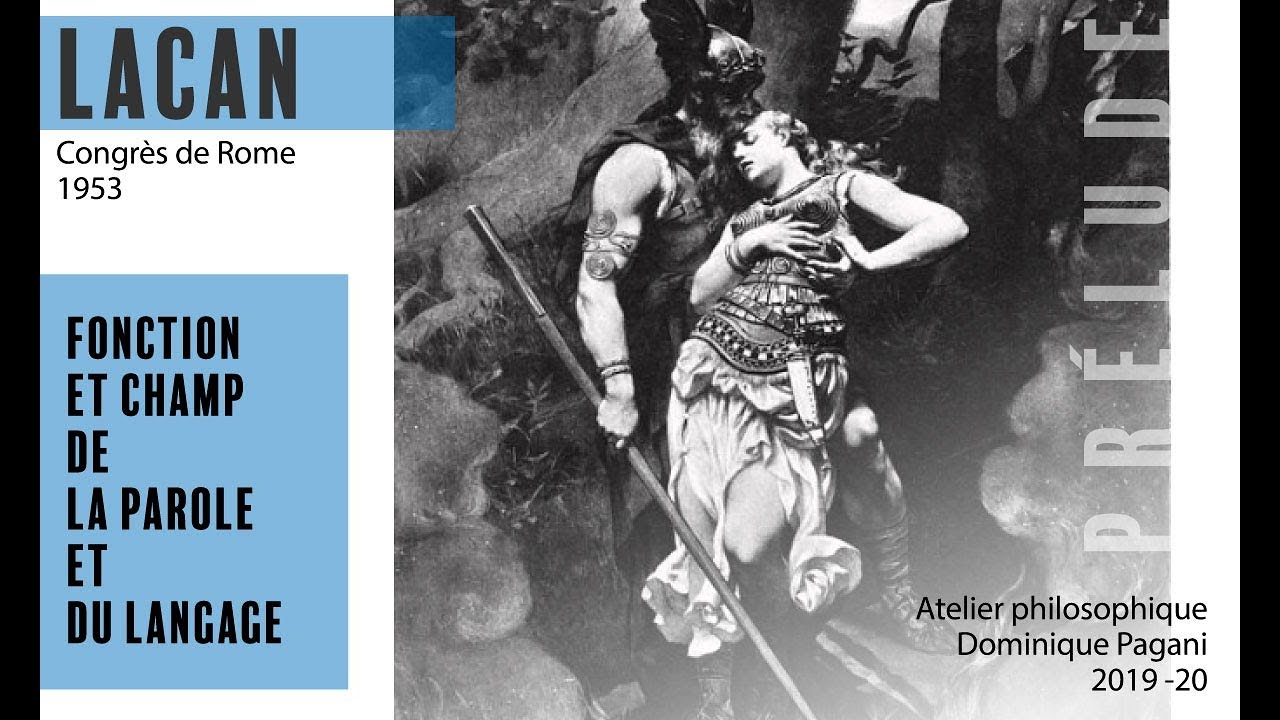
Wotan and Brünnhilde: the punishment of sleep 0:15 We are in the very last minutes, almost the last seconds, if I count the passages with speech, text, from Die Walküre, the second day of the tetralogy, which lasts four days. I say this for the impatient. Especially in that era, we're used to short pieces. I look on iTunes where they classify everything by tracks, or tracks that last 1 minute 20.
0:45 Anyway, Die Walküre alone lasts about 3 hours, 3h50, 3h40, depending on the version. Here it's about 3h50. I'm not going to tell the whole story, this isn't the place, but it's a bit like Zeus and Athena, the relationship between Wotan and his daughter. And so in the last minutes... Zeus inflicts a punishment on his daughter, that's the subject of the drama Die Walküre, on his favorite daughter, perhaps even the only deeply shared love, no doubt the deepest love in Wagner's entire work, even more than Tristan, which is saying a lot - it's surely that of Wotan and his daughter.
1:25 So why did he punish her? Because she did what he himself would have wanted to do, but he was prevented by his contracts, by his obligations as king of the gods, he couldn't. And so he's furious, she made the wrong warrior win because she saw him in the throes of love, and it moved her as a woman. And she, a warrior virgin, he inflicts on her the most terrible punishment: he condemns her to sleep, as there's a bit of a Sleeping Beauty echo in these Nordic and Germanic myths. And the first mortal to wake her will possess her, which is a humiliation for her, a warrior virgin like Athena, for that matter.
2:07 And so in the last minutes I just played, the last somewhat dramatic scene, is when she puts on a vamp act - there's no other word for it - to tell her father that this punishment is too severe, it's not possible. Brünnhilde, who is his favorite daughter, as you would have been. His innermost thought - I'm quoting elements of the libretto, I'll go quickly. Wotan says to his daughter in an earlier passage, when I speak to you I speak to myself. And she says, you know that I am your innermost thought. So, they are truly very close. She says, you're not really going to inflict this punishment on me.
2:41 And she puts on such a vamp act that in the end, to soften the punishment, he decides she will fall asleep but surrounded by flames. So that it won't be just anyone who wakes her, but a valiant, courageous hero, etc. And of course that will be Siegfried in the future, but we're not there yet, that will be the sequel. So why do I bring up this passage? In the wake of the first workshop of this new season, where I recommended reading, in Lacan's Écrits, the chapter titled 'The Function and Field of Speech and Language,' where Lacan pounds the table to reaffirm the essential importance of the symbolic function in the delivery of Freud's message.
3:33 He settles his scores with institutionalized psychoanalysis, which concerns itself with everything except the essential thing, that is, language, speech in particular, attention to the patient and to the letter. And why do I bring this up? Because there is of course the question, especially in late Freud, of the death drive, of the repetition compulsion and the death drive. So I'm going to play the few seconds where Wotan, with a kiss on his daughter's eye, a magical kiss, makes her fall into a kind of eternal sleep.
4:08 We hear the eternal sleep theme, and we hear another theme beforehand, small chromatic slides in the strings, which I'll point out as a marker. We hear a sleep - I'd say a human sleep, even though here it's feminine since it's the Valkyrie's sleep. It's a woman's breast rising and falling in peaceful sleep. So the contrast is between this sleep - healthy, biological, physiological, restorative sleep - and the endless downward slide toward eternal sleep, that is, what Freud calls the extinguishing of all drives, and therefore of all the tensions that characterize the death drive.
4:56 Because Freud says elsewhere - I'm saying all this haphazardly for now - that pleasure... people always say 'that excites me, that excites me.' Yes, but Freud says pleasure doesn't come from excitation but, on the contrary, from the release of tensions. And here, it's a resolution in every sense of the word, literally first of all - that is, the knot comes undone; anxiety comes from tightness here, from what constricts.
5:27 That is to say, sleep - all the anxieties, the tensions come undone, subside, but eternal sleep is a slide toward a state like this table, like everything that is inert, that is, where there is no more desire. Because what characterizes life precisely is desire, drive, tension, an intentionality toward something. And here, it's the cessation of all that.
5:57 This isn't developed here because we'll do that in the discussion that follows. But I'd like, in every sense of the term - starting with the literal sense, the auditory, aural sense - to make you hear how Wagner, brilliantly, intuitively - he's an artist, when he plays the ideologue he often talks nonsense, God knows he wrote theoretical texts where the best and the worst often rub shoulders, often the worst - but here, with a brilliant, almost prophetic aesthetic insight, makes both sleeps audible.
Listening: eternal sleep and the Valkyrie's sleep 6:32 So I'll begin with Wotan's last words as he puts his daughter to sleep, and I'll point out - it will be recognizable - the eternal sleep. Great gentleness, it's a true inner nerve.
7:13 Here he wants the Valkyrie's sleep to be peaceful. Like breezes.
7:55 And here we hear a theme, a kind of high-low figure, which is played by the brass - I'll let it play from now on - which, for the listener following this since the beginning, since Das Rheingold, is a leitmotif called the renunciation of love. So here, the score betrays the father's feelings for his daughter. Because in the text, there's nowhere that it's expressed in terms of love.
8:45 Watch, the eternal sleep is coming now, from here - flute. You see the slide, chromatic, by half-tones, then it passes to the woodwinds, now to the strings, to the violin, and it descends, and it descends.
9:31 Vertiginously and gently. And now we'll hear the Valkyrie's sleep. Where's the long... There.
11:05 ch
The logic of the subject facing the reconstitution of Nazism 12:15 Thank you very much, Philippe, for giving me the opportunity to elaborate somewhat on what I began at our first back-to-school workshop on October 11th, at the René Goscinny community center in the 13th arrondissement. As usual, this first talk opened a cycle of lectures that I'll try to keep up this year.
12:55 On the theme, I remind you, of the logic of the subject - to quote it literally - facing the reconstitution of Nazism. Clearly that requires some explanation. I won't go back over what I already said last time, but since Philippe kindly gives me the chance to keep our audience - our public - in suspense, so to speak, because there isn't just listening in suspense between two monthly workshops, and the subject deserves it, that we spell things out.
13:40 Which we don't always have time to do in a limited session. I do want to address both subjects at once. First, the logic of the subject, a rather classic philosophical problem after all - perhaps not formulated exactly that way, but still. Then the reconstitution of Nazism, alas, well beyond philosophy.
14:11 Philosophy is making headlines almost across the planet now, from Brazil to Ukraine, to Poland, to France - far-right parties are raising their heads, and openly Nazi parties, as in Ukraine or the Baltic states or Poland, no longer hesitate to invoke it. There's even a new Nazi history now, with new historians claiming that it's the communists' fault that World War II broke out, and that Hitler, fortunately, intervened to oppose Judeo-Bolshevism.
14:53 Anyway, I do want to discuss this very classic academic term - the subject in philosophy, the logic of the subject - and the reconstitution of Nazism, which isn't strictly a philosophical theme, which could be a theme of current historical or social affairs, I don't know - I always want to discuss one in relation to the other and vice versa, to link them. Now, Philippe gave me excellent advice following a recommendation I'd made at the end of the workshop, when I said, after a historical introduction on events linked to the Third Reich.
15:41 I borrowed from historians who are the great specialists on the matter - I'm thinking of Chapoutot, Ingrao, well known - I had finally addressed the philosophical position of the subject with this expression, literally, 'the subject finally in question.' And half-jokingly, half-seriously, I said, I remind you that this is the title of a chapter by Lacan. We'll get to it, in the Écrits. The Écrits is a compilation Lacan put together over several years - today we'd call it a compilation.
16:17 And in this case, I recommended turning, in his Écrits, to a chapter drawn from the famous Rome Discourse delivered in 1956, before an assembly of analysts from around the world, a congress of psychoanalysts. And I said that there was a bit of everything in this compilation, whereas this was a chapter that, especially concerning our subject - namely the subject - was, to use a journalistic term, almost unavoidable.
16:58 It was one of the best preparations, a better propaedeutic one had to go through in order to make somewhat less obscure certain developments we were going to undertake on the question of the subject in philosophy. And then I realized afterward, thanks to Philippe, that the text is nonetheless very difficult, especially given Lacan's style. Of course, I said - not maliciously, but almost affectionately - that he had his own style, it was a bit like sub-Mallarmé.
17:31 I maintain that, from a strictly literary point of view - but I mean it's not pejorative. On the contrary, I recall saying that this chapter was a masterpiece, in form as much as in substance. And so we decided to hold this session between two workshops to spell things out, to prepare a little those who might struggle to plunge straight into a direct reading of Lacan's text - and one can understand that - to prepare their reading somewhat.
18:09 So, let me clarify right away that this isn't about reading the whole chapter, which is quite long, of 'The Function and Field of Speech and Language,' to cite exactly the title Lacan gave this chapter - not only because it's long, but because there are all sorts of things that don't relate to our topic. We mustn't forget that here Lacan is settling his scores with institutionalized psychoanalysis, especially that of his time. Though quite a few Lacanians would say things haven't improved since, but that's another matter.
18:44 So there you have it, there are off-topic questions, developments one doesn't understand without prior knowledge. The effort - to Lacan's great credit - the enormous effort he made, the insistence he brought to bear. We know that the unconscious is what insists on making itself heard. Through this or that slip, this or that parapraxis, the unconscious slips through and insists on making itself heard. So, Lacan, well...
19:15 Lacan, with remarkable insistence, applied himself to reminding the analytic community first, the clinic, the whole body of practitioners, that we had drifted far from the essence of Freud's message in the half-century since the first stammerings of psychoanalysis appeared. We had drifted all the further from it as we spoke less and less about language. Now, we come back a bit to our philosophical notion of the subject - I'll make the connection in a moment.
19:53 Now, Lacan's point is to say: Freud's great discovery - and Freud never stops repeating it himself - is that the analyst's material is the patient's speech, it's language, and language in act, not a politician's discourse, but speech. So why do I say there's a necessary relation to the notion of the subject? I recall here - this will be the link I make between the October 11th workshop and what we'll see this evening in Lacan's writing.
The subject answers the question "who is it?" 20:39 A very brief digression: one can talk about the subject endlessly on a religious, philosophical, metaphysical level - but I did point out that it's above all, first of all, a school notion. We have to start at the beginning. We all learned, at elementary school, on the benches of the local public school - which recalls the great turning point of the last session - that the subject is what answers the question 'who is it that?' That's what our teachers told us.
21:11 I even said, well, once we've cleared that up, we no longer need to do research on the subject, we know what it is, we know who it is - not what it is, who it is? It's not a 'what,' right? It's the one who answers the question 'who is it that?' So we can close the books and go get a drink, and enjoy the comfort after the effort, because everything has been said about the subject. Yes, except the problems are only beginning. I had taken the very trivial example, in the style of 'the wind shakes the trees, the wind stirs the trees.' Who is it that stirs the trees? The wind. The wind is the subject for any grammatical analyst.
22:03 Yes, except that here the subject, the wind, isn't someone, it's something. It used to be someone in antiquity - we find traces of this in our language when we say 'it's raining,' what's called impersonal moods in grammar, because at one time it was a person who made it rain, it was Zeus, for example. I'll even cite, in sub-Saharan Africa in particular, Songhai-Zarma, between Niger and Burkina Faso, also between Niger and Mali - the deity of storms and rain is called Dongo.
22:41 There. But otherwise, we know - we are post-, we are modern, we are post-Galilean, post-Cartesian. We know that in nature, what reigns is inertia. The wind is not a living being. Life is the exception in nature. There may be planets like that - statistically, probabilistically, there must be some. But for now, I mean, living things are the exception rather than the rule. That's why it annoys me a bit when people say 'nature,' meaning organic, meaning green. No, nature is extremely rare. In nature there are far more immense ammonia clouds, nuclear reactions at the heart of stars. Yes, that indeed. Thorium and atomic decay. I'm afraid of saying something foolish, so I'll stop there.
23:42 But as for living things, for now, we only know of them in our very immediate neighborhood. I say this in passing to point out that the biggest nuclear plant around here is still the sun. A small stone in the garden of the anti-nuclear crowd. They'll say I'm being paid - if only they knew - by the nuclear lobby, forgetting there's also the powerful lobby behind wind turbines. That's not our subject. Let's get back to the subject. So, yes, the problems begin. The wind shakes the trees. Who is it that shakes the trees? The wind, yes, but the wind isn't a who, it's a what. It's not someone, it's something.
"All speech signifies for someone" 24:22 And here I come back to Lacan, and to the formula of Lacan's that I quote most often because it has a scope, an extension far beyond the strictly analytic field of the clinic. And it has great philosophical bearing - it's this very important formula, moreover, in this chapter: 'Before signifying something, every speech signifies for someone.'
24:55 The material of this chapter is so rich that I think we'll need two sessions, as we did for Clouscard. And I don't know if it's the presence of the piano - it's Philippe's piano that inspires me each time toward this genre. I spoke of Preludes and Fugues last time. Today's session is the Prelude, which condenses a bit all this rich material, and then afterward we can follow the text in a more linear way in a future session.
25:28 But for now I'm bringing all this in a bit haphazardly. So: before signifying something, every speech signifies for someone - I want to dwell on this sentence. The most important word is 'before.' Of course, everyone suddenly understands, even though it had to be said for us to remember it, because we tend to forget. Before signifying something, every speech signifies for someone - so much so that when someone talks to himself alone, we say he's crazy.
26:02 And even when he speaks all alone, he's speaking to someone - to God, in prayer. God isn't a 'something,' after all. He's the 'someone' par excellence. If anyone is truly 'someone,' it's God, if he exists - we must grant him that. There, he speaks to a friend, in short, a drunkard muttering to himself in the street, holding forth apparently incoherently, is speaking to someone - to a repudiated woman, someone who abandoned him, he's settling scores, whatever it may be.
26:37 So why do I say the important word is 'before'? Because it means that, of course, if I tell you these little cakes are delicious, I'm saying something to someone. This is the triangle of the sign I'm recalling here, and even of the symbol. We see the ternary aspect of the symbolic order. Since these are notions I'll return to repeatedly, I'll give a first indication here.
27:13 Namely: the speaker is number one, the thing I'm speaking about, the person I'm speaking to. The word is always at the center of this triangle. A word is something that expresses something with someone in mind. A word, a sentence, a text, a speech, a discourse.
27:43 Let's just go back to the passage, Lacan's style, which I said was under Mallarmé's influence. Actually it was almost affectionate, it was to give a warning, because I have an enormous admiration for Mallarmé, that it's difficult, but that once you know the code a bit, it's because it wants to be rigorous. There's this difficulty, one must not think it's gratuitous. Whether it wants to be an agent of healing, of training, or of investigation.
The patient's speech, the sole medium of analysis 28:19 Psychoanalysis has only one medium, the patient's speech. So far everyone agrees. The analyst's raw material, there is no other, is the patient's speech. And then comes this sentence: the obviousness of the fact does not excuse neglecting it. Lacan summed up his whole diatribe against those millions of psychoanalysts who have drifted away from the core of Freud's advance.
28:49 The unconscious is inextricably bound up in words and in speech. The obviousness of the fact does not excuse neglecting it. Let me give another example concerning the link between them, still all mixed up like this, in disorder, between the unconscious and language and speech. In popular, familiar mythology, I'm thinking of fairies, good fairies, bad fairies, in all the fairy tales for children.
29:21 Now we know that fairies are at the cradle of newborns. To bring either curses or blessings if they are good and benevolent fairies. There, I said that quickly on purpose to show how much we slide over what is essential in Freud. Now I take up the two words again, stressing the root of curses and blessings.
29:51 That is to say, even before we've begun to babble, to speak, to cry, there are words around the cradle, there is speech. Things are stirring around the cradle. Doctors, parents, nurses, no matter which for now. It's profound, these imaginary traditions, tales and mythologies. It's true that there are people who suffer their whole lives, up to neurosis, sometimes up to madness and psychosis, sometimes up to suicide, from bad words swallowed too soon.
30:30 So, I go back and continue. Whether it wants to be an agent of healing, of training, or of investigation, psychoanalysis has only one medium, the patient's speech. The obviousness of the fact, yes, once it's been said it's obvious, does not excuse neglecting it. And implied here: it's all the more inexcusable to have forgotten how much language is at the center of the psychoanalytic advance. Now, every word calls for a response. Immediately, Lacan recovers the essence of Freud's advance. We are not in the substantial, we are not looking for something inside the patient, some essence, I don't know what, organic, psychological.
31:10 No, he is placed as he really is, within a relation. Relation in logic is the opposite of substance. A father exists. A son exists. The father-son relation is not an existence. It's a relation between two existences. A thing either is by itself — that's substance — or it is through another. For example, when I say left, right, above or below, these are terms that express relations, not substances, we agree on that. The proof is that what we call up is down for New Zealanders, at the antipodes.
31:48 So by saying 'now every word calls for a response,' he is precisely recalling this relation. We shall show that there is no speech without a response, even if it meets only silence. Let me open a parenthesis — I had a friend who had been in analysis for a very long time, I believe he still is actually; when I met him he'd already been in analysis for 15 years, if I may put it that way — and he told me that his analyst was, as young people would say, a hardliner, meaning someone who never said a word during sessions, not a therapist who talks. And one day, terribly anxious, my friend said to him at the end of the session: Doctor, at least tell me whether I'll pull through. And he told me, that bastard, for the first time, opened his mouth to say no.
32:42 I close the parenthesis and the anecdote. We shall show that there is no speech without a response, even if it meets only silence, provided it has a listener, and that this is the heart of its function in analysis. But if the psychoanalyst does not know that this is how the function of speech works, in other words if the psychoanalyst forgets Freud's message, he will only feel its pull more strongly. And if it is emptiness that first makes itself heard there, it is within himself that he will experience it, and it is beyond speech that he will seek — unfortunately, implied for Lacan — and it is beyond speech that he will seek a reality to fill that emptiness, in lived experience, in some frustration, I don't know, in the psychological, even in the biological.
Wiederholungszwang and Cartesian dualism 33:33 It seems like we're very far from the reconstruction of Nazism, so let me get there. I'm getting there, and here I'm going to introduce another Freudian notion, that of speech — well, it's connected, but still. It's the famous death drive, as it's usually translated, death instinct — instinct has a biological connotation one must be wary of.
34:12 And Trieb in German — but the word Freud uses is precisely not Trieb, which is instinct, including for an animal; but when he speaks of the repetition compulsion, which is characteristic, through which the death drive manifests itself, he calls it Wiederholung, which means repetition, Wiederholungszwang — those dry-sounding German monosyllables. Wiederholungszwang, that's not Trieb, that's Zwang. Zwang, that's really it.
34:44 Compulsion, that is. The repetition drive would be a very good translation. So what does this have to do with Nazism? Death, yes, fine, but still. We know well about the death drive — one thinks of Goebbels killing himself in Hitler's bunker, and killing first his children, then his wife, then himself — that's registered in town halls, that goes beyond this empiricism when I speak of the death drive.
35:21 And here I'm going to take things from a bit further back in this prelude to plunge into the heart of the matter. I say first, gratuitously, and it will be illustrated later, that in Freud the death drive is always linked to an ego drive. Because you'll tell me, well, the subject is the ego, isn't it — the answer to the question who is it, it's you, it's him, it's me, it's an ego, it's a self.
35:51 And here one must remember that I don't organize my workshops quite at random, and that there is continuity. And so, about two years ago, I devoted a workshop to Descartes's First Meditation — first meditation, if I recall correctly — in order to introduce the notion of modernity.
36:26 And modernity in the Freudian sense isn't so unexpected. Descartes, precisely, as a counter-example too. Descartes's great discovery is the Cogito, first person singular of the verb to think. Cogito simply means 'I think' in Latin. And for Descartes, in Cartesian dualism, there exist two substances. I use his language and his era. God created us this way, composing us of two substances, thought and extension.
37:12 Thought, which is immaterial — there's no atom of thought, says Descartes. And extension, with which we, along with all material beings, are composed. We had seen the dualistic, even binary, side of this fundamental opposition, an opposition found throughout classical thought — we find it in Spinoza too.
37:43 For Spinoza, God is a substance composed of an infinity of attributes, of which we know only two: thought and extension. In this sense Spinoza is in Descartes's wake, at that level at least, even if he departs from it on other points. What characterizes them? Thought is not material and matter does not think. That's what must be firmly grasped. It's a philosophical result of an upheaval that had just occurred in the scientific order, called the Galilean break.
38:20 Everything collapsed, the whole of Aristotelian physics, the whole ancient world collapsed, the whole animist — there's no other word — anthropomorphic interpretation of nature collapsed. We now know there are no nymphs in springs. There's H2O and inertia. Nature was de-divinized, de-animated, and it is since it became de-animated that man could make a place for himself in it and, as Descartes says, become master and possessor of nature, and emerge from nothingness.
38:59 I say this a bit to provoke today's dominant thinking, which says exactly the opposite, doesn't it? That civilization brings only darkness — but I've lived too long in poor countries to see how much nature in Africa is above all the mosquito and malaria, the leading cause of death in the world. Guaranteed organic, but well, we'll come back to this complete denial of what I often say: the peculiar trait of modernity is too often to deny modernity, to refuse to be hostile to modernity.
39:47 To be modern is to hate modernity. It's to listen to baroque music — I have nothing against it, don't put words in my mouth. But still, Vivaldi didn't listen to music from three centuries before him. It's to dream of being far from cars, from fine particles. Anyway, that's not our subject. We'll come back to it. Thought and extension. Thought is not extended, is not material. Extension does not think.
The unconscious, a third term; the dream and the evil genius 40:29 There are two things. And there, I'll go quickly, with Freud a third term comes to be introduced between thought and extension. Because you'll tell me, this story of yours about the subject is just the Cartesian cogito. I think, I see the book on this table. There, that belongs to the subject, knowing that the plate does not.
41:00 Except — what does Freud say? That the unconscious consists of thoughts I do not think and wishes I do not wish. Now there we're in full absurdity. One wonders if we're still among sane people. We'd need to figure this out. Thoughts I do not think, wishes I do not wish. You know, when you're desperately looking for your keys, your wife getting impatient because you have an appointment at the theater with friends, and you can't find the key.
41:39 And finally we searched so long that it's too late, we call our friends to cancel, we don't go to the theater. And as soon as we hang up the phone, I go straight for my key — it was on the electricity bill. I understand why I didn't want to find it. My unconscious saw it, called it, knew perfectly well where it was. But I didn't want to find that key. Maybe I didn't feel like going to the theater, maybe I wanted to watch my football match. If you look closely, it's almost funny once you know how common this kind of thing is.
42:14 So, thoughts I do not think, wishes I do not wish. In other words, with Freud, the subject goes well beyond — let's go there — consciousness as our concept understands it. Yes, the subject is indeed, the subject of action, our schoolteacher didn't deceive us, but it's contested within the very site of the subject. There is consciousness, which is up top — I say that because we speak of the subconscious, meaning what's underneath, it's a rather familiar and imaginary notion, the subconscious.
42:52 But the unconscious is precisely those thoughts I do not think and those wishes I do not wish, which most of the time are even completely opposed and contrary to the thoughts I'm conscious of and the wishes I'm conscious of. So here we have a ternary schema. It's no longer thought on one side and extension on the other. In general philosophy of knowledge, one would say the subject, me, and the object, the camera. I see the object. There's a third term.
43:30 And since I was speaking of Descartes, Descartes unwittingly brings this third term to light without realizing it — it's brilliant — when, at the height of doubt, when he even wonders whether he's dreaming or truly awake, since he notices that if the criterion of existence is the reality of things, the fact that I see them, that I touch them, in short the empirical criterion of the sensible, to speak like Plato.
44:01 If that's the criterion, then, I might say, I see my grandmother in a dream and yet she's not there. It's the same criterion — I see her, I stubbornly maintain she's right there before me. And Descartes adds, however... What he just said: we cannot doubt what we see, what we touch right there, especially what we touch very closely. I am giving this lecture in front of a camera right now, I cannot deny it.
44:32 And Descartes says: unless I compare myself to those madmen whose brains are so clouded by the black vapors of bile that they believe themselves kings when they are stark naked, or that they have a body of glass or of clay. But what? They are madmen! And I would be no less mad if I modeled myself on their example. This is the passage Foucault often cites to say, you see, this is where the great confinement dates from. I am reason, the mad are outside humanity.
45:09 But Foucault pretends to forget — he knows very well, he knows this text by heart, knows it very well — that right there Descartes moves to a new paragraph and becomes admirable. He humbles himself. 'However, I must consider here that I am a man, and that consequently I am accustomed to sleep and to represent to myself in my dreams the same things, or sometimes even less probable things, than these madmen do when awake. How often has it happened to me that in the night I dreamt... So that, thinking carefully about it, I notice that there is no conclusive sign' — what Descartes wants is certainty — 'by which one can distinguish being awake from being asleep, we're getting there, that I am quite astonished' — and at that time, astonished meant a thunderclap, a deflagration — 'that I am quite astonished, and this astonishment is almost enough to persuade me that I am dreaming.'
46:02 Immense Descartes, a great moment in the history of thought and writing, to go that far. And in the Second Meditation, he takes up the argument again, somewhat shaken — it took a period of latency — and he ends, I'm getting to it, by forging the famous hypothesis of the evil genius. So he says: but. I will imagine, one further step, since we've despaired of sensory certainties — the dream argument has shown that the sensible does not suffice to guarantee that a thing exists, even in a dream — but there are still mathematical certainties, that 2 plus 3 equals 5, I mean that, whether I'm asleep or awake, 2 plus 3 will always make 5.
46:49 And it's there that he brings in another argument. He says, there's also the problem of God — I don't know whether he exists or not, since I'm still at too elementary a stage, since I don't even know whether I'm awake to settle the question of God's existence. But precisely because the question isn't settled, let's admit he exists — in that case, we're told he's omnipotent and that he created me. So he could have made me in such a way that every time I add two and three, I find five — not because it's true in itself, as Kant would say, but because God made me in such a way that every time I do this addition, I find that... and he could decide tomorrow that two plus three makes nine.
47:30 And it's there that he says... But no, God is also said to be infinitely good, so he cannot deceive me. And there he arrives at the famous hypothesis of the evil genius. So now, all of a sudden, there is no longer a something — no longer a piece of wax, a book, a camera — but a someone who arises. There, I say this to show that this third term, these thoughts I do not think, this will I do not will — well, Descartes did not go, as Freud did, as far as concluding that the evil genius is within himself.
Beyond the Pleasure Principle: trauma victims and fort-da 48:04 It's still interesting that he came this close to the truth. So, what does this have to do with Nazism and the death drive? This is where I turn away for a moment from Lacan to look at his primary inspiration, namely Freud. In that work, the famous New Introductory Lectures on Psycho-Analysis, which are more or less the last, near-final state of Freudian thought, where this idea of the repetition drive, and hence of death, first appears — we'll see how the two are linked — which characterizes what is called his third topography, well, the last state of his thinking, which leads to a crisis because, like the very great thinkers, Freud is someone who is always questioning what he has said.
49:07 I say this as a hypothesis, I don't know if it's justified, but let's see how far I can go, and then afterward he backtracks, takes another path. It's the complete opposite of the caricature Onfray makes of him, for example. Freud is someone who systematically wants to persuade us he is right. So he's a dialectical opportunist, I'd say. Why is it a crisis? Because up to this point, Freud had very quickly distinguished — but it's familiar, so I don't need to dwell on it — our psyche as always caught between two often contradictory drives, the pleasure principle and the reality principle. The pleasure principle, which pushes me toward everything that gives me pleasure, and, well, the reality principle, which tells me: watch out, if I keep eating this I'll get seriously ill or have indigestion.
50:21 When there's no danger, the reality principle tells me I can satisfy my pleasure without risk — it's the pleasure principle that explains everything I do. For instance, in Freud, the dream is the fulfillment of a wish. Repressed perhaps, but still a wish. And then, all of a sudden, he brings in the death drive. So why does that contradict the pleasure principle? Here I have to quickly recall — since I mentioned it in the workshop on October 11 — but it's a reminder always worth making at least briefly: up until this work, Freud's patients were the Viennese bourgeoisie.
51:13 The bourgeoisie of a capital that had become, after the 1914 war, its capital — an immense city for a tiny country, whereas it had been an immense empire, the Austro-Hungarian Empire — and many neuroses were treated within the Viennese establishment. And then all of a sudden, a change of clientele: after the war, war-traumatized patients paraded across his couch. What does this have to do with what I was saying? It's that these war-traumatized patients, one notices, obsessively, all share this in common — on the couch they always tell it, they go back to the moment of the trauma, the traumatic event, by which their illness, their anguish, their neurosis began.
52:03 I was there in the trench, I saw my friend next to me with his guts spilling out, with enormous effort... Anyone who has had a car accident knows this symptom well — you can't help reliving the last seconds right before the crash. The headlights were right in front of me, with a feeling of dread, and then a blank each time, or darkness, right at the moment of the actual impact, the trauma — in short, an almost impossible reconstruction.
52:35 He says: but this contradicts everything I've said so far, because these people's unconscious keeps pushing them to repeat what? The most unpleasant moment of their lives, not a happy one. It doesn't sing along with happy memories. That's how it started. And here I want to arrive at something rather... He says it himself, it's a hypothesis, it's speculation.
53:06 There are things I'm certain of, because 3000 times I've seen on my couch someone who is in a state of erection and who has a dream of flying. There's a link between the flying dream — I say this because flying dreams are often euphoric, yes, there's a reason for that. And conversely, falling dreams, in relation to erection, would rather be about castration. Falling dreams tend to be anxiety-inducing. Let me give maybe a second example. I took the example of war-traumatized patients. Second example, the one that became famous, of the child he observed while staying with friends, a child of about 5.
53:44 He had observed a little game. When his mother went out, she was often away, he would take a small toy, a kind of little rattle he had in his playpen, attached to a string. He would skillfully throw it out of the playpen and then reel it back in with the string, like a fisherman reeling in his line with a reel.
54:14 Except that he was punctuating the two phases. He was not yet at the stage of speech, he was still infans, word for word that means he hadn't yet reached the phatic stage of speech. So when she moved away, a German speaker would hear the vowel O — Fort in German means go away, over there, far away. That was when he threw it, and when he got it back with visible contentment and jubilation, when he had the reel again in his hand, he said da, da means there, fort-da, fort-da, the famous fort-da game.
54:55 Freud later noticed, from other details, that there was a maternal complex in the child, who suffered greatly from his mother's absence. And it was a way of gaining mastery over a situation in which he was in total helplessness. That is, he would start by throwing the mother overboard and then bringing her back with jubilation, as if he were mastering it. There. That brings me directly to a generalization he draws from these examples.
Life seeks to return to death by detours 55:34 If, then, the organic instincts — let's go back to biology for now — are conservative factors, the organic instincts are not death drives, they are made to survive, historically acquired, and if they tend toward regression, toward the reproduction of earlier states, then we have no choice but to attribute organic evolution as such, that is, progressive evolution, to the action of external, disruptive factors that divert the organism from its tendency toward stagnation. In other words, if there were no obstacles to confront, the organism would remain at its primitive protozoan stage.
56:10 If there was all this fabulous evolution, it's because problems arose and adaptation was necessary. I often use the example of sharks, because zoologists say it's one of the oldest animal species still in existence. Sharks already existed at the end of the primary era. And for good reason — they are the kings, I'll say the kings of oil, in their biotope they are the masters. They have no problems to confront, no reason to evolve, they're just fine as they are. Except near Australia, in the South China Sea, they're hunted a bit because of shark fins which apparently are an aphrodisiac, I mean, but otherwise sharks are doing quite well.
56:53 So, I repeat, progressive evolution must be attributed to the action of external factors — understood as external to the organism — disruptive and diverting the organism from its tendency toward stagnation. So it is not spontaneously that we become more complex. The elementary living being would very willingly have remained unchanged from the very beginning of its existence. It would have asked nothing better than to lead a uniform kind of life under invariable conditions. But it is no doubt, in the final analysis, the evolution of our Earth and its relations with the Sun — through catastrophes, I mean, the ice ages, all that.
57:33 Depending on whether the Earth moves away or comes closer. It's the evolution of our Earth and its relations with the Sun that had repercussions on the evolution of organisms. The conservative organic instincts assimilated each of the modifications imposed on life. That's one of the hypotheses for the extinction of the dinosaurs — since they're cold-blooded animals, they couldn't withstand the onset of the great ice age. It's a hypothesis. The conservative instincts assimilated each of the modifications of life that were thus imposed on them, retained them with a view to repetition, and that's how they give the false impression of forces tending toward change and progress — toward evolution, how magnificent — whereas in reality they seek only to fulfill an ancient goal, by following paths as new as they are old, new paths to return to the oldest goal of all, inertia, tranquility, falling asleep.
58:29 Basta, so I come back to my eternal sleep. This goal toward which everything organic tends can moreover be guessed at. This whole passage is fascinating. Life would come into opposition with the conservative character of the instincts if the goal it sought to reach represented a state totally foreign to it. This goal must rather be represented by an ancient state, an original state that life has.
58:59 Life once abandoned and toward which it tends to return by all the detours of evolution. Through all the detours of evolution, life seeks to recover death. Not murder, not slaughter, but death, extinction, exhaustion. If we accept as an experimental fact — here you see his background, positivism, the hard sciences, his training, he's a biologist, he's a doctor — if we accept as an experimental fact admitting no exception that everything living returns to the inorganic state, dies for internal reasons, we can say — and this is underlined for the first time — the goal toward which all life tends is death. And conversely, the non-living existed before the living. So it is indeed a return to origins that drives all evolution.
59:53 At a certain point, a force of which we can as yet have no representation awakened the properties of life in inanimate matter. This may have been a process that later served as a model, an analogous one, which caused consciousness to arise in a certain layer of living matter. Later, the disturbance of equilibrium that thus occurred in inanimate substance produced in it a tendency to abolish that state of tension — the first tendency to return to the inanimate state. Living substance still, at this early stage, had an easy death. The vital path determined by the chemical structure of young life could not have been long to travel.
1:00:37 For a long time, vital substance was thus easily born and reborn, and easily died, until the decisive external factors underwent modifications that made them capable of imposing on the surviving substance — one that had survived their often violent actions — ever greater deviations from the primitive vital path, and ever more complicated detours to reach the final goal. I'm in the process of justifying my own detours.
The ego as a barrier; Kafka's The Burrow 1:01:11 After all, isn't it? As long as you're taking a detour, it means you've played a good trick on death. So, how do we get to Nazism? Last segment before we arrive directly at Nazism. If I now step back from what Freud is saying, Freud is going to define the ego as the barrier that the subject — I now take the whole subject, conscious, unconscious, entire — that the organism, for now, thinking, eating, feeding, reproducing, the ego is a compromise between forces and forces of humanity.
1:02:03 Internal impulses and external dangers. That's the ego. It's a wall, a barrier, it's the enclosure of a property. Inside its property, that's the ego. Outside, you never know what might happen. So we can guess, from this metaphor, that if the barrier is too rigid, if the shell is too thick, there's a risk of withering and dying inside. For example, look — I look at animals, mammals are always hiding, protecting themselves and avoiding any danger, but at mating season, they're all forced to confront danger. Because reproduction must happen. Same for food. The lion has to stop napping. Hunger makes the lionesses work. There, at some point, you have to tear yourself away from spontaneous inertia, in order to go...
1:02:56 Go and take on the conditions of their reproduction. There's a Kafka story I recommend at this point, called The Burrow. You picture the image — the burrow, it's more than a wall. It's an animal, a burrowing animal — Kafka has many animal stories — telling of an animal, a kind of rodent we imagine, terribly anxious, you can feel it, who spends the whole story recounting how he built his burrow, the detours he made, the ruses, the decoys, the false trails.
1:03:32 There, his obsession is that one day he'll feel a predator's teeth in his back, and he does everything to avoid it. And sometimes he's proud, he looks at those crossroads where he's stored food, his labyrinth. You think of a mole, I don't know, things like that. So, a nice image of the ego for now, in the Freudian sense, except that from time to time he has to go out to replenish his food stores. And there's a passage — I laugh because apparently Kafka used to laugh out loud reading his own texts, he'd cough up blood because he already had tuberculosis, that's how hard he laughed.
1:04:11 It's not just that, there's something even more anguishing. He has to go out, so sometimes he goes out and he tells how, when he's in the forest, a bit anxious, and comes back and sees, ten meters away, the entrance to his labyrinth, which he alone can see because he's hidden it, camouflaged it with branches and things. He says — this is what makes me laugh, it's brilliant — that it's perhaps precisely when he is not inside it that his labyrinth protects him best, but that he can see with what perfection he built it.
"Ein feste Burg": Luther, Heidegger and the Panzers 1:04:41 That's magnificent! So, if the ego is that, then I'm not far from Nazism. What am I alluding to? You've noticed I don't talk about fascism and Nazism. I don't mean that Germans are hereditarily Nazi — everyone knows I'm a germanophile. But, I mean, Nazism illustrates a few fundamental traits of the history, the habitus of the German nation. Let me explain.
1:05:18 Luther said that the greatest form of divine service after theology was music, and he composed chorales. The great tradition of German sacred music — Bach, Handel, among the summits of Western music — comes from this importance the Reformation gave to music, which we find again in the United States with the spiritual, thanks to the enrichment brought by our sub-Saharan brothers, who brought to the Western scale certain modifications that gave rise to the blues scale. That's the importance of the chorale.
1:05:52 The most famous chorale Luther composed is titled 'Ein feste Burg ist unser Gott' — 'A Mighty Fortress Is Our God' — you'd think you were in Kafka's Burrow. First point. I'm talking about the ego which is excessively armored, encased, shielded, the ego that lives — how do they put it? — Zemmour and all that, the great replacement, this obsession with being infiltrated from within by intruders.
1:06:48 Ein feste Burg ist unser Gott. Immense admiration for Luther, not for other reasons, but here, this is typically German. The 'Burg' is the citadel. Usually at the top of a mountain, a hill — I think of the Wartburg, one of the most sacred spots in Germany, that Romanesque monastery inside which Luther translated the Bible, and where you can still see on the wall the ink stain, because the devil appeared while he was working. He must have been tired.
1:07:18 Luther, a good German, didn't want to stop working and writing. He picked up the inkwell and threw it at the devil. You can still see the stain on the wall. They must maintain it from time to time. Extraordinary! Heidegger says in the notebooks of 1933 that one of the greatest achievements of Western metaphysics is the creation of the Panzer Divisionen. What are Panzers? They're tanks.
1:07:49 The obsession with penetration — another libidinal notion — the obsession with penetration by communists, by Jews, that is, by Judeo-Bolsheviks, because it's all the same breed. I'm putting myself inside Nazi thinking, don't attribute these words to me, it's all the same breed. That is, what infiltrates, you know, what is invisible and comes and insinuates itself in you without your being able to see it — that's the worst thing. It's not the enemy I'm fighting, I don't know, the French, the English, fine, that's another matter — the French are white negroes.
1:08:24 I mean, it's not the warrior I can shoot at face to face, it's someone who's behind your back, and above all who insinuates himself without my knowledge through propaganda, through discourse, because he's a coward, not strong enough to confront things head-on. Sorry for the pleonasm, 'confront head-on.' And the redundancy. I'm not interpreting here, there are thousands of texts for those who...
1:09:00 He knows a bit about it — take specialists who have nothing Marxist about them, I'm thinking of Chapoutot, but who knows the documentary history admirably and who specializes in Nazi culture. He even gave a talk, wrote a book called 'The Nazi Cultural Revolution.' It's an enormous ideological work in which he showed well that Christianity was a first weakening of Germany. The valiant Germans who made sacrifices back then, the warriors, etc. — they were told, 'if someone strikes you on one cheek, turn the other.' Really, what was that?
The contemporary tributaries of the reconstitution of Nazism 1:09:39 So Christianity, Jewishness, Marxism, collectivism, universalism — that reminds me of the present moment. Collectivism, because it's fashionable these days. At least among the dominant — I mean the dominant cultures that dominate us. But it's not only the dominant! Wait, wait — all the intelligentsia of the 60s, 70s, 80s, structuralism, Foucault, Deleuze, Derrida — it's an all-out attack on universalism.
1:10:14 I'm not saying they're Nazis, I'm talking about the reconstitution of Nazism. I'm not saying that this little stream two meters wide is the Amazon. I'm saying that with tributaries like this, it ends up producing the Amazon — what's called a watershed basin in geography. Because the slope pushes them all in the same direction. That's the meaning of my message. If I stray, if I lose myself, if I get tangled up, know that this is why. I was born in '45.
1:10:49 After the greatest carnage humanity has ever been able to imagine. So you see, whoever is aggressive is obsessed with defense, with protection. That's very topical. The most widespread discourse around us today, including among the masses, the middle classes in particular, is indeed that of the danger of fine particles.
1:11:25 That's invisible but it seeps into me without my noticing, these filthy things. They never say, isn't it odd that in Niger, where there are very few vehicles, in Niger or any very poor country, there's no industry, life expectancy is 42 years, here it's 80. No, that's... all the pathological processes — I started with Freud and Lacan for this reason. We dismiss it right away, denial. What's happening, what's being reconstituted, is serious. We live in fear. There are even those who say it's too late, there's nothing to be done.
1:12:00 Those are the collapsologists, you know. In any case, collapse is inevitable. So the dates keep changing. For the end of the world, some say 20 years, for example. By 2050 there'll be a temperature of I-don't-know-what. Your city is going to be wiped out by a wave, because the seas are going to rise, since Greenland is melting. You see? It's terrifying. It's terrifying. It's made to be terrifying. And the worst is that there are millions of sincere people living in fear, who have introjected — to borrow a notion familiar to a great psychoanalyst named Melanie Klein.
1:12:40 I'm borrowing a lot from psychoanalysis tonight, it's not my field, but I'm showing how precious it can be in the fight against this fatal reconstitution — of great fears. I remember, moreover, that all those who admired Jean-Paul-ski, as the Canard Enchaîné called John Paul II — you know, his slogan was 'be not afraid.' Be not afraid of communism, but for everything else, all those who admire Jean-Paul-ski live in fear of Arabs, of pollution, of the yellow vests, of whatever you like, of the return of collectivism, of who knows what, of demonstrations, of riots.
Odysseus and the repetition of carnage; Rousseau 1:13:32 So there's the link I wanted to draw between the death drive, repetition, and the repetition of what? Of carnage. And here I come back to my figure of Ulysses, to show you that there is a certain continuity in my lecture cycles after all, despite the many detours that occasionally develop within them. About Ulysses, I'll simply recall something that's never said, even though everyone knows it, but hastens to forget it.
1:14:04 The Odyssey is the repetition of a carnage by the same perpetrator, our Odysseus, Ulysses himself. I say Odysseus in Greek because its first letter, the omega — I'm adding this, I'm doing it on purpose, perhaps a bit imaginatively — this letter forms a cycle like this, as if the first arc of the omega and the second — the first being the massacre of the Trojans, thanks to the Trojan Horse which Ulysses came up with, it is indeed he who enabled the carnage — and that fatal night, the victory and the night.
1:14:43 Everything was fair then; old age and childhood, vainly relying on their weakness, put up their defense; victory and night, crueler than we were, spurred us on to murder and confounded our blows. No child, no old man spared, nothing at all. That's the sack of Troy. By whom? Thanks to whom? Or rather because of the cunning of ingenious Ulysses, who had the idea of bringing in the horse?
1:15:14 To make the Trojans bring in the horse, inside which were his companions. So that's the beginning, we know it, but we forget that at the end — because everyone says it's a happy ending — 'happy is he who, like Ulysses, has made a fine journey' and then 'returned full of experience and reason, to live among his kin.' Yes, yes, that's the legend that has taken the place of history. Because in fact, when he returns, it's the appalling massacre of the suitors, which is also a carnage.
1:15:46 And it's the same Ulysses who is the one behind it. I'm not saying he was wrong — maybe they were arrant usurpers, bastards, whatever you like, taking advantage of his estate. It was a fortified farm, there was a dung heap in front of the entrance, it wasn't Edinburgh Castle. He disguises himself as a beggar, takes his bow, and picks them off one by one — but you have to see the detail, there's brain matter on the walls, it's appalling.
1:16:20 As if, despite the whole immense detour of the letter omega, this cycle around the Mediterranean — you see why I insist on the Greek letter — he had been unable to prevent the return of carnage coming from himself. And yet, at each stage, at each stopover, as travel agencies would say, an island, a woman, peace, no carnage, paradise — Calypso, Nausicaa, Circe — it always ends badly.
1:16:56 So, when I talk about... you see there's a link between carnage and its repetition. I'm not talking about the carnage done by a pack of wolves on a poor stag they've chased all day, I'm talking about what is properly human. As Rousseau says in The Social Contract, after showing that we gained everything by passing — contrary to those who think Rousseau is a naturalist about the state of nature versus civil society, since Rousseau says that in the state of nature there was only a stupid and limited animal, and that it's only in civil society that one finds an intelligent being, a man — except, he's not stupid, Rousseau, he says that when one passes into civil society, one's faculties are exercised and develop, one's passions are ennobled, he's speaking of man of course, one's whole soul is elevated to such a point that... the pinnacle of everything gained by passing into the social state.
1:17:58 And there, there's this terrible sentence that foretells the recurring carnage. 'If the abuses of this new condition did not often degrade him below the condition he came from' — below bestiality, below the animal. For this reason I specify, it's not about wolves or brutes. I'm talking about carnage, I'm talking about the death drive, I'm talking about this obsession with the Panzer Divisionen, with Germany besieged by threats, the West surrounded by threats, humanity.
1:18:37 And the West is threatened by whom? By the Chinese! I mean, really, if all Chinese women start having washing machines, we'd need 15 planets! You hear that, I'm not inventing anything. It means it's fine for us, but they mustn't have it. What's happening is monstrous. I keep sliding back and forth between the Nazi past and the present to show how this comes about, because these are fears unfortunately felt sincerely by many. There are many who spread them deliberately and cynically, but there are those who experience them sincerely.
The bark of the protoplasmic vesicle in Freud 1:19:14 So there, this time I wanted to insist on this link. And so when I said I was going far back, I return to this hypothesis of the ego, which sits at that periphery precisely. Not what is inside, not what is outside, but the periphery itself, the barrier, the enclosure. And here he has quite an extraordinary image, which he himself says is purely speculative, but which makes clear what he means.
1:19:52 This system must lie at the boundary separating the outside from the inside. We're right there. Turned toward the external world and encompassing all the other psychic systems. But we realize at once that none of these definitions teach us anything new. I went too fast, excuse me. There, there, there. In other words, oversimplifying the living organism — so it's a diagram — we can picture it in the form of an undifferentiated vesicle of irritable substance.
1:20:36 In other words, an external light, a gust of wind, a coldness, a change of temperature—these are immediately felt. An undifferentiated ball of irritable substance. As a result, its surface oriented toward the outer world—the outer world finds itself differentiated by the very fact of this orientation. The part facing external aggressions is more marked by differences than the part at the center.
1:21:09 As a result, its surface oriented toward the outer world finds itself differentiated by the very fact of its orientation and serves as an organ meant to receive excitations. But for now there are odors, moods, just as an animal can very well have.
1:21:43 Embryology, insofar as it constitutes a recapitulation of phylogenetic evolution—you know, a parallel is often drawn between ontogenesis and phylogenesis. The stage the wholly undifferentiated individual passes through, the fetus which little by little differentiates and becomes more complex, would reproduce the evolution of the species. I'm not a specialist, so I'm saying what is commonly said, just as the fetus begins immersed in a liquid, life arose from the depths of the oceans, and so on.
1:22:14 Embryology, insofar as it constitutes a recapitulation of phylogenetic evolution, shows us indeed that the central nervous system originates from the ectoderm, and that the gray cortex of the brain, which descends directly from the primitive surface—that's his specialty—could well have inherited its essential properties. Nothing therefore stands in the way of the hypothesis according to which external excitations, by ceaselessly assailing the surface of the protoplasmic ball, would have produced lasting modifications in its substance, thanks to which excitation processes would unfold there differently than they unfold in the deeper layers.
1:23:00 A cortex would thus have formed—I spoke earlier of an enclosure, a cortex, that's what is around the fruit, around what is most fragile in the fruit, the pulp, we agree, the most precious and most fragile part, and which contains inside the seeds that will allow the species to reproduce—careful, all that does require a cortex. So nothing stands in the way of the hypothesis according to which the external excitations would thus have formed a cortex so softened by the excitations it constantly received that it would have acquired properties making it fit only to receive new excitations and incapable of undergoing any further modification.
1:23:45 Applied to the system consciousness, this hypothesis would mean that the elements of the gray matter, having reached the limit of the modifications they were capable of undergoing due to the passage of excitation, have become inaccessible to any further modification in that respect. But they would instead be capable of giving rise to consciousness. The fact of the appearance of consciousness is certainly related to the nature of the modifications undergone both by the substance, the ball, and by the excitation processes that reach and traverse it. What exactly is this nature? To this question, several answers can be given, none of which is yet susceptible to experimental verification. He does say we are in the realm of speculation.
1:24:31 One may suppose that in passing from one element to another, the excitation must overcome a resistance, and that it is to the diminishing of this resistance that the lasting trace left by the excitation should be attached. A facilitated pathway. One would thus arrive at the conclusion that no resistance of this kind needs to be overcome in the system consciousness, where the passage from one element to another would occur freely. And we now understand better the link between the hardness of the armor, of the shell, of the cortex, to use his image again, and the fragility of what lies inside.
1:25:11 In other words, aggressiveness reaches its zenith when terror and fear are present, when awareness of the precariousness of the situation becomes conscious. That is why I absolutely wanted to recall—and this will be the last reference, let's say, in connection with this business of what is well bounded, enclosed, and what is external—the very first traces, to use his image again. I'm thinking of the pre-Socratics and among them in particular Anaximander.
Anaximander: the apeiron and the peras 1:26:01 Anaximander, disciple of Thales, one of the very first. We know that the pre-Socratics are each characterized by the fact that, first of all, we have no texts of theirs, or hardly any, of any length—we know them only through testimonies. I'm drawing here on Aristotle, on this one, on that one, on Diogenes Laërtius, on compilers, testimonies most often very short and elliptical. So we have a few quotations. We have a principle: number for Pythagoras, the atom for Democritus, fire, the logos for Heraclitus, or combat—it's the same thing for him, all of that.
1:26:42 Polemos, combat—Polemos is the father of all things. Water for Thales, which is at the origin of the universe; sometimes it's water, sometimes it's fire. Nous is already rarer and more abstract—that's Anaxagoras. Intelligence, at the origin of everything; there would be an intelligent design, as we'd say now, which organized the cosmos, which would therefore not be due to chance, which would be ordered.
1:27:13 Anaximander, his principle, is the only one, because here it's the infinite. Well, we translate it as the infinite. And the word is Apeiron. I come back to my armor image. Because you know what a beltway is. You know what a perimeter is. It's what surrounds, precisely. It's what makes it so that beyond it is the suburbs, and this side of it is Paris, for example. It's what delimits. It's clear, it's sharp.
1:27:45 Now Anaximander is going to build an entire theoretical model out of the struggle between two principles: the apeiron, the contourless—word for word, if I translate the word literally, with the privative alpha, as it's called, like aphonic, apraxic, apatride—it's the Greek privative A. Apeiron, that which has no contour, that which has no limit, that which is not finished, that which is not bounded, everything that was an anti-value for the Greeks.
1:28:20 The Greeks, if you look closely at all their art, and legal language in particular, are fond of what is perfect in the grammatical sense, that is, completed. That's why the verb tenses referring to the past, to things that are finished, completed, are called the perfect tense, or the pluperfect. Whereas the imperfect, precisely, is what can continue to happen again, it's habit. Every morning I used to do this, I used to do that, I used to wash up, and so on.
1:28:52 So, the struggle between the apeiron and the peras—well, this is where I'll leave Anaximander aside, except that with this peras, everything, as we can now see, is a matter of setting and dosage. Either it is—I keep Freud's image, I'm speaking imaginatively—provided with little entry cells so that something can pass in and out.
Musical parenthesis: the musette and the accordion 1:29:22 To feed, digest, excrete, and so on. Or else it is too closed. And that is the death drive. Or else it is too closed off to the outside. That's what I was alluding to earlier for those haunted by the fear of the great replacement. Let me open a little musical parenthesis, because I've basically finished the essential part of my talk with this link between the typically Nazi fantasy of the aggressor obsessed with defense—which is, for instance, contradictory, but after all psychoanalysis is familiar with what are called ambivalences, which are much more serious than ambiguities because they are completely unconscious.
1:30:12 Yes, a little musical parenthesis, apropos of great replacements—the musical genre called musette, a fairly popular genre, which was even more so at a time when the working class and urban populations did not consist solely of executives and hipsters, as tends to be the case now, because soon, given the price of rents, there won't be much room left in Paris for the strictly working classes.
1:30:52 In short, musette culture, style, genre—it's a genre in between musical styles. Everyone associates it with the accordion. If you ask what instrument embodies the musette genre, everyone will say it's the accordion. Afterward it can be accompanied by drums, a double bass, sure, yes. But it's the accordion, smooth and gliding, that is the emblematic voice of the musette genre.
1:31:22 Yes, except that, etymologically, that's wrong. Originally, musette comes from the bagpipe. But here we find again the etymology, well, of an instrument called the musette, since the bagpipe is rather associated with Brittany, whereas it was the traditional instrument of the Auvergne countryside. Hence the role of the Auvergnat community in the drinking establishments of Paris. Back then people would say they were going to the bougnat's place. Almost everywhere, there were entire neighborhoods—not far from Clermont-Ferrand, whole valleys have a magnificent property built with money earned over thirty years running a bar at the corner of Boulevard Saint-Germain and Boulevard Saint-Michel, I don't really know, but that's the idea.
1:32:11 So originally, it wasn't the accordion. The accordion was brought over by Italians—there's your great replacement, those damned Ritals, I'm speaking the way the Auvergnats used to speak. There were knife fights between the accordion and the musette over the market for drinking establishments. Because there are always those who believe they've had bad luck, that there was a happy era before them and now they have to endure these hordes of invaders. It's always been like that. That's life. Life is what comes in and goes out.
1:32:43 That is how I will conclude for now.