Germanic mythology
5 videos, newest first.
What Dominique Pagani says
Dominique Pagani approaches Germanic mythology through Wagner's Ring, which, as he recalls, draws on the Icelandic Eddas1. He relies on Lévi-Strauss, for whom Wagner is the father of the structural analysis of myths, and draws an "algebra" out of the narrative: gold and love exclude each other, and the curse of the ring follows from this exclusion12. With Marx and Clouscard, he reads the three tiers of the world, dwarves, giants and gods, as a symbolism of class relations: the gods do not work, and Alberich makes gold work like capital3. He dwells on several figures: Freia, whose name means "free"; Loge, the fire, whom he likens to Hermes and Heraclitus; the Norns, the Germanic counterpart of the Parcae; the world ash tree, mutilated by Wotan. For him, the Norns' thread breaks because of Siegfried's free act: this marks the end of fatalism and the passage from the circular time of the gods to the world of men45. He thus links the theme to memory, freedom and the understanding.
- 19 #13 Comment des sciences de l'histoire peuvent-elles être réelles?29 Jan 2021
- 29 #15 Comment des sciences de l'histoire peuvent-elles être réelles?18 Feb 2021
- 39 #12 Comment des sciences de l'histoire peuvent-elles être réelles?14 Jan 2021
- 4#3 Bien-et Mé-faits de l'amnésie...6 Nov 2020
- 59 #18 Le Crépuscule des dieux ou de la répétition à la libération3 Apr 2021
Introduction produced automatically from the 5 sessions on this theme, to be reviewed; the numbers link to the sessions.
The 5 videos
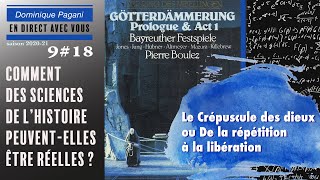 Season 9.2
9 #18 Twilight of the Gods, or from repetition to liberation
3 Apr 2021How does Wagner's Twilight of the Gods move from the circular time of fate, in which everything repeats, to the freedom of the world of men?
 Season 9.2
9 #15 How can sciences of history be real?
18 Feb 2021How does a mythic narrative such as Wagner's Ring, taken at its midpoint, reveal a rigorous logic, an "algebra" of gold and love, that the sciences of history and culture can bring out?
 Season 9.2
9 #13 How can sciences of history be real?
29 Jan 2021How can sciences of history have a rigor with nothing to envy in the hard sciences, and what does Wagner's Das Rheingold show on this subject?
 Season 9.2
9 #12 How can sciences of history be real?
14 Jan 2021How can understanding, the faculty of the sciences and of the "if… then," axiologically neutral, be put to the service of evil, and how does Wagner's Das Rheingold show this?
 Season 9.1
#3 Benefits and harms of amnesia...
6 Nov 2020How do anamnesis and amnesia, individual and collective, work upon memory, and what does it mean for memory to be overdetermined?