Christianity
17 videos, newest first.
What Dominique Pagani says
Dominique Pagani approaches Christianity mainly through Hegel, as the religion of incarnate transcendence, in which one must descend in order to rise. In his view, Christianity de-substantializes the world: it contributes to a secularization that frees the subject from its alienation in substance1. He sets it in an inverse relation to Hellenism: Christian transcendence answers Greek immanence, and evil as a lie answers the Greek evil of hubris. He links this lie to the "prince of this world" of John's Gospel and defines it as a privation of self-knowledge2. In the Apocalypse, he reads the descent to earth of the heavenly Jerusalem, a city of gratuitousness, and he takes up the question of whether Jesus was a communist3. A large part of his analysis goes through Parsifal. He answers Nietzsche, who saw the work as a Christian betrayal of the Greek ideal before recognizing its music. He reads "Redemption to the Redeemer" as a salvation that is given, not earned, and the reunion of the Grail and the spear as the passage from substance to subject through the negative45. He connects these readings with Hölderlin, Nerval and Gracq.
- 1Ibn Battûta19 Feb 2020
- 2Le Mal ou la "déconnaissance" de soi2 Dec 2024
- 3La mondanité chez Clouscard ou les privilèges pour tous18 May 2023
- 4Sauver le sauveur ? La rédemption - fin du cycle ou son recommencement ?21 Apr 2024
- 5De la fidélité à la grâce - De la substance au Sujet30 May 2024
Introduction produced automatically from the 17 sessions on this theme, to be reviewed; the numbers link to the sessions.
The 17 videos
 Season 13
Evil, or the "unknowing" of the self
2 Dec 2024Why can the essence of evil be defined as lying, that is, as a privation of self-knowledge?
 Season 12
From fidelity to grace - From substance to Subject
30 May 2024What does the separation of the Grail and the spear mean in the second act of Parsifal, and how can their reunion be understood as the passage from substance to subject?
 Season 12
Saving the saviour? Redemption - the end of the cycle or its new beginning?
21 Apr 2024What does the final formula of Parsifal, "Redemption to the redeemer," mean: does redemption close the cycle or set it going again?
 Season 11
Worldliness in Clouscard, or privileges for all
18 May 2023Why does mondanité, in Clouscard, not reduce to "bling-bling", and what does the world become when the privileges of a few are extended to all?
 Season 11
Worldliness in Clouscard, or "The dominant ideology"
26 Apr 2023What does the world mean, and worldliness in Clouscard's sense, between the happiness of being in the world and the lie of the world that keeps the dominated under the ideology of the dominant?
 Pagani Parle Musique
NIETZSCHE - NO PITY FOR WAGNER • Pagani Parle Musique
27 Jul 2022Why does Nietzsche, after condemning Parsifal as a Christian betrayal of the Greek ideal, recognize in its music the truth he had refused?
 Le Gros Rouge Qui Tâche
Dominique Pagani - Hölderlin, poetry and politics
19 Mar 2022How can we read Hölderlin, given his contradictory receptions, and what does his poetry matter to communist militants?
 Questions and answers
From the lost voice to the path of modernity • From modal music to tonal music • D Pagani
23 May 2021How does the passage from modal music to tonal music, starting with the legend of Paul the Deacon's "lost voice," mark the West's entry into modernity?
 Musicosophie
Musicosophy 12. Nietzsche (right up) against Wagner
28 Jan 2021What does the conflict between Nietzsche and Wagner reveal, once we reread Nietzsche's texts while listening to the music?
 At the Tropiques bookshop
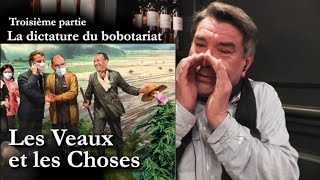
Calves and Things (3): The dictatorship of the bobotariat
6 Oct 2020Is political ecology anything other than the aesthetic surface of dominant liberal ideology?
 Season 8
#16 • Return to the logics of the subject
30 Jul 2020What becomes of art once aesthetic religion has disappeared, and what do we, moderns, gain from this loss?
 Season 6
#6.5 • The Logic of the Subject in the face of the reconstitution of Nazism
19 Feb 2020How does the modern stage of the relation between substance and subject, where absolute knowledge becomes possible, shed light both on the logic of the subject and on the reconstitution of Nazism?
 Season 4
#4.3 Angélique (by Nerval)
11 Dec 2017How can a literary text, that of a madman, achieve such rigor that it grounds a rationality in the human order, where Kant had separated nature and freedom by an unbridgeable abyss?
 Season 3
#3.6 From Ulysses to Daedalus
1 Aug 2017How does one pass from the theoretical order (what can I know?) to the practical order (what must I do?), and why is Rousseau, "Newton of morality," the decisive figure for this?
 Season 2
#2.6 Between crisis and war: Philosophising?
1 Aug 2017How does the reading of Phèdre, which joins the highest poetic beauty to the most profound content, lead from the psychological unconscious to class unconscious, and is there a universal criterion of beauty?
 Saint-Dizier Popular University
Is History a subject?
9 Mar 2017Is history a subject matter, and whose history, of what, do we make?
 Season 1
#1.7 Between crisis and war: Philosophising?
11 Dec 2015Why does the philosophy of knowledge lead to the question "what must I do?", and what content should be given to freedom?