Translated from the French. Read the original.
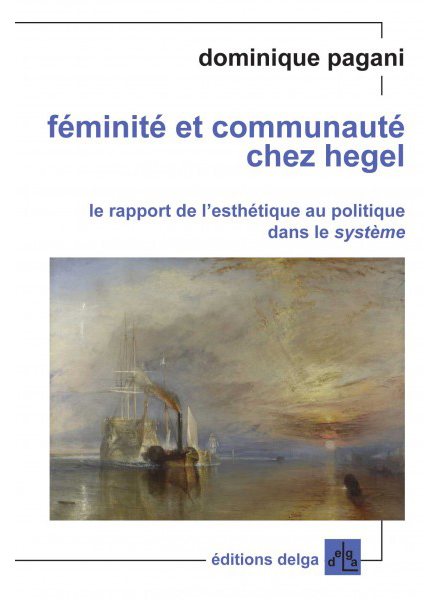
Féminité et communauté chez Hegel
Le rapport de l'esthétique au politique dans le Système
Dominique Pagani · Éditions Delga · 2011
In his preface to the Phenomenology of Spirit, Hegel points out that “By the ease with which Spirit is satisfied, one can measure the extent of its loss.” He is thereby targeting Schelling’s absolute poematism, which trades the richness of the poem for the palette of a painter limited to two colors: “red for the historical scene and green for landscapes according to demand.”
Reducing this binarity still further, our time (“Each philosophy merely sums up its time in thought”) censors red in favor of green alone; the color, very “völkisch,” of the “Teutonic Forests” that dominate Freiburg; a green unencumbered by history: that of political ecology, which is “fed up with Gaullo-communism” (D. Cohn-Bendit), or of the Medef, which says it wants “to be done with the C.N.R.” (D. Kessler).
In writing Féminité et communauté chez Hegel, the author has endeavored, out of pure aesthetic concern, to restore to it a light touch of rose; the one that embalms us “in the cross of present suffering”: as one will have gathered, we are here in representation, at the theater. Hence the problem of knowledge appears there only in the light that completes every drama; beginning with the one that our Ulysses of Spirit calls “the aesthetic religion”: Recognition.
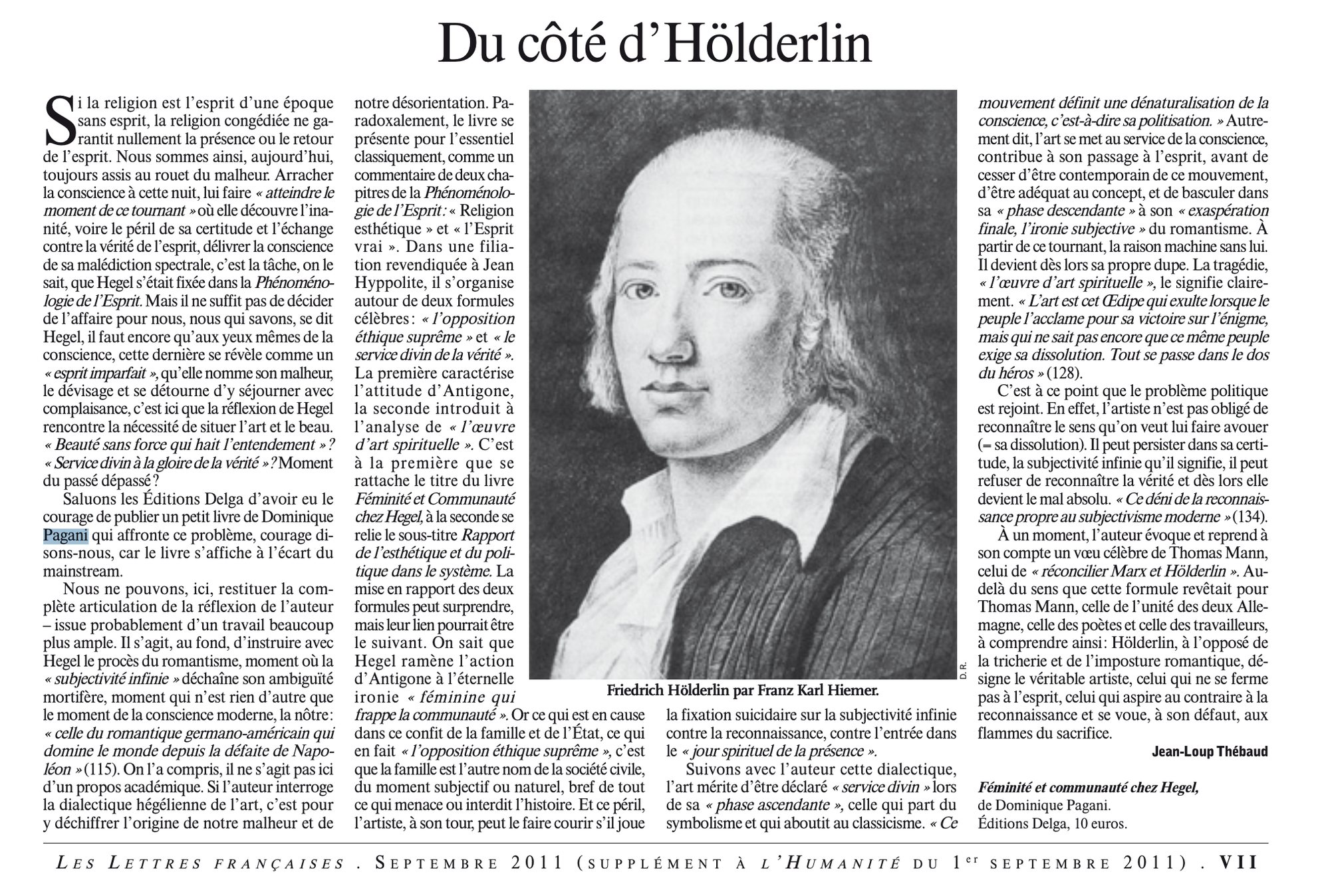
“Du côté d’Hölderlin”
Jean-Loup Thébaud — Les Lettres françaises, septembre 2011 (supplément à L’Humanité du 1er septembre 2011)
If religion is the spirit of a spiritless age, religion, once dismissed, in no way guarantees the presence or the return of spirit. And so we are, today, still seated at the spinning wheel of unhappiness. To tear consciousness away from this night, to make it “reach the moment of this turning point” where it discovers the inanity, indeed the peril, of its certainty and exchanges it for the truth of Spirit, to deliver consciousness from its spectral curse: that, as we know, is the task Hegel had set himself in the Phenomenology of Spirit. But it is not enough to decide the matter for us, we who know, Hegel tells himself; it is further necessary that, in the very eyes of consciousness, the latter reveal itself as an “imperfect Spirit,” that it name its unhappiness, stare it in the face, and turn away from complacently tarrying in it; it is here that Hegel’s reflection encounters the necessity of situating art and the beautiful. “Beauty without strength that hates the understanding”? “Divine service to the glory of truth”? A moment of the past, surpassed?
Let us salute Éditions Delga for having had the courage to publish a short book by Dominique Pagani that confronts this problem—courage, we say, for the book openly stands apart from the mainstream.
We cannot, here, convey the complete articulation of the author’s reflection—which probably stems from a much broader work. At bottom, it is a matter of prosecuting, with Hegel, the case against romanticism, the moment when “infinite subjectivity” unleashes its deadly ambiguity, a moment that is nothing other than the moment of modern consciousness, our own: “that of the German-American romantic who has dominated the world since the defeat of Napoleon” (115). As one will have gathered, this is not an academic discourse. If the author questions the Hegelian dialectic of art, it is in order to decipher in it the origin of our unhappiness and of our disorientation. Paradoxically, the book presents itself, for the most part, in classical fashion, as a commentary on two chapters of the Phenomenology of Spirit: “Aesthetic Religion” and “True Spirit.” In an avowed filiation with Jean Hyppolite, it is organized around two famous formulas: “the supreme ethical opposition” and “the divine service of truth.” The first characterizes Antigone’s stance; the second leads into the analysis of “the spiritual work of art.” It is to the first that the title of the book Féminité et Communauté chez Hegel relates; to the second is linked the subtitle Rapport de l’esthétique et du politique dans le système. Bringing the two formulas together may come as a surprise, but their link might be the following. We know that Hegel traces Antigone’s action back to the eternal “feminine irony that strikes the community.” Now, what is at stake in this conflict of the family and the State, what makes it “the supreme ethical opposition,” is that the family is the other name for civil society, for the subjective or natural moment, in short, for everything that threatens or forbids history. And this peril the artist, in his turn, can bring about if he plays the suicidal fixation on infinite subjectivity against recognition, against entry into the “spiritual daylight of presence”
Let us follow this dialectic with the author: art deserves to be declared “divine service” during its “ascending phase,” the one that starts from symbolism and culminates in classicism. “This movement defines a denaturalization of consciousness, that is to say, its politicization.” In other words, art places itself at the service of consciousness, contributes to its passage to Spirit, before ceasing to be contemporary with this movement, to be adequate to the concept, and tipping over into its “descending phase,” down to its “final exasperation, the subjective irony” of romanticism. From this turning point on, reason schemes without it. It thereby becomes its own dupe. Tragedy, “the spiritual work of art,” signifies this clearly. “Art is that Oedipus who exults when the people acclaim him for his victory over the riddle, but who does not yet know that these same people demand his dissolution. Everything happens behind the hero’s back” (128)
It is at this point that we rejoin the political problem. Indeed, the artist is not obliged to recognize the meaning one would make him confess (= his dissolution). He can persist in his certainty, the infinite subjectivity he signifies; he can refuse to recognize the truth, and from then on it becomes absolute evil. “This denial of recognition peculiar to modern subjectivism” (134)
At one point, the author invokes and makes his own a famous wish of Thomas Mann’s, that of “reconciling Marx and Hölderlin.” Beyond the meaning this formula held for Thomas Mann, that of the unity of the two Germanys, that of the poets and that of the workers, to be understood thus: Hölderlin, as opposed to romantic trickery and imposture, designates the true artist, the one who does not close himself off from Spirit, the one who on the contrary aspires to recognition and, failing that, devotes himself to the flames of sacrifice.
Jean-Loup Thébaud