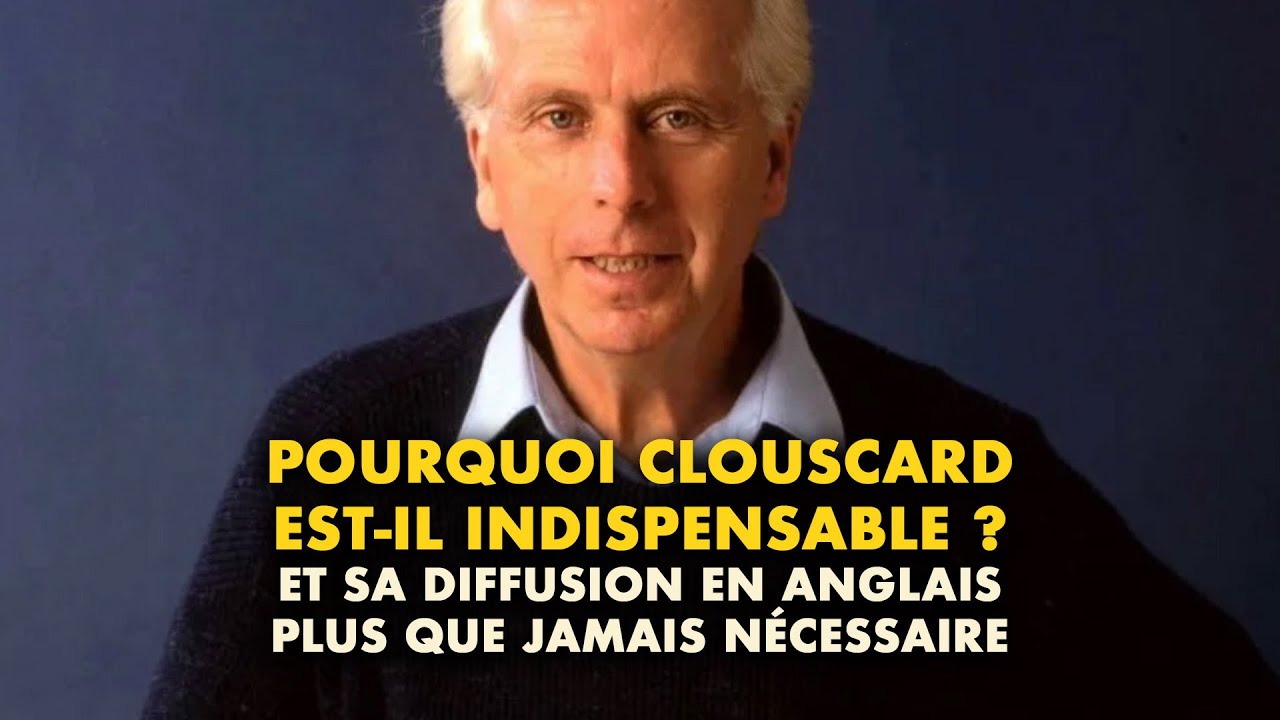
English translation of the French transcript, made with AI and not yet proofread — click a paragraph to jump to it. Show the French original
What is to be done? The detour through theory and Le Capitalisme de la séduction 0:00 When I talk about the efforts we have to make simply to finance a translation that would allow Anglo-Saxon publishers to distribute it within their geographical, sociological and economic sphere, that's not only a financial question, it's an eminently political question. And there, the word regains its nobility. Yes, up to this point, I'll take a reference, perhaps Lenin's most famous title, "What Is to Be Done?"
0:30 The thing is, when you say "What is to be done?", you might think it means "Come on, that's enough intellectuals, reflection, theory is important, that's all very nice, but now, I mean, we have to move to action, we have to be practical, you know." Stirring up the air. You know, there are people in offices, plenty of them like that, people bustling about, etc. "Oh dear, you look like you fell out of bed," etc. Actually they don't do much, but anyway they make themselves noticed, they stir up hot air. Another phrase of Lenin's helps us understand in what sense he poses the question "What is to be done?"
1:01 No revolutionary practice without revolutionary theory. Without revolutionary theory, no revolutionary practice. So, "What is to be done?" In the most immediate and urgent sense, a detour through theory. That's where the content of Clouscard's work, coupled with the considerable extension that an audience in the Anglo-Saxon world would give it, constitutes on its own a threshold-crossing for our wildest political hopes.
1:37 I'm not used to justifying my relationship to Clouscard for those who aren't familiar with it, but I have often presented myself as the one who practiced it most regularly, most daily, and for the longest duration. Not to mention a shared community of ideas—well, you know, I always start from his overly kind formula that he expressed when dedicating to me The Capitalism of Seduction, which is the best-selling of his publications, where he writes, to Dominique Pagani, to whom this book owes a great deal. That's where I have to set the record straight.
2:08 I don't know whether you speak in terms of debt in a friendship like that, because ideas passed from one to the other, and whoever is clever enough can claim paternity in many cases. But in any case, what's certain—I say this calmly—is that I owe him incomparably more than what he claims to owe me. A brief word all the same about this exceptional book; it's no accident that it had this success. From The Capitalism of Seduction I'll retain only one chapter at the end of the volume. Really a prose poem, "The Country House."
2:38 It's not... Those who lived through the 60s, 70s, 80s, 90s, 2000s won't get over it. You get the impression he's telling the story of their life, the life of the people around them, the life of people they've seen. There are phrases that he dared to say like no one else, right? I'm thinking for example of many Nordic countries, particularly the Dutch, who bought enormously in regions like the Drôme or Haute-Provence. Clouscard analyzed the process by which peasants were driven off their land by the rising cost of credit for farm machinery.
3:14 They had to equip themselves. Once equipped, they were in debt for life. Afterward, they abandoned their farms. Hence a huge rural depopulation at the time, which meant the land lost its value. At that point, it was bought up by the Dutchman, so to speak, who was thrilled to finally have his house in the south of France. And Clouscard speaks—just to point out the degree of lucidity and relevance of his expression—of ecological neocolonialism. You see, I remind you he was born in 1928, so he was 17 when the war ended.
From the Liberation to May '68: the decline of the forces of the Resistance 3:48 There's of course the end of the war, the moment of the Liberation. Probably the greatest government France has enjoyed since the Convention. The crushing of the most reactionary forces on the planet, the crushing of the brown plague under the boots of the Red Army, made advances possible. It took 50 million dead, the second world conflict, but social advances that were unthinkable even in the 1930s.
4:18 First date, the Liberation. Second date, May '68. 1968. Because there's May, there's June, there are the Grenelle Accords, there's the workers' '68, which Clouscard not only never disparaged but always glorified. On the other hand, he rose up against the '68 whose memory the ruling power, the dominant ideology, would like to monopolize—and it has almost succeeded.
4:48 There are plenty of young people who see only that in '68—well, plenty of those who didn't live through that period, that is, the liberal-libertarian '68, versus doubling the minimum wage, consolidating pension gains, getting union rights recognized within companies, and the great demand of Cohn-Bendit that kicked off the student movements, namely being able to go visit the girls in their dormitories in the student residences—it's not quite the same stakes. It's true that the '68ers, I mean that in the pejorative sense, those of the societal rather than the social '68, when you talked to them about wages, about pensions, they'd say—I'm giving you the word used at the time—those are "sectional" demands.
5:31 It's not "metro, work, sleep," you see, the contempt. First date, the Liberation, I repeat myself, second date, '68—why do I repeat myself? Because that's where everything starts from. Don't take my word for it, let's even be scientific, take a measurement, and you'll see it's no longer a matter of opinion, we're not at the corner café. What are the two great political forces that decline starting from '68?
6:01 It can be measured in elections, in polls, in whatever you like. On the right, Gaullism; on the left, communism. How curious, the two forces of the Resistance. First, and here I echo what I myself call, in all its horror, the extreme center. So that center-right, Giscard, or center-left, Mitterrand—what does it matter, right? The extreme center, all those who weren't above board at the end of the war, all those who were a bit compromised, you know, in certain accommodations, hastened to reappear—of course, not under the mask of the far right or of...
6:47 Well, there were still only the royalists left, who made up 1.4%. No, but among the various moderates, center-left, center-right, unaffiliated, the extreme center. And its hideous face, you know, this center that hugged the walls in 1945 and that would gradually gain more and more importance until it came to run practically the whole Western world. Why am I developing this point? You'll say, but it's off topic. What? Sorry? Clouscard's work that follows The Capitalism of Seduction is—listen closely—Neofascism and the Ideology of Desire.
Néofascisme et idéologie du désir: fascism through the left 7:24 As early as the 1970s, with a lucidity that has no equivalent, not only in France but even in what's called Western thought. You know, I don't like that expression, "thought"—I'd say Atlanticist. You can be Atlanticist and African. And conversely, there are Americans who oppose that kind of thought, a few, there are some. With this incomparable lucidity, Clouscard said that fascism was coming back as early as the 1970s, not through the far right, which at that time was under 2%—the traditional far right, you know, royalist, Catholic, fundamentalist, whatever you like.
8:04 No, through the liberal-libertarian left. In fact, before coining the phrase "liberal-libertarian," I'm giving you, in a nutshell, Clouscard's great breakthroughs—he had spoken of "libertarian social democracy." That's because he clearly understood that the weakening of the forces of the Resistance was an unhoped-for gift for those who, until then, since 1945, had been hugging the walls. I've summarized for you the essence of what lies at the origin of these analyses.
8:34 There's a complex here that needs to be seen clearly. We mustn't shy away from these paradoxes that almost no one denounces. Namely that those who called themselves to the left of the Communist Party in '68—and here I'm giving you the literal wording that appears on almost every page of Clouscard's work—those who called themselves to the left of the PCF, that is, those called the gauchistes, the enemies of the PCF, who had no words harsh enough against the CGT and against the PCF at the time, and against de Gaulle of course, against the only two forces that gave the Atlanticist powers a rash—how curious, those who called themselves to the left of the PCF were in fact to the right of de Gaulle.
9:11 That's the secret. Well, it's not really a secret, it's well known, if you look at the pedigree of the people who were out in front, so to speak, backing Mitterrand. I'm thinking of Foucault, one of Clouscard's favorite targets, and for good reason—he played a major role in the ideological counter-revolution, along with Deleuze and Derrida, and others. I'll quote Foucault for once in a positive light, when he said Mitterrand is Vichy. For once he said something worth engraving on tablets.
9:45 You know, now they tell you, "Oh dear, here he goes, already talking about Nazism, that's it, Godwin's point, you know?" It's extraordinary, this scam of Godwin's point. At a time—and this is measurable—just look at the recent elections in Sweden, where Nazis are coming back to power almost everywhere in Europe, in countries that were held up as models of democracy, and still are, for many people, to the point of lecturing the whole world sometimes. At the very moment Nazism is coming back, from Austria to Sweden, the growing forces of the German far right, which used to hug the walls, which never exceeded 2% throughout the Cold War.
10:25 That's exactly the moment when we're supposed to stop talking about the return of Nazism. Listen, that's a good one, it really is a scam, you know. They never tell you that, it's odd though. And as for Ukraine, no, we don't talk about it, but there are no Nazis in Ukraine. Even those covered head to toe in swastikas—we see them, but no, we don't understand it, it's a bit of... oh, there are a few, you know, some crackpots, there are some everywhere, right? Yes, but it's not crackpots who decide the names of streets and public monuments in Ukraine. And that glorifies the very worst not only in the history of Ukraine or of Europe, but perhaps even of humanity.
10:59 I'm telling you that even German SS officers sometimes wrote reports in which they were stunned by the cruelty of the Bandera forces toward, of course, communists, Jews—not even to mention them—but even Poles. The massacres of Poles by those same forces. That's it. History is bringing all of that back to the surface. Michel Clouscard—you're starting to understand his extraordinary isolation, and the reasons why I'm delighted that his audience will soon be broadened to reach the English-speaking world, which isn't limited to England or the United States.
Clouscard's solitude and seduction as progress 11:36 A Chinese student is more likely, you know, to read foreign books in English than in French. For example, the stakes are immense. Now, Michel Clouscard must be pulled out of this isolation—careful, not a human isolation, since he was surrounded by friends until the end, but his ontological isolation. That is, you know very well that someone can be surrounded by all the friends you like, yet if a single being is missing, everything is depopulated.
12:06 What is he missing? Recognition by his peers, by the Marxists themselves, by the thinkers, by the intelligentsia with revolutionary pretensions. That's where his solitude was terrible. Our association is appealing to everyone who feels concerned by this thought, no doubt the most relevant thought today, the most in tune with the crisis, which he was the only one to have analyzed when he said—summing it up, for millions of young people today, it sums up the situation—when he said "everything is permitted, but nothing is possible."
12:40 There you have the results of Cohn-Bendit's '68, not that of the CGT. "Everything is permitted, but nothing is possible." "Everything is permitted, but..." at the unemployment office. So there you go, we need help. All efforts will be welcome, from the most modest to the most substantial. I'm trying to convey, especially to those not yet familiar with his work, this practically untapped treasure that constitutes the work of the man I maintain is without doubt the greatest theoretical intellectual of the postwar period in the French language.
13:15 Don't think it's only cause for despair. If modern, present-day capitalism no longer seeks only to repress, to rule through exploitation, through force, but to seduce, that's because there has been progress. This progress began with the French Revolution, and we cannot do without it. It's public opinion. You have to have it on your side. Otherwise you can't do anything. Otherwise you can't claim to be a democracy, even if you've emptied democracy of all its substance.
13:45 At the very least, appearances must be kept up, and so, one must seduce. I'd like to leave you on this note of hope, as part of the wishes I make for the coming year. Happy New Year to all of you.