Childhood
3 videos, newest first.
What Dominique Pagani says
Dominique Pagani approaches childhood mainly through Rousseau. He contrasts the childhood of Rousseau, who was shaped by country paths and novels, with that of Voltaire, who was born into wealth and schooled at Louis-le-Grand1. He places Emile in the tradition of paideia, where the pedagogical is the antechamber of the political: it is not enough to be born a man, one must become one, and to do so the aristocrat's child must learn a manual trade2. He notes a maternal fixation in Rousseau and follows the motif of the island from the mother's womb to the tomb at Ermenonville, which he reads as a return to that womb12. In 2023, he takes up this thread again in discussing poetic intuition3. In the fifth walk, the movement of the water makes one an infant again. Hölderlin says that melancholy has devoured the song of his childhood, and Jaccottet finds in the poet as a child a stupor before the Neckar. He links the dread of the fragmented body to the premature birth of the human species and to the mirror stage, and sets against it the figure of the mother who gathers it up3.
- 1« D’un triangle de folie au cœur de la conscience moderne »19 Dec 2014
- 2La PHILO avec PAGANI : E comme ENFANCE4 Jun 2023
- 3UN PRINTEMPS DES PEUPLES ?18 Mar 2023
Introduction produced automatically from the 3 sessions on this theme, to be reviewed; the numbers link to the sessions.
The 3 videos
 PaduTeam
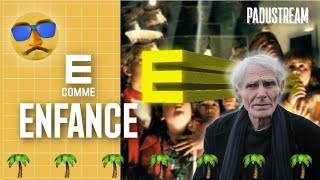
PHILOSOPHY with PAGANI: E for ENFANCE (CHILDHOOD)
4 Jun 2023What do childhood, Émile and Ermenonville teach us about Rousseau, and why is the island the symbol without which he cannot be understood?
 Season 11
A SPRINGTIME OF THE PEOPLES?
18 Mar 2023Does poetic speech proceed from the immediate intuition of genius or from a rigor that proceeds by mediations?
 A Philosophical Alphabet
E for Enfance (Childhood)
19 Dec 2014How do childhood, Émile and the island of Ermenonville help us understand Rousseau?