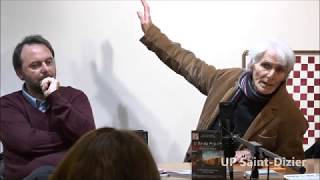
Dominique Pagani presents Thomas Mann as coming from the Hamburg haute bourgeoisie, raised in a reactionary milieu, and conservative and hostile to the Enlightenment in his youth12. In his view, Mann nevertheless "saved the honour" of the German intelligentsia, notably through his wartime BBC broadcasts, Deutsche Hörer!. In them, Mann judges those who put communism and Nazism on the same moral level to be stupid or fascist, and predicts a return of fascism in the name of freedom34. Pagani sees these remarks as a prophecy that the Cold War and today's textbooks would confirm, and he points out that Mann was not in the communist camp but in the camp of peace. He often takes up Mann's idea that Germany must reconcile Marx and Hölderlin5. He also cites Buddenbrooks, Doctor Faustus and Death in Venice, which he mentions in connection with Visconti's film and as an example of German writers' fascination with Italy6. Finally, he links Mann to Northern Germany and the Baltic coast.
Summary produced automatically from 20 of the passages below, to be reviewed; the numbers link to the moment in the session.
Who is this?
Paul Thomas Mann (6 June 1875 – 12 August 1955) was a German novelist, short story writer, social critic, philanthropist, essayist, and the 1929 Nobel Prize in Literature laureate. His highly symbolic and ironic epic novels and novellas are noted for their insight into the psychology of the artist and the intellectual. His analysis and critique of the European and German soul used modern versions of German and Biblical stories, as well as the ideas of Johann Wolfgang von Goethe, Friedrich Nietzsche, and Arthur Schopenhauer. […]
8:36BuddenbrooksPresented as the greatest German novelist of his generation, conservative by upbringing, from the grand bourgeoisie of Hamburg.
12:03In 1943, he judges it stupid or fascist to put communism and nazi-fascism on the same level and predicts a return of fascism in the name of freedom.
53:41Deutsche Hörer!Coming from a reactionary background, he saves honor through his broadcasts from London; putting Nazism and communism on the same level betrays a preference for Nazism.

 Season 12 · 24 Jun 2024For a "fresh and joyful" apocalypse?