 Season 7 · 11 Apr 2020#4 • Harnessed to confinitude
Absolute non-knowledge
Worked through in 2 videos · 5 passages.
What Dominique Pagani says
Dominique Pagani presents absolute non-knowledge as a personal hypothesis: access to absolute knowledge symmetrically produces a repression, a denial, an absolute "I do not want to know"1. He treats it as a force that grows along with knowledge itself: the closer one comes to absolute knowledge, the stronger its negation becomes2. This non-knowledge is not only found outside. It lies hidden in the unconscious and resists the progress of knowledge, so that our enemy is within ourselves3. He connects it to Nietzsche, who, in his view, lets the mask drop by stating that the untrue, uncertainty or ignorance may be worth more than the true4. On the historical level, he holds that this denial was never carried as far as under Nazism. He takes up this point in a session devoted to the logic of the subject in the face of the reconstruction of Nazism5.
- 1#6.6 • La Logique du Sujet face à la reconstitution du nazisme29 Mar 2020 · 13:25
- 2#6.6 • La Logique du Sujet face à la reconstitution du nazisme29 Mar 2020 · 29:14
- 3#4 • Les Attelé(e)s de la confinitude11 Apr 2020 · 34:15
- 4#4 • Les Attelé(e)s de la confinitude11 Apr 2020 · 45:56
- 5#6.6 • La Logique du Sujet face à la reconstitution du nazisme29 Mar 2020 · 1:47:05
Summary produced automatically from 5 of the passages below, to be reviewed; the numbers link to the moment in the session.
Season 7 · 11 Apr 2020#4 • Harnessed to confinitude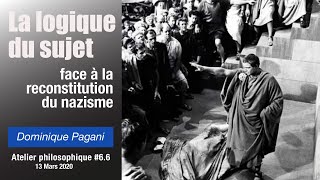 Season 6 · 29 Mar 2020#6.6 • The Logic of the Subject in the face of the reconstitution of Nazism